


JEE Mains · Chemistry · STD 12 - Co-ordination chemistry
- JEE Mains 2026
- Easy
- MCQ
Given below are two statements:
Statement I: Each electron in \(e_g\) orbitals destabilizes the orbitals by \(+0.6\Delta_o\) and each electron in the \(t_{2g}\) orbitals stabilizes the orbitals by \(-0.4\Delta_o\) in an octahedral field on the basis of crystal field theory.
Statement II: All the d-orbitals of the transition metals have the same energy in their free atomic state but when a complex is formed the ligands destroy the degeneracy of these orbitals on the basis of crystal field theory.
In the light of the above statements, choose the correct answer from the options given below
Pick an option to check your answer.
Answer & Solution
Correct Answer
(A) Both Statement I and Statement II are correct
Step-by-step Solution
Detailed explanation
In an octahedral crystal field, the five degenerate d-orbitals split into two sets: a lower energy \(t_{2g}\) set and a higher energy \(e_g\) set.
The energy of the \(t_{2g}\) orbitals is lowered by \(0.4\Delta_o\) (stabilization of \(-0.4\Delta_o\)) and the energy of the \(e_g\) orbitals is raised by \(0.6\Delta_o\) (destabilization of \(+0.6\Delta_o\)) relative to the barycenter. Hence, Statement I is correct.
In the free atomic or ionic state, all five d-orbitals of a transition metal are degenerate (have the same energy). When ligands approach the central metal ion to form a complex, the spherically symmetrical field is disrupted, which destroys the degeneracy of the d-orbitals and causes them to split. Hence, Statement II is correct.
Both Statement I and Statement II are correct.
Answer: Both Statement I and Statement II are correct
More questions from Chemistry
- A \(100\, mL\) solution was made by adding \(1.43\, g\) of \(Na _{2} CO _{3} \cdot xH _{2} O .\) The normality of the solution is \(0.1\) \(N.\) The value of \(x\) is.......... (The atomic mass of \(Na\) is \(23\, g / mol\) ) :JEE Mains 2020 Hard
- The mass of sodium acetate \(\left(\mathrm{CH}_3 \mathrm{COONa}\right)\) required to prepare \(250 \mathrm{~mL}\) of \(0.35\ \mathrm{M}\) aqueous solution is _______\(g\). (Molar mass of \(\mathrm{CH}_3 \mathrm{COONa}\) is \(82.02 \mathrm{~g} \mathrm{~mol}^{-1}\) )JEE Mains 2024 Medium
- The major product formed when \(1, 1, 1-\) trichloro propane is treated with aqueous potassium hydroxide isJEE Mains 2014 Hard
- The formation enthalpies, \(\Delta \mathrm{H}_{\mathrm{f}} \ominus\) for \(\mathrm{H}_{(\mathrm{g})}\) and \(\mathrm{O}_{(\mathrm{g})}\) are 220.0 and \(250.0 \mathrm{~kJ} \mathrm{~mol}^{-1}\), respectively, at 298.15 K , and \(\Delta \mathrm{H}_{\mathrm{f}}{ }^{\ominus}\) for \(\mathrm{H}_2 \mathrm{O}_{(\mathrm{g})}\) is \(-242.0 \mathrm{~kJ} \mathrm{~mol}^{-1}\) at the same temperature. The average bond enthalpy of the \(\mathrm{O}-\mathrm{H}\) bond in water at 298.15 K is __________ \(\mathrm{kJ} \mathrm{mol}^{-1}\) (nearest integer).JEE Mains 2025 Hard
- Decreasing order towards \(S_N 1\) reaction for the following compounds is:
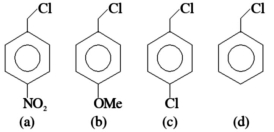 JEE Mains 2023 Medium
- \(Ph - CH = CH _2 \xrightarrow[ HBr ]{( PhCOO )_2}\) Product
Consider the above reaction
A. The reaction proceeds through a more stable radical intermediate.
B. The role of peroxide is to generate \(\dot{ H }\) (Hydrogen radical).
C. During this reaction, benzene is formed as a biproduct.
D. 1-Bromo-2-phenylethane is fanned as the minor product.
E. The same reaction in absence of peroxide proceeds via carbocation intermediate.
Identify the correct statements. Choose the correct answer from the options given below:JEE Mains 2026 Easy
More PYQs from JEE Mains
- A force \(\overrightarrow{ F }=4 \hat{ i }+3 \hat{ j }+4 \hat{ k }\) is applied on an intersection point of \(x =2\) plane and \(x\) -axis. The magnitude of torque of this force about a point \((2,3,4)\) is.......... . (Round off to the Nearest Integer)JEE Mains 2021 Hard
- Which is major product formed when acetone is heated with iodine and potassium hydroxide?JEE Mains 2014 Hard
- On complete combustion of \(0.492\,g\) of an organic compound containing \(C , H\) and \(O , 0.7938\,g\) of \(CO _{2}\) and \(0.4428\,g\) of \(H _{2} O\) was produced. The \(\%\) composition of oxygen in the compound is \(........\)JEE Mains 2022 Medium
- A uniform thin bar of mass \(6 \,kg\) and length \(2.4\, meter\) is bent to make an equilateral hexagon. The moment of inertia about an axis passing through the centre of mass and perpendicular to the plane of hexagon is ...... \(\times \,10^{-1} \,kg m ^{2}\)JEE Mains 2021 Hard
- The order of reactivity of the given haloalkanes towards nucleophile isJEE Mains 2013 Medium