


JEE Mains · Chemistry · STD 12 - Co-ordination chemistry
- JEE Mains 2026
- Hard
- Numerical
\(5.33\) g of \(CrCl_3 \cdot 6H_2O\), which is a \(1 : 3\) electrolyte, is dissolved in water and is passed through a cation exchanger. The chloride ions in the eluted solution, on treatment with \(AgNO_3\) results in \(8.61\) g of \(AgCl\). The ratio of moles of complex reacted and moles of \(AgCl\) formed is _______ \(\times 10^{-2}\). (Nearest integer)
[Molar mass in g mol\(^{-1}\) Cr : \(52\), Ag : \(108\), Cl : \(35.5\), H : \(1\), O : \(16\)]
Pick an option to check your answer.
Answer & Solution
Correct Answer
(D) 33
Step-by-step Solution
Detailed explanation
Molar mass of \(CrCl_3 \cdot 6H_2O = 52 + 3 \times 35.5 + 6 \times 18 = 266.5 \text{ g mol}^{-1}\)
Moles of complex reacted \(= \dfrac{5.33}{266.5} = 0.02 \text{ mol}\)
Since the complex is a \(1:3\) electrolyte, it dissociates to give one complex cation and three chloride anions. Its formula is \([Cr(H_2O)_6]Cl_3\).
When passed through a cation exchanger, the complex cation is exchanged, and the chloride ions pass into the eluted solution.
Molar mass of \(AgCl = 108 + 35.5 = 143.5 \text{ g mol}^{-1}\)
Moles of \(AgCl\) formed \(= \dfrac{8.61}{143.5} = 0.06 \text{ mol}\)
The ratio of moles of complex reacted to moles of \(AgCl\) formed is:
\(\text{Ratio} = \dfrac{0.02}{0.06} = \dfrac{1}{3} = 0.3333...\)
This can be written as \(33.33 \times 10^{-2}\).
Rounding to the nearest integer, we get \(33\).
Answer: \(33\)
More questions from Chemistry
- Consider the following thermochemical data:
(i) \( 2Al(s) + 6HCl(aq) \rightarrow Al_2Cl_6(aq) + 3H_2(g) \) ; \( \Delta H_1 = -1200\text{ kJ/mol} \)
(ii) \( H_2(g) + Cl_2(g) \rightarrow 2HCl(g) \) ; \( \Delta H_2 = -164\text{ kJ/mol} \)
(iii) \( HCl(g) + aq \rightarrow HCl(aq) \) ; \( \Delta H_3 = -83\text{ kJ/mol} \)
(iv) \( Al_2Cl_6(s) + aq \rightarrow Al_2Cl_6(aq) \) ; \( \Delta H_4 = -663\text{ kJ/mol} \)
The enthalpy of formation of anhydrous solid \( Al_2Cl_6 \) is:JEE Mains 2026 Hard - The process with negative entropy change isJEE Mains 2019 Hard
- For electron in ' 2 s ' and ' 2 p ' orbitals, the orbital angular momentum values, respectively are :JEE Mains 2025 Easy
- The correct order of electron gain enthalpies of \(Cl\), \(F , Te\) and \(Po\) is .....JEE Mains 2022 Easy
- Given below are two statements: one is labelled as Assertion \((A)\) and the other is labelled as Reason\((R):\) Assertion \((A):\) The ionic radii of \(O ^{2-}\) and \(Mg ^{2+}\) are same. Reason \(( R )\) : Both \(O ^{2-}\) and \(Mg ^{2+}\) are isoelectronic species. In the light of the above statements, choose the correct answer from the options given belowJEE Mains 2022 Medium
- Number of moles of \(AgCl\) formed in the following reaction is \(........\).
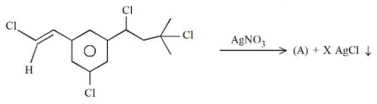 JEE Mains 2023 Hard
More PYQs from JEE Mains
- Two point charges \(A\) and \(B\) of magnitude \(+8 \times 10^{-6}\,C\) and \(-8 \times 10^{-6}\,C\) respectively are placed at a distance \(d\) apart. The electric field at the middle point \(O\) between the charges is \(6.4 \times 10^{4}\,NC ^{-1}\). The distance ' \(d\) ' between the point charges \(A\) and \(B\) is..............\(m\)JEE Mains 2022 Medium
- Match List \(I\) with List \(II\).
Choose the correct answer from the options given below:List \(-I\) List \(-II\) \(A.\) \(\mathrm{K}_2\left[\mathrm{Ni}(\mathrm{CN})_4\right]\) \(I.\) \(\mathrm{sp}^3\) \(B.\) \(\left[\mathrm{Ni}(\mathrm
{CO})_4\right]\)\(II.\) \(\mathrm{sp}^3 \mathrm{~d}^2\) \(C.\) \(\left[\mathrm{Co}\left(\mathrm{NH}_3\right)
_6\right] \mathrm{Cl}_3\)\(III.\) \(\mathrm{dsp}^2\) \(D.\) \(\mathrm{Na}_3\left[\mathrm{CoF}_6\right]\) \(IV.\) \(\mathrm{d}^2 \mathrm{sp}^3\) JEE Mains 2024 Medium - Among the following, which is the strongest oxidizing agent ?JEE Mains 2022 Easy
- \(500\) mL of \(0.2\) M MnO\(_4^-\) solution in basic medium when mixed with \(500\) mL of \(1.5\) M KI solution, oxidises iodide ions to liberate molecular iodine. This liberated iodine is then titrated with a standard \(x\) M thiosulphate solution in presence of starch till the end point. If \(300\) mL of thiosulphate was consumed, then the value of \(x\) is __________.JEE Mains 2026 Hard
- The sum of two forces \(\overrightarrow{\mathrm{P}}\) and \(\overrightarrow{\mathrm{Q}}\) is \(\overrightarrow{\mathrm{R}}\) such that \(|\overrightarrow{\mathrm{R}}|=|\overrightarrow{\mathrm{P}}| .\) The angle \(\theta\) (in degrees) that the resultant of \(2 \overrightarrow{\mathrm{P}}\) and \(\overrightarrow{\mathrm{Q}}\) will make with \(\overrightarrow{\mathrm{Q}}\) isJEE Mains 2020 Medium
- A string of length \(1\, m\) and mass \(5\, g\) is fixed at both ends. The tension in the string is \(8.0\, N\). The string is set into vibration using an external vibrator of frequency \(100\, Hz\). The separation between successive nodes on the string is close to .... \(cm\)JEE Mains 2019 Medium