


JEE Mains · Chemistry · STD 12 - Co-ordination chemistry
- JEE Mains 2026
- Hard
- MCQ
Given below are two statements:
Statement - I : The number of paramagnetic species among \( [CoF_{6}]^{3-} \), \( [TiF_{6}]^{3-} \), \( V_{2}O_{5} \) and \( [Fe(CN)_{6}]^{3-} \) is 3.
Statement - II : \( K_{4}[Fe(CN)_{6}] < K_{3}[Fe(CN)_{6}] < [Fe(H_{2}O)_{6}]SO_{4}.H_{2}O < [Fe(H_{2}O)_{6}]Cl_{3} \) is the correct order in terms of number of unpaired electron(s) in the complexes.
In the light of the above statements, choose the correct answer from the options given below.
Pick an option to check your answer.
Answer & Solution
Correct Answer
(A) Both statement - I and statement - II are true
Step-by-step Solution
Detailed explanation
Paramagnetic species :
\(\left[ CoF _6\right]^3,\left[ TiF _6\right]^3,\left[ Fe ( CN )_6\right]^3\)
Diamagnetic species : \(V _2 O _5\)
In \(K _4\left[ Fe ( CN )_6\right] \Rightarrow\) No. of unpaired electron \(=0\)
\(K _3\left[ Fe ( CN )_6\right] \Rightarrow\) No. of unpaired electron \(=1\)
\(\left[ Fe \left( H _2 O \right)_6\right] SO _4 \cdot H _2 O \Rightarrow\) No. of unpaired electron \(=4\)
\(\left[ Fe \left( H _2 O \right)_6\right] Cl _3 \Rightarrow\) No. of unpaired electron \(=5\)
More questions from Chemistry
- The standard enthalpy of formation of \(NH_3\) is \(-46.0\, kJ/mol\). If the enthalpy of formation of \(H_2\) from its atoms is \(-436\, kJ/mol\) and that of \(N_2\) is \(-712\, kJ/mol\), the average bond enthalpy of \(N - H\) bond in \(NH_3\) is......\(kJ/mol\)JEE Mains 2014 Hard
- Elements P and Q form two types of non-volatile, non-ionizable compounds PQ and \( PQ_{2} \). When 1 g of PQ is dissolved in 50 g of solvent 'A', \( \Delta T_{b} \) was 1.176 K while when 1 g of \( PQ_{2} \) is dissolved in 50 g of solvent 'A', \( \Delta T_{b} \) was 0.689 K. \( K_{b} \) of 'A' = \( 5 \, K \, kg \, mol^{-1} \). The molar masses of elements P and Q (in \( g \, mol^{-1} \)) respectively, are:JEE Mains 2026 Medium
- Enthalpies of formation of \(CCl _{4( g )}, H _2 O_{( g )}, CO _{2( g )}\) and \(HCl_{ ( g )}\) are \(-105,-242,-394\) and \(-92\,kJ\,mol ^{-1}\) respectively. The magnitude of enthalpy of the reaction given below is \(......kJ\,mol ^{-1}\) (nearest integer) \(CCl _{4( g )}+2 H _2 O_{( g )} \rightarrow CO _{2( g )}+4 HCl_{( g )}\)JEE Mains 2023 Medium
- Match List-I with List-II.
Choose the correct answer from the options given below:List-I
ReagentsList-II
Reaction Name
(Involving aldehydes)A. \(H _2, Pd - BaSO _4\) I. Etard Reaction B. \(SnCl _2, HCl\) II. Rosenmund Reduction C. \(CrO _2 Cl _2, CS _2\) III. Gatterman-Koch Reaction D. \( CO , HCl , \) \( \text { Anhyd. } AlCl _3\) IV. Stephen Reaction JEE Mains 2026 Hard - Given \(XNa_2HAsO_3 + YNaBrO_3 + ZHCl \longrightarrow\) \(NaBr + H_3AsO_4 + NaCl\) The values of \(X, Y\) and \(Z\) in the above redox reaction are respectivelyJEE Mains 2013 Medium
- x mg of \(\mathrm{Mg}(\mathrm{OH})_2(\) molar mass \(=58)\) is required to be dissolved in 1.0 L of water to produce a pH of 10.0 at 298 K. The value of x is ________ mg. (Nearest integer)
(Given : \(\mathrm{Mg}(\mathrm{OH})_2\) is assumed to dissociate completely in \(\mathrm{H}_2 \mathrm{O}\))JEE Mains 2025 Medium
More PYQs from JEE Mains
- A particle of mass \({m}\) is suspended from a ceiling through a string of length \(L\). The particle moves in a horizontal circle of radius \(r\) such that \({r}=\frac{{L}}{\sqrt{2}}\). The speed of particle will be:JEE Mains 2021 Hard
- \(\mathrm{K}_{\mathrm{n}}\) for \(\mathrm{CH}_3 \mathrm{COOH}\) is \(1.8 \times 10^{-3}\) and \(\mathrm{K}_{\mathrm{b}}\) for \(\mathrm{NH}_4 \mathrm{OH}\) is \(1.8 \times 10^{-5}\). The \(\mathrm{pH}\) of ammonium acetate solution will be _______.JEE Mains 2024 Hard
- Consider a completely full cylindrical water tank of height 1.6 m and cross-sectional area \(0.5 \mathrm{~m}^2\). It has a small hole in its side at a height 90 cm from the bottom. Assume, the cross-sectional area of the hole to be negligibly small as compared to that of the water tank. If a load 50 kg is applied at the top surface of the water in the tank then the velocity of the water coming out at the instant when the hole is opened is : \(\left(\mathrm{g}=10 \mathrm{~m} / \mathrm{s}^2\right)\)JEE Mains 2025 Hard
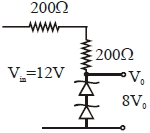
- The circuit shown below is working as a \(8\; \mathrm{V}\;dc\) regulated voltage source. When \(12 \;\mathrm{V}\) is used as input, the power dissipated (in \(\mathrm{mW}\) ) in each diode is (considering both zener diodes are identical)
 JEE Mains 2020 Medium
- Two moles of an ideal monoatomic gas occupies a volume \(V\) at \(27^o C\). The gas expands adiabatically to a volume \(2\ V\). Calculate \((a)\) the final temperature of the gas and \((b)\) change in its internal energy.JEE Mains 2018 Medium
- A solution is prepared by dissolving 0.3 g of a non - volatile non - electrolyte solute 'A' of molar mass 60 g \( mol^{-1} \) and 0.9 g of a non - volatile non - electrolyte solute 'B' of molar mass 180 g \( mol^{-1} \) in 100 mL \( H_{2}O \) at \( 27^{\circ}C \). Osmotic pressure of the solution will be
[Given: \( R=0.082~L \) atm \( K^{-1} \) \( mol^{-1} \)]JEE Mains 2026 Medium