


JEE Mains · Chemistry · STD 12 - Co-ordination chemistry
- JEE Mains 2026
- Medium
- Numerical
The total number of unpaired electrons present in the \(d^3\), \(d^4\) (low spin), \(d^5\) (high spin), \(d^6\) (high spin) and \(d^7\) (low spin) octahedral complex systems is _______.
Pick an option to check your answer.
Answer & Solution
Correct Answer
(A) 15
Step-by-step Solution
Detailed explanation
In an octahedral complex, the d-orbitals split into \(t_{2g}\) and \(e_g\) levels.
For \(d^3\): Configuration is \(t_{2g}^3 e_g^0\). Number of unpaired electrons = \(3\).
For \(d^4\) (low spin): Configuration is \(t_{2g}^4 e_g^0\). Number of unpaired electrons = \(2\).
For \(d^5\) (high spin): Configuration is \(t_{2g}^3 e_g^2\). Number of unpaired electrons = \(5\).
For \(d^6\) (high spin): Configuration is \(t_{2g}^4 e_g^2\). Number of unpaired electrons = \(4\).
For \(d^7\) (low spin): Configuration is \(t_{2g}^6 e_g^1\). Number of unpaired electrons = \(1\).
Total number of unpaired electrons = \(3 + 2 + 5 + 4 + 1 = 15\).
Answer: \(15\)
More questions from Chemistry
- Choose the correct statements.
(A) Weight of a substance is the amount of matter present in it.
(B) Mass is the force exerted by gravity on an object.
(C) Volume is the amount of space occupied by a substance.
(D) Temperatures below \(0^{\circ} \mathrm{C}\) are possible in Celsius scale, but in Kelvin scale negative temperature is not possible.
(E) Precision refers to the closeness of various measurements for the same quantity.
Choose the correct answer from the options given below :JEE Mains 2025 Medium - The mass of non-volatile, non-elctrolyte solute (molar mass \(= 50\,g\,mol^{- 1})\) needed to be dissolved in \(114\,g\) octane to reduce its vapour pressure to \(75\%,\) is .............. \(\mathrm{g}\)JEE Mains 2018 Hard
- Which one among the following chemical tests is used to distinguish monosaccharide from disaccharide?JEE Mains 2021 Easy
- It has been found that for a chemical reaction with rise in temperature by \(9\, K\) the rate constant gets doubled. Assuming a reaction to be occurring at \(300\, K\), the value of activation energy is found to be \(......\,k\,J \,mol ^{-1}\). [nearest integer] (Given \(\ln 10=2.3, R =8.3 JK ^{-1} mol ^{-1}, \log 2=0.30\) )JEE Mains 2022 Medium
- Which of the following statements is false?JEE Mains 2018 Medium
- The correct nomenclature for the following compound is _______.
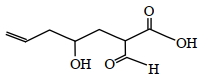 JEE Mains 2024 Medium
More PYQs from JEE Mains
- The electrostatic force \(\left(\vec{F}_1\right)\) and magnetic force \(\left(\vec{F}_2\right)\) acting on a charge \(q\) moving with velocity \(v\) can be written _______.JEE Mains 2024 Hard
- If \(100\, mole\) of \(H_2O_2\) decomposes at \(1\, bar\) and \(300\, K\), the work done \((kJ)\) by one mole of \(O_2(g)\) as it expands against \(1\, bar\) pressure is............. \(kJ\) \(2{H_2}{O_2}(l) \rightleftharpoons {H_2}O(l) + {O_2}(g)\) \((R = 8.3\, JK^{-1}\, mol^{-1})\)JEE Mains 2016 Hard
- \(RMgI\) when treated with ice cold water liberated a gas which occupied \(1.4\text{ dm}^3/\text{g}\) at STP. The gas produced is further reacted with iodine in presence of \(HIO_3\) to give compound (X). Compound (X) in presence of Na and dry ether produced compound (Y). Molar mass of compound (Y) is _______ \(\text{g mol}^{-1}\). (Nearest integer)JEE Mains 2026 Hard
- If a copper wire is stretched to increase its length by \(20 \% \). The percentage increase in resistance of the wire is \(..........\%\)JEE Mains 2023 Medium
- Four \(NOR\) gates are connected as shown in figure. The truth table for the given figure is :
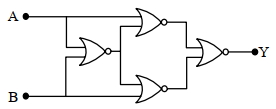 JEE Mains 2021 Hard
- Value of \(\mathrm{K}_{\mathrm{p}}\) for the equilibrium reaction \(\mathrm{N}_{2} \mathrm{O}_{4(\mathrm{~g})} \rightleftharpoons 2 \mathrm{NO}_{2(9)}\) at \(288 \,\mathrm{~K}\) is \(47.9 .\) The \(\mathrm{K}_{\mathrm{C}}\) for this reaction at same temperature is \(......\) (Nearest integer) \(\left(R=0.083\, L\, \operatorname{bar} \,\mathrm{K}^{-1} \,\mathrm{~mol}^{-1}\right)\)JEE Mains 2021 Medium