


JEE Mains · Chemistry · STD 12 - 3. Chemical kinetics
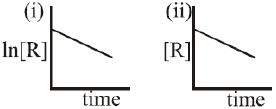
The given plots represent the variation of the concentration of a reactant \(R\) with time for two different reactions \((i)\) and \((ii).\) The respective orders of the reactions are
- A \(1,1\)
- B \(0,2\)
- C \(0,1\)
- D \(1,0\)
Answer & Solution
Correct Answer
(D) \(1,0\)
Step-by-step Solution
Detailed explanation
For first order reaction \(\ln \,{[R]_t}\, = \, - \,Kt\, + \,\ln \,{[R]_0}\) For zero oeder reaction \({[R]_t}\, = \, - \,Kt\, + \,{[R]_0}\) Where \('R'\) is reactant.
See the Complete Solution
Get step-by-step explanations for this and 2.5 Lakh+ more JEE, NEET & CET questions.
- Unlock all solutions
- Practice the full chapter
- Track accuracy across PYQs
4.8 rated on Google Play · 14,000+ reviews
More questions from Chemistry
- For the reaction, \(3A+2B \to C + D\), the differential rate law can be written asJEE Mains 2014 Hard
- The solubility product constants of \(Ag_2CrO_4\) and \(AgBr\) are \(32x\) and \(4y\) respectively at \(298\) K. The value of \(\left(\dfrac{\text{molarity of } Ag_2CrO_4}{\text{molarity of } AgBr}\right)\) can be expressed as :JEE Mains 2026 Medium
- The number of sigma bonds in \(\begin{array}{*{20}{c}} {{{\rm{H}}_3}{\rm{C}} - {\rm{C}} = {\rm{CH}} - {\rm{C}} \equiv {\rm{C}} - {\rm{H}}}\\ {|\,\,\,\,\,\,\,\,\,\,\,\,\,\,\,\,\,\,\,\,\,\,\,\,}\\ {H\,\,\,\,\,\,\,\,\,\,\,\,\,\,\,\,\,\,\,\,\,\,\,\,} \end{array}\) is \(......\)JEE Mains 2021 Medium
- Given below are two statements :
Statement (I) : Alcohols are formed when alkyl chlorides are treated with aqueous potassium hydroxide by elimination reaction.
Statement (II) : In alcoholic potassium hydroxide, alkyl chlorides form alkenes by abstracting the hydrogen from the \(\beta\)-carbon.
In the light of the above statements, choose the most appropriate answer from the options given below :JEE Mains 2025 Medium - The correct match between Item \(I\) and Item \(II\) is
Item \(I\) Item \(II\) \(A\) Allosteric effect \(P\) Molecule binding to the active site of enzyme \(B\) Competitive inhibitor \(Q\) Molecule crucial for communication in the body \(C\) Receptor \(R\) Molecule binding to a site other than the active site of enzyme \(D\) Poison \(S\) Molecule binding to the enzyme covalently JEE Mains 2019 Hard - Concentrated \(HNO _{3}\) reacts with Iodine to giveJEE Mains 2022 Medium
More PYQs from JEE Mains
- When a rubber-band is stretched by a distance \(x\), it exerts restoring force of magnitude \(F=ax+bx^2\) where \(a\) and \(b\) areconstants. The work done in stretching the unstretched rubber-band by \(L\) isJEE Mains 2014 Medium
- Given below are two statements :
Statement (I) : It is impossible to specify simultaneously with arbitrary precision, both the linear momentum and the position of a particle.
Statement (II) : If the uncertainty in the measurement of position and uncertainty in measurement of momentum are equal for an electron, then the uncertainty in the measurement of velocity is \(\geqslant \sqrt{\frac{\mathrm{h}}{\pi}} \times \frac{1}{2 \mathrm{~m}}\).
In the light of the above statements, choose the correct answer from the options given below :JEE Mains 2025 Medium - The variation of molar conductivity with concentration of an electrolyte \((X)\) in aqueous solution is shown in the given figure. The electrolyte \(X\) is :
 JEE Mains 2020 Medium
 - let \(y = y\left( x \right)\) be the solution of the differential equation \(\sin x\frac{{dy}}{{dx}} + ycos\;x = 4x\;\), \(x \in \left( {0,\pi } \right)\) . If \(y\left( {\frac{\pi }{2}} \right) = 0\) then \(y\left( {\frac{\pi }{6}} \right) = .\;.\;..\;\) .JEE Mains 2018 Hard
- If \(\vec{a}=2 \hat{i}+\hat{j}+2 \hat{k},\) then the value of \(|\hat{ i } \times(\overrightarrow{ a } \times \hat{ i })|^{2}+|\hat{j} \times(\overrightarrow{ a } \times \hat{ j })|^{2}+|\hat{ k } \times(\overrightarrow{ a } \times \hat{ k })|^{2}\) is equal toJEE Mains 2020 Medium
- Let \(B=\left[\begin{array}{ccc}1 & 3 & \alpha \\ 1 & 2 & 3 \\ \alpha & \alpha & 4\end{array}\right], \alpha > 2\) be the adjoint of \(a\) matrix \(A\) and \(| A |=2\), then \([\alpha\,\,-2 \alpha \,\, \alpha \,\,] B \left[\begin{array}{c}\alpha \\ -2 \alpha \\ \alpha\end{array}\right]\) is equal to :-JEE Mains 2023 Hard