


JEE Mains · Chemistry · STD 12 - Chemical kinetics
- JEE Mains 2019
- Hard
- Numerical
The following results were obtained during kinetic studies of the reaction \(2A+B\) \(\to\) products
| Experiment | \([A]\) (in \(mol\, L^{-1})\) | \([B]\) (in \(mol\, L^{-1})\) | Initial rate of reaction (in \(mol\, L^{-1}\,min^{-1})\) |
| \(I\) | \(0.10\) | \(0.20\) | \(6.93 \times {10^{ - 3}}\) |
| \(II\) | \(0.10\) | \(0.25\) | \(6.93 \times {10^{ - 3}}\) |
| \(III\) | \(0.20\) | \(0.30\) | \(1.386 \times {10^{ - 2}}\) |
Pick an option to check your answer.
Answer & Solution
Correct Answer
(B) \(10\)
Step-by-step Solution
Detailed explanation
\(R\,\, = \,k{[A]^x}\,{[B]^y}\)
\(6.93\, \times \,{10^{ - 3}}\, = \,k\,{(0.1)^x}\,{(0.2)^y}\) ...... \((i)\)
\(6.93\, \times \,{10^{ - 3}}\, = \,k\,{(0.1)^x}\,{(0.25)^y}\) ...... \((ii)\)
\(1.386 \times \,{10^{ - 2}}\, = \,k\,{(0.2)^x}\,{(0.3)^y}\) . .... \((iii)\)
\( \Rightarrow \,y = 0\) (from \((i)\) and \((ii)\)), zero order w.r.t. \(B\)
\(x=1\) (from \((i)\) and \((ii)\))
\( \Rightarrow \,\) First order wrt \(A\)
\( \Rightarrow 6.93\times 10^{-3}\,=\,k(0.1)\)
\( \Rightarrow k=6.93\times 10^{-3}\,min^{-1}\)
More questions from Chemistry
- Which one of the following substituents at para position is most effective in stabilizing the phenoxide ion ?
 JEE Mains 2014 Hard
- Identify the incorrect statements about group \(15\) elements : \((A)\) Dinitrogen is a diatomic gas which acts like an inert gas at room temperature. \((B)\) The common oxidation states of these elements are \(-3,+3\) and +5 . \((C)\) Nitrogen has unique ability to form \(\mathrm{p} \pi-\mathrm{p} \pi\) multiple bonds. \((D)\) The stability of +\(5\) oxidation states increases down the group. \((E)\) Nitrogen shows a maximum covalency of \(6\). Choose the correct answer from the options given below.JEE Mains 2024 Medium
- The mechanism of \(S _{ N } 1\) reaction is given as \(R - X \rightarrow R ^{\oplus} X ^{\ominus} \rightarrow R ^{\oplus} \| X ^{\ominus} \stackrel{ Y^\ominus }{\rightarrow} R - Y + X ^{\ominus}\) Ion pair Solvent separated ion pair A student writes general characteristics based on the given mechanism as: \((a)\) The reaction is favoured by weak nucleophiles \((b)\) \(R^ \oplus\) would be easily formed if the substituents are bulky \((c)\) The reaction is accompained by recemization \((d)\) The reaction is favoured by non-polar solvents. Which observations are correct \(?\)JEE Mains 2020 Medium
- Given below are two statements: Statement \((I)\): A solution of \(\left[\mathrm{Ni}\left(\mathrm{H}_2 \mathrm{O}\right)_6\right]^{2+}\) is green in colour. Statement \((II)\): A solution of \(\left[\mathrm{Ni}(\mathrm{CN})_4\right]^{2-}\) is colourless. In the light of the above statements, choose the most appropriate answer from the options given below:JEE Mains 2024 Hard
- An ideal gas undergoes isothermal compression from \(5\, m^3\) to \(1\, m^3\) against a constant external pressure of \(4\, Nm^{-2}\). Heat released in this process is used to increase the temperature of \(1\, mole\) of \(Al\). If molar heat capacity of \(Al\) is \(24\, J\, mol^{-1}\,K^{-1}\), the temperature of \(Al\) is increases byJEE Mains 2019 Medium
- Consider the given graph showing variation of reactant concentration with time.
Three different reactions were started with identical initial concentration of reactants. Which of the following statement is correct?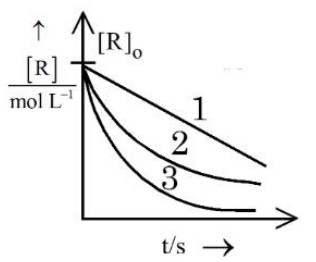 JEE Mains 2026 Medium
More PYQs from JEE Mains
- A large drum having radius \(R\) is spinning around its axis with angular velocity \(\omega\), as shown in figure. The minimum value of \(\omega\) so that a body of mass M remains stuck to the inner wall of the drum, taking the coefficient of friction between the drum surface and mass M is \(\mu\), is :
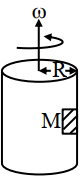 JEE Mains 2026 Hard
- Arrange the following Cobalt complexes in the order of increasing Crystal Field Stabilization Energy \((CFSE)\) value. Complexes : \(\left[\mathrm{CoF}_{6}\right]^{3-},\left[\mathrm{Co}\left(\mathrm{H}_{2} \mathrm{O}\right)_{6}\right]^{2+},\left[\mathrm{Co}\left(\mathrm{NH}_{3}\right)_{6}\right]^{3+}\) and \(\left[\mathrm{Co}(\mathrm{en})_{3}\right]^{3+}\) \(\quad\quad\quad\quad\quad\quad A\quad\quad\quad\quad \quad B\quad\quad\quad\quad\quad\quad C\quad\quad\quad\quad\quad\quad D\) Choose the correct option:JEE Mains 2021 Medium
- A parallel plate capacitor of capacitance \(1 \mu \mathrm{~F}\) is charged to a potential difference of 20 V . The distance between plates is \(1 \mu \mathrm{~m}\). The energy density between plates of capacitor is _________.JEE Mains 2025 Easy
- The four quantum numbers for the electron in the outer most orbital of potassium (atomic no. \(19\)) are _______.JEE Mains 2024 Hard
- Arrange the following in order of magnitude of work done by the system / on the system at constant temperature :
(a) \(\left|\mathrm{w}_{\text {reversible }}\right|\) for expansion in infinite stage.
(b) \(\left|w_{\text {irreversible }}\right|\) for expansion in single stage.
(c) \(\left|w_{\text {reversible }}\right|\) for compression in infinite stage.
(d) \(\left|w_{\text {irreversible }}\right|\) for compression in single stage.
Choose the correct answer from the options given below:JEE Mains 2025 Medium - In reaction \(A + 2B\) \( \rightleftharpoons \) \(2C + D\), initial concentration of \(B\) was \(1.5\, times\) of \([A]\) , but at equilibrium the concentrations of \(A\) and \(B\) became equal. The equilibrium constant for the reaction isJEE Mains 2019 Hard