


JEE Mains · Chemistry · STD 12 - Chemical kinetics
- JEE Mains 2022
- Medium
- Numerical
\(2 NO +2 H _{2} \rightarrow N _{2}+2 H _{2} O\) The above reaction has been studied at \(800^{\circ} C\). The related data are given in the table below.
| Reaction serial number | Initial pressure of \(H _{2}\) / \(kPa\) | Initial Pressure of \(NO /\) \(kPa\) | Initial rate \(\left(\frac{- dp }{ dt }\right) /( kPa / s )\) |
| \(1\) | \(65.6\) | \(40.0\) | \(0.135\) |
| \(2\) | \(65.6\) | \(20.1\) | \(0.033\) |
| \(3\) | \(38.6\) | \(65.6\) | \(0.214\) |
| \(4\) | \(19.2\) | \(65.6\) | \(0.106\) |
Pick an option to check your answer.
Answer & Solution
Correct Answer
(C) \(2\)
Step-by-step Solution
Detailed explanation
On decreasing pressure of \(NO\) by a factor of '\(2\)' the rate of reaction decreases by a factor of '\(4\)'.
\(\therefore\) Order of reaction w.r.t. 'NO' \(=2\)
More questions from Chemistry
- The correct decreasing order of densities of the following compounds is:
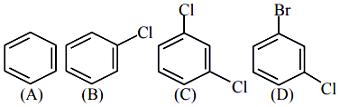 JEE Mains 2021 Medium
- A xenon compound \('A'\) upon partial hydrolysis gives \(XeO _{2} F _{2}\). The number of lone pair of electrons present in compound \(A\) is ....... . (Round off to the Nearest integer)JEE Mains 2021 Medium
- Which of the following ions does not liberate hydrogen gas on reaction with dilute acids ?JEE Mains 2017 Hard
- The correct order of ionic size of \(N^{3-} , Na^+ ,F^- , Mg^{2+}\) and \(O^{2-}\) isJEE Mains 2022 Hard
- The difference between electron gain enthalpies will be maximum between:JEE Mains 2023 Easy
- For the reaction, \(aA + bB \rightarrow cC + dD ,\) the plot of log \(k\) vs \(\frac{1}{ T }\) is given below The temperature at which the rate constant of the reaction is \(10^{-4} s ^{-1}\) is .............. \(K\). (Rounded-off to the nearest integer) [Given: The rate constant of the reaction is \(10^{-5} s ^{-1}\) at \(500 K\).]
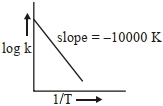 JEE Mains 2021 Medium
More PYQs from JEE Mains
- \(A\,\xrightarrow{{A{g_2}O}}\) ppt \(A\,\xrightarrow{{H{g^{2 + }}\,/\,{H^ + }}}B\,\xrightarrow{{NaB{H_4}}}C\,\xrightarrow[{conc.\,\,HCl}]{{ZnC{l_2}}}\) Turbidity within \(5\) minutes. Consider the following reactions \(‘A’\) isJEE Mains 2019 Hard
- There is a small source of light at some depth below the surface of water (refractive index \(=\frac{4}{3}\) ) in a tank of large cross sectional surface area. Neglecting any reflection from the bottom and absorption by water, percentage of light that emerges out of surface is (nearly)...........\(\%\) [Use the fact that surface area of a spherical cap of height \(\mathrm{h}\) and radius of curvature \(\mathrm{r} \text { is } 2 \pi \mathrm{rh}]\)JEE Mains 2020 Hard
- Consider two solid spheres of radii \(\mathrm{R}_{1}=1 \;\mathrm{m}\) \(\mathrm{R}_{2}=2\; \mathrm{m}\) and masses \(\mathrm{M}_{1}\) and \(\mathrm{M}_{2},\) respectively. The gravitational field due to sphere \((1)\) and \((2)\) are shown. The value of \(\frac{\mathrm{M}_{1}}{\mathrm{M}_{2}}\) is
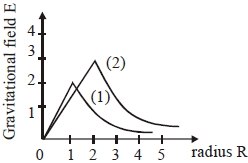 JEE Mains 2020 Medium
- \( X_{2}(g) + Y_{2}(g) \rightleftharpoons 2Z(g) \),
\(X _2(g)\) and \(Y _2(g)\) are added to a 1 L flask and it is found that the system attains the above equilibrium at \(T ( K )\) with the number of moles of \(X _2(g), Y _2(g)\) and \(Z ( g )\) being 3,3 and 9 mol respectively (equilibrium moles). Under this conditions of equilibrium, 10 mol of \(Z ( g )\) is added to the flask and the temperature is maintained at \(T ( K )\). Then the number of moles of \(Z ( g )\) in the flask when the new equilibrium is established is _________ . (Nearest integer).JEE Mains 2026 Hard - A point particle of mass, moves along the uniformly rough track \(PQR\) as shown in the figure. The coefficient of friction, between the particle and the rough track equals \(\mu\). The particle is released, from rest, from the point \(P\) and it comes to rest at a point \(R\). The energies, lost by the ball, over the parts, \(PQ\) and \(PR\), of the track, are equal to each other, and no energy is lost when particle changes direction from \(PQ\) to \(QR\). The values of the coefficient of friction \(\mu\) and the distance \(x(=QR)\) are, respecitvely close to
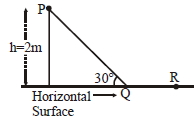 JEE Mains 2016 Hard
- An accelerated electron has a speed of \(5 \times 10^{6} \,\mathrm{~ms}^{-1}\) with an uncertainty of \(0.02\,\%\). The uncertainty in finding its location while in motion is \(x \times 10^{-9}\, \mathrm{~m}\). The value of \(x\) is \(......\) (Nearest integer) [Use mass of electron \(\left.=9.1 \times 10^{-31}\, \mathrm{~kg}, \mathrm{~h}=6.63 \times 10^{-34}\, \mathrm{~J} \mathrm{~s}, \)\(\pi=3.14\right]\)JEE Mains 2021 Hard