


JEE Mains · Chemistry · STD 11 - Redox reactions
- JEE Mains 2026
- Medium
- MCQ
Among \(Fe^{3+}\), \(Pb^{2+}\), \(Cu^{2+}\) and \(Mn^{2+}\), identify the one that gets precipitated out while passing \(H_2S\) in presence of \(NH_4OH\) as group reagent. The highest possible oxidation state of the corresponding metal is
Pick an option to check your answer.
Answer & Solution
Correct Answer
(D) \(+7\)
Step-by-step Solution
Detailed explanation
The group reagent \(H_2S\) in the presence of \(NH_4OH\) is used for the precipitation of Group IV cations in qualitative analysis.
Among the given ions, \(Mn^{2+}\) belongs to Group IV and is precipitated as \(MnS\).
\(Pb^{2+}\) and \(Cu^{2+}\) belong to Group II and are precipitated by \(H_2S\) in an acidic medium.
\(Fe^{3+}\) belongs to Group III and is precipitated as \(Fe(OH)_3\) by \(NH_4OH\) in the presence of \(NH_4Cl\).
The metal corresponding to the precipitated ion is Manganese (\(Mn\)).
The electronic configuration of \(Mn\) is \([Ar] 3d^5 4s^2\). By losing all its valence electrons, it can exhibit a maximum oxidation state of \(+7\) (for example, in \(KMnO_4\)).
Answer: \(+7\)
More questions from Chemistry
- Which of the following statement(s) is/are correct? \((A)\) The \(pH\) of \(1 \times 10^{-8}\,M\,HCl\) solution is \(8\). \((B)\) The conjugate base \(H _2 PO _4^{-}\)is \(HPO _4{ }^{2-}\). \((C)\) \(K _{ w }\) increases with increase in temperature. \((D)\) When a solution of weak monoprotic acid is titrated against a strong base at half neutralisation point, \(pH =\frac{1}{2} pK _{ a }\) Choose the correct answer from the option given below.JEE Mains 2023 Medium
- Enthalpies of formation of \(CCl _{4( g )}, H _2 O_{( g )}, CO _{2( g )}\) and \(HCl_{ ( g )}\) are \(-105,-242,-394\) and \(-92\,kJ\,mol ^{-1}\) respectively. The magnitude of enthalpy of the reaction given below is \(......kJ\,mol ^{-1}\) (nearest integer) \(CCl _{4( g )}+2 H _2 O_{( g )} \rightarrow CO _{2( g )}+4 HCl_{( g )}\)JEE Mains 2023 Medium
- Total enthalpy change for freezing of 1 mol of water at \(10^{\circ} \mathrm{C}\) to ice at \(-10^{\circ} \mathrm{C}\) is _______.
(Given : \(\Delta_{\text {fus }} H=x \mathrm{~kJ} / \mathrm{mol}\))
\(\begin{aligned} & \mathrm{C}_{\mathrm{p}}\left[\mathrm{H}_2 \mathrm{O}(\mathrm{l})\right]=\mathrm{y} \mathrm{J} \mathrm{mol}^{-1} \mathrm{~K}^{-1} \\ & \mathrm{C}_{\mathrm{p}}\left[\mathrm{H}_2 \mathrm{O}(\mathrm{s})\right]=\mathrm{z} \mathrm{J} \mathrm{mol}^{-1} \mathrm{~K}^{-1}\end{aligned}\)JEE Mains 2025 Medium - The dissociation constant of acetic is \(x \times 10^{-5}\). When \(25 mL\) of \(0.2\,M\,CH COO _3 COO\) solution is mixed with \(25\,mL\) of \(0.02\,M\,CH { }_3 COOH\) solution, the \(pH\) of the resultant solution is found to be equal to 5 . The value of \(x\) is \(..........\).JEE Mains 2023 Medium
- The number of units, which are used to express concentration of solutions from the following is _________.(Mass percent, Mole, Mole fraction, Molarity, ppm, Molality.)JEE Mains 2023 Medium
- \( \wedge _m^o\) for \(NaCl,\,HCl\) and \(NaA\) are \(126.4,\,425.9\) and \(100.5\,\,S\,cm^2\,mol^{-1},\) respectively. If the conductivity of \(0.001\,M\,HA\) is \(5\times 10^{-5}\,S\,cm^{-1},\) degree of dissociation of \(HA\) isJEE Mains 2019 Hard
More PYQs from JEE Mains
- The electron in a hydrogen atom first jumps from the third excited state to the second excited state and subsequently to the first excited state. The ratio of the respective wavelengths, \(\lambda _1/\lambda _2\), of the photons emitted in this process isJEE Mains 2019 Hard
- Given below are two statements: Statement \(I\): IUPAC name of \(\mathrm{HO}-\mathrm{CH}_2-\left(\mathrm{CH}_2\right)_3-\) \(\mathrm{CH}_2-\mathrm{COCH}_3\) is \(7\)-hydroxyheptan-2-one. Statement \(II\): \(2\)-oxoheptan-\(7\)-ol is the correct IUPAC name for above compound In the light of the above statements.
choose the most appropriate answer from the options given below:JEE Mains 2024 Hard - The diameter of an air bubble which was initially \(2\,mm\), rises steadily through a solution of density \(1750\,kg\,m\,m ^{-3}\) at the rate of \(0.35\,cms ^{-1}\). The coefficient of viscosity of the solution is poise (in nearest integer). (the density of air is negligible).JEE Mains 2022 Medium
- Two circular discs of radius each 10 cm are joined at their centres by a rod of length 30 cm and mass 600 gm as shown in figure.
If the mass of each disc is 600 gm and applied torque between two discs is \(43 \times 10^{5}\) dyne cm, the angular acceleration of the discs about the given axis \(AB\) is ___________\(rad/s^{2}\).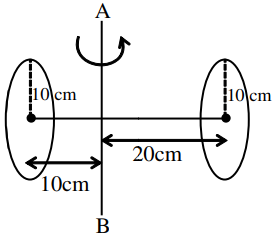 JEE Mains 2026 Hard
- The magnetic field existing in a region is given by \(\overrightarrow{\mathrm{B}}=0.2(1+2 \mathrm{x}) \hat{\mathrm{k} T}\). A square loop of edge \(50 \mathrm{~cm}\) carrying \(0.5 \mathrm{~A}\) current is placed in \(x-y\) plane with its edges parallel to the \(x-y\) axes, as shown in figure. The magnitude of the net magnetic force experienced by the loop is___________ \(\mathrm{mN}\).
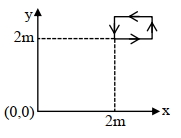 JEE Mains 2024 Hard