


All Redox reactions questions
Newest firstShowing 51–67 of 67 questions
-
- (A) Combination of dinitrogen with dioxygen at \(2000 \;K\)
- (B) Formation of ozone from atmosphereic oxygen in the presence of sunlight
- (C) Reaction of \(\mathrm{H}_{2} \mathrm{SO}_{4}\) with \(\mathrm{NaOH}\)
- (D) Reaction of \(\left[\mathrm{Co}\left(\mathrm{H}_{2} \mathrm{O}\right)_{6}\right] \mathrm{Cl}_{3}\) with \(\mathrm{AgNO}_{3}\)
Show answer and solution
Correct Answer: (A)
\(\mathrm{N}_{2}+\mathrm{O}_{2} \stackrel{2000 \mathrm{K}}{\longrightarrow} 2 \mathrm{NO} \quad\) (Redox reaction)during the reaction, oxidation of nitrogen take place from \(0\) to \(2\) and reduction of oxygen take place from \(0\) to \(-2 .\) It means this reaction is redox reaction.
\(3 \mathrm{O}_{2} \stackrel{\mathrm{hv}}{\longrightarrow} 2 \mathrm{O}_{3} \quad\) (Non - redox reaction)
\(\mathrm{H}_{2} \mathrm{SO}_{4}+2 \mathrm{NaOH} \rightarrow \mathrm{Na}_{2} \mathrm{SO}_{4}+2 \mathrm{H}_{2} \mathrm{O}\) (neutralization reaction)
\(\left[\mathrm{Co}\left(\mathrm{H}_{2} \mathrm{O}\right)_{6}\right] \mathrm{Cl}_{3}+3 \mathrm{AgNO}_{3}\)
\(\rightarrow 3 \mathrm{AgCl} \downarrow+\left[\mathrm{Co}\left(\mathrm{H}_{2} \mathrm{O}\right)_{6}\right]\left(\mathrm{NO}_{3}\right)_{3}\)
(White ppt.)
- 52. The sum of the total number of bonds between chromium and oxygen atoms in chromate and dichromate ions is 2020 Hard
- (A) \(12\)
- (B) \(13\)
- (C) \(14\)
- (D) \(15\)
Show answer and solution
Correct Answer: (A)
Total number of bonds between chromium and oxygen in both structures are \(18\)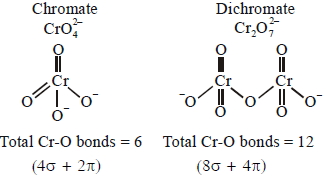
-
- (A) \(55\)
- (B) \(52\)
- (C) \(60\)
- (D) \(50\)
Show answer and solution
Correct Answer: (D)
\(K _{2} Cr _{2} O _{7}+ FeC _{2} O _{4} \longrightarrow Cr ^{+3}+ Fe ^{+3}+ CO _{2}\)\(n=6 \quad \quad n=3\)
\(\frac{0.02 \times 6 \times V ( mL )}{1000}=\frac{0.288}{144} \times 3\)
\(\Rightarrow \quad V =50 mL\)
-
- (A) \(2KMnO_4 \longrightarrow K_2MnO_4 + MnO_2 + O_2\)
- (B) \(2NaBr + Cl_2 \longrightarrow 2NaCl + Br_2\)
- (C) \(2CuBr \longrightarrow CuBr_2 + Cu\)
- (D) \(2MnO_4^ - + 10{I^ - } + 16{H^ + } \longrightarrow 2M{n^{2 + }} + 5{I_2} + 8{H_2}O\)
Show answer and solution
Correct Answer: (C)
\(2C{u^ \oplus }\) \(\longrightarrow\) \(C{u^{2 + }} + Cu\) -
- (A) \(1\)
- (B) \(1.5\)
- (C) \(2\)
- (D) \(3\)
Show answer and solution
Correct Answer: (C)
\(n-\) factors of \(KMnO_4=5,\,n-\) factor of \(FeSO_4=1\)\(n-\) factors of \(FeC_2O_4=3,\,Fe_2(SO_4)_3\) does not react
\(n-\) factors of \(Fe_2(C_2O_4)_3=6\),
\(n_{eq}\,KMnO_4=n_{eq}[FeC_2O_4+Fe_2(C_2O_4)_3+FeSO_4]\)
or, \(x \times 5=1 \times 3+1\times 6+1\times1 \)
\(x=2\)
- 56. In the reaction of oxalate with permanganate in acidic medium, the number of electrons involved in producing one molecule of \(CO_2\) is 2019 Medium
- (A) \(1\)
- (B) \(10\)
- (C) \(2\)
- (D) \(5\)
Show answer and solution
Correct Answer: (A)
Explanation:
The redox reaction between oxalate ions (\( \text{C}_2\text{O}_4^{2-} \)) and permanganate ions (\( \text{MnO}_4^- \)) in an acidic medium consists of oxidation and reduction half-reactions.
To find the number of electrons involved per molecule of \( \text{CO}_2 \) produced, we look at the balanced oxidation half-reaction of the oxalate ion:
\( \text{C}_2\text{O}_4^{2-} \rightarrow 2\text{CO}_2 + 2e^- \)
From this balanced half-reaction:
- Oxidation of \( 1 \) molecule of oxalate ion (\( \text{C}_2\text{O}_4^{2-} \)) produces \( 2 \) molecules of \( \text{CO}_2 \).
- This process releases a total of \( 2 \) electrons.
Therefore, the number of electrons involved in producing one single molecule of \( \text{CO}_2 \) is calculated as:
\( \text{Number of electrons} = \frac{2\text{ electrons}}{2\text{ molecules of CO}_2} = 1\text{ electron} \)
Hence, Option A is the correct choice. - 57. The correct order of the oxidation states of nitrogen in \(NO, N_2O, NO_2\) and \(N_2O_3\) is 2019 Hard
- (A) \(N_2O < N_2O_3 < NO < NO_2\)
- (B) \(NO_2 < NO < N_2O_3 < N_2O\)
- (C) \(NO_2 < N_2O_3 < NO < N_2O\)
- (D) \(N_2O < NO < N_2O_3 < NO_2\)
Show answer and solution
Correct Answer: (D)
\(\mathop {NO}\limits^{ + 2} ,{\mkern 1mu} \mathop {{N_2}}\limits^{ + 1} O{\mkern 1mu} ,{\mkern 1mu} \mathop {{\text{ }}N}\limits^{ + 4} {O_2},\mathop {{N_2}}\limits^{ + 3} {O_3}\) - 58. In \(KO_2\), the nature of oxygen species and the oxidation state of oxygen atom are, respectively 2018 Hard
- (A) Superoxide and \(-1\)
- (B) Superoxide and \(-1/2\)
- (C) Peroxide and \(-1/2\)
- (D) Oxide and \(-2\)
Show answer and solution
Correct Answer: (B)
In \(KO_2\), the nature of oxygen species and the oxidation state of oxygen atom are superoxide (superoxide ion is \(O_2^-\)) and \(-1/2\) respectively.Let \(x\) be oxidation state of oxygen. The oxidation state of \(K\) is \(+1.\) Hence
\(+1+2(x)=0\)
\(2x=-1\)
\(x=-\frac {1}{2}\)
-
- (A) \(MnO_4 ^-\) and \(CrO_2Cl_2\)
- (B) \([NiCl_4]^{2-}\) and \([CoCl_4]^{2-}\)
- (C) \([Fe(CN)_6]^{3-}\) and \([Cu(CN)_2]^{2-}\)
- (D) \([FeCl_4]^-\) and \(Co_2O_3\)
Show answer and solution
Correct Answer: (A)
\((1)\,Cr\mathop {{O_2}}\limits^{2 - } \mathop {C{l_2}}\limits^{ - 1} \,\,Cr = + 6;\,Mn\mathop {{O_2}}\limits^{2 - } \,\,Mn = + 4\)(Highest oxidation state)
\((2)\,{[Ni\mathop {C{l_4}}\limits^{ - 1} ]^{2 - }}\,\,Ni = + 2;\,{[Co\mathop {C{l_4}}\limits^{ - 1} ]^{2 - }}\,\,Co = + 2\)
\((3)\,{[Fe{(\mathop {CN}\limits^{ - 1} )_6}]^{3 - }}\,\,Fe = + 3;\,{[Cu{(\mathop {CN}\limits^{ - 1} )_4}]^{2 - }}\,\,Cu = + 2\)
\((4)\,{[Fe\mathop {C{l_4}}\limits^{ - 1} ]^ - }\,\,Fe = + 3;\,C{o_2}\mathop {{O_3}}\limits^{ - 2} \,Co = + 3\)
-
- (A) \(XeF_4 + O_2F_2 \rightarrow XeF_6 + O_2\)
- (B) \(XeF_2 + PF_5 \rightarrow [XeF]^+ PF_6^-\)
- (C) \(XeF_6 + H_2O \rightarrow XeOF_4 + 2HF\)
- (D) \(XeF_6 + 2H_2O \rightarrow XeO_2F_2 + 4HF\)
Show answer and solution
Correct Answer: (A)
The following reaction is an example of redox reaction as xenon undergoes oxidation from state \(+4\) to \(+6\) and oxygen undergoes reduction from state \(+1\) to \(0 .\)\(\stackrel{+4}{\mathrm{X}} \mathrm{eF}_{4}+\stackrel{+1}{\mathrm{O}_{2}} \mathrm{F}_{2} \rightarrow \stackrel{+6}{\mathrm{Xe}} \mathrm{F}_{6}+\stackrel{0}{\mathrm{O}_{2}}\)
-
- (A) \(Sn^{4+}\) is the oxidizing agent because it undergoes oxidation
- (B) \(Sn^{4+}\) is the reducing agent because it undergoes oxidatio
- (C) \(H_2SO_3\) is the reducing agent because it undergoes oxidation
- (D) \(H_2SO_3\) is the reducing agent because it undergoes reduction
Show answer and solution
Correct Answer: (C)
\(\mathop {{H_2}S{O_3}}\limits^{ + 4} (aq) + \mathop {Sn^{+4}} (aq) + {H_2}O(l) \to S{n^{2 + }}(aq) + \mathop {HS{O_4}^ - }\limits^{ + 6} (aq) + 3{H^ + }\) Hence \(H_2SO_3\) is the reducing agent because it undergoes oxidation -
- (A) \(3\)
- (B) \(4\)
- (C) \(6\)
- (D) \(5\)
Show answer and solution
Correct Answer: (C)
Oxidation state of Cr in \(C{r_2}O_7^{2-}\): \(+6\)
Oxidation state of Cr in \(C{r^{3+}}\): \(+3\)
Electrons gained by Cr per mole of \(C{r_2}O_7^{2-}\): \(2 \times (+6 - +3) = 6e^-\)
Oxidation state of Fe in \(F{e^{2+}}\): \(+2\)
Oxidation state of Fe in \(F{e^{3+}}\): \(+3\)
Electrons lost by Fe per mole of \(F{e^{2+}}\): \(+3 - +2 = 1e^-\)
Oxidation state of C in \({C_2}O_4^{2-}\): \(+3\)
Oxidation state of C in \(C{O_2}\): \(+4\)
Electrons lost by C per mole of \({C_2}O_4^{2-}\): \(2 \times (+4 - +3) = 2e^-\)
For the reaction to be balanced, total electrons gained = total electrons lost.
Let the coefficient for \(F{e^{2+}}\) be \(x\) and for \({C_2}O_4^{2-}\) be \(y\).
\(1 \times 6 = x \times 1 + y \times 2\)
\(6 = x + 2y\)
The smallest integer solution is \(x=4, y=1\).
Total electrons involved: \(6\)
-
- (A) \(MnO_4^-\)
- (B) \(Cr_2O_7^{2-}\)
- (C) \(SO_3^{2-}\)
- (D) \(KI\)
Show answer and solution
Correct Answer: (A)
\(H_2O_2\) acts as a reducing agent only in presence of strong oxidising agents (\(i.e.,MnO_4^-\) ) in acidic as well as alkaline medium. \(2KMnO_4 + 3H_2SO_4 + 5H_2O_2 \to K_2SO_4 + 2MnSO_4 + 8H_2O + 5O_2\) -
- (A) \(Li_2O + 2KCl \rightarrow 2LiCl + K_2O\)
- (B) \([ CoCl( NH_3 )_5]^+ +5H^+ \rightarrow Co^{2+} +5NH_4^+ +Cl^-\)
- (C) \([ Mg(H_2O)_6]^{2+} +(EDTA)^{4-} \xrightarrow{{excess\,NaOH}} \) \([Mg(EDTA)]^{2+} +6H_2O\)
- (D) \(CuSO_4 + 4KCN \rightarrow K_2[Cu(CN)_4]+K_2SO_4\)
Show answer and solution
Correct Answer: (B)
Equation \(-1\) is not balanced with respect to charge.Equation \(-2\) gives \(K _3\left[ Cu ( CN )_4\right]\) as product.
Equation \(-3\) reaction is unfavourable in the forward direction \(\left( K _2 O\right.\) is unstable, while \(LiO _2\) is stable).
Equation \(-4\) is correct and balanced.
-
- (A) It is diamagnetic in nature
- (B) It is derivative of \(H_2O_2\)
- (C) \(Na_2O_2\) oxidises \(Cr^{3+}\) to \(CrO_4^{2-}\) in acid medium
- (D) It is the super oxide of sodium
Show answer and solution
Correct Answer: (D)
Explanation:
Let us evaluate each statement regarding sodium peroxide (\( \text{Na}_2\text{O}_2 \)):
1. Diamagnetic Nature: The peroxide ion (\( \text{O}_2^{2-} \)) has a total of 18 electrons. According to Molecular Orbital Theory, all electrons are completely paired up in its molecular orbitals, which makes it diamagnetic in nature. This statement is correct.
2. Derivative of \( \text{H}_2\text{O}_2 \): Sodium peroxide reacts readily with water or dilute acids at low temperatures to produce hydrogen peroxide (\( \text{H}_2\text{O}_2 \)). Therefore, it behaves as a stable salt derivative of hydrogen peroxide. This statement is correct.
3. Oxidation of Chromium: In an alkaline (basic) medium, sodium peroxide acts as a strong oxidizing agent and converts trivalent chromium (\( \text{Cr}^{3+} \)) into yellow chromate ions (\( \text{CrO}_4^{2-} \)). Option C has been modified to reflect this correct chemical environment.
4. Peroxide vs Superoxide: \( \text{Na}_2\text{O}_2 \) is the peroxide of sodium where oxygen exists in a \( -1 \) oxidation state as the \( \text{O}_2^{2-} \) ion. On the other hand, sodium superoxide has the chemical formula \( \text{NaO}_2 \) containing the \( \text{O}_2^- \) ion. Thus, statement D is completely incorrect.
Since the question asks for the statement that is not correct, Option D is the correct choice. -
- (A) \(2,1,2\)
- (B) \(2,1,3\)
- (C) \(3, 1,6\)
- (D) \(3, 1, 4\)
Show answer and solution
Correct Answer: (C)
On balancing the given reaction, we find\(3Na_2HAsO_3 + NaBrO_3 + 6HCl \longrightarrow\)
\(6NaCl + 3H_3AsO_4 + NaBr\)
-
- (A) \(I^-\)
- (B) \(S(s)\)
- (C) \(NO_3^ - \left( {aq} \right)\)
- (D) \(Cr_2O_7^{2 - }\)
Show answer and solution
Correct Answer: (A)
If an electronegative element is in its lowest possible oxidation state in a compound or in free state. It can function as a powerful reducing agent.
e.g. \(I^-\)
No questions on this page match these filters.