


JEE Mains · Chemistry · STD 11 - Redox reactions
- JEE Mains 2026
- Hard
- MCQ
In order to oxidise a mixture of \(1\) mole each of \(FeC_2O_4\), \(Fe_2(C_2O_4)_3\), \(FeSO_4\) and \(Fe_2(SO_4)_3\) in acidic medium, the number of moles of \(KMnO_4\) required is
Pick an option to check your answer.
Answer & Solution
Correct Answer
(B) \(2\)
Step-by-step Solution
Detailed explanation
In acidic medium, \(KMnO_4\) acts as an oxidising agent and gets reduced to \(Mn^{2+}\). The n-factor for \(KMnO_4\) is \(5\).
The n-factors for the given reducing agents are calculated based on the total number of moles of electrons lost per mole of the compound:
For \(FeC_2O_4\):
\(Fe^{2+} \rightarrow Fe^{3+} + e^{-}\)
\(C_2O_4^{2-} \rightarrow 2CO_2 + 2e^{-}\)
Total electrons lost \(= 3\), so n-factor \(= 3\).
Equivalents \(= 1 \times 3 = 3\).
For \(Fe_2(C_2O_4)_3\):
\(Fe^{3+}\) is not oxidised.
\(3C_2O_4^{2-} \rightarrow 6CO_2 + 6e^{-}\)
Total electrons lost \(= 6\), so n-factor \(= 6\).
Equivalents \(= 1 \times 6 = 6\).
For \(FeSO_4\):
\(Fe^{2+} \rightarrow Fe^{3+} + e^{-}\)
\(SO_4^{2-}\) is not oxidised.
Total electrons lost \(= 1\), so n-factor \(= 1\).
Equivalents \(= 1 \times 1 = 1\).
For \(Fe_2(SO_4)_3\):
Neither \(Fe^{3+}\) nor \(SO_4^{2-}\) can be oxidised further.
n-factor \(= 0\).
Equivalents \(= 0\).
Total equivalents of the reducing mixture \(= 3 + 6 + 1 + 0 = 10\).
Let the number of moles of \(KMnO_4\) required be \(x\).
Equivalents of \(KMnO_4 = x \times 5\).
Equating the equivalents of the oxidising and reducing agents:
\(5x = 10\)
\(x = 2\)
Answer: \(2\)
More questions from Chemistry
- On charging the lead storage battery, the oxidation state of lead changes from \(x_1\) to \(y_1\) at the anode and from \(x_2\) to \(y_2\) at the cathode. The values of \(x_1, y_1, x_2, y_2\) are respectively :JEE Mains 2025 Easy
- Major product \(\mathrm{B}\) of the following reaction has _______ \(\pi\)-bond.
 JEE Mains 2024 Medium
- In order to prepare a buffer solution of \(pH\, 5.74\) sodium acetate is added to acetic acid. If the concentration of acetic acid in the buffer is \(1.0\) \(M\), the concentration of sodium acetate in the buffer is ......... \(M\). (Round off to the Nearest Integer). [Given : \(pKa\) (acetic acid) \(=4.74\) ]JEE Mains 2021 Medium
- Ionic reactions with organic compounds proceed through _______ \((A)\) Homolytic bond cleavage \((B)\) Heterolytic bond cleavage \((C)\) Free radical formation \((D)\) Primary free radical \((E)\) Secondary free radical Choose the correct answer from the options given below:JEE Mains 2024 Hard
- The unit of the van der Waals gas equation parameter \('a'\) in \(\left(\mathrm{P}+\frac{\mathrm{an}^{2}}{\mathrm{~V}^{2}}\right)(\mathrm{V}-\mathrm{nb})=\mathrm{n} \mathrm{RT}\) is :JEE Mains 2021 Easy
- \(\mathrm{N}_{2} \mathrm{O}_{5(9)} \rightarrow 2 \mathrm{NO}_{2(9)}+\frac{1}{2} \mathrm{O}_{2(\mathrm{~g})}\) In the above first order reaction the initial concentration of \(\mathrm{N}_{2} \mathrm{O}_{5}\) is \(2.40 \times 10^{-2}\, \mathrm{~mol} \,\mathrm{~L}^{-1}\) at \(318 \,K.\) The concentration of \(\mathrm{N}_{2} \mathrm{O}_{5}\) after \(1\, hour\) was \(1.60 \times 10^{-2}\, \mathrm{~mol} \,\mathrm{~L}^{-1}\), The rate constant of the reaction at \(318\, \mathrm{~K}\) is \(.....\,\times 10^{-3} \mathrm{~min}^{-1}\). (Nearest integer) [Given: \(\log 3=0.477, \log 5=0.699\) ]JEE Mains 2021 Medium
More PYQs from JEE Mains
- The energy of one mole of photons of radiation of frequency \(2 \times 10^{12}\,Hz\) in \(Jmol ^{-1}\) is \(.....\)(Nearest integer) (Given: \(h =6.626 \times 10^{-34}\,JS\) \(\left. N _{ A }=6.022 \times 10^{23}\, mol ^{-1}\right)\)JEE Mains 2023 Medium
- A beam of electromagnetic radiation of intensity \(6.4 \times 10^{-5}\; \mathrm{W} / \mathrm{cm}^{2}\) is comprised of wavelength, \(\lambda=310 \;\mathrm{nm} .\) It falls normally on a metal (work function \(\varphi=2 \;\mathrm{eV}\) ) of surface area of \(1\; \mathrm{cm}^{2} .\) If one in \(10^{3}\) photons ejects an electron, total number of electrons ejected in \(1 \;s\) is \(10^{\mathrm{x}}\).then \(\mathrm{x}\) is \(\left(\mathrm{hc}=1240\; \mathrm{eV} \mathrm{nm}, 1\; \mathrm{eV}=1.6 \times 10^{-19} \;\mathrm{J}\right)\)JEE Mains 2020 Hard
- A particle is released on a vertical smooth semicircular track from point \(X\) so that \(OX\) makes angle \(\theta \) from the vertical ( see figure). The normal reaction of the track on the particle vanishes at point \(Y\) where \(OY\) makes angle \(\phi \) with the horizontal. Then
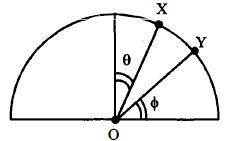 JEE Mains 2014 Hard
- Two long parallel wires \(X\) and \(Y\), separated by a distance of 6 cm , carry currents of 5A and 4A, respectively, in opposite directions as shown in the figure. Magnitude of the resultant magnetic field at point P at a distance of 4 cm from wire Y is \(x \times 10^{-5} \mathrm{~T}\). The value of \(x\) is__________ . Take permeability of free space as \(\mu_0=4 \pi \times 10^{-7} \mathrm{SI}\) units.
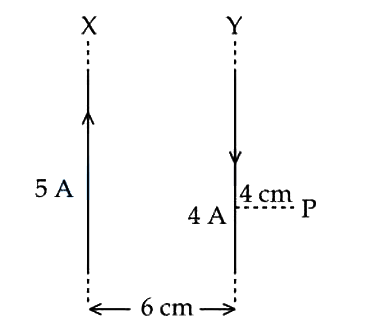 JEE Mains 2025 Easy
- \(10.0 \,\mathrm{~mL}\) of \(0.05\, \mathrm{M}\, \mathrm{KMnO}_{4}\) solution was consumed in a titration with \(10.0\, \mathrm{~mL}\) of given oxalic acid dihydrate solution. The strength of given oxalic acid solution is \(.....\,\times 10^{-2} \,\mathrm{~g} / \mathrm{L}\) (Round off to the nearest integer)JEE Mains 2021 Medium