


JEE Mains · Chemistry · STD 11 - Redox reactions
- JEE Mains 2026
- Hard
- Numerical
\(500\) mL of \(0.2\) M MnO\(_4^-\) solution in basic medium when mixed with \(500\) mL of \(1.5\) M KI solution, oxidises iodide ions to liberate molecular iodine. This liberated iodine is then titrated with a standard \(x\) M thiosulphate solution in presence of starch till the end point. If \(300\) mL of thiosulphate was consumed, then the value of \(x\) is __________.
Pick an option to check your answer.
Answer & Solution
Correct Answer
(A) 1
Step-by-step Solution
Detailed explanation
First, we calculate the millimoles of the reactants:
Millimoles of \(\text{MnO}_4^-\) = \(500 \text{ mL} \times 0.2 \text{ M} = 100 \text{ mmol}\)
Millimoles of \(\text{I}^-\) = \(500 \text{ mL} \times 1.5 \text{ M} = 750 \text{ mmol}\)
In a basic medium, \(\text{MnO}_4^-\) is reduced to \(\text{MnO}_2\). The change in oxidation state of Mn is from \(+7\) to \(+4\), so its n-factor is \(3\).
The problem explicitly states that iodide ions are oxidized to molecular iodine (\(\text{I}_2\)). The change in oxidation state for iodine is from \(-1\) to \(0\), so the n-factor for \(\text{I}^-\) is \(1\).
Equivalents of \(\text{MnO}_4^-\) = \(100 \times 3 = 300 \text{ meq}\)
Equivalents of \(\text{I}^-\) = \(750 \times 1 = 750 \text{ meq}\)
Since \(\text{MnO}_4^-\) is the limiting reagent, the equivalents of \(\text{I}_2\) produced will be equal to the equivalents of \(\text{MnO}_4^-\) consumed.
Equivalents of \(\text{I}_2\) formed = \(300 \text{ meq}\)
The liberated iodine is titrated with thiosulphate (\(\text{S}_2\text{O}_3^{2-}\)):
\(\text{I}_2 + 2\text{S}_2\text{O}_3^{2-} \rightarrow 2\text{I}^- + \text{S}_4\text{O}_6^{2-}\)
For thiosulphate, the n-factor is \(1\) (as \(2\) moles of \(\text{S}_2\text{O}_3^{2-}\) lose \(2\) moles of electrons).
From the law of equivalence:
Equivalents of \(\text{S}_2\text{O}_3^{2-}\) = Equivalents of \(\text{I}_2\)
\(\text{Molarity} \times \text{Volume (in mL)} \times \text{n-factor} = 300\)
\(x \times 300 \times 1 = 300\)
\(x = 1\)
Answer: \(1\)
More questions from Chemistry
- \({image}\) The above reaction requires which of the following reaction conditions ?
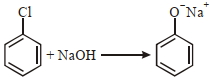 JEE Mains 2021 Medium
- Sum of bond order of \(\mathrm{CO}\) and \(\mathrm{NO}^{+}\)is____________.JEE Mains 2024 Hard
- Two pi and half sigma bonds are present inJEE Mains 2019 Medium
- Number of electrons that Vanadium \((Z=23)\) has in p-orbitals is equal to \(......\)JEE Mains 2021 Medium
- Incorrect method of preparation for alcohols from the following is:JEE Mains 2023 Medium
- A flask contains a mixture of compounds \(A\) and \(B.\) Both compounds decompose by first-order kinetics. The half-lives for \(A\) and \(B\) are \(300\) \(s\) and \(180\, s ,\) respectively. If the concentrations of \(A\) and \(B\) are equal initially, the time required for the concentration of \(A\) to be four times that of \(B (\) in \(s ):\) (Use \(\ln 2=0.693)\)JEE Mains 2020 Medium
More PYQs from JEE Mains
- Three identical spheres of mass m , are placed at the vertices of an equilateral triangle of length a. When released, they interact only through gravitational force and collide after a time \(\mathrm{T}=4\) seconds. If the sides of the triangle are increased to length 2 a and also the masses of the spheres are made 2 m , then they will collide after _____ seconds.JEE Mains 2025 Medium
- In a coil, the current changes form \(-2 \mathrm{~A}\) to \(+2 \mathrm{~A}\) in \(0.2 \mathrm{~s}\) and induces an emf of \(0.1 \mathrm{~V}\). The selfinductance of the coil is _______.JEE Mains 2024 Hard
- The \(SI\) unit of a physical quantity is pascal-second. The dimensional formula of this quantity will be ..............JEE Mains 2022 Medium
- A tennis ball is dropped on to the floor from a height of \(9.8\,m\). It rebounds to a height \(5.0\,m\). Ball comes in contact with the floor for \(0.2\,s\). The average acceleration during contact is \(..........ms ^{-2}\). [Given \(g =10\,ms ^{-2}\) ]JEE Mains 2023 Medium
- A Carnot engine operates between two reservoirs of temperatures \(900\; \mathrm{K}\) and \(300 \;\mathrm{K}\) The engine performs \(1200\; \mathrm{J}\) of work per cycle. The heat energy (in \(\mathrm{J}\) ) delivered by the engine to the low temperature reservoir, in a cycle. isJEE Mains 2020 Medium
- In an experiment for determination of refractive index of glass of a prism by \(i - \delta\) , plot it was found thata ray incident at angle \(35 ^o \), suffers a deviation of \(40 ^o \) and that it emerges at angle \(7 9 ^o \). In that case which of the following is closest to the maximum possible value of the refractive index?JEE Mains 2016 Medium