


प्रश्न
3 प्रश्न3 में से 1–3 प्रश्न
-
- (A) \(60\)
- (B) \(-24\)
- (C) \(-60\)
- (D) \(24\)
उत्तर और हल देखें
सही उत्तर: (C)
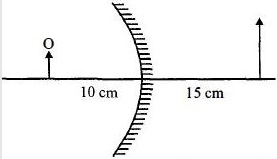
convex mirror is used as a shaving mirror.From question \(: v=15\, \mathrm{cm}, u=-10\,\mathrm{cm}\)
Radius of curvature, \(R=2\,\,f=?\)
Using mirror formula, \(\frac{1}{v}+\frac{1}{u}=\frac{1}{f}\)
\(\frac{1}{15}+\frac{1}{(-10)}=\frac{1}{f} \Rightarrow f=-30\, \mathrm{cm}\)
Therefore radius of curvature,
\(R=2\, \,f=-\,60\, \mathrm{cm}\)
-
- (A) \(3f\)
- (B) \(\frac{3}{2}f\)
- (C) \(f\)
- (D) \(2f\)
उत्तर और हल देखें
सही उत्तर: (D)
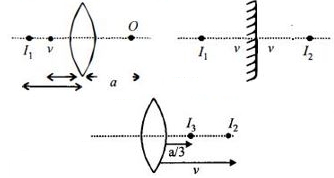
When object is keept at a distance \('a'\) from thin covex lensBy lens formula: \(\frac{1}{v}-\frac{1}{u}=\frac{1}{f}\)
\(\frac{1}{V}-\frac{1}{(-a)}=\frac{1}{f}\)
or, \(\frac{1}{v}=\frac{1}{f}-\frac{1}{a}\) ...... \((i)\)
Mirror forms image at equal distance from mirror
Now, again from lens formula
\(\frac{3}{a}-\frac{1}{V}=\frac{1}{f}\)
\({\frac{3}{a} - \frac{1}{f} + \frac{1}{a} = \frac{1}{f}}\) [From eqn. \((i)\)]
Hence, \(a=2f\)
-
- (A) \(30\)
- (B) \(15\)
- (C) \(60\)
- (D) \(1\)
उत्तर और हल देखें
सही उत्तर: (A)
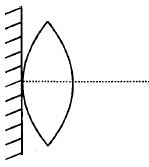
Magnifying power of telescope,\(M P=\frac{\tan \beta( \text { angle subtended by image at eye piece) } }{\tan \alpha \text { (angle subtended by object on objective) }}\)
Also, \(M P =\frac{f_{o}}{f_{e}}=\frac{150}{5}=30\)
\(\tan \alpha =\frac{50}{1000}=\frac{1}{20}\, \mathrm{rad}\)
\(\therefore \quad \tan \beta=\theta=M P \times \tan \alpha\)
\(=30 \times \frac{1}{20}=\frac{3}{2}=1.5\)
or, closest value of \(\beta \approx 60^o\)
इस पेज पर इन फ़िल्टर से कोई प्रश्न नहीं मिला।