


उपसहसंयोजन यौगिक के सभी प्रश्न
नए पहले271 में से 201–250 प्रश्न
-
- (A) \((a)-(iii), (b)-(i), (c)-(ii), (d)-(iv)\)
- (B) \((a)-(iv), (b)-(ii), (c)-(iii), (d)-(i)\)
- (C) \((a)-(ii), (b)-(i), (c)-(iii), (d)-(iv)\)
- (D) \((a)-(i), (b)-(ii), (c)-(iii), (d)-(iv)\)
उत्तर और हल देखें
सही उत्तर: (A)
Sol. Complex Type of Isomerism \((a)\) \(\left[ Co \left( NH _{3}\right)_{6}\right]\left[ Cr ( CN )_{6}\right]\) Co-ordination isomerism
\((b)\) \(\left[ Co \left( NH _{3}\right)_{3}\left( NO _{2}\right)_{3}\right]\) Linkage isomerism
\((c)\) \(\left[ Cr \left( H _{2} O \right)_{6}\right] Cl _{3}\) Solvate isomerism
\((d)\) \(cis-[CrCl\) \(\left._{2}(\text { ox })_{2}\right]^{3-}\) Optical isomerism -
- (A) \(\left[\mathrm{Ni}(\mathrm{CN})_{4}\right]^{2-}>\left[\mathrm{NiCl}_{4}\right]^{2-}>\left[\mathrm{Ni}\left(\mathrm{H}_{2} \mathrm{O}\right)_{6}\right]^{2+}\)
- (B) \(\left[\mathrm{NiCl}_{4}\right]^{2-}>\left[\mathrm{Ni}(\mathrm{CN})_{4}\right]^{2-}>\left[\mathrm{Ni}\left(\mathrm{H}_{2} \mathrm{O}\right)_{6}\right]^{2+}\)
- (C) \(\left[\mathrm{NiCl}_{4}\right]^{2-}>\left[\mathrm{Ni}\left(\mathrm{H}_{2} \mathrm{O}\right)_{6}\right]^{2+}>\left[\mathrm{Ni}(\mathrm{CN})_{4}\right]^{2-}\)
- (D) \(\left[\mathrm{Ni}\left(\mathrm{H}_{2} \mathrm{O}\right)_{6}\right]^{2+}>\left[\mathrm{NiCl}_{4}\right]^{2-}>\left[\mathrm{Ni}(\mathrm{CN})_{4}\right]^{2-}\)
उत्तर और हल देखें
सही उत्तर: (C)
\(\left[\mathrm{NiCl}_{4}\right]^{-2-}>\left[\mathrm{Ni}\left(\mathrm{H}_{2} \mathrm{O}\right)_{6}\right]^{-2+}>\left[\mathrm{Ni}(\mathrm{CN})_{4}\right]^{-2-}\)Splitting energy order : \(\Delta_{\mathrm{t}}<\Delta_{0} \quad<\Delta_{\mathrm{sq}}\)
absorbed energy order : \(\left[\mathrm{NiCl}_{4}\right]^{-2-}<\left[\mathrm{Ni}\left(\mathrm{H}_{2} \mathrm{O}\right)_{6}\right]^{-2+}<\left[\mathrm{Ni}(\mathrm{CN})_{4}\right]^{-2-}\)
intensity of colour of compound : \(\quad\left[\mathrm{NiCl}_{4}\right]^{-2-}>\left[\mathrm{Ni}\left(\mathrm{H}_{2} \mathrm{O}\right)_{6}\right]^{2+}>\left[\mathrm{Ni}(\mathrm{CN})_{4}\right]^{2-}\)
- 203. \(\Delta_{0} > P\) पर विचार करते हुए, \(\left[ Ru \left( H _{2} O \right)_{6}\right]^{2+}\) का चुम्बकीय आघूर्ण ( \(BM\) में) होगा .......... | 2020 मध्यम
- (A) \(0\)
- (B) \(3\)
- (C) \(6\)
- (D) \(9\)
उत्तर और हल देखें
सही उत्तर: (A)
Magnetic moment (in \(B.M.\)) of \(\left[ Ru \left( H _{2} O \right)_{6}\right]^{2+}\) would be; while considering that \(\Delta_{0}> P ,\)\(Ru _{(44)} ;[ Kr ] 4 d ^{7} 5 s ^{1}\) (in ground state)
\(\Rightarrow\) Here number of unpaired electrons in
\(Ru ^{2+}=\left( t _{2} g \right)^{6}( eg )^{0}=0\) and Hence
\(\mu_{ m }=\sqrt{ n ( n +2)} B \cdot M =0 \, B \cdot M\)

-
- (A) \((a)\) तथा \((b)\) मात्र
- (B) \((c)\) तथा \((d)\) मात्र
- (C) \((b)\) तथा \((c)\) मात्र
- (D) \((a)\) तथा \((d)\) मात्र
उत्तर और हल देखें
सही उत्तर: (D)
(c) Splitting power of ethylenediamine (en) is greater than fluoride (F) ligand therefore more energy absorbed by \(\left[\mathrm{Co}(\mathrm{en})_{3}\right]^{3+}\) as compared to \(\left[\mathrm{CoF}_{6}\right]^{3-}\)So wave length of light absorbed by \(\left[\mathrm{Co}(\mathrm{en})_{3}\right]^{3+}\) is lower than that of \(\left[\mathrm{CoF}_{6}\right]^{3-}\)
(d) \(\Delta_{t}=\frac{4}{9} \Delta_{0}\)
so if \(\Delta_{0}=18,000 \mathrm{cm}^{-1}\)
\(\Delta_{t}=\frac{4}{9} \times 18000=8000 \mathrm{cm}^{-1}\)
Statement (a) and (d) are incorrect.

-
- (A) \((d)\) तथा \((a)\)
- (B) \((a)\) तथा \((b)\)
- (C) \((b)\) तथा \((c)\)
- (D) \((c)\) तथा \((d)\)
उत्तर और हल देखें
सही उत्तर: (D)
\(\left[\mathrm{Pt}\left(\mathrm{NH}_{3}\right)_{3} \mathrm{Cl}\right]^{+}\) and \(\left[\mathrm{Pt}\left(\mathrm{NH}_{3}\right) \mathrm{Cl}_{5}\right]^{-}\) does not show geometrical isomerism
-
- (A) \(t _{2 g }^{4} e _{ g }^{0}\) जब \(\Delta_{ o }< P\)
- (B) \(e _{ g }^{2} t _{2 g }^{2}\) जब \(\Delta_{ O }< P\)
- (C) \(t _{2 g }^{3} e _{ g }^{1}\) जब \(\Delta_{ o }< P\)
- (D) \(t _{2 e }^{3} e _{ e }^{1}\) जब \(\Delta_{ O }> P\)
उत्तर और हल देखें
सही उत्तर: (C)
back pairing is not possible because pairing energy \(>\Delta_{0}\)
-
- (A) \(( I ),( III )\) and \(( IV )\) only
- (B) \(( II ),( III )\) और \(( IV )\) केवल
- (C) \(( I ),( II )\) और \(( III )\) केवल
- (D) \((I)\) और \((II)\) केवल
उत्तर और हल देखें
सही उत्तर: (C)
\((I)\) Under weak field ligand, octahedral \(Mn(II)\) and tetrahedral \(Ni(II)\) both the complexes are high spin complex.\((II)\) Tetrahedral \(Ni(II)\) complex can very rarely be low spin because square planar (under strong ligand) complexes of \(Ni ( II )\) are low spin complexes.
\((III)\) With strong field ligands \(Mn (II)\) complexes can be low spin because they have less number of unpaired electron (unpaired electron \(=1\) )
While with weak field ligands \(Mn(II)\) complexes can be high spin because they have more number of unpaired electron (unpaired electron \(=5)\)
\((IV)\) Aqueous solution of \(Mn(II)\) ions is pink in colour.
-
- (A) \(3\) , प्रतिचुम्बकीय
- (B) \(2 \frac{1}{2}\), अनुचुम्बकीय
- (C) \(3\) , अनुचुम्बकीय
- (D) \(2 \frac{1}{2}\), प्रतिचुम्बकीय
उत्तर और हल देखें
सही उत्तर: (A)
According to \(MOT\) (If \(z\) is internuclear axis)The configuration of
\(\mathrm{CN}^{-}: \sigma_{1 \mathrm{s}}^{2}, \sigma_{1 \mathrm{s}}^{* 2}, \sigma_{2 \mathrm{s}}^{2}, \sigma_{2 \mathrm{s}}^{*2}, \pi_{2 \mathrm{p}_{\mathrm{x}}}^{2}=\pi_{2 \mathrm{p}_{\mathrm{y}}}^{2}, \sigma_{2 \mathrm{p}_{\mathrm{z}}}^{2}\)
Bond order \(=\frac{1}{2}(10-4)\)
\(=3\)
\(\mathrm{CN}^{-}\) is diamagnetic due to absence of unpaired electron
- 209. \(\left[ Co \left( NH _{3}\right)_{4} Cl _{2}\right]\) के समावयवी जिसमें/जिनमें \(Cl - Co - Cl\) कोण \(90^{\circ}\) का है, है/हें 2020 कठिन
- (A) रेखांशिक तथा ट्रान्स
- (B) सिस तथा ट्रान्स
- (C) ट्रान्स मात्र
- (D) सिस मात्र
उत्तर और हल देखें
सही उत्तर: (D)
\(\left.\mathrm{Co}\left(\mathrm{NH}_{3}\right)_{4} \mathrm{Cl}_{2}\right]\) has 2 geometrical isomerscis isomer has \(\mathrm{Cl}-\mathrm{Co}-\mathrm{Cl}\) angle of \(90^{\circ}\)

- 210. \(\left[ CoF _{3}\left( H _{2} O \right)_{3}\right]\) की क्रिस्टल क्षेत्र स्थायीकरण ऊर्जा \(( CFSE )\left(\Delta_{0}< P \right)\) है 2020 कठिन
- (A) \(-0.8 \Delta_{0}\)
- (B) \(-0.4 \Delta_{0}+ p\)
- (C) \(-0.8 \Delta_{0}+2 P\)
- (D) \(-0.4 \Delta_{0}\)
उत्तर और हल देखें
सही उत्तर: (D)
\(\left[ CoF _{3}\left( H _{2} O \right)_{3}\right] \quad \Delta_{0}< P\)Means all ligands behaves as weak field ligands
\(=[-0.4 \times 4+0.6 \times 2] \Delta_{0}\)
\(=[-1.6+1.2] \Delta_{0}\)
\(=\left[-0.4 \Delta_{0}\right]\)

-
- (A) टेट्राऐक्वाडाइक्लोराइडो क्रोमियम \((III)\) क्लोराइड ड़ाईडहाइड्रेट
- (B) हेक्साएक्वाक्रोमियम \((III)\) क्लोराइड
- (C) डाइक्लोराइडाटेट्राऐक्वा क्रोमियम \((IV)\) क्लोराइड ड़ाईहाइड्रेट
- (D) टेट्राऐक्वाडाइक्लोराइडो क्रोमियम \((IV)\) क्लोराइड ड़ाईहाइड्रेट
उत्तर और हल देखें
सही उत्तर: (A)
\(\mathrm{Cr}\left(\mathrm{H}_{2} \mathrm{O}\right)_{6} \mathrm{Cl}_{\mathrm{n}}\)if magnetic mement is 3.83 BM then it contain three unpaired electrons. It means chromium in \(+3\) oxidation state so molecular formula is
\(\mathrm{Cr}\left(\mathrm{H}_{2} \mathrm{O}\right)_{6} \mathrm{Cl}_{3}\)
This formula have following isomers
(a) \(\left[\mathrm{Cr}\left(\mathrm{H}_{2} \mathrm{O}\right)_{6}\right] \mathrm{Cl}_{3}:\) react with \(\mathrm{AgNO}_{3}\) but does not show geometrical isomerism.
(b) \(\left[\mathrm{Cr}\left(\mathrm{H}_{2} \mathrm{O}\right)_{5} \mathrm{Cl}\right] \mathrm{Cl}_{2} \cdot \mathrm{H}_{2} \mathrm{O}\) react with \(\mathrm{AgNO}_{3}\) but does not show geometrical isomerism.
(c) \(\left[\mathrm{Cr}\left(\mathrm{H}_{2} \mathrm{O}\right)_{4} \mathrm{Cl}_{2}\right] \mathrm{Cl} .2 \mathrm{H}_{2} \mathrm{O}\) react with \(\mathrm{AgNO}_{3}\) and show geometrical isomerism.
(d) \(\left[\mathrm{Cr}\left(\mathrm{H}_{2} \mathrm{O}\right)_{3} \mathrm{Cl}_{3}\right] .3 \mathrm{H}_{2} \mathrm{O}\) does not react with \(\mathrm{AgNO}_{3}\) and show geometrical isomerism.
\(\left[\mathrm{Cr}\left(\mathrm{H}_{2} \mathrm{O}\right)_{4} \mathrm{Cl}_{2}\right] \mathrm{Cl} .2 \mathrm{H}_{2} \mathrm{O}\) react with \(\mathrm{AgNO}_{3}\) and show geometrical isomerism and it's IUPAC nomenclature is \(\quad\) Tetraaquadichlorido chromium (III) Chloride dihydrate.
-
- (A) \(\mathrm{Mg}\) तथा \(\mathrm{Mg}_{3} \mathrm{N}_{2}\)
- (B) \(Na\) तथा \(\mathrm{NaNO}_{3}\)
- (C) \(\mathrm{Mg}\) तथा \(\mathrm{Mg}\left(\mathrm{NO}_{3}\right)_{2}\)
- (D) \(\mathrm{Na}\) तथा \(\mathrm{Na}_{3} \mathrm{N}\)
उत्तर और हल देखें
सही उत्तर: (A)
\(3 \mathrm{Mg} (A)+\mathrm{N}_{2} \stackrel{\Delta}{\longrightarrow} \mathrm{Mg}_{3} \mathrm{N}_{2} (B)\stackrel{6H_2O}{\longrightarrow}\)\(3Mg(OH)_2+2NH_3 (colorless\; gas)\)\(\mathrm{CuSO}_{4}+4 \mathrm{NH}_{3} \rightarrow\left[\mathrm{Cu}\left(\mathrm{NH}_{3}\right)_{4}\right] \mathrm{SO}_{4}\) deep blue solution
-
- (A) \(15\)
- (B) \(8\)
- (C) \(6\)
- (D) \(10\)
उत्तर और हल देखें
सही उत्तर: (C)
\(EDTA^{4-}\) is hexadentate ligand, so its donation sites are six.
-
- (A) \(A-(i i), B-(i), C-(i i i)\)
- (B) \(A-(i i i), B-(i), C-(i i)\)
- (C) \(A-(i 1), B-(i i), C-(i)\)
- (D) \(A-(i), B-(i i), C-(i i i)\)
उत्तर और हल देखें
सही उत्तर: (B)
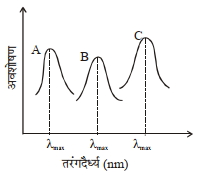
Strength of ligand \(F^{-}< NCS ^{-}< NH _{3}\)\(\Delta_{oh}\) order
\(\left[ MF _{6}\right]^{(-6+ n )} < [ M ( NCS )]^{(-6+ n )} < \quad\left[ M \left( NH _{3}\right)_{6}\right]^{ n ^{+}}\)
\(\Delta_{max}\) order
\(\left[ MF _{6}\right]^{(-6+ n )} > [ M ( NCS )]^{(-6+ n )} > \quad\left[ M \left( NH _{3}\right)_{6}\right]^{ n ^{+}}\)
As given in graph \(A < B < C\) \((\lambda_{max})\)
\(\therefore\) Correct matching is \(A -( iii ), B -( i ), C -( ii )\)
- 215. निम्नलिखित में से वह जो सर्वाधिक अनुचुंबकी य व्यवहार प्रदर्शित करता है, है :- \(gly\) = ग्लाइसिनेटो; \(bpy =2,2\) '-बाईपिरिडीन 2020 मध्यम
- (A) \(\left[ Pd ( gly )_{2}\right]\)
- (B) \(\left[ Ti \left( NH _{3}\right)_{6}\right]^{3+}\)
- (C) \(\left[ Co ( OX )_{2}( OH )_{2}\right]^{-}\left(\Delta_{0}> P \right)\)
- (D) \(\left[ Fe ( en )( bpy )\left( NH _{3}\right)_{2}\right]^{2+}\)
उत्तर और हल देखें
सही उत्तर: (C)
\(\left[ Co ( OX )_{2}( OH )_{2}\right]^{-}\) \(\Delta_{0}> P [\) S.F.L \(]\)It has highest number of unpaired \(e^{-}s.\) so it is most paramagnetic.

-
- (A) \((III) > (I) > (II) > (IV)\)
- (B) \((I) > (IV) > (III) > (II)\)
- (C) \((\mathrm{II}) \approx(\mathrm{I})>(\mathrm{IV})>(\mathrm{III})\)
- (D) \((\mathrm{III})>(\mathrm{I})>(\mathrm{IV})>(\mathrm{II})\)
उत्तर और हल देखें
सही उत्तर: (B)
\((I)\;\;\left[\mathrm{Cr}\left(\mathrm{H}_{2} \mathrm{O}\right)_{6}\right]^{2+}\)\(\mathrm{Cr}^{+2} \Rightarrow[\mathrm{Ar}] 3 \mathrm{d}^{4}\)
\(\mathrm{H}_{2} \mathrm{O} \rightarrow\) Weak field ligand
\(\text { Unpaired } \mathrm{e}^{-}=4\)
\(\text { Magnetic moment } =\sqrt{24} \mathrm{BM} =4.89 \mathrm{BM}\)
\((II)\;\;\left[\mathrm{Fe}(\mathrm{CN})_{6}\right]^{4-}\)
\(\mathrm{Fe}^{+2} \Rightarrow[\mathrm{Ar}] 3 \mathrm{d}^{6}\)
\(\mathrm{CN}^{-} \rightarrow\) Strong field ligand
Unpaired \(\mathrm{e}^{-}=0\)
Magnetic moment \(=0 \mathrm{BM}\) \(=0 \mathrm{BM}\)
\(\mathrm{III}\;\;\left[\mathrm{Fe}\left(\mathrm{C}_{2} \mathrm{O}_{4}\right)_{3}\right]^{3-}\)
\(\mathrm{Fe}^{+3} \Rightarrow[\mathrm{Ar}] 3 \mathrm{d}^{5}\)
As \(\Delta_{0}>P\)
Unpaired \(\mathrm{e}^{-}=1\)
\(\text { Magnetic moment } =\sqrt{3} \mathrm{BM}\)\(=1.73 \mathrm{BM}\)
\((IV)\;\;\left(\mathrm{Et}_{4} \mathrm{N}\right)^{+}\left[\mathrm{CoCl}_{4}\right]^{2-}\)
\(\mathrm{Co}^{+2} \Rightarrow[\mathrm{Ar}] 3 \mathrm{d}^{7}\)
Unpaired electrons \(=3\)
\(\begin{aligned} \text { Magnetic moment } &=\sqrt{15} \mathrm{BM} \\ &=3.87 \mathrm{BM} \end{aligned}\)
Hence order of magnetic moment is \(I>IV>III>II\)
-
- (A) \(2.84\; \mathrm{BM}\) तथा \(-1.6 \Delta_{0}\)
- (B) \(1.73\; \mathrm{BM}\) तथा \(-2.0 \Delta_{0}\)
- (C) \(0\; \mathrm{BM}\) तथा \(-2.4 \Delta_{0}\)
- (D) \(5.92\; \mathrm{BM}\) तथा \(0\)
उत्तर और हल देखें
सही उत्तर: (B)
\([\mathrm{Pb}(\mathrm{F})(\mathrm{Cl})(\mathrm{Br})(\mathrm{I})]^{2-}\) have three geometrical isomer so formula for \(\left[\mathrm{Fe}(\mathrm{CN})_{6}\right]^{\mathrm{n}-6}\) is \(\left[\mathrm{Fe}(\mathrm{CN})_{6}\right]^{3-}\) and \(\mathrm{CFSE}\) for this complex is\(\mathrm{Fe}^{3+} \Rightarrow 3 \mathrm{d}^{5} 4 \mathrm{s}^{\circ}\)
\(\text { Magnetic Moment }=\sqrt{3}\)
\(=1.73 \mathrm{B.M}\)
\(\mathrm{CFSE}=[(-0.4 \times 5)+(0.6 \times 0)] \Delta_{0}\)
\(=-2.0 \Delta_{0}\)

- 218. \(\left[ Pt ( en )\left( NO _{2}\right)_{2}\right]\) के लिए, सम्भावित समावयवियों की संख्या है 2020 मध्यम
- (A) \(3\)
- (B) \(2\)
- (C) \(1\)
- (D) \(4\)
उत्तर और हल देखें
सही उत्तर: (A)
\(\left[ Pt ( en )\left( NO _{2}\right)_{2}\right] \Rightarrow\) does not show \(G.I.\) as well as optical isomerism.This complex will have three linkage isomers as follows
\(\left[ Pt ( en )\left( NO _{2}\right) 2\right] I\)
\(\left[ Pt ( en )\left( NO _{2}\right)( ONO )\right] II\)
\(\left[ Pt ( en )( ONO )_{2}\right] III\)

- 219. \(\left[ Ru ( en )_{3}\right] Cl _{2}\) तथा \(\left[ Fe \left( H _{2} O \right)_{6}\right] Cl _{2}\) के d-इलैक्ट्रॉन विन्यास क्रमशः है 2020 मध्यम
- (A) \(t _{2 g }^{4} e _{ g }^{2}\) तथा \(t _{2 g }^{6} e _{ g }^{0}\)
- (B) \(t_{2 g }^{6} e _{ g }^{0}\) तथा \(t _{2 g }^{6} e _{ g }^{0}\)
- (C) \(t_{2 g}^{6} e_{g}^{0}\) तथा \(t_{2 g}^{4} e_{g}^{2}\)
- (D) \(t _{2 g }^{4} e _{ g }^{2}\) तथा \(t _{2 g }^{4} e _{ g }^{2}\)
उत्तर और हल देखें
सही उत्तर: (C)
\(\left[ Ru ( en )_{3}\right] Cl _{2} \quad R _{ u } \Rightarrow 4 d\) seriesen \(\Rightarrow\) chelating ligand
\(CN =6,\) octahedral splitting hence laye splitting of \(d-\)subshell
\(\left[ Fe \left( H _{2} O \right)_{6}\right] Cl _{2} \Rightarrow H _{2} O \Rightarrow\) Weak filled ligand
\(Fe ^{+2} \Rightarrow[ Ar ] 3 d ^{6} 4 s ^{0}\) less plitting
\(CN =6\) octahedral splitting

- 220. सिद्धान्त जो \(\left[ Ni ( Co )_{4}\right]\) में आबन्ध के प्रकृति की पूर्णरूप/समुचित ढंग से व्याख्या कर सकता है, होगा। 2020 आसान
- (A) वर्नर सिद्धान्त
- (B) क्रिस्टल क्षेत्र सिद्धान्त
- (C) संयोजकता आबन्ध सिद्धान्त
- (D) आण्विक कक्षक सिद्धान्त
उत्तर और हल देखें
सही उत्तर: (D)
In complex \([Ni(CO)_4]\) decrease in \(Ni-C\) bond length and increase in \(C-O\) bond length as well as it's magnetic property is explained by \(MOT.\) -
- (A) \(\left[ Cr \left( H _{2} O \right)_{5} Cl \right] Cl _{2} \cdot H _{2} O\)
- (B) \(\left[ Cr \left( H _{2} O \right)_{3} Cl _{3}\right] \cdot 3 H _{2} O\)
- (C) \(\left[ Cr \left( H _{2} O \right)_{4} Cl _{2}\right] Cl \cdot 2 H _{2} O\)
- (D) \(\left[ Cr \left( H _{2} O \right)_{6}\right] Cl _{3}\)
उत्तर और हल देखें
सही उत्तर: (C)
\(\%\) mass of water\(=\frac{x \times 18}{(12+6 \times 16+35 \times 3+52)} \times 100=13.5\)
\(\Rightarrow \quad x=\frac{265 \times 13.5}{18 \times 100} \simeq 2\)
-
- (A) \((\mathrm{A}) \approx(\mathrm{C}) \approx(\mathrm{D}) < (\mathrm{B})\)
- (B) \((\mathrm{A}) \approx(\mathrm{C}) < (\mathrm{B}) \approx(\mathrm{D})\)
- (C) \((\mathrm{C}) < (\mathrm{D}) < (\mathrm{B}) < (\mathrm{A})\)
- (D) \((\mathrm{C}) \approx(\mathrm{D}) < (\mathrm{B}) < (\mathrm{A})\)
उत्तर और हल देखें
सही उत्तर: (A)
\(\left[\mathrm{Ni}(\mathrm{CO})_{4}\right] \quad \mu_{\mathrm{m}}=0 \mathrm{B}. \mathrm{M}\)\({\left[\mathrm{Ni}\left(\mathrm{H}_{2} \mathrm{O}\right)_{6}\right] \mathrm{Cl}_{2}}\quad {\mu_{\mathrm{m}}=2.8 \mathrm{B} . \mathrm{M}}\)
\({\mathrm{Na}_{2}\left[\mathrm{Ni}(\mathrm{CN})_{4}\right]} \quad {\mu_{\mathrm{m}}=0 \mathrm{B.M}}\)
\(\left[\mathrm{PdCl}_{2}\left(\mathrm{PPh}_{3}\right)_{2}\right] \quad \mu_{\mathrm{m}}=0 \mathrm{B.M}\)
\((\mathrm{A}) \approx(\mathrm{C}) \approx(\mathrm{D}) < (\mathrm{B})\)
-
- (A) \(0\) तथा \(0\)
- (B) \(0\) तथा \(2\)
- (C) \(0\) तथा \(1\)
- (D) \(2\) तथा \(2\)
उत्तर और हल देखें
सही उत्तर: (A)
If the complex \(MA_2B_2\) is \(sp^3\) hybridised then the shape of this complex is tetrahedral this structure is opticaly inactive due to the presence of plane of symmetry.Optical isomes \(= 0\)
If the complex \(MA_2B_2\) is \(dsp^2\) hybridised then the shape of this complex is square planar
Both isomers are optically inactive due to the presence of plane of symmetry.
Optical isomers \(= 0\)

-
- (A) \(242.5\)
- (B) \(83.7\)
- (C) \(145.5\)
- (D) \(97\)
उत्तर और हल देखें
सही उत्तर: (D)
\(CFSE =0.4 \Delta_{0}\)\(=0.4 \times \frac{20300}{83.7}\)
\(=97\, kJ / mol\)
-
- (A) \(\left[ Ni \left( NH _{3}\right)_{4}\left( H _{2} O \right)_{2}\right]^{2+}\)
- (B) \(\left[ Ni \left( NH _{3}\right)_{2} Cl _{2}\right]\)
- (C) \(\left[ Pt \left( NH _{3}\right)_{2} Cl _{2}\right]\)
- (D) \(\left[ Ni ( en )_{3}\right]^{2+}\)
उत्तर और हल देखें
सही उत्तर: (B)
\(\left[ Ni \left( NH _{3}\right)_{2} Cl _{2}\right]\) is tetrahedral complex, therefore does not show geometrical and optical isomerism.\(\left[ Ni \left( NH _{3}\right)_{2} Cl _{2}\right]\) does not show structural isomerism
\(\left[ Ni \left( NH _{3}\right)_{4}\left( H _{2} O \right)_{2}\right]^{2+} \&\left[ Pt \left( NH _{3}\right)_{2} Cl _{2}\right]\) show geometrical isomerism
\(\left[ Ni ( en )_{3}\right]^{2+}\) show optical isomerism
-
- (A) \(\left[\mathrm{Pt}\left(\mathrm{NH}_{3}\right)_{2} \mathrm{Cl}_{2}\right]\)
- (B) \(\left[\mathrm{Co}\left(\mathrm{NH}_{3}\right)_{4} \mathrm{Cl}_{2}\right]^{+}\)
- (C) \(\left[\mathrm{Co}\left(\mathrm{NH}_{3}\right)_{3}\left(\mathrm{NO}_{2}\right)_{3}\right]\)
- (D) \(\left[\mathrm{CoCl}_{2}(\mathrm{en})_{2}\right]\)
उत्तर और हल देखें
सही उत्तर: (C)
\(\left[\mathrm{Ma}_{3} \mathrm{b}_{3}\right]\) type complex shows fac and mer isomerism.\(\left[\mathrm{Co}\left(\mathrm{NH}_{3}\right)_{3}\left(\mathrm{NO}_{2}\right)_{3}\right]\)

-
- (A) \(\left[\operatorname{Mn}\left( H _{2} O \right)_{6}\right]^{2+}\) तथा \(\left[ Cr \left( H _{2} O \right)\right]^{2+}\)
- (B) \(\left[ Cr \left( H _{2} O \right)_{6}\right]^{2+}\) तथा \(\left[ CoCl _{4}\right]^{2-}\)
- (C) \(\left[ Cr \left( H _{2} O \right)_{6}\right]^{2+}\) तथा \(\left[ Fe \left( H _{2} O \right)_{6}\right]^{2+}\)
- (D) \(\left[ Co ( OH )_{4}\right]^{2-}\) तथा \(\left[ Fe \left( NH _{3}\right)_{6}\right]^{2+}\)
उत्तर और हल देखें
सही उत्तर: (C)
Thus complex \(\left[ Cr \left( H _{2} O \right)_{6}\right]^{2+}\) and \(\left[ Fe \left( H _{2} O \right)_{6}\right]^{2+}\) have same no. of unpaired \(e^-\) and hence same magnetic moment (spin only).
-
- (A) चतुष्फलकीय और \(-1.6 \Delta_{ t }+1 P\)
- (B) चतुष्फलकीय और \(-0.6 \Delta_{\text {t }}\)
- (C) अष्टफलकीय और \(-1.6 \Delta_{0}\)
- (D) अष्टफलकीय और \(-2.4 \Delta_{0}+2 P\)
उत्तर और हल देखें
सही उत्तर: (B)
If spin only magnetic moment of the complex is \(4.90 BM ,\) it means number of unpaired electrons should be \(4.\)\((A)\) In octahedral complex: \(\left[ M \left( H _{2} O \right)_{6}\right]^{2+}\)
\(C.F.S.E.\) \(=\left(-0.4 \Delta_{0}\right) \times 4+\left(+0.6 \Delta_{0}\right) \times 2+0 \times P\)
\((B)\) In tetrahedral complex: \(\left[ M \left( H _{2} O \right)_{4}\right]^{2+}\)
\(C.F.S.E.\) \(=\left(-0.6 \Delta_{t}\right) \times 3+\left(+0.4 \Delta_{t}\right) \times 3+0 \times P\)
\(=-0.6 \Delta_{ t }\)

-
- (A) \(14\)
- (B) \(10\)
- (C) \(8\)
- (D) \(6\)
उत्तर और हल देखें
सही उत्तर: (D)
\(\left( A \right)\,N{a_4}\left[ {\mathop F\limits^x e{{\left( {CN} \right)}_5}\left( {NOS} \right)} \right]\)\((+1) 4+x+(-1) 5+(-1) 1=0\)
\(x=+2\)
\(\left( B \right)\,N{a_4}\left[ {\mathop {Fe{O_4}}\limits^y } \right]\)
\((+1) 4+y+(-2) 4=0\)
\(y=+4\)
\(\left( C \right)\,\left[ {F\mathop {{e_2}}\limits^z {{\left( {CO} \right)}_9}} \right]\)
\(2 z+0 \times 9=0\)
\(z=0\)
so \(( x + y + z )=+2+4+0\)
\(=6\)
-
- (A) \([Co(NH_3)_5(H_2O)]Cl_3\)
- (B) \(K_2[CoCl_4]\)
- (C) \([Co(NH_3)_5Cl]Cl_2\)
- (D) \(K_3[Co(CN)_6]\)
उत्तर और हल देखें
सही उत्तर: (D)
As \(CN^-\) is a strong field ligand. \(K_3[Co(CN)_6]\) will have maximum \(‘\Delta ’.\) -
- (A) \(6\) तथा \(6\)
- (B) \(5\) तथा \(3\)
- (C) \(3\) तथा \(3\)
- (D) \(5\) तथा \(6\)
उत्तर और हल देखें
सही उत्तर: (D)
\(en\) and \(C_2 O_4^{2-}\) are a bidentate ligand. So coordination number of \([Co(Cl)(en)_2]Cl\) is \(5\) and \(K_3[Al(C_2O_4)_3]\) is \(6\) - 232. \(CuSO _{4} \cdot 5 H _{2} O\) में जल के कितने अणु \(Cu\) से अप्रत्यक्ष रूप से बन्धित हैं- 2019 कठिन
- (A) \(1\)
- (B) \(3\)
- (C) \(2\)
- (D) \(4\)
उत्तर और हल देखें
सही उत्तर: (A)
\([Cu(H_2O)_4]SO_4.H_2O\) -
- (A) \(a -iii,\,b -iv,\,c -i,\,d - ii\)
- (B) \(a -i,\,b -ii,\,c -iii,\,d - iv\)
- (C) \(a -ii,\,b -i,\,c -iv,\,d - iii\)
- (D) \(a -iv,\,b -iii,\,c -i,\,d - ii\)
उत्तर और हल देखें
सही उत्तर: (A)
\(Co \to \) Vitamin \(B_{12}\)
\(Zn \to \) Carbonic anhydrase
\(Rh \to \) Wilkinson catalyst
\(Mg \to \) Chlorophyll -
- (A) \(C{r^{2 + }} > R{u^{3 + }} > F{e^{2 + }} > {V^{2 + }}\)
- (B) \({V^{2 + }} > C{r^{2 + }} > R{u^{3 + }} > F{e^{2 + }}\)
- (C) \(C{r^{2 + }} > {V^{2 + }} > R{u^{3 + }} > F{e^{2 + }}\)
- (D) \({V^{2 + }} > R{u^{3 + }} > C{r^{2 + }} > F{e^{2 + }}\)
उत्तर और हल देखें
सही उत्तर: (B)
Since \(CN^-\) and \(NH_3\) are strong field ligands, low spin complexes are formed.Complex Configuration No. of unpaired electrons \([V(CN)_6]^{4-}\) \(t_{2g}^3\,e_g^0\) \(3\) \({[Cr{(N{H_3})_6}]^{2 + }}\) \(t_{2g}^4\,e_g^0\) \(2\) \({[Ru{(N{H_3})_6}]^{3 + }}\) \(t_{2g}^5\,e_g^0\) \(1\) \({[Fe{(CN)_6}]^{4 - }}\) \(t_{2g}^6\,e_g^0\) \(0\) Magnetic moment is directly proportion to number of unpaired electrons.
- 235. एक अष्टफलक होमोलेप्टिक \(Mn ( II )\) के संकुल का चुंबकीय आघूर्ण \(5.9 \,BM\) है। इस संकुल के लिए उपयुक्त संलग्नी है : 2019 कठिन
- (A) ethylenediamine
- (B) \(CN^-\)
- (C) \(NCS^-\)
- (D) \(CO\)
उत्तर और हल देखें
सही उत्तर: (C)
Homoleptic complexes contain identical ligands, \(e.g.,\,[Mn(NCS)_6]^{4-}.\) -
- (A) \(Ni^{2+}\)
- (B) \(Fe^{2+}\)
- (C) \(Co^{2+}\)
- (D) \(Mn^{2+}\)
उत्तर और हल देखें
सही उत्तर: (C)
\(Co^{2+}\) high spin \(t_{2g}^5\, e_g^2\, ‘3’\) unpaired electrons \(Co^{2+}\) low spin \(t_{2g}^6\, e_g^1\, ‘1’\) unpaired electron Difference is \(3 -1 = 2\) -
- (A) \(0\) तथा \(5.92\)
- (B) \(2.84\) तथा \(5.92\)
- (C) \(4.9\) तथा \(0\)
- (D) \(0\) तथा \(4.9\)
उत्तर और हल देखें
सही उत्तर: (C)
\({[Fe{(CN)_6}]^{4 - }}\) \({[Fe{({H_2}O)_6}]^{2 + }}\)\(F{e^{2 + }}\, \to \,3{d^6}\) \(F{e^{2 + }}\, \to \,3{d^6}\)
\(t_{2g}^6\,e{g^0}\) \(t_{2g}^4\,e{g^2}\)
\(\mu \, = \,\sqrt {n(n + 2)} \) \(\mu \, = \,\sqrt {n(n + 2)} \,=\,\sqrt {24}\)
\(\mu \, =0\) \(\mu \, = \,4.9\,BM\)
-
- (A) \( - \,0.4\,{\Delta _0}\) तथा \( - \,0.8\,{\Delta _t}\)
- (B) \( - \,0.4\,{\Delta _0}\) तथा \( - \,1.2\,{\Delta _t}\)
- (C) \( - \,2.4\,{\Delta _0}\) तथा \( - \,1.2\,{\Delta _t}\)
- (D) \( - \,0.6\,{\Delta _0}\) तथा \( - \,0.8\,{\Delta _t}\)
उत्तर और हल देखें
सही उत्तर: (A)
\(CFSE = [-0.4\,n_{t2g} + 0.6\,n_{eg}]\, \Delta _o\) -
- (A) \(\left[ Fe \left( H _{2} O \right)_{6}\right]^{2+}\) तथा \(\left[ Cr \left( H _{2} O \right)_{6}\right]^{2+}\) के स्पिनमात्र-चुम्बकीय आघूर्ण लगभग एक जैसे हैं।
- (B) \(\left[ Ni \left( NH _{3}\right)_{4}\left( H _{2} O \right)_{2}\right]^{2+}\) का स्पिनमात्रचुम्बकीय आघूर्ण \(2.83 BM\) है।
- (C) जेमस्टोन, रूबी, में \(Cr ^{3+}\) आयन होता है जो बेरिल के अष्टफलकीय स्थल में उपस्थित रहता है।
- (D) जब \(\left[ CoCl \left( NH _{3}\right)_{5}\right]^{2+}\) पीला प्रकाश शोषित करता है तो इसका रंग बैंगनी हो जाता है।
उत्तर और हल देखें
सही उत्तर: (C)
In gemstone, ruby has \(Cr^{3+}\) ion occupying the octahedral sites of aluminium oxide \((Al_2O_3)\) normally occupied by \(Al^{3+}\) ion. -
- (A) \(Mn -C\) आबन्ध
- (B) \(Mn -Mn\) आबन्ध
- (C) \(Mn -O\) आबन्ध
- (D) \(C -O\) आबन्ध
उत्तर और हल देखें
सही उत्तर: (A)
Organometalic compound contains at least one chemical bond between carbon and a metal. -
- (A) ज्यामितीय समावयवता
- (B) उपसहसंयोजन समावयता
- (C) बंधनी समावयता
- (D) आयनन समावयवता
उत्तर और हल देखें
सही उत्तर: (A)
Cobalt \((III)\) chloride on reaction with ethylenediemine in ratio \(1:22\) isomeric products complexes \(A\) and \(B\)
-
- (A) \(EDTA\)
- (B) सिस-प्लेटिन
- (C) \(D\)-पेनीसिलामाइन
- (D) डेसफेरीआक्साइम \(B\)
उत्तर और हल देखें
सही उत्तर: (A)
\((A)\) \(EDTA\) (ethylene diamine tetra acetate) is used for lead poisoning
\((B)\) Cis platin is used as a anti cancer drug
\((C)\) \(D-\) penicillamine is used for copper poisoning
\((D)\) desferrioxime \(B\) is used for iron poisoning -
- (A) त्रि-दंतुर
- (B) द्वि-दंतुर
- (C) चतुरदंतुर
- (D) षट्-दंतुर
उत्तर और हल देखें
सही उत्तर: (C)
Both nitrogen and oxygen are donating atoms -
- (A) \(5.92\)
- (B) \(6.93\)
- (C) \(3.87\)
- (D) \(4.90\)
उत्तर और हल देखें
सही उत्तर: (A)
Maximum number of unpaired electron of metal or metal ion in complexes \(= n = 5\)\({\mu _s} = \sqrt {n\left( {n + 2} \right)} = \sqrt {35} = 5.916 \approx 5.92\)
-
- (A) \([Au(CN_2 ]^-\) तथा \([Ag(CN_2) ]^-\)
- (B) \([Au(CN_2 ]^-\) तथा \([AgCl_2]^-\)
- (C) \([Au(OH)_4 ]^-\) तथा \([Ag(OH)_2]^-\)
- (D) \([Au(NH_3)_2 ]^+\) तथा \([Ag(CN)_2]^-\)
उत्तर और हल देखें
सही उत्तर: (A)
\([Au(CN_2]^-\) and \([Ag(CN)_2 ]^-\) both are soluble complexes. -
- (A) \(L_3 < L_1 < L_2\)
- (B) \(L_3 < L_2 < L_1\)
- (C) \(L_1 < L_2 < L_3\)
- (D) \(L_2 < L_1 < L_3\)
उत्तर और हल देखें
सही उत्तर: (A)
\(\begin{array}{*{20}{c}}
{{L_1}}&{{L_2}}&{{L_3}} \\
{Green}&{Blue}&{\operatorname{Re} d}
\end{array}\)absorbed wave length order of \(\lambda \) \(Red > Green > Blue\) \(L_3 > L_1 > L_2\)
\(\therefore \) Strength of ligand \(\alpha \,\,\Delta \,\,\alpha \,\,1/\lambda\)
\(\therefore \) Strength of ligand \(L_2 > L_1 > L_3\)
-
- (A) \((II) > (I) > (III)\)
- (B) \((III) > (II) > (I)\)
- (C) \((I) > (II) > (III)\)
- (D) \((III) > (I) > (II)\)
उत्तर और हल देखें
सही उत्तर: (C)
As we known thatStrong ligand \(\alpha \) \(CFSE\) \(\alpha \) \({E_{absorbed}}\,\propto \,\frac{1}{{{\lambda _{absorbed}}}}\)
We have
\(\mathop {{{[CoCl{{(N{H_3})}_5}]}^{2 + }}}\limits_{(I)} ,\) \(\mathop {{{[Co{{(N{H_3})}_5}{H_2}O]}^{3 + }}}\limits_{(II)} \) and \(\mathop {{{[Co{{(N{H_3})}_6}]}^{3 + }}}\limits_{(III)} \)
\(\therefore \,III\, > \,II\, > \,I\) (as per \({E_{absorbed}}\) )
\(\therefore \,\,\frac{1}{{{\lambda _{absorbed}}}}\)
\(I\, > \,II\, > \,III\)
- 248. उभयनिष्ठ ट्रान्जिशन तथा इनर-ट्रान्जिशन धातु के प्रति नीचे दिये गये लिगैण्ड की अधिकतम सम्भव दन्तिकतायें क्रमशः हैं
 2019 कठिन
- (A) \(6\) तथा \(8\)
- (B) \(8\) तथा \(6\)
- (C) \(8\) तथा \(8\)
- (D) \(6\) तथा \(6\)
उत्तर और हल देखें
सही उत्तर: (A)
General coordination number of \(CN^-\) in transition element is \(6\) and in inner transition element is \(8-12\). because inner transition metal ions can make available more number of vacant orbitals of nearly same energy than transition metal ions. The high effective nuclear charge of inner-transition metal ions make them form complex with high coordination number. -
- (A) ट्रांस \(- \left[ {Pd{{\left( {Cl} \right)}_2}{{\left( {N{H_3}} \right)}_2}} \right]\)
- (B) ट्रांस \(\left[ {Pt{{\left( {Cl} \right)}_2}{{\left( {N{H_3}} \right)}_2}} \right]\)
- (C) सिस \(- \left[ {Pd{{\left( {Cl} \right)}_2}{{\left( {N{H_3}} \right)}_2}} \right]\)
- (D) सिस \(\left[ {Pt{{\left( {Cl} \right)}_2}{{\left( {N{H_3}} \right)}_2}} \right]\)
उत्तर और हल देखें
सही उत्तर: (D)
cis \(-[PtCl_2(NH_3)_2]\) is used in chemotherapy to inhibits the growth of tumors -
- (A) क्रिस्टल क्षेत्र विपाटन मापक्रम का मापन क्रमशः \((A)\) तथा \((B)\) के पीले तथा बैंगनी रंग की ऊर्जा के मापन द्वारा किया जा सकता है।
- (B) तीन अयुग्मित इलेक्ट्रोन के साथ दोनों यौगिक अनचुंबकीय है।
- (C) दोनों ही पूरक रंगों के अनुरूप ऊर्जा को अवशोषित करते है।
- (D) \(\left(\Delta_{0}\right)_{ A } < \left(\Delta_{0}\right)_{ B }\)
उत्तर और हल देखें
सही उत्तर: (A)
\({\Delta _0}\) is calculated from the energies of absorbed radiation not from emitted radiation (complementary colour).

इस पेज पर इन फ़िल्टर से कोई प्रश्न नहीं मिला।