


Questions
18 questionsShowing 1–18 of 18 questions
-
- (A) \(140\)
- (B) \(40\)
- (C) \(60\)
- (D) \(650\)
Show answer and solution
Correct Answer: (C)
Maximum emf \(\varepsilon={N} \omega {AB}\)\({N}=20, \omega=50, {B}=3 \times 10^{-2} {T}\)
\(\varepsilon=20 \times 50 \times \pi \times(0.08)^{2} \times 3 \times 10^{-2}=60.28 \times 10^{-2}\)
Rounded off to nearest integer \(=60\)
-
- (A) \(80\)
- (B) \(800\)
- (C) \(8\)
- (D) \(0.80\)
Show answer and solution
Correct Answer: (A)
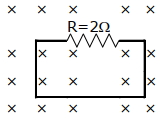
\(\phi=\overrightarrow{ B } \cdot \overrightarrow{ S }\)\(\phi=\frac{4}{\pi} \times 10^{-3}\left(1-\frac{ t }{100}\right) \cdot \pi R ^{2}\)
\(\phi=4 \times 10^{-3} \times(1)^{2}\left(1-\frac{t}{100}\right)\)
\(\varepsilon=\frac{- d \phi}{ dt }\)
\(\varepsilon=\frac{- d }{ dt }\left(4 \times 10^{-3}\left(1-\frac{ t }{100}\right)\right)\)
\(\varepsilon=4 \times 10^{-3}\left(\frac{1}{100}\right)=4 \times 10^{-5} V\)
When \(B=0\)
\(1-\frac{t}{100}=0\)
\(t=100 sec\)
\(E=\frac{\varepsilon^{2}}{R} t\)
\(E=\frac{\left(4 \times 10^{-5}\right)^{2}}{2 \times 10^{-6}} \times 100 J\)
\(E=\frac{16 \times 10^{-10} \times 100}{2 \times 10^{-6}} J\)
\(E=0.08 J\)
-
- (A) Outward and decreasing with time
- (B) Parallel to the plane of coil and decreasing with time
- (C) Outward and increasing with time
- (D) Parallel to the plane of coil and increasing with time
Show answer and solution
Correct Answer: (A)
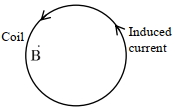
\(\vec{B}\) must not be parallel to the plane of coil for non zero flux and according to lenz law if \({B}\) is outward it should be decreasing for anticlockwise induced current. -
- (A) \(144\)
- (B) \(121\)
- (C) \(169\)
- (D) \(108\)
Show answer and solution
Correct Answer: (A)
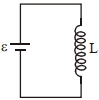
\(\varepsilon=\frac{L dI }{ dt }\)\(3 \int_{0}^{4} t dt =2 \int_{0}^{ I } d I\)
\(\frac{3}{2} \times 16=2 I\)
\(I =12\)
\(V =\frac{1}{2} LI ^{2}=\frac{1}{2} \times 2(12)^{2}=144 J\)
-
- (A) \(1\)
- (B) \(4\)
- (C) \(2\)
- (D) \(0\)
Show answer and solution
Correct Answer: (C)
\({emf} ={BLV}\)\(=1 .(2 {R}) \cdot 1\)
\(=2 {V}\)
-
- (A) \(\frac{\mu_{0}}{4 \pi} 8 \sqrt{2} \frac{{a}^{2}}{{b}}\)
- (B) \(\frac{\mu_{0}}{4 \pi} \frac{8 \sqrt{2}}{{a}}\)
- (C) \(\frac{\mu_{0}}{4 \pi} 8 \sqrt{2} \frac{{b}^{2}}{{a}}\)
- (D) \(\frac{\mu_{0}}{4 \pi} \frac{8 \sqrt{2}}{{b}}\)
Show answer and solution
Correct Answer: (A)
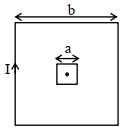
\({B}=\left[\frac{\mu_{0}}{4 \pi} \frac{{I}}{{b} / 2} \times 2 \sin 45\right] \times 4\)\(\phi=2 \sqrt{2} \frac{\mu_{0}}{\pi} \frac{{I}}{{b}} \times {a}^{2}\)
\(\therefore {M}=\frac{\phi}{{I}}=\frac{2 \sqrt{2} \mu_{0} {a}^{2}}{\pi {b}}=\frac{\mu_{0}}{4 \pi} 8 \sqrt{2} \frac{{a}^{2}}{{b}}\)
-
- (A) \(1\, {m} / {s}\)
- (B) \(1 \,{cm} / {s}\)
- (C) \(10^{2}\, {m} / {s}\)
- (D) \(10^{-2} \,{cm} / {s}\)
Show answer and solution
Correct Answer: (B)
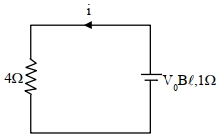
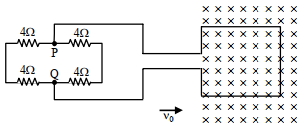
Equivalent circuit\(i=\frac{{VoB} \ell}{4+1} \Rightarrow {V}_{0}=\frac{5(2\, {mA})}{5 \times .2}=10^{-2} \,{m} / {s}=1\, {cm} / {s}\)
-
- (A) \(108.25\)
- (B) \(54.125\)
- (C) \(88.37\)
- (D) \(62.50\)
Show answer and solution
Correct Answer: (A)
\(\in=[\vec{B} \vec{V} \vec{L}]=B V L \sin \theta\)\(=\left(2.5 \times 10^{-4}\, T \right)\left(180 \times \frac{5}{18}\, m / s \right)(10 \,m ) \sin 60^{\circ}\)
\(=108.25 \times 10^{-3}\, V\)
-
- (A) \(0.4\)
- (B) \(0.8\)
- (C) \(0.125\)
- (D) \(0.2\)
Show answer and solution
Correct Answer: (D)
\(\mathrm{U}=\frac{1}{2} \mathrm{Li}^{2}=64 \Rightarrow \mathrm{L}=2\)\(\mathrm{i}^{2} \mathrm{R}=640\)
\(\mathrm{R}=\frac{640}{(8)^{2}}=10\)
\(\tau=\frac{\mathrm{L}}{\mathrm{R}}=\frac{1}{5}=0.2\)
-
- (A) \(71\)
- (B) \(73\)
- (C) \(74\)
- (D) \(80\)
Show answer and solution
Correct Answer: (C)
\(I_{\max }=\frac{V}{R}=\frac{20 V}{10 K \Omega}=2\; mA\)For LR - decay circuit
\(I=I_{\max } e ^{- R / L}\; mA\)
\(I=2 e ^{\frac{-10 \times 10^{3} \times 1 \times 10^{-6}}{10 \times 10^{-3}}}\; mA\)
\(I=2 e ^{-1}\; mA\)
\(I=2 \times 0.37\; mA\)
\(I=\frac{74}{100}\; mA\)
\(x=74\)
-
- (A) Auxilliary transformer
- (B) Auto transformer
- (C) Step-up transformer
- (D) Step down transformer
Show answer and solution
Correct Answer: (C)
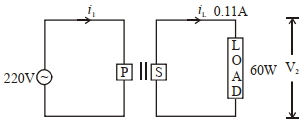
\(V _{ S }=\frac{ P }{ i }=\frac{60}{0.11}=545.45\)\(V _{ P }=220\)
\(V _{ S } > V _{ P }\)
\(\Rightarrow\) Step up transformer
-
- (A) \(6\)
- (B) \(25\)
- (C) \(10\)
- (D) \(0\)
Show answer and solution
Correct Answer: (C)
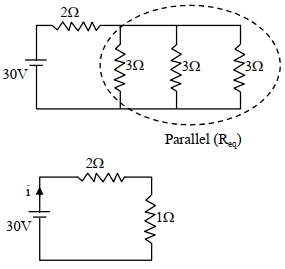
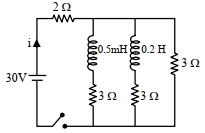
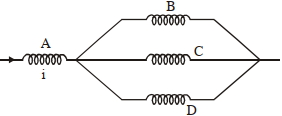
In steady state, inductor behaves as a conducting wire.So, equivalent circuit becomes
\(\frac{1}{{R}_{{eq}}}=\frac{1}{3}+\frac{1}{3}+\frac{1}{3}=1\)
\(\Rightarrow {R}_{{eq}}=1\, \Omega\)
\(\Rightarrow\) Circuit becomes
\(\Rightarrow {i}=\frac{30}{3}=10\, {A}\)
-
- (A) \(12\)
- (B) \(6\)
- (C) \(9\)
- (D) \(1\)
Show answer and solution
Correct Answer: (D)
\(\phi \propto i\)\(\Rightarrow B \propto i\)
so, field at centre of \(C =\frac{3}{3}=1 T\)
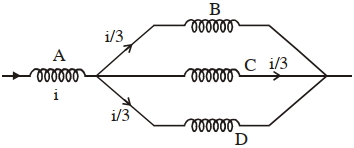
-
- (A) \(10\)
- (B) \(60\)
- (C) \(180\)
- (D) \(120\)
Show answer and solution
Correct Answer: (B)
As we know induce emf\(|\epsilon|=\frac{{d} \phi}{{dt}}=20 {t}+20\, {mV}\)
\(|{i}|=\frac{|\epsilon|}{{R}}=10 {t}+10\, {mA}\)
\(\text { at } {t}=5\)
\(\mid {i} \mid=60\, {mA}\)
-
- (A) \(A-\)Flux, \(B-EMF, C-\)Power dissipated
- (B) \(A-\)Power dissipated, \(B-\)Flux, \(C-EMF\)
- (C) \(A-Flux, B-\)Power, dissipated, \(C-EMF\)
- (D) \(A-EMF, B-\)Power dissipeated, \(C-\)Flux
Show answer and solution
Correct Answer: (A)
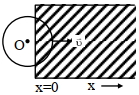
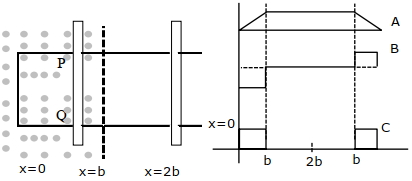
As rod moves in field area increases upto \(x=b\) then field is absent and again flux is generated on return journey from \(x=b\) to \(x=0\). Thus plot \(A\) for flux.\(\Rightarrow e=-\frac{d \phi}{d t} \Rightarrow\) curve \(B\) for \(e m f\)
\(\Rightarrow\) Power dissipated \(=v i \Rightarrow\) curve \(C\) for power dissipated
- 16. The current \((i)\) at time \(t =0\) and \(t =\infty\) respectively for the given circuit is
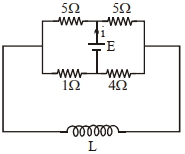 2021 Hard
- (A) \(\frac{18 E }{55}, \frac{5 E }{18}\)
- (B) \(\frac{10 E }{33}, \frac{5 E }{18}\)
- (C) \(\frac{5 E }{18}, \frac{18 E }{55}\)
- (D) \(\frac{5 E }{18}, \frac{10 E }{33}\)
Show answer and solution
Correct Answer: (D)
At \(t=0,\) current through inductor is zero,hence \(R _{ eq }=(5+1) \|(5+4)=\frac{18}{5}\)
\(i _{1}=\frac{ E }{18 / 5}=\frac{5 E }{18}\)
At \(t=\infty\), inductor becomes a simple wire and now the circuit will be as shown in figure
hence \(R _{ eq }=(5 \| 5)+(4 \| 1)=\frac{33}{10} ; \quad(\| \Rightarrow\) parallel \()\)
\(i _{2}=\frac{ E }{33 / 10}=\frac{10 E }{33}\)

-
- (A) \(\frac{ B _{0} v _{0}^{2} d }{2 a }\)
- (B) \(\frac{ B _{0} v _{0} d }{2 a }\)
- (C) \(\frac{ B _{0} v _{0} d ^{2}}{ a }\)
- (D) \(\frac{ B _{0} v _{0} d ^{2}}{2 a }\)
Show answer and solution
Correct Answer: (C)
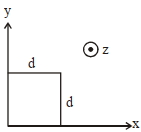
\(E _{1}=\frac{ B _{0}( x + d )}{ a } v _{0} d\)\(E _{2}=\frac{ B _{0}( x )}{ a } v _{0} d\)
\(E _{ net }= E _{1}- E _{2}\)
\(E _{ net }=\frac{ B _{0} v _{0} d ^{2}}{ a }\)
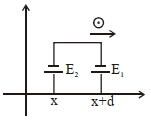
-
- (A) \(\frac{ L }{ R } \ell n 5\)
- (B) infinite
- (C) \(\frac{ L }{ R } \ell n 2\)
- (D) \(\frac{ L }{ R } \ln 10\)
Show answer and solution
Correct Answer: (C)
Magnetic energy \(=\frac{1}{2} Li ^{2}=25 \%\)\(ME \Rightarrow 25 \% \Rightarrow i =\frac{ i _{0}}{2}\)
\(i = i _{0}\left(1- R ^{- Rt / L }\right)\) for charging
\(t =\frac{ L }{ R } \ell n 2\)
No questions on this page match these filters.