


Questions
18 questionsShowing 1–18 of 18 questions
-
- (A) \(1.45 \times 10^{16}\, {MHz}\)
- (B) \(0.19 \times 10^{15} \,{MHz}\)
- (C) \(1.45 \times 10^{9}\, {MHz}\)
- (D) \(9.0 \times 10^{27} \,{MHz}\)
Show answer and solution
Correct Answer: (C)
For every large distance \(P.E.\) \(=0\)\(\&\) total energy \(=2.6+0=2.6\, {eV}\)
Finally in first excited state of \({H}\) atom total energy \(=-3.4 \,{eV}\)
Loss in total energy \(=2.6-(-3.4)\)
\(\quad\quad\quad\quad\quad\quad\quad\quad=6\,eV\)
It is emitted as photon
\(\lambda=\frac{1240}{6}=206\, {nm}\)
\({f}=\frac{3 \times 10^{8}}{206 \times 10^{-9}}=1.45 \times 10^{15} \,{Hz}\)
\(=1.45 \times 10^{9}\, {Hz}\)
-
- (A) \(6\)
- (B) \(9\)
- (C) \(3\)
- (D) \(4\)
Show answer and solution
Correct Answer: (C)
\(F =\frac{- d U }{ dr }=-4 U _{0} r ^{3}=\frac{ mv ^{2}}{ r }\)\(mv ^{2}=4 U _{0} r ^{4}\)
\(v \propto r ^{2}\)
\(mvr =\frac{ nh }{2 \pi}\)
\(r ^{3} \propto n\)
\(r \propto n^{1 / 3}\)
\(\alpha=3\)
-
- (A) \(0.44\)
- (B) \(6.57\)
- (C) \(4.38\)
- (D) \(2.46\)
Show answer and solution
Correct Answer: (D)
\(\mathrm{nf}_{1}=\mathrm{k}\left(\frac{1}{1}-\frac{1}{3^{2}}\right)\)\(\mathrm{nf}_{2}=\mathrm{k}\left(1-\frac{1}{2^{2}}\right)\)
\(\frac{\mathrm{f}_{1}}{\mathrm{f}_{2}}=\frac{8 / 9}{3 / 4} \Rightarrow \mathrm{f}_{2}=2.46 \times 10^{15}\)
- 4. According to Bohr atom model, in which of the following transitions will the frequency be maximum ? 2021 Hard
- (A) \(n =4\) to \(n =3\)
- (B) \(n =2\) to \(n =1\)
- (C) \(n =5\) to \(n =4\)
- (D) \(n =3\) to \(n =2\)
Show answer and solution
Correct Answer: (B)
\(\Delta E =13.6\left[\frac{1}{ n _{1}^{2}}-\frac{1}{ n _{2}^{2}}\right]= hv\)It is maximum if \(n _{1}=1\) and \(n _{2}=2\)
\(n =5 \ldots \ldots \ldots \ldots \ldots \ldots \ldots \ldots \ldots \ldots \ldots \ldots .-0.544\, eV\)
\(n=4 \ldots \ldots \ldots \ldots \ldots \ldots \ldots \ldots \ldots \ldots \ldots \ldots -0.850\, eV\)
\(n =3 \ldots \ldots \ldots \ldots \ldots \ldots \ldots \ldots \ldots \ldots \ldots \ldots -1.511 \,eV\)
\(n =2 \ldots \ldots \ldots \ldots \ldots \ldots \ldots \ldots \ldots \ldots \ldots \ldots -3.4\, eV\)
\(n =1 \ldots \ldots \ldots \ldots \ldots \ldots \ldots \ldots \ldots \ldots \ldots \ldots -13.6\, eV\)
- 5. An \(X-\)ray tube is operated at \(1.24\) million volt. The shortest wavelength of the produced photon will be ..... \(nm\) 2021 Medium
- (A) \(10^{-3}\)
- (B) \(10^{-1}\)
- (C) \(10^{-2}\)
- (D) \(10^{-4}\)
Show answer and solution
Correct Answer: (A)
\(\lambda_{\min }=\frac{1240}{\Delta V }( nm )\)\(=\frac{1240}{1.24 \times 10^{6}}=10^{-3} \,nm\)
-
- (A) \(1: 9\)
- (B) \(7: 108\)
- (C) \(7: 135\)
- (D) \(1: 3\)
Show answer and solution
Correct Answer: (C)
\(\frac{1}{\lambda_{1}}= R \left[\frac{1}{1^{2}}-\frac{1}{4^{2}}\right]\)\(\frac{1}{\lambda_{2}}= R \left[\frac{1}{3^{2}}-\frac{1}{4^{2}}\right]\)
\(\frac{\lambda_{1}}{\lambda_{2}}=\frac{\left[\frac{1}{9}-\frac{1}{16}\right]}{\left[1-\frac{1}{16}\right]}=\frac{7}{9 \times 15}\)
\(\frac{\lambda_{1}}{\lambda_{2}}=\frac{7}{135}\)
-
- (A) \(v _{ n } \propto n\)
- (B) \(v _{ n } \propto \frac{1}{ n }\)
- (C) \(v _{ n } \propto n ^{2}\)
- (D) \(v _{ n } \propto \frac{1}{ n ^{2}}\)
Show answer and solution
Correct Answer: (B)
We know velocity of electron in \(n ^{\text {th }}\) shell ofhydrogen atom is given by
\(v =\frac{2 \pi k Ze ^{2}}{ nh }\)
\(\therefore v \propto \frac{1}{ n }\)
-
- (A) \(13.6\)
- (B) \(2815.2\)
- (C) \(331.2\)
- (D) \(27.2\)
Show answer and solution
Correct Answer: (B)
\(E \propto \frac{1}{ r } \quad r \propto \frac{1}{ m }\)\(E \propto m\)
Ionization potential \(=13.6 \times \frac{\left(\text { Mass }_{\mu}\right) eV }{\left(\text { Mass }_{e}\right)}\)
\(=13.6 \times 207 eV =2815.2 eV\)
-
- (A) \(112\)
- (B) \(224\)
- (C) \(336\)
- (D) \(741\)
Show answer and solution
Correct Answer: (A)
time taken \(=\frac{2 \pi r }{\text { speed }}\)\(=\frac{2 \times \pi \times 5 \times 10^{-11}}{2.2 \times 10^{6}}\)
\(=\frac{2 \times 22 \times 10 \times 5 \times 10^{-11}}{7 \times 22 \times 10^{6}}\)
\(=\frac{10}{7} \times 10^{-16}\)
Current \(\frac{ q }{ t }\left(1 e =1.6 \times 10^{-19} C \right)\)
\(=\frac{1.6 \times 10^{-19}}{10 \times 10^{-16}} \times 7\)
\(=\frac{1.6}{100} \times 10^{-3} \times 7\)
\(=112 \times 10^{-5} A\)
\(=112 \times 10^{-5} \times 1000 m A\)
\(=1.12 mA\)
-
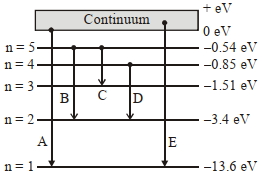
- (A) The ionization potential of hydrogen, second member of Balmer series and third member of Paschen series.
- (B) The first member of the Lyman series, third member of Balmer series and second member of Paschen series.
- (C) The series limit of Lyman series, third member of Balmer series and second member of Paschen series.
- (D) The series limit of Lyman series, second member of Balmer series and second member of Paschen series.
Show answer and solution
Correct Answer: (C)
\(A \rightarrow\) Series limit of Lymen series.\(B \rightarrow\) Third member of Balmer series.
\(C \rightarrow\) Second member of Paschen series.
- 11. The atomic hydrogen emits a line spectrum consisting of various series. Which series of hydrogen atomic spectra is lying in the visible region? 2021 Medium
- (A) Brackett series
- (B) Paschen series
- (C) Lyman series
- (D) Balmer series
Show answer and solution
Correct Answer: (D)
Conceptual -
- (A) \(20\)
- (B) \(22\)
- (C) \(25\)
- (D) \(15\)
Show answer and solution
Correct Answer: (D)
For 1 st line\(\frac{1}{\lambda_{1}}= R z^{2}\left(\frac{1}{2^{2}}-\frac{1}{3^{2}}\right)\)
\(\frac{1}{\lambda_{1}}= R z^{2} \frac{5}{36}\) ........\((i)\)
For \(3^{\text {rd }}\) line
\(\frac{1}{\lambda_{3}}= Rz ^{2}\left(\frac{1}{2^{2}}-\frac{1}{5^{2}}\right)\)
\(\frac{1}{\lambda_{3}}= Rz ^{2} \frac{21}{100}\) \(.........(ii)\)
(ii) \(+( i )\)
\(\frac{\lambda_{1}}{\lambda_{3}}=\frac{21}{100} \times \frac{36}{5}=1.512=15.12 \times 10^{-1}\)
\(x \approx 15\)
-
- (A) \(27.5\)
- (B) \(17.5\)
- (C) \(13.6\)
- (D) \(10\)
Show answer and solution
Correct Answer: (D)
As we know\({E}_{k_{a}}=E_{k}-E_{L}\)
\(\frac{h c}{\lambda_{k_{a}}}=E_{k}-E_{L}\)
\(E_{L}= E_{k}-\frac{h c}{\lambda_{k_{a}}}\)
\(=27.5 {KeV}-\frac{12.42 \times 10^{-7}\, {eV\,m}}{0.071 \times 10^{-9}\, {m}}\)
\(E_{L}=(27.5-17.5)\, {keV}\)
\(=10\,{keV}\)
-
- (A) \(4.17\)
- (B) \(2.19\)
- (C) \(3.25\)
- (D) \(4.34\)
Show answer and solution
Correct Answer: (A)
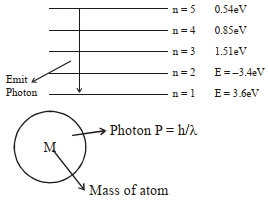
\((\Delta E )\) Releases when photon going from \(n =5\) to \(n =\Delta E =(13.6-0.54)\, eV =13.06\, eV\)\(P _{ i }= P _{ f }\) (By linear momentum conservation)
\(0=\frac{ h }{\lambda}- Mv = V _{ Recoil }=\frac{ h }{\lambda M }.....(i)\)
And \(\Delta E =\frac{ hc }{\lambda}=\frac{ hc }{\lambda M } \times M \Rightarrow McV _{ Recoil }\)
\(V _{ Recoil }=\frac{\Delta E }{ Mc }=\frac{13.06 \times 1.6 \times 10^{-19}}{1.67 \times 10^{-27} \times 3 \times 10^{8}}=4.17 \,m / sec\)
-
- (A) \(25\)
- (B) \(16\)
- (C) \(10\)
- (D) \(6\)
Show answer and solution
Correct Answer: (C)
\(\frac{ hc }{\lambda}= mc ^{2}\)\(m =\frac{ h }{ c \lambda}\)
- 16. The wavelength of the photon emitted by a hydrogen atom when an electron makes a transition from \(n =2\) to \(n =1\) state is ...... \(nm.\) 2021 Medium
- (A) \(194.8\)
- (B) \(913.3\)
- (C) \(490.7\)
- (D) \(121.8\)
Show answer and solution
Correct Answer: (D)
\(\frac{1}{\lambda}= R \left(\frac{1}{1^{2}}-\frac{1}{2^{2}}\right)\)\(\lambda=121.8\, nm\)
- 17. Which level of the single ionized carbon has the same energy as the ground state energy of hydrogen atom ? 2021 Medium
- (A) \(1\)
- (B) \(6\)
- (C) \(4\)
- (D) \(8\)
Show answer and solution
Correct Answer: (B)
Energy of \(H\) -atom is \(E =-13.6 Z ^{2} / n ^{2}\)for \(H\) -atom \(Z =1 \&\) for ground state, \(n =1\)
\(\Rightarrow E =-13.6 \times \frac{1^{2}}{1^{2}}=-13.6 eV\)
Now for carbon atom (single ionised), \(Z=6\)
\(E=-13.6 \frac{ Z ^{2}}{ n ^{2}}=-13.6 \quad\) (given)
\(\Rightarrow n ^{2}=6^{2} \Rightarrow n =6\)
-
- (A) \(11\)
- (B) \(15\)
- (C) \(10\)
- (D) \(8\)
Show answer and solution
Correct Answer: (B)
No. of different wavelengths \(=\frac{{n}({n}-1)}{2}\)\(=\frac{6 \times(6-1)}{2}=\frac{6 \times 5}{2}=15\)
No questions on this page match these filters.