


JEE Mains · Chemistry · STD 11 - Structure of atom
- JEE Mains 2026
- Medium
- MCQ
The species having identical radii according to the Bohr's theory are:
A. \(H\) (first orbit)
B. \(He^+\) (first orbit)
C. \(He^+\) (Second orbit)
D. \(Li^{2+}\) (first orbit)
E. \(Be^{3+}\) (Second orbit)
Choose the correct answer from the options given below:
Pick an option to check your answer.
Answer & Solution
Correct Answer
(B) A and E Only
Step-by-step Solution
Detailed explanation
According to Bohr's theory, the radius of the \(n\)-th orbit of a hydrogen-like species is given by \(r_n = 0.529 \times \dfrac{n^2}{Z} \text{ \AA}\).
For \(H\) (first orbit), \(n = 1\), \(Z = 1 \Rightarrow r = 0.529 \times \dfrac{1^2}{1} = 0.529 \text{ \AA}\).
For \(He^+\) (first orbit), \(n = 1\), \(Z = 2 \Rightarrow r = 0.529 \times \dfrac{1^2}{2} = 0.2645 \text{ \AA}\).
For \(He^+\) (second orbit), \(n = 2\), \(Z = 2 \Rightarrow r = 0.529 \times \dfrac{2^2}{2} = 1.058 \text{ \AA}\).
For \(Li^{2+}\) (first orbit), \(n = 1\), \(Z = 3 \Rightarrow r = 0.529 \times \dfrac{1^2}{3} = 0.176 \text{ \AA}\).
For \(Be^{3+}\) (second orbit), \(n = 2\), \(Z = 4 \Rightarrow r = 0.529 \times \dfrac{2^2}{4} = 0.529 \text{ \AA}\).
The radii of \(H\) (first orbit) and \(Be^{3+}\) (second orbit) are identical. Therefore, species A and E have identical radii.
Answer: A and E Only
More questions from Chemistry
- The number of compound/s given below which contain/s \(- COOH\) group is .... . \((A)\) Sulphanilic acid \((B)\) Picric acid \((C)\) Aspirin \((D)\) Ascorbic acidJEE Mains 2021 Medium
- The order of relative stability of the contributing structure is: Choose the correct answer from the options given below:
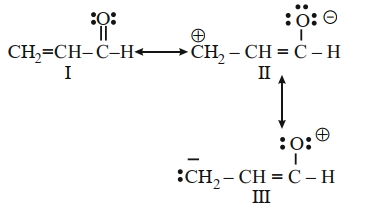 JEE Mains 2024 Hard
- A soft drink was bottled with a partial pressure bf \(CO _{2}\) of \(3\) bar over the liquid at room temperature. The partial pressure of \(CO _{2}\) over the solution approaches a value of 30 bar when \(44\, g\) of \(CO _{2}\) is dissolved in \(1\, kg\) of water at room temperature. The approximate \(pH\) of the soft drink is............... \(\times 10^{-1}\) (First dissociation constant of \(H _{2} CO _{3}=4.0 \times 10^{-7}\)\(\log 2=0.3 ;\) density of the soft \(\left.\operatorname{drink}=1\, g\, mL ^{-1}\right)\)JEE Mains 2020 Medium
- The rate of a reaction doubles when its temperature changes from \(300\, K\) to \(310\, K.\) Activation energy of such a reaction will be .......... \(kJ\, mol^{-1}\). \((R= 8.314\,JK^{-1} \,mol^{-1}\) and \(\log 2=0.301)\)JEE Mains 2013 Hard
- Energy of an electron is given by \(E =- 2.178 \times 10^{-18}\,J \, \left( {\frac{{{Z^2}}}{{{n^2}}}} \right) .\) Wavelength of light required to excite an electron in an hydrogen atom from level \(n = 1\) to \(n = 2\) will be : \((h = 6.62 \times 10^{-34} \,Js\) and \(c = 3.0 \times 10^8 \,ms^{-1})\)JEE Mains 2013 Hard
- Of the species, \(NO , NO ^{+}, NO ^{2+}, NO ^{-},\) the one with minimum bond strength is :JEE Mains 2020 Hard
More PYQs from JEE Mains
- Which of the following phenomena does not explain by wave nature of light? \((A)\) reflection \((B)\) diffraction \((C)\) photoelectric effect \((D)\) interference \((E)\) polarization Choose the most appropriate answer from the options given below :JEE Mains 2024 Hard
- This question has Statement-I and Statement-2. Of the four ch.oices given after the Statements, choose the one that best describes the two Statetnents. Statement \(-1\) : A capillary is dipped in a liquid and liquid rises to a height \(h\) in it. As the temperature of the liquid is raised, the height \(h\) increases (if the density of the liquid and the angle of contact remain the same). Statement \(-2\) : Surface tension of a liquid decreases with the rise in its temperature.JEE Mains 2013 Medium
- The gravitational field in a region is given by \(\vec E\) \(=(5\,N / kg)\, \hat i + (12\,N / kg)\,\hat j\) If the potential at the origin is taken to be zero, then the ratio of the potential at the points \((12\,m, 0)\) and \((0, 5\,m)\) isJEE Mains 2013 Hard
- Radius of the first excited state of Helium ion is given as : \(\mathrm{a}_0 \rightarrow\) radius of first stationary state of hydrogen atom.JEE Mains 2025 Easy
- A cricket ball of mass \(0.15\, kg\) is thrown vertically up by a bowling machine so that it rises to a maximum height of \(20 \;m\) after leaving the machine. If the part pushing the ball applies a constant force \(F\) on the ball and moves horizontally a distance of \(0.2\, m\) while launching the ball, the value of \(F(\) in \(N)\) is \(\left(g=10\, m s^{-2}\right)\)JEE Mains 2020 Medium
- \(0.8\, \mathrm{~g}\) of an organic compound was analysed by Kjeldahl's method for the estimation of nitrogen. If the percentage of nitrogen in the compound was found to be \(42\, \%\), then \(....\,\mathrm{mL}\) of \(1\, \mathrm{M}\) \(\mathrm{H}_{2} \mathrm{SO}_{4}\) would have been neutralized by the ammonia evolved during the analysis.JEE Mains 2021 Hard