


JEE Mains · Chemistry · STD 12 -Aldehydes and ketones
- JEE Mains 2026
- Hard
- MCQ
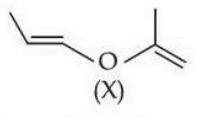
A molecule (X) with following structure under mild acidic condition is hydrolysed to produce (Y) and (Z). Identify the correct statements about (Y) and (Z).
A. Both (Y) and (Z) have same molar mass.
B. (Y) and (Z) can be distinguished from each other by \(NaHCO_3\).
C. (Y) and (Z) react with HCN with same rates.
D. (Y) and (Z) undergo addition reaction with \(2,4\)-DNP.
Choose the correct answer from the options given below:
Pick an option to check your answer.
Answer & Solution
Correct Answer
(D) A and D Only
Step-by-step Solution
Detailed explanation
Molecule \((X)\) is an ether with two enol ether functional groups attached to the central oxygen atom. On mild acidic hydrolysis, an enol ether cleaves to give a carbonyl compound and an alcohol.
The \(1\)-propenyl side \((CH_3-CH=CH-O-)\) hydrolyses to propanal, \(CH_3CH_2CHO\).
The isopropenyl side \((-O-C(CH_3)=CH_2)\) hydrolyses to the enol of acetone, which tautomerises to acetone, \(CH_3COCH_3\).
Therefore, \((Y)\) and \((Z)\) are propanal and acetone.
Statement A: Both \((Y)\) and \((Z)\) have the same molar mass.
Propanal and acetone are functional isomers with the same molecular formula \(C_3H_6O\) and hence the same molar mass \((58\text{ g mol}^{-1})\).
Statement A is true.
Statement B: \((Y)\) and \((Z)\) can be distinguished by \(NaHCO_3\).
\(NaHCO_3\) reacts only with carboxylic acids (releasing \(CO_2\)). Neither an aldehyde nor a ketone reacts with \(NaHCO_3\), so it cannot distinguish between them.
Statement B is false.
Statement C: \((Y)\) and \((Z)\) react with HCN at the same rate.
In nucleophilic addition to carbonyls, aldehydes react faster than ketones due to lower steric hindrance and a more electrophilic carbonyl carbon (fewer \(+I\) alkyl groups). So propanal reacts faster than acetone.
Statement C is false.
Statement D: \((Y)\) and \((Z)\) undergo addition reaction with \(2,4\)-DNP.
Both aldehydes and ketones react with \(2,4\)-DNP (Brady's reagent) by nucleophilic addition followed by loss of water to give coloured \(2,4\)-dinitrophenylhydrazone precipitates.
Statement D is true.
Hence, the correct statements are A and D only, which corresponds to option \((4)\).
More questions from Chemistry
- When a \(60\,W\) electric heater is immersed in a gas for \(100\,s\) in a constant volume container with adiabatic walls, the temperature of the gas rises by \(5^{\circ}\,C\). The heat capacity of the given gas is \(.........\,JK ^{-1}\) (Nearest integer)JEE Mains 2023 Medium
- Given below are two statements :
Statement I : When a system containing ice in equilibrium with water (liquid) is heated, heat is absorbed by the system and there is no change in the temperature of the system until whole ice gets melted.
Statement II : At melting point of ice, there is absorption of heat in order to overcome intermolecular forces of attraction within the molecules of water in ice and kinetic energy of molecules is not increased at melting point.
In the light of the above statements, choose the correct answer from the options given below:JEE Mains 2025 Medium - The percentage dissociation of a salt \(\left(\mathrm{MX}_3\right)\) solution at given temperature (van't Hoff factor \(\mathrm{i}=\) 2) is ______ % (Nearest integer)JEE Mains 2025 Easy
- \(M_3 A_2\) is a sparingly soluble salt of molar mass \(y\) g mol\(^{-1}\) and solubility \(x\) g L\(^{-1}\). The ratio of the molar concentration of the anion (\(A^{3-}\)) to the solubility product of the salt isJEE Mains 2026 Medium
- Potassium dichromate when heated with concentrated sulphuric acid and a soluble chloride, gives brown-red vapours of:JEE Mains 2013 Hard
- Two statements are given below: Statement \(I:\) The melting point of monocarboxylic acid with even number of carbon atoms is higher than that of with odd number of carbon atoms acid immediately below and above it in the series. Statement \(II :\) The solubility of monocarboxylic acids in water decreases with increase in molar mass. Choose the most appropriate optionJEE Mains 2022 Medium
More PYQs from JEE Mains
- Consider the following reactions.
\( PbCl_{2}+K_{2}CrO_{4}\rightarrow A+2KCl \)
(Hot solution)
\( A+NaOH\rightleftharpoons B+Na_{2}CrO_{4} \)
\( PbSO_{4}+4CH_{3}COONH_{4}\rightarrow(NH_{4})_{2}SO_{4}+X \)
In the above reactions, A, B and X are respectively.JEE Mains 2026 Hard - A transformer operating at primary voltage \(8\,kV\) and secondary voltage \(160\,V\) serves a load of \(80\,kW\). Assuming the transformer to be ideal with purely resistive load and working on unity power factor, the loads in the primary and secondary circuit would be.JEE Mains 2022 Medium
- Given below are two statements: one is labelled as Assertion \((A)\) and the other is labelled as Reason \((R).\) Assertion \((A) :\) Metallic character decreases and non-metallic character increases on moving from left to right in a period. Reason \((R)\) \(:\) It is due to increase in ionisation enthalpy and decrease in electron gain enthalpy, when one moves from left to right in a period. In the light of the above statements, choose the most appropriate answer from the options given below :JEE Mains 2021 Easy
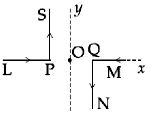
- As shown in the figure, two infinitely long, identical wires are bent by \(90^o\) and placed in such a way that the segments \(LP\) and \(QM\) are along the \(x-\) axis, while segments \(PS\) and \(QN\) are parallel to the \(y-\) axis. If \(OP = OQ = 4\, cm\), and the magnitude of the magnetic field at \(O\) is \(10^{-4}\, T\), and the two wires carry equal current (see figure), the magnitude of the current in each wire and the direction of the magnetic field at \(O\) will be \((\mu_ 0 = 4\pi \times10^{-7}\, NA^{-2})\)
 JEE Mains 2019 Hard
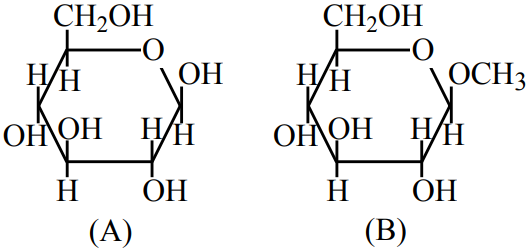
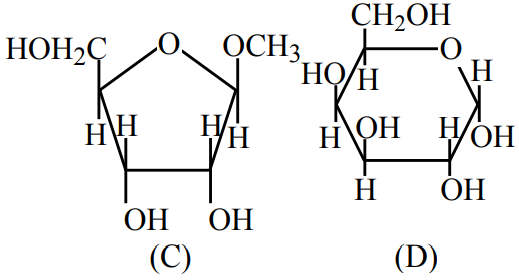
- From the given following \(( A\) to D \()\) cyclac structures, those which will not react with Tollen's reagent are :
 JEE Mains 2026 Medium
- For the disproportionation reaction \(2 Cu ^{+}( aq ) \rightleftharpoons Cu ( s )+ Cu ^{2+}( aq )\) at \(298\, K\) In \(K\) (where \(K\) is the equilibrium constant) is....... \(\times 10^{-1}\) Given \(\left( E _{ Cu ^{2+} / Cu ^{+}}^{0}=0.16 V \right.\) \(E _{ Cu ^{+} / Cu }^{0}=0.52 V\)\(\left.\frac{ RT }{ F }=0.025\right)\)JEE Mains 2020 Medium