


JEE Mains · Chemistry · STD 12 - Alcohol, phenol and ethers
- JEE Mains 2026
- Medium
- MCQ
Consider compounds A, B and C with following structural formulae
\(A = \) CH\(_3\) - CH\(_2\) - CH\(_2\) - CH\(_2\) - CH\(_2\) - OH
\(B = \) CH\(_2 =\) CH - CH\(_2\) - CH\(_2\) - CH\(_3\)
\(C = \) HO - CH\(_2\) - CH\(_2\) - CH(OH) - CH\(_3\)
For the conversion of B from A, reagent (D) required is _________ and structural formula of product (E) obtained when C undergoes same reaction using excess reagent (D) is _________.
Pick an option to check your answer.
Answer & Solution
Correct Answer
(D) D E Conc. H\(_2\)SO\(_4\) or H\(_3\)PO\(_4\) CH\(_2 =\) CH \(-\) CH \(=\) CH\(_2\)
Step-by-step Solution
Detailed explanation
Compound A is pentan-1-ol (\(CH_3-CH_2-CH_2-CH_2-CH_2-OH\)) and Compound B is pent-1-ene (\(CH_2=CH-CH_2-CH_2-CH_3\)).
The conversion of an alcohol to an alkene is a dehydration reaction, which requires an acidic dehydrating agent such as concentrated \(H_2SO_4\) or \(H_3PO_4\). Thus, reagent D is concentrated \(H_2SO_4\) or \(H_3PO_4\).
Compound C is butane-1,3-diol (\(HO-CH_2-CH_2-CH(OH)-CH_3\)).
When C is treated with excess dehydrating agent (reagent D), both hydroxyl groups undergo elimination (dehydration). The elimination of two water molecules yields a conjugated diene, which is highly stable due to resonance.
The product E formed is 1,3-butadiene (\(CH_2=CH-CH=CH_2\)).
Answer:
| D | E |
| Conc. H\(_2\)SO\(_4\) or H\(_3\)PO\(_4\) | CH\(_2 =\) CH \(-\) CH \(=\) CH\(_2\) |
More questions from Chemistry
- The potential for the given half cell at \(298 \mathrm{~K}\) is \((-)\) _______ \(\times 10^{-2} \mathrm{~V}\). \(2 \mathrm{H}_{(\mathrm{aq})}^{+}+2 \mathrm{e}^{-} \rightarrow \mathrm{H}_2(\mathrm{~g})\) \({\left[\mathrm{H}^{+}\right]=1 \mathrm{M}, \mathrm{P}_{\mathrm{H}_2}=2 \mathrm{~atm}}\) (Given: \(2.303 \mathrm{RT} / \mathrm{F}=0.06 \mathrm{~V}, \log 2=0.3\) )JEE Mains 2024 Hard
- Given below are two statements: Statement \(I:\) For \(KI\), molar conductivity increases steeply with dilution. Statement \(II:\) For carbonic acid, molar conductivity increases slowly with dilution. In the light of the above statements, choose the correct answer from the options given below:JEE Mains 2022 Medium
- Find the correct statements related to group 15 hydrides.
A. Reducing nature increases from NH\(_3\) to BiH\(_3\)
B. Tendency to donate lone pair of electrons decreases from NH\(_3\) to BiH\(_3\)
C. The stability of hydrides decreases from NH\(_3\) to BiH\(_3\)
D. HEH bond angle decreases from NH\(_3\) to SbH\(_3\) (E = Elements of group 15)
Choose the correct answer from the options given below:JEE Mains 2026 Medium - For reaction \(A \rightarrow P\), rate constant \(k = 1.5 \times 10^3\) s\(^{-1}\) at \(27°\)C. If activation energy for the above reaction is \(60\) kJ mol\(^{-1}\), then the temperature (in \(°\)C) at which rate constant, \(k = 4.5 \times 10^3\) s\(^{-1}\) is _______. (Nearest integer)
Given : \(\log 2 = 0.30\), \(\log 3 = 0.48\), \(R = 8.3\) J K\(^{-1}\) mol\(^{-1}\), \(\ln 10 = 2.3\)JEE Mains 2026 Medium - Match the LIST-I with LIST-II
No. LIST-I (Reagent) No. LIST-II (Functional Group detected) A. Sodium bicarbonate solution I. double bond/unsaturation B. Neutral ferric chloride II. carboxylic acid C. Ceric ammonium nitrate III. phenolic - OH D. Alkaline KMnO IV. alcoholic - OH
Choose the correct answer from the options given below :JEE Mains 2025 Medium - A liquid when kept inside a thermally insulated closed vessel at \(25^{\circ} \mathrm{C}\) was mechanically stirred from outside. What will be the correct option for the following thermodynamic parameters ?JEE Mains 2025 Medium
More PYQs from JEE Mains
- In the figure, potential difference between \(A\) and \(B\) is......\(V\)
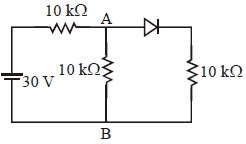 JEE Mains 2020 Medium
- The velocity of upper layer of water in a river is \(36 kmh ^{-1}\). Shearing stress between horizontal layers of water is \(10^{-3} Nm ^{-2}\). Depth of the river is \(m\). (Co-efficiency of viscosity of water is \(10^{-2} \,Pa . s\) )JEE Mains 2022 Medium
- \(\mathrm{K}_{\text {sp }}\) for \(\mathrm{Cr}(\mathrm{OH})_3\) is \(1.6 \times 10^{-30}\). What is the molar solubility of this salt in water?JEE Mains 2025 Medium
- For a thin symmetric prism made of glass (refractive index \(1.5\)), the ratio of incident angle and minimum deviation will be _______.JEE Mains 2026 Medium
- Consider the coordination compound, \([Co(NH_3)_6]Cl_3\). In the fonnation of this complex, the species which acts as the Lewis acid isJEE Mains 2014 Hard
-
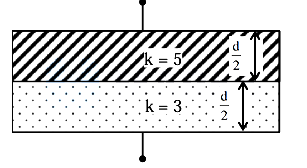
Space between the plates of a parallel plate capacitor of plate area \(4 \mathrm{~cm}^2\) and separation of (d) 1.77 mm, is filled with uniform dielectric materials with dielectric constants (3 and 5) as shown in figure. Another capacitor of capacitance 7.5 pF is connected in parallel with it. The effective capacitance of this combination is ________ pF. \(\left(\right.\) Given \(\left.\varepsilon_0=8.85 \times 10^{-12} \mathrm{~F} / \mathrm{m}\right)\)JEE Mains 2025 Hard