


JEE Mains · Chemistry · STD 12 - Alcohol, phenol and ethers
- JEE Mains 2026
- Hard
- Numerical
One mole of phenol is treated with dilute HNO\(_3\) at \(298\) K to give a mixture of products. The mixture is separated by steam distillation. The steam volatile compound (X) is separated. The increase in percentage of oxygen in (X) with respect to phenol is _____ \(\times 10^{-1}\) %
(Given molar mass in g mol\(^{-1}\) H:\(1\), C:\(12\), N:\(14\), O:\(16\))
Pick an option to check your answer.
Answer & Solution
Correct Answer
(C) 175
Step-by-step Solution
Detailed explanation
When phenol is treated with dilute \(\text{HNO}_3\) at \(298\text{ K}\), it undergoes electrophilic aromatic substitution to give a mixture of ortho-nitrophenol and para-nitrophenol.
The mixture is separated by steam distillation. Ortho-nitrophenol is steam volatile due to intramolecular hydrogen bonding, whereas para-nitrophenol is not steam volatile due to intermolecular hydrogen bonding. Thus, the steam volatile compound (X) is ortho-nitrophenol.
Molecular formula of phenol: \(\text{C}_6\text{H}_6\text{O}\)
Molar mass of phenol \(= (6 \times 12) + (6 \times 1) + 16 = 94\text{ g mol}^{-1}\)
Percentage of oxygen in phenol \(= \dfrac{16}{94} \times 100 \approx 17.02\%\)
Molecular formula of ortho-nitrophenol (X): \(\text{C}_6\text{H}_5\text{NO}_3\)
Molar mass of ortho-nitrophenol \(= (6 \times 12) + (5 \times 1) + 14 + (3 \times 16) = 139\text{ g mol}^{-1}\)
Percentage of oxygen in ortho-nitrophenol \(= \dfrac{48}{139} \times 100 \approx 34.53\%\)
Increase in percentage of oxygen \(= 34.53\% - 17.02\% = 17.51\%\)
We need to express this as \(y \times 10^{-1} \%\).
\(17.51\% = 175.1 \times 10^{-1} \%\)
Rounding to the nearest integer, we get \(175\).
Answer: \(175\)
More questions from Chemistry
- \(\mathrm{A} \rightarrow \mathrm{~B}\)
The molecule A changes into its isomeric form B by following a first order kinetics at a temperature of 1000 K . If the energy barrier with respect to reactant energy for such isomeric transformation is \(191.48 \mathrm{~kJ} \mathrm{~mol}^{-1}\) and the frequency factor is \(10^{20}\), the time required for \(50 \%\) molecules of A to become \(B\) is _________ picoseconds (nearest integer). \(\left[\mathrm{R}=8.314 \mathrm{~J} \mathrm{~K}^{-1} \mathrm{~mol}^{-1}\right]\)JEE Mains 2025 Hard - In a nucleophilic substitution reaction \(R - Br + C{l^ - }\xrightarrow{{DMF}}R - Cl + B{r^ - }\) , which one of the following undergoes complete inversion of configuration?JEE Mains 2014 Hard
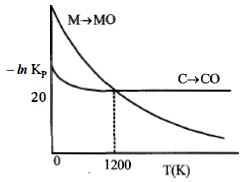
- The plot shows the variation of \(- In\,K_p\) versus temperature for the two reactions. \(M(s) + \frac{1}{2}{O_2}(s)\, \to \,MO(s)\,\) and \(C(s) + \frac{1}{2}{O_2}(g)\, \to \,CO(s)\,\) Identify the correct statement
 JEE Mains 2016 Hard
- While estimating the nitrogen present in an organic compound by Kjeldahl's method, the ammonia evolved from \(0.25\,g\) of the compound neutralized \(2.5\,mL\) of \(2\,M\,H _{2} SO _{4}\). The percentage of nitrogen present in organic compound is \(......\)JEE Mains 2022 Medium
- The pair in which both the species have the same magnetic moment (spin only) is :JEE Mains 2020 Medium
- Which of the following reagent is used for the following reaction ? \(CH _{3} CH _{2} CH _{3} \stackrel{?}{\longrightarrow} CH _{3} CH _{2} CHO\)JEE Mains 2021 Medium
More PYQs from JEE Mains
- Given below are two statements: Statement \((I)\) : A \(\pi\) bonding \(MO\)has lower electron density above and below the inter-nuclear axis. Statement \((II)\) : The \(\pi^*\) antibonding \(MO\) has a node between the nucles.
In the light of the above statements, choose the most appropriate answer from the options given below:JEE Mains 2024 Hard - Which of the following reaction/s will not give \(p-\)aminoazobenzene ? \({image}\)
 JEE Mains 2021 Medium
- The following statements relate to the adsorption of gases on a solid surfuce. Identify the incorrect statement among themJEE Mains 2015 Medium
- The surface of water in a water tank of cross section area \(750\,cm ^2\) on the top of a house is \(h m\). above the tap level. The speed of water coming out through the tap of cross section area \(500\,mm ^2\) is \(30\,cm / s\). At that instant, \(\frac{d h}{d t}\) is \(x \times 10^{-3} m / s\). The value of \(x\) will be \(.............\).JEE Mains 2023 Medium
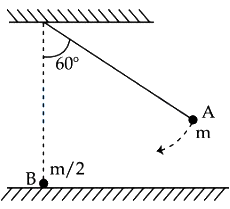
- As shown below, bob \(A\) of a pendulum having massless string of length ' \(R\) ' is released from \(60^{\circ}\) to the vertical. It hits another bob \(B\) of half the mass that is at rest on a friction less table in the center. Assuming elastic collision, the magnitude of the velocity of bob A after the collision will be (take g as acceleration due to gravity.)
 JEE Mains 2025 Hard
- Given below are two statements : one is labelled as Assertion A and the other is labelled as Reason \(R\). Assertion A : The nuclear density of nuclides \({ }_5^{10} B ,{ }_3^6 Li ,{ }_{26}^{56} Fe ,{ }_{10}^{20} Ne\) and \({ }_{83}^{209} Bi\) can be arranged as \(\rho_{ Bi }^{ N }>\rho_{ Fe }^{ N }>\rho_{ Ne }^{ N }>\rho_{ B }^{ N }>\rho_{ Li }^{ N }\). Reason \(R\) : The radius \(R\) of nucleus is related to its mass number \(A\) as \(R=R_0 A^{1 / 3}\), where \(R_0\) is a constant. In the light of the above statement, choose the correct answer from the options given below :JEE Mains 2023 Medium