


enEnglishguગુજરાતી
JEE Mains · Physics · STD 11 - Oscillations
- JEE Mains 2013
- Hard
- Numerical
Two simple pendulums of length \(1\, m\) and \(4\, m\) respectively are both given small displacement in the same direction at the same instant. They will be again in phase after the shorter pendulum has completed number of oscillations equal to
Pick an option to check your answer.
Answer & Solution
Correct Answer
(A) \(2\)
Step-by-step Solution
Detailed explanation
Let \(\mathrm{T}_{1}\) and \(\mathrm{T}_{2}\) be the time period of the two
pendulums \(T_{1}=2 \pi \sqrt{\frac{1}{g}}\) and \(T_{2}=2 \pi \sqrt{\frac{4}{g}}\)
As \(\ell_{1}<\ell_{2}\) therefore \(\mathrm{T}_{1}<\mathrm{T}_{2}\)
Let at \(t=0\) they start swinging together. since their time periods are different, the swinging will not be in unison always. Only when number of completed oscillations
differ by an integer, the two pendulums will again begin to swing together
Let longer length pendulum complete \(n\) oscillation and shorter length pendulum complete \((\mathrm{n}+1)\) oscillation. For unison swinging
\((n+1) T_{1}=n T_{2}\)
\((n+1) \times 2 \pi \sqrt{\frac{1}{g}}=(n) \times 2 \pi \sqrt{\frac{4}{g}}\)
\(\Rightarrow n=1\)
\(\therefore n+1=1+1=2\)
More questions from Physics
- For three low density gases \(A, B, C\) pressure versus temperature graphs are plotted while keeping them at constant volume, as shown in the figure. The temperature corresponding to the point ' \(K\) ' is \(...........\,{}^{\circ}\,C\)
 JEE Mains 2023 Medium
- Consider a uniform wire of mass \(M\) and length \(L\). It is bent into a semicircle. Its moment of inertia about a line perpendicular to the plane of the wire passing through the centre is :JEE Mains 2021 Medium
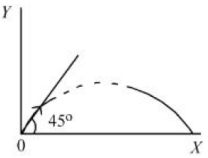
- A particle of mass \(100\,g\) is projected at time \(t =0\) with a speed \(20\,ms ^{-1}\) at an angle \(45^{\circ}\) to the horizontal as given in the figure. The magnitude of the angular momentum of the particle about the starting point at time \(t=2\,s\) is found to be \(\sqrt{ K }\,kg\,m ^2 / s\). The value of \(K\) is \(............\) \(\left(\right.\) Take \(\left.g =10\,ms ^{-2}\right)\)
 JEE Mains 2023 Hard
- \(N\,moles\) of a diatomic gas in a cylinder are at a temperature \(T\). Heat is supplied to the cylinder such that the temperature remains constant but \(n\,moles\) of the diatomic gas get converted into monoatomic gas. What is the change in the total kinetic energy of the gas ?JEE Mains 2017 Medium
- A sample of an ideal gas is taken through the cyclic process \(ABCA\) as shown in figure. It absorbs, \(40\,J\) of heat during the part \(A B\), no heat during \(BC\) and rejects \(60\,J\) of heat during \(CA\). \(A\) work \(50\,J\) is done on the gas during the part \(BC\). The internal energy of the gas at \(A\) is \(1560\,J\). The work done by the gas during the part \(CA\) is.............\(J\)
 JEE Mains 2022 Medium
- Match the LIST-I with LIST-II
List-I List-II A. Planck's constant I. \(ML^2T^{-2}\) B. Stopping potential II. \(T^{-1}\) C. Work function III. \(ML^2T^{-1}\) D. Threshold frequency IV. \(ML^2T^{-3}A^{-1}\)
Choose the correct answer from the options given below:JEE Mains 2026 Medium
More PYQs from JEE Mains
- A shell is fired from a fixed artillery gun with an initial speed \(u\) such that it hits the target on the ground at a distance \(R\) from it. If \(t_1\) and \(t_2\) are the values of the time taken by it to hit the target in two possible ways, the product \(t_1t_2\) isJEE Mains 2019 Hard
- When the temperature of a metal wire is increased from \(0^{\circ} \,C\) to \(10^{\circ}\, C\), its length increases by \(0.02 \% .\) The percentage change in its mass density will be closest to:JEE Mains 2020 Hard
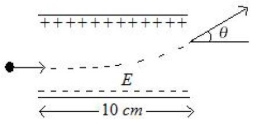
- A uniform electric field of \(10\,N / C\) is created between two parallel charged plates (as shown in figure). An electron enters the field symmetrically between the plates with a kinetic energy \(0.5\,eV\). The length of each plate is \(10\,cm\). The angle \((\theta)\) of deviation of the path of electron as it comes out of the field is \(.........\)(in degree).
 JEE Mains 2023 Hard