


JEE Mains · Physics · STD 12 - Current electricity
- JEE Mains 2026
- Hard
- MCQ
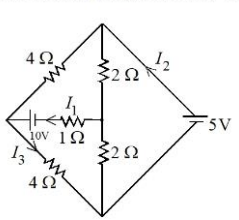
Refer to the figure given below. The values of \(I_1\), \(I_2\) and \(I_3\) are __________.
Pick an option to check your answer.
Answer & Solution
Correct Answer
(A) \(I_1 = 2.5\) A, \(I_2 = 1.875\) A, \(I_3 = 1.875\) A
Step-by-step Solution
Detailed explanation
Using the principle of superposition, we analyse the circuit with one source active at a time.
Case 1: Only the \(10\text{ V}\) source is active (the \(5\text{ V}\) source is replaced by a short circuit).
With the \(5\text{ V}\) source shorted, the top and bottom nodes of the bridge are directly connected by a wire, forming a Wheatstone bridge.
Checking for balance:
Left arm ratio: \(\dfrac{4}{4} = 1\)
Right arm ratio: \(\dfrac{2}{2} = 1\)
The ratios are equal, so the bridge is balanced. Hence, no current flows through the middle branch connecting the two nodes, and the contribution to \(I_2\) from the \(10\text{ V}\) source is \(0\text{ A}\).
Equivalent resistance of the balanced bridge:
\((4 + 2)\,\Omega \parallel (4 + 2)\,\Omega = 6\,\Omega \parallel 6\,\Omega = 3\,\Omega\)
Total resistance including the series \(1\,\Omega\) resistor:
\(R_{eq} = 3 + 1 = 4\,\Omega\)
Current drawn from the \(10\text{ V}\) source:
\(I_{1(10V)} = \dfrac{10}{4} = 2.5\text{ A}\)
This current splits equally between the two \(6\,\Omega\) branches, so the current through the bottom \(4\,\Omega\) resistor is:
\(I_{3(10V)} = \dfrac{2.5}{2} = 1.25\text{ A}\)
Case 2: Only the \(5\text{ V}\) source is active (the \(10\text{ V}\) source is replaced by a short circuit).
Now the \(5\text{ V}\) source is applied across the top and bottom nodes, and the \(1\,\Omega\) resistor lies in the middle branch between the left and centre nodes.
For the left branch (\(4\,\Omega\) and \(4\,\Omega\) in series), the potential at the midpoint is \(\dfrac{5}{2} = 2.5\text{ V}\).
For the right branch (\(2\,\Omega\) and \(2\,\Omega\) in series), the potential at the midpoint is also \(\dfrac{5}{2} = 2.5\text{ V}\).
Since both midpoints are at the same potential, no current flows through the \(1\,\Omega\) middle branch. Hence, the contribution to \(I_1\) from the \(5\text{ V}\) source is \(0\text{ A}\).
Equivalent resistance seen by the \(5\text{ V}\) source:
\((4 + 4)\,\Omega \parallel (2 + 2)\,\Omega = 8\,\Omega \parallel 4\,\Omega = \dfrac{8 \times 4}{8 + 4} = \dfrac{8}{3}\,\Omega\)
Total current supplied by the \(5\text{ V}\) source:
\(I_{2(5V)} = \dfrac{5}{8/3} = \dfrac{15}{8} = 1.875\text{ A}\)
Current through the left branch (which includes the bottom \(4\,\Omega\) resistor):
\(I_{3(5V)} = \dfrac{5}{8} = 0.625\text{ A}\)
Applying superposition:
\(I_1 = I_{1(10V)} + I_{1(5V)} = 2.5 + 0 = 2.5\text{ A}\)
\(I_2 = I_{2(10V)} + I_{2(5V)} = 0 + 1.875 = 1.875\text{ A}\)
\(I_3 = I_{3(10V)} + I_{3(5V)} = 1.25 + 0.625 = 1.875\text{ A}\)
Hence, the correct option is \((1)\ I_1 = 2.5\text{ A},\ I_2 = 1.875\text{ A},\ I_3 = 1.875\text{ A}\).
More questions from Physics
- A brass wire of length 2 m and radius 1 mm at \(27^{\circ} C\) is held taut between two rigid supports. Initially it was cooled to a temperature of \(-43^{\circ} C\) creating a tension T in the wire. The temperature to which the wire has to be cooled in order to increase the tension in it to 1.4 T , is _________ \({ }^{\circ} C\)JEE Mains 2026 Easy
- Which of the following phenomena does not explain by wave nature of light? \((A)\) reflection \((B)\) diffraction \((C)\) photoelectric effect \((D)\) interference \((E)\) polarization Choose the most appropriate answer from the options given below :JEE Mains 2024 Hard
- A particle of mass \(\mathrm{m}\) and charge \(\mathrm{q}\) has an initial velocity \(\overline{\mathrm{v}}=\mathrm{v}_{0} \hat{\mathrm{j}} .\) If an electric field \(\overrightarrow{\mathrm{E}}=\mathrm{E}_{0} \hat{\mathrm{i}}\) and magnetic field \(\overrightarrow{\mathrm{B}}=\mathrm{B}_{0} \hat{\mathrm{i}}\) act on the particle, its speed will double after a time:JEE Mains 2020 Medium
- Match the LIST-I with LIST-II
Choose the correct answer from the options given below :LIST-I LIST-II (A) Gravitational constant (I) \(\left[\mathrm{LT}^{-2}\right]\) (B) Gravitational potential energy (II) \(\left[\mathrm{L}^2 \mathrm{~T}^{-2}\right]\) (C) Gravitational potential (III) \(\left[\mathrm{ML}^2 \mathrm{~T}^{-2}\right]\) (D) Acceleration due to gravity (IV) \(\left[\mathrm{M}^{-1} \mathrm{~L}^3 \mathrm{~T}^{-2}\right]\) JEE Mains 2025 Medium - Two resistors of \(200 \, \Omega\) and \(400 \, \Omega\) are connected in series with a battery of \(100\) V. A bulb rated at \(200\) V, \(100\) W is connected across the \(400 \, \Omega\) resistance. The potential drop across the bulb is _______ V.JEE Mains 2026 Hard
- Let the moment of inertia of a hollow cylinder of length \(30\, cm\) (inner radius \(10\, cm\) and outer radius \(20\, cm\)), about its axis be \(I\). The radius of a thin cylinder of the same mass such that its moment of inertia about its axis is also \(I\), is ......... \(cm\).JEE Mains 2019 Hard
More PYQs from JEE Mains
- Choose the correct option from the following options given belowJEE Mains 2022 Medium
- A person pushes a box on a rough horizontal platform surface. He applies a force of \(200\, N\) over a distance of \(15\, m .\) Thereafter, he gets progressively tired and his applied force reduces linearly with distance of \(100\, N\). The total distance through which the box has been moved is \(30\, m\). What is the work done by the person during the total movement of the box\(........J\)\(?\)JEE Mains 2020 Hard
- A solenoid has a core made of material with relative permeability \(400\). The magnetic field produced in the interior of solenoid is \(1.0\) T. The magnetic intensity in SI units is \(\alpha \times 10^5\). The value of \(\alpha\) is ______.
(Free space permeability \(\mu_0=4\pi \times 10^{-7}\) SI units.)JEE Mains 2026 Medium - A massless spring gets elongated by amount \(x_1\) under a tension of 5 N . Its elongation is \(x_2\) under the tension of 7 N . For the elongation of \(\left(5 x_1-2 x_2\right)\), the tension in the spring will be,JEE Mains 2025 Easy