


Questions
17 questionsShowing 1–17 of 17 questions
-
- (A) \(4\)
- (B) \(6\)
- (C) \(2\)
- (D) \(1\)
Show answer and solution
Correct Answer: (A)
\(f_{c}=f_{0}\)\(\frac{3 V_{C}}{4 L}=\frac{2 V_{0}}{2 L^{\prime}}\)
\(\frac{3 V_{C}}{4 L}=\frac{V_{0}}{L^{\prime}}\)
\(L ^{\prime}=\frac{4 L }{3} \frac{ V _{0}}{ V _{ C }}=\frac{4 L }{3} \sqrt{\frac{ B \cdot \rho_{1}}{\rho_{2} \cdot B }}( B\) is bulk modulus)
\(=\frac{4 L }{3} \sqrt{\frac{\rho_{1}}{\rho_{2}}}\)
\(x =4\)

-
- (A) \(4\)
- (B) \(12\)
- (C) \(16\)
- (D) \(8\)
Show answer and solution
Correct Answer: (D)
Sound level decreases by \(5\, dB\) every \(km\) so sound level decreased in \(20\, km =100 \,dB\)\(\beta_{2}-\beta_{1}=10 \log _{10} \frac{ I _{2}}{ I _{1}}\)
\(-100=10 \log _{10} \frac{ I _{2}}{ I _{1}} \Rightarrow \frac{ I _{1}}{ I _{2}}=10^{10}\)
\(I _{2}=10^{-10} I _{1} \Rightarrow P _{2}=10^{-10} P _{1}=10^{-8}\, W\)
\(\mathrm { x } = 8\)
-
- (A) \(Y(x, t)=0.03\left[\sin 5.1 x-\left(0.2 \times 10^{3}\right) t\right]\)
- (B) \(Y(x, t)=0.06\left[\sin 5.1 x-\left(1.5 \times 10^{3}\right) t\right]\)
- (C) \(Y(x, t)=0.06\left[\sin 0.8 x-\left(0.5 \times 10^{3}\right) t\right]\)
- (D) \(Y(x, t)=0.03\left[\sin 5.1 x-\left(1.5 \times 10^{3}\right) t\right]\)
Show answer and solution
Correct Answer: (D)
\(\omega=2 \pi f\)\(=1.5 \times 10^{3}\)
\(A=\frac{6}{2}=3 \,cm =0.03\, m\)
-
- (A) \(1050\)
- (B) \(750\)
- (C) \(2025\)
- (D) \(2250\)
Show answer and solution
Correct Answer: (C)
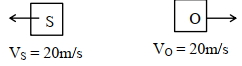
\({V}_{{S}}=20 {m} / {s} \quad {V}_{{O}}=20 {m} / {s}\)\({f}^{\prime}={f}\left(\frac{{V}-{V}_{0}}{{V}+{V}_{{s}}}\right)\)
\(1800={f}\left(\frac{340-20}{340+20}\right)\)
\({f}=2025 {Hz}\)
-
- (A) \(13\)
- (B) \(16.6\)
- (C) \(18.4\)
- (D) \(14.8\)
Show answer and solution
Correct Answer: (D)
\(d =6 cm , f =504, v =336 m / s\)\(e =0.3 d\)
\(l+ e =\frac{\lambda}{4}=\frac{ V }{4 f }\)
\(l=16.66-0.3 \times 6\)
\(l=14.866 cm\)
\(l=14.8 cm\)
-
- (A) \(340\)
- (B) \(342\)
- (C) \(335\)
- (D) \(337\)
Show answer and solution
Correct Answer: (C)
Initially beat frequency \(=5 \,Hz\)so, \(\rho_{ A }=340 \pm 5=345\, Hz ,\) or \(335\, Hz\)
after filing frequency increases slightly
so, new value of frequency of \(A >\rho_{ A }\)
Now, beat frequency \(=2\, Hz\)
\(\Rightarrow\) new \(\rho_{ A }=340 \pm 2=342\, Hz ,\) or \(338 \,Hz\)
-
- (A) \(340\)
- (B) \(34\)
- (C) \(17\)
- (D) \(3.4\)
Show answer and solution
Correct Answer: (B)
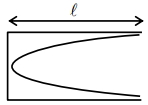
\(\frac{\lambda}{4}=\ell \Rightarrow \lambda=4 \ell\)\({f}=\frac{{V}}{\lambda}=\frac{{V}}{4 \ell}\)
\(\Rightarrow 250=\frac{340}{4 \ell}\)
\(\Rightarrow \ell=\frac{34}{4 \times 25}=0.34\, {m}\)
\(\ell=34\, {cm}\)
-
- (A) \(50\)
- (B) \(100\)
- (C) \(10\)
- (D) \(2\)
Show answer and solution
Correct Answer: (C)
\(\mu=9.0 \times 10^{-4}\, \frac{{kg}}{{m}}\)\({T}=900\, {N}\)
\({V}=\sqrt{\frac{{T}}{\mu}}=\sqrt{\frac{900}{9 \times 10^{-4}}}=1000 \,{m} / {s}\)
\({f}_{1}=500 \,{Hz}\)
\({f}=550\)
\(\frac{{nV}}{2 \ell}=500 \ldots . \text { (i) }\)
\(\frac{({n}+1) {V}}{2 \ell}=500 \ldots(ii)\)
\((ii)\, (i)\) \(\frac{{V}}{2 \ell}=50\)
\(\ell=\frac{1000}{2 \times 50}=10\)
-
- (A) \(2\)
- (B) \(4\)
- (C) \(6\)
- (D) \(8\)
Show answer and solution
Correct Answer: (A)
At \({t}=0, {Y}=\frac{1}{1+{x}^{2}}\)\(\text { At time } t=t, y=\frac{1}{1+(x-v t)^{2}}\)
\(\text { At } t=1, y=\frac{1}{1+(x-v)^{2}}....(i)\)
\(\text { At } t=1, y=\frac{1}{1+(x-2)^{2}}....(ii)\)
comparing \((i) \& (ii)\)
-
- (A) \(330\)
- (B) \(132\)
- (C) \(185\)
- (D) \(852\)
Show answer and solution
Correct Answer: (B)
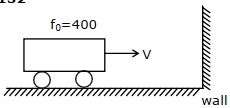
Wall as an observerFrequency received by wall
\({f}_{1}={f}_{0}\left(\frac{{C}}{{C}-{V}}\right)\)
Again wall as a source
Frequency received by observer on car
\({f}_{2}={f}_{1}\left(\frac{{C}+{V}}{{C}}\right)\)
\(500=400\left(\frac{{C}+{v}}{{C}-{V}}\right)\)
\(\frac{5}{4}=\frac{{C}+{V}}{{C}-{V}}\)
\({C}=9 {V}\)
\({V}=\frac{{C}}{9}=\frac{330}{9}\,{m} / {s}\)
\({V}=\frac{330}{9} \times \frac{18}{5}=132\, {km} / {hr}\)
-
- (A) \(12.15\)
- (B) \(121.5\)
- (C) \(1215\)
- (D) \(24.3\)
Show answer and solution
Correct Answer: (C)
\(\mu=0.135 gm / cm =0.0135 kg / m\)\(y =-0.21 \sin ( x +30 t )\)
\((x\) in meter \(\&\) \(t\) in sec)
\(v =\frac{\omega}{ k }=\frac{30}{1}=30 m / s\)
\(v =\sqrt{\frac{ T }{\mu}} \Rightarrow T = v ^{2} \mu=(30)^{2}(0.0135)\)
\(=12.15\)
\(= x \times 10^{-2} N\)
\(\Rightarrow x =1215\)
-
- (A) \(1\)
- (B) \(2\)
- (C) \(0\)
- (D) \(4\)
Show answer and solution
Correct Answer: (B)
\(v =\sqrt{\frac{ T }{\mu}}\)\(\frac{\Delta V }{ V }=\frac{1}{2} \frac{\Delta T }{ T }\)
-
- (A) \(8\)
- (B) \(16\)
- (C) \(32\)
- (D) \(24\)
Show answer and solution
Correct Answer: (A)
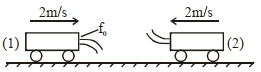
Frequency of sound heard by car\(-1,\) which comes by reflection from car\(-2\)\(f _{1}= f _{0}\left(\frac{340+2}{340-2}\right)\left(\frac{340+2}{340-2}\right)\)
\(= f _{0}\left(\frac{342}{338}\right)^{2}\)
Frequency of sound coming directly from car\(-2\)
\(f _{2}= f _{0}\left(\frac{340+2}{340-2}\right)\)
\(\therefore f _{1}- f _{2}= f _{0}\left(\frac{342}{338}\right)\left(\frac{342}{338}-1\right)=8.09 \simeq 8\)
-
- (A) \(1210\)
- (B) \(1250\)
- (C) \(605\)
- (D) \(2420\)
Show answer and solution
Correct Answer: (A)
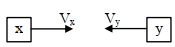
\({V}_{{x}}=36 {km} / {hr}=10 {m} / {s}\)\({V}_{{y}}=72 {km} / {hr}=20 {m} / {s}\)
by doppler's effect
\({F}^{\prime}={F}_{0}\left(\frac{{V} \pm {V}_{0}}{{V} \pm {V}_{{s}}}\right)\)
\(1320={F}_{0}\left(\frac{340+20}{340-10}\right) \Rightarrow {F}_{0}=1210 {Hz}\)
-
- (A) \(3\)
- (B) \(1\)
- (C) \(5\)
- (D) \(7\)
Show answer and solution
Correct Answer: (B)
For node\(\cos \left(1.57 {cm}^{-1}\right) {x}=0\)
\(\left(1.57 {cm}^{-1}\right) {x}=\frac{\pi}{2}\)
\({x}=\frac{\pi}{2(1.57)} {cm}=1\, {cm}\)
-
- (A) \(7\)
- (B) \(10\)
- (C) \(25\)
- (D) \(49\)
Show answer and solution
Correct Answer: (A)
\({y}_{1}={A}_{1} \operatorname{sink}({x}-{vt})\)\({y}_{1}=12 \sin 6.28({x}-{vt})\)
\({y}_{2}=5 \sin 6.28({x}-{vt}+3.5)\)
\(\Delta \phi=\frac{2 \pi}{\lambda}(\Delta {x})\)
\(={K}(\Delta {x})\)
\(=6.28 \times 3.5=\frac{7}{2} \times 2 \pi=7 \pi\)
\({A}_{{DE}}=\sqrt{{A}_{1}^{2}+{A}_{2}^{2}+2 {A}_{1} {A}_{2} \cos \phi}\)
\({A}_{{DA}}=\sqrt{(12)^{2}+(5)^{2}+2(12)(5) \cos (7 \pi)}\)
\(=\sqrt{144+25-120}\)
\(=\,7\)
-
- (A) \(y=A \sin (15 x-2 t)\)
- (B) \(y=\operatorname{Ae}^{-x^{2}}(v t+\theta)\)
- (C) \(y=A e^{x} \cos (\omega t-\theta)\)
- (D) \(y=A \sin x \cos \omega t\)
Show answer and solution
Correct Answer: (A)
\(y = F ( x , t )\)For travelling wave \(y\) should be linear function of \(x\) and \(t\) and they must exist as \((x \pm v t)\)
\(y = A \sin (15 x-2 t) \rightarrow\) linear function in \(x\) and \(t.\)
No questions on this page match these filters.