


JEE Mains · Chemistry · STD 12 - Electrochemistry
- JEE Mains 2024
- Medium
- MCQ
The reaction occurs in which of the following galvanic cell?

Pick an option to check your answer.
Answer & Solution
Correct Answer
(A) \(\mathrm{Pt}\left|\mathrm{H}_{2(\mathrm{~g})}\right| \mathrm{HCl}_{(\text {soln.) }}\left|\mathrm{AgCl}_{(\mathrm{s})}\right| \mathrm{Ag}\)
Step-by-step Solution
Detailed explanation
The given cell reaction is:
\( \frac{1}{2}\text{H}_{2(g)} + \text{AgCl}_{(s)} \rightarrow \text{H}^{+}_{(aq)} + \text{Cl}^{-}_{(aq)} + \text{Ag}_{(s)} \)
Let us break this down into the two half-cell reactions:
1. Anodic half-cell reaction (Oxidation at Pt electrode):
\( \frac{1}{2}\text{H}_{2(g)} \rightarrow \text{H}^{+}_{(aq)} + e^{-} \)
This represents a hydrogen gas electrode, where \( \text{H}^{+} \) ions are released into the solution.
2. Cathodic half-cell reaction (Reduction at Ag electrode):
\( \text{AgCl}_{(s)} + e^{-} \rightarrow \text{Ag}_{(s)} + \text{Cl}^{-}_{(aq)} \)
This represents a metal-insoluble salt anion electrode, where \( \text{Cl}^{-} \) ions are released into the solution.
Combining both reactions, the net products in the solution are \( \text{H}^{+}_{(aq)} \) and \( \text{Cl}^{-}_{(aq)} \), which together form hydrochloric acid (\( \text{HCl} \)). Therefore, the common electrolyte solution must be \( \text{HCl}_{(soln.)} \), not \( \text{KCl}_{(soln.)} \).
The standard cell representation for this cell without a liquid junction is:
\( \text{Pt} \mid \text{H}_{2(g)} \mid \text{HCl}_{(soln.)} \mid \text{AgCl}_{(s)} \mid \text{Ag} \)
Hence, the correct option is (A).
More questions from Chemistry
- For the reaction \(\mathrm{N}_2 \mathrm{O}_4(\mathrm{~g}) \rightleftharpoons 2 \ \mathrm{NO}_2(\mathrm{~g})\), \(\mathrm{K}_{\mathrm{p}}=0.492 \mathrm{~atm}\) at \(300 \mathrm{~K}\) . \(\mathrm{K}_{\mathrm{c}}\) for the reaction at same temperature is _______ \( \times 10^{-2}\). (Given : \(\mathrm{R}=0.082 \mathrm{~L} \mathrm{~atm} \mathrm{~mol}^{-1} \mathrm{~K}^{-1}\) )JEE Mains 2024 Hard
- Consider the following complex ions \( \mathrm{P}=\left[\mathrm{FeF}_6\right]^{3-} \) , \( \mathrm{Q}=\left[\mathrm{V}\left(\mathrm{H}_2 \mathrm{O}\right)_6\right]^{2+} \) , \( \mathrm{R}=\left[\mathrm{Fe}\left(\mathrm{H}_2 \mathrm{O}\right)_6\right]^{2+}\) The correct order of the complex ions, according to their spin only magnetic moment values (in \(B.M.\)) is :JEE Mains 2024 Hard
- Which of the following statements/ relationships is not correct in thermodynamic changes ?JEE Mains 2013 Hard
- At \(-20^{\circ} \mathrm{C}\) and \(1 \mathrm{~atm}\) pressure, a cylinder is filled with equal number of \(\mathrm{H}_2 . \mathrm{I}_2\) and \(\mathrm{HI}\) molecules for the reaction \(\mathrm{H}_2(\mathrm{~g})+\mathrm{I}_2(\mathrm{~g}) \rightleftharpoons 2 \mathrm{HI}(\mathrm{g})\), the \(\mathrm{K}_{\mathrm{p}}\) for the process is \(\mathrm{x} \times 10^{-1} \cdot \mathrm{x}=\) _______. [Given : \(\mathrm{R}=0.082 \mathrm{~L} \mathrm{~atm} \mathrm{~K}^{-1} \mathrm{~mol}^{-1}\) ]JEE Mains 2024 Medium
- Compound that will give positive Lassaigne's test for both nitrogen and halogen isJEE Mains 2023 Hard
- Number of lone pair (s) of electrons on central atom and the shape of \(BrF _{3}\) molecule respectively, are ..... .JEE Mains 2022 Medium
More PYQs from JEE Mains
- Three charged particle \(A, B\) and \(C\) with charges \(-4 q, 2 q\) and \(-2 q\) are present on the circumference of a circle of radius \(d\). the charged particles \(A, C\) and centre \(O\) of the circle formed an equilateral triangle as shown in figure. Electric field at \(O\) along \(x-\)direction is
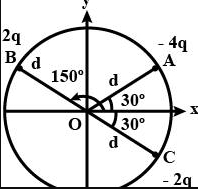 JEE Mains 2020 Medium
- In the given circuit, the equivalent resistance between the terminal \(A\) and \(B\) is \(........\Omega\).
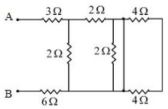 JEE Mains 2023 Medium
- A point source is kept at the center of a spherically enclosed detector. If the volume of the detector increased by 8 times, the intensity willJEE Mains 2026 Easy
- A capacitor, \(C_1=6 \mu \mathrm{~F}\) is charged to a potential difference of \(\mathrm{V}_0=5 \mathrm{~V}\) using a 5 V battery. The battery is removed and another capacitor, \(\mathrm{C}_2=12 \mu \mathrm{~F}\) is inserted in place of the battery. When the switch 'S' is closed, the charge flows between the capacitors for some time until equilibrium condition is reached. What are the charges \(\left(q_1\right.\) and \(\left.q_2\right)\) on the capacitors \(C_1\) and \(C_2\) when equilibrium condition is reached.
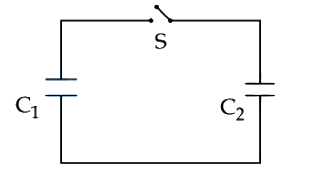 JEE Mains 2025 Medium
- The unit of \(\sqrt{\frac{2 \mathrm{I}}{\epsilon_0 c}}\) is :
(I = intensity of an electromagnetic wave, \(\mathrm{c}:\) speed of light)JEE Mains 2025 Easy - A particle is moving along the \(x-\)axis with its coordinate with the time '\(t\)' given be \(\mathrm{x}(\mathrm{t})=10+8 \mathrm{t}-3 \mathrm{t}^{2} .\) Another particle is moving the \(y-\)axis with its coordinate as a function of time given by \(\mathrm{y}(\mathrm{t})=5-8 \mathrm{t}^{3} .\) At \(\mathrm{t}=1\; \mathrm{s},\) the speed of the second particle as measured in the frame of the first particle is given as \(\sqrt{\mathrm{v}} .\) Then \(\mathrm{v}\) (in \(\mathrm{m} / \mathrm{s})\) isJEE Mains 2020 Medium