


All D and f- block elements questions
Newest firstShowing 101–150 of 211 questions
-
- (A) Both \(A\) and \(R\) are true but \(R\) is NOT the correct explanation of \(A\)
- (B) \(A\) is false but \(R\) is true
- (C) \(A\) is true but \(R\) is false
- (D) Both \(A\) and \(R\) are true and \(R\) is the correct explanation of \(A\)
Show answer and solution
Correct Answer: (A)
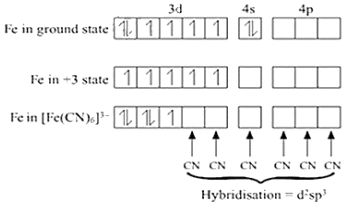
Unpaired electron \(=1\)\(\mu=\sqrt{ n ( n +2)}=\sqrt{1 \times 3}=1.74 \text { B.M. }\)
\(\left[ Fe \left( H _2 O \right)_6\right]^{3+}\) No pairing because \(H _2 O\) is WFL Number of unpaired electrons \(=5, \mu=5.92\,BM\) Assertion is true, Reason is true but not correct explanation.
-
- (A) Both Statement \(I\) and Statement \(II\) are true
- (B) Both Statement \(I\) and Statement \(II\) are false
- (C) Both Statement \(I\) is true but Statement \(II\) is false
- (D) Both Statement \(I\) is false but Statement \(II\) is true
Show answer and solution
Correct Answer: (C)
(1) \(K _2 Cr _2 O\), is used as primary standard. The concentration \(Na _2 Cr _2 O _7\) changes in aq. solution.(2) It is less soluble than \(Na _2 Cr _2 O _7\).
-
- (A) A, B, D only
- (B) C and E only
- (C) A and E only
- (D) A, B and E only
Show answer and solution
Correct Answer: (C)
(1) \(Na > Cs > Li\) - true \{If considered with sign\}
The low solubility of Csl is due to smaller hydration enthalpy of it's two ions.
\(Li _2 CO _3\) is highly stable to heat - false.
In Conc. \(NH _3, K\) formed blue solution - true
All the alkali metal hydrides are ionic solid (True). - 104. In alkaline medium, the reduction of permanganate anion involves a gain of \(........\) electrons. 2023 Easy
- (A) \(4\)
- (B) \(5\)
- (C) \(3\)
- (D) \(7\)
Show answer and solution
Correct Answer: (C)
In faintly alkaline medium,\(MnO _4^{-}+3 e ^{-}+2 H _2 O \longrightarrow MnO _2+4 OH ^{-}\)
No. of electrons gained \(=3\)
- 105. In chromyl chloride, the number of d-electrons present on chromium is same as in (Given at no. of \(Ti : 22, V : 23, Cr : 24, Mn : 25, Fe : 26)\) 2023 Medium
- (A) \(T_i\,(III)\)
- (B) \(Fe\, (III)\)
- (C) \(V\, (IV)\)
- (D) \(Mn\,(VII)\)
Show answer and solution
Correct Answer: (D)
In \(CrO _2 Cl _2\) oxidation state of \(Cr\) is +6\(Cr ( VI )=[ Ar ]^{18} 3 d ^0\)
\(Mn ( VII )=[ Ar ]^{18} 3 d ^0\)
\(Fe ( III )=[ Ar ]^{18} 3 d ^5\)
\(Ti ( III )=[ Ar ]^{18} 3 d ^1\)
\(V ( IV )=[ Ar ]^{18} 3 d ^1\)
Hence \(Cr\) (VI) and \(Mn\) (VII) have same \(d^0\) configuration.
- 106. \(K _2 Cr _2 O _7\) paper acidified with dilute \(H _2 SO _4\) turns green when exposed to 2023 Medium
- (A) Carbon dioxide
- (B) Sulphur trioxide
- (C) Hydrogen sulphide
- (D) Sulphur dioxide
Show answer and solution
Correct Answer: (D)
\(3 SO _2+ Cr _2 O _7^{2-}+2 H ^{+} \rightarrow 3 SO _4^{2-}+2 Cr ^{+3}+ H _2 O\) -
- (A) \(67\)
- (B) \(65\)
- (C) \(68\)
- (D) \(66\)
Show answer and solution
Correct Answer: (C)
By balancing the redox reaction we get\(10\left[ FeSO _4 \cdot\left( NH _4\right)_2 SO _4 \cdot 6 H _2 O \right]+2 KMnO _4+8 H _2 SO _4\)
\(\downarrow\)
\(5 Fe _2\left( SO _4\right)_3+2 MnSO _4+10\left( NH _4\right)_2 SO _4+ K _2 SO _4+68 H _2 O\)
- 108. \(KMnO _4\) oxidises \(I ^{-}\)in acidic and neutral/faintly alkaline solution, respectively to 2023 Hard
- (A) \(I _2\) and \(IO _3^{-}\)
- (B) \(IO _3^{-}\) and \(I _2\)
- (C) \(IO _3^{-}\) and \(IO _3^{-}\)
- (D) \(I_2\) and \(I_2\)
Show answer and solution
Correct Answer: (A)
In acidic medium\(2 MnO _4^{-}+10 I ^{-}+16 H ^{+} \rightarrow 2 Mn ^{2+}+5 I _2+8 H _2 O\)
In neutral/faintly alkaline solution
\(2 MnO _4^{-}+ I ^{-}+ H _2 O \rightarrow 2 MnO _2+2 OH ^{-}+ IO _3^{-}\)
-
- (A) \(4 f^2 6 s^2\)
- (B) \(4 f^4\)
- (C) \(4 f^3\)
- (D) \(4 f ^4 6 s ^2\)
Show answer and solution
Correct Answer: (B)
\(Nd (60)=[ Xe ] 4 f ^4 5 d ^0 6 s ^2\)\(Nd ^{2+}=[ Xe ] 4 f ^4 5 d ^0 5 s ^0\)
-
- (A) \(Ce ^{4+}\) and \(Eu ^{2+}\)
- (B) \(Ce ^{4+}\) and \(Tb ^{4+}\)
- (C) \(Ce ^{3+}\) and \(Ce ^{4+}\)
- (D) \(Eu ^{2+}\) and \(Ce ^{4+}\)
Show answer and solution
Correct Answer: (D)
Factual -
- (A) \(V _2 O _3 > V _2 O _4 > V _2 O _5\)
- (B) \(V _2 O _3 > V _2 O _5 > V _2 O _4\)
- (C) \(V _2 O _5 > V _2 O _4 > V _2 O _3\)
- (D) \(V _2 O _4 > V _2 O _3 > V _2 O _5\)
Show answer and solution
Correct Answer: (A)
With increase in \(\%\) of oxygen acidic nature of oxide of an element increase and basic nature decreases -
- (A) \({\left[ Fe ( CN )_6\right]^{3-} < \left[ CoF _6\right]^{3-} < \left[ MnBr _4\right]^{2-}} < \left[ Mn ( CN )_6\right]^{3-}\)
- (B) \({\left[ Fe ( CN )_6\right]^{3-} < \left[ Mn ( CN )_6\right]^{3-} < \left[ CoF _6\right]^{3-}} < \left[ MnBr _4\right]^{2-}\)
- (C) \({\left[ MnBr _4\right]^{2-} < \left[ CoF _6\right]^{3-} < \left[ Fe ( CN )_6\right]^{3-}} < \left[ Mn ( CN )_6\right]^{3-}\)
- (D) \({\left[ CoF _6\right]^{3-} < \left[ MnBr _4\right]^{2-} < \left[ Fe ( CN )_6\right]^{3-}} < \left[ Mn ( CN )_6\right]^{3-}\)
Show answer and solution
Correct Answer: (B)
Spin magnetic moment \(\mu=\sqrt{n(n+2)}\) B.M - 113. The magnetic moment of a transition metal compound has been calculated to be \(3.87\) \(B.M.\) The metal ion is 2023 Medium
- (A) \(Cr ^{2+}\)
- (B) \(Mn ^{2+}\)
- (C) \(V ^{2+}\)
- (D) \(Ti ^{2+}\)
Show answer and solution
Correct Answer: (C)
\(Cr ^{+2}:[ Ar ], 3 d ^4, 4 s ^0 n =4, \mu=\sqrt{4(4+2)}=\sqrt{24}\)\(=4.89\,BM\)
\(Mn ^{+2}:[ Ar ], 3 d ^5, 4 s ^0 n =5, \mu=\sqrt{5(5+2)}=\sqrt{35}\)
\(=5.91\,BM\)
\(V ^{+2}:[ Ar ], 3 d ^3, 4 s ^0 n =3, \mu=\sqrt{3(3+2)}=\sqrt{15}\)
\(=3.87\,BM\)
\(Ti ^{+2}:[ Ar ], 3 d ^2, 4 s ^0 n =2, \mu=\sqrt{2(2+2)}=\sqrt{8}\)
\(=2.82\,BM\)
- 114. The number of electrons involved in the reduction of permanganate to manganese dioxide in acidic medium is \(.......\). 2023 Medium
- (A) \(4\)
- (B) \(3\)
- (C) \(2\)
- (D) \(1\)
Show answer and solution
Correct Answer: (B)
\(\stackrel{+7}{ MnO _4^{-}}+4 H ^{+}+3 e ^{-} \longrightarrow \stackrel{+4} MnO _2+2 H _2 O\) - 115. The pair of lanthanides in which both elements have high third-ionization energy is: 2023 Medium
- (A) \(Eu , Gd\)
- (B) \(Eu , Yb\)
- (C) \(Lu , Yb\)
- (D) \(Dy, Gd\)
Show answer and solution
Correct Answer: (B)
\(\left.Eu ^{+2}:[ Xe ] 4 f ^7\right\}\) High IE due to half\(\left.Yb ^{+2}:[ Xe ] 4 f ^{14}\right\}\) filled \& fully filled configurations
-
- (A) \((ii)\) and \((iii)\)
- (B) \((i), (ii)\) and \((iv)\)
- (C) \((i)\) and \((iii)\)
- (D) \((ii), (iii)\) and \((iv)\)
Show answer and solution
Correct Answer: (B)
\((i), (ii)\) and \((iv)\) correct.Manganese exhibits \(+7\) oxidation state in its oxide. \(\left( Mn _2 O _7\right)\)
\(Ru\) and \(Os\) from \(RuO _4\) and \(OsO _4\) oxide in \(+8\) oxidation state
\(Cr\) in \(+6\) oxidation act is oxidizing.
\(Sc\) does not show \(+4\) oxidation state.
-
- (A) \(5\)
- (B) \(4\)
- (C) \(3\)
- (D) \(2\)
Show answer and solution
Correct Answer: (A)
Change in oxidation state of \(Mn =5\) - 118. Which halogen is known to cause the reaction given below: \(2 Cu ^{2+}+4 X ^{-} \rightarrow Cu _2 X _2( s )+ X _2\) 2023 Medium
- (A) Only Iodine
- (B) Only Bromine
- (C) All halogens
- (D) Only Chlorine
Show answer and solution
Correct Answer: (A)
\(2 Cu ^{2+}+4 I ^{-} \rightarrow Cu _2 I _2( s )+ I _2\) -
- (A) \(B\) and \(D\) only
- (B) \(A\) and \(E\) only
- (C) \(A\) and \(B\) only
- (D) \(C\) and \(D\) only
Show answer and solution
Correct Answer: (A)
\(1.\) \({ }_{62} Sm : 4 f ^6 6 s ^2\)\(2.\) \({ }_{64} Gd : 4 f ^7 5 d ^1 6 s ^2\)
\(3.\) \({ }_{63} Eu : 4 f^7 6 s ^2\)
\(4.\) \({ }_{65} Tb : 4 f ^9 6 s ^2\)
\(5.\) \({ }_{61} Pm : 4 f ^5 6 s ^2\)
-
- (A) \((B), (C)\) only
- (B) \((A), (B), (D)\) only
- (C) \((C), (D)\) only
- (D) \((A), (B)\) only
Show answer and solution
Correct Answer: (A)
\((A)\) The \(M ^{3+} / M ^{2+}\) reduction potential formanganese is greater than iron
\((B)\) \(E _{ Fe ^{+3} / Fe ^{+2}}^0=+0.77\)
\(E _{ Mn ^{+3} / Mn ^{+2}}^0=+1.57\)
(C) \(E _{ Cr ^{+3} / Cr ^{+2}}^0=-0.26\)
\(\therefore \quad Cr ^{2 \oplus}+ H ^{\oplus} \longrightarrow Cr ^{3 \oplus}+\frac{1}{2} H _2\)
(D) \(V ^{2 \oplus}=3\) unpaired electron
Magnetic Moment \(=3.87\) B.M
-
- (A) \(C\) only
- (B) \(D\) only
- (C) \(A\) and \(B\) only
- (D) \(C\) and \(D\) only
Show answer and solution
Correct Answer: (D)
\(Ce ^{+4}\) and \(Tb ^{+4}\) act as oxidising agent. -
- (A) \(9\)
- (B) \(8\)
- (C) \(4\)
- (D) \(6\)
Show answer and solution
Correct Answer: (D)
\(2 KMnO _{4}+5 H _{2} C _{2} O _{4}+3 H _{2} SO _{4} \rightarrow K _{2} SO _{4} + 2 MnSO _{4}+10 CO _{2}+8 H _{2} O\)\(Mn ^{2+}\) has \(5\) unpaired electrons therefore the magnetic moment is \(\sqrt{35}\, BM\)
-
- (A) \(6\)
- (B) \(5\)
- (C) \(3\)
- (D) \(4\)
Show answer and solution
Correct Answer: (B)
\(Co ^{3+}\) can't liberate \(H _{2}\).It has \(d ^{6}\) configuration,
Number of unpaired electrons \(=4\)
\(\mu=\sqrt{4 \times 6}=4.92\) \(B.M.\)
-
- (A) \(Mn ^{3+}\)
- (B) \(Fe ^{3+}\)
- (C) \(Ti ^{3}\)
- (D) \(Cr ^{3+}\)
Show answer and solution
Correct Answer: (A)
Strongest oxidising agent have highest reduction potential value\(E _{ Mn ^{+3} / Mn ^{+2}}^{0}=1.51 \,V\) (highest)
-
- (A) \(2\)
- (B) \(56\)
- (C) \(10\)
- (D) \(0\)
Show answer and solution
Correct Answer: (D)
\(3 MnO _{4}^{2-}+4 H ^{+} \longrightarrow 2 MnO _{4}^{-}+ MnO _{2}^{+7}+2 H _{2} O\)\(Mn ^{+7}=\) no. of unpaired electrons is \(' 0 '\)
\(\mu=0\, \text { B.M. }\)
- 126. Cerium \((IV)\) has a noble gas configuration. Which of the following is correct statement about it? 2022 Medium
- (A) It will not prefer to undergo redox reactions.
- (B) It will prefer to gain electron and act as an oxidizing agent
- (C) It will prefer to give away an electron and behave as reducing agent
- (D) It acts as both, oxidizing and reducing agent.
Show answer and solution
Correct Answer: (B)
Cerium exists in two different oxidation state \(+3\), \(+4\)\(Ce ^{+4}+ e ^{-} \rightarrow Ce ^{3+} \,\quad\quad\,\,\, E ^{0}=+1.61 \,V\)
\(Ce ^{+3}+3 e ^{-} \rightarrow Ce \quad\quad\,\,\, E ^{0}=-2.336 \,V\)
It shows \(Ce ^{+4}\) acts as a strong oxidising agent \(\&\) accepts electron.
-
- (A) Both statement \(I\) and Statement \(II\) are ture
- (B) Both statement \(I\) and Statement \(II\) are false
- (C) Statement \(I\) is true but Statement \(II\) is false
- (D) Statement \(I\) is false but Statement \(II\) is true
Show answer and solution
Correct Answer: (B)
Neutral \(KMnO _{4}\) oxidises \(I ^{-}\)to \(IO _{3}^{-}\)Manganate ion has \(d \pi- p \pi\) bonding.
- 128. In \(3 d\) series, the metal having the highest \(M ^{2+} / M\) standard electrode potential is .... . 2022 Easy
- (A) \(Cr\)
- (B) \(Fe\)
- (C) \(Cu\)
- (D) \(Zn\)
Show answer and solution
Correct Answer: (C)
\(Cr ^{-2} / Cr \rightarrow-0.90 \,V\)\(Fe ^{-2} / Fe \rightarrow-0.44\, V\)
\(Cu ^{+2} / Cu \rightarrow+0.34\, V\)
\(Zn ^{+2} / Zn \rightarrow-0.76 \,V\)
-
- (A) \(Sc ^{3+}, Zn ^{2+}\)
- (B) \(Ti ^{4+}, Cu ^{2+}\)
- (C) \(V ^{2+}, Ti ^{3+}\)
- (D) \(Zn ^{2+}, Mn ^{2+}\)
Show answer and solution
Correct Answer: (A)
(A) \(Sc ^{3+}, Zn ^{2+}\)\(3 d ^{0} \quad 3 d ^{10}\)
(B) \(Ti ^{4+}, Cu ^{2+}\)
\(3 d ^{0} \quad 3 d ^{9}\)
(C) \(V ^{2+}, Ti ^{3+}\)
\(3 d^{3} \quad 3 d^{1}\)
(D) \(Zn ^{2+}, Mn ^{2+}\)
\(3 d^{10} 3 d^{5}\)
No \(d-d\) transitions in ions with \(d^{0}\) and \(d^{10}\) configuration. Therefore they are colourless.
-
- (A) \(S _{2} O _{7}^{2-}\)
- (B) \(S _{2} O _{8}^{2-}\)
- (C) \(SO _{3}^{2-}\)
- (D) \(SO _{4}^{2-}\)
Show answer and solution
Correct Answer: (D)
\(8 MnO _{4}^{-}+3 S _{2} O _{3}^{2-}+ H _{2} O \frac{\text { neutral or }}{\text { alk. solution }} 88 MnO _{2}+6 SO _{4}^{2-}+2 OH ^{-}\) -
- (A) \(5\)
- (B) \(1\)
- (C) \(0\)
- (D) \(3\)
Show answer and solution
Correct Answer: (D)
\(8 MnO _{4}{ }^{+7}+3 S _{2} O _{3}{ }^{2-}+ H _{2} O \rightarrow 8 MnO _{2}+6 SO _{4}{ }^{2-}+2 OH ^{-}\)Change in oxidation state of \(Mn\) is from \(+7\) to \(+4\) which is \(3 .\)
-
- (A) \(3\)
- (B) \(2\)
- (C) \(1\)
- (D) \(4\)
Show answer and solution
Correct Answer: (A)
\(MnO _{4}^{2-}\) disproportionates in a neutral or acidic solution to give \(MnO _{4}^{-}\)and \(Mn ^{+4}\)\(3 MnO _{4}^{2-}+3 H ^{+} \longrightarrow 2 MnO _{4}^{-}+ MnO _{2}+2 H _{2} O\)
O.S. of \(Mn\) in \(MnO _{4}^{-}=+7\)
O.S. of \(Mn\) in \(MnO _{2}=+4\)
\(\text { difference }=3\)
- 133. Metals generally melt at very high temperature. Amongst the following, the metal with the highest melting point will be \(......\) 2022 Easy
- (A) \(Hg\)
- (B) \(Ag\)
- (C) \(Ga\)
- (D) \(Cs\)
Show answer and solution
Correct Answer: (B)
\(Hg , Ga , Cs\) are liquid near room temperature But \(Ag\) (silver) is solid. - 134. Spin only magnetic moment of \(\left[ MnBr _{6}\right]^{4-}\) is \(.....\,B.M.\) (round off to the closest integer) 2022 Medium
- (A) \(65\)
- (B) \(6\)
- (C) \(12\)
- (D) \(81\)
Show answer and solution
Correct Answer: (B)
\(Mn ^{2+} \rightarrow t _{2 g ^{ 111 }} e _{ g ^{11}}\)\(\mu_{s}=\sqrt{35}\)
\(=5.91\)
\(=6\)
-
- (A) \(Eu ^{2+}\) and \(Tm ^{2+}\)
- (B) \(Sm ^{2+}\) and \(Tm ^{3+}\)
- (C) \(Tb ^{4+}\) and \(Yb ^{2+}\)
- (D) \(Dy ^{3+}\) and \(Yb ^{3+}\)
Show answer and solution
Correct Answer: (C)
\(Tb \rightarrow 4 f ^{9} 6 s ^{2}\)\(Tb ^{+4} \rightarrow 4 f ^{7}\)
\(Yb \rightarrow 4 f ^{14} 6 s ^{2}\)
\(Yb ^{+2} \rightarrow 4 f ^{14}\)
-
- (A) \(3\)
- (B) \(4\)
- (C) \(5\)
- (D) \(6\)
Show answer and solution
Correct Answer: (B)
\(MnO _{4}^{2-} \stackrel{ H ^{+}}{\longrightarrow} MnO _{4}^{-}+ MnO _{2}\)No. of unpaired \(\overline{ e }=3\)
\(\therefore \mu=\sqrt{15}=3.877\) Nearest Integer \(=4\)
-
- (A) \([ Xe ]\,4 f ^{14} \,5 d ^{9}\, 6 s ^{1}\)
- (B) \([ Kr ]\, 4 f ^{14} \,5 d ^{10}\)
- (C) \([ Xe ] \,4 f ^{14}\, 5 d ^{10}\)
- (D) \([ Xe ] \,4 f ^{14}\, 5 d ^{8} \,6 s ^{2}\)
Show answer and solution
Correct Answer: (A)
\({ }_{78} Pt =[ Xe ] \,4 f ^{14} \,5 d ^{9}\, 6 s ^{1}\) (Exceptional electronic configuration) -
- (A) \(Ce\) (At. No. \(58\))
- (B) \(La\) (At. No. \(57\))
- (C) \(Lu\) (At. No. \(71\))
- (D) \(Gd\) (At. No. \(64\))
Show answer and solution
Correct Answer: (A)
\(Ce =[ Xe ] 4 f ^{1} 5 d ^{1} 6 s ^{2}\)\(Ce ^{3+}=[ Xe ] 4 f ^{1} 5 d ^{0}\)
\(Ce ^{+4}=[ Xe ] 4 f ^{0} 5 d ^{0}\) (Noble gas configuration)
-
- (A) \(6\)
- (B) \(54\)
- (C) \(9\)
- (D) \(81\)
Show answer and solution
Correct Answer: (A)
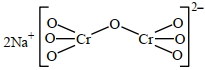
\(4 FeCr _{2} O _{4}+8 Na _{2} CO _{3}+7 O _{2} \rightarrow 8 Na _{2} CrO _{4}+2 Fe _{2} O _{3}\)\(+8 CO _{2}\)
\(2 Na _{2} CrO _{4}+2 H ^{+} \rightarrow \underbrace{ Na _{2} Cr _{2} O _{7}}_{ B }+2 Na ^{+}+ H _{2} O\)
- 140. The products obtained from a reaction of hydrogen peroxide and acidified potassium permanganate are 2022 Medium
- (A) \(Mn ^{4+}, H _{2} O\) only
- (B) \(Mn ^{2+}, H _{2} O\) only
- (C) \(Mn ^{4+}, H _{2} O , O _{2}\) only
- (D) \(Mn ^{2+}, H _{2} O , O _{2}\) only
Show answer and solution
Correct Answer: (D)
\(6 H ^{+}+2 MnO _{4}^{-}+5 H _{2} O _{2} \longrightarrow 2 Mn ^{+2}+8 H _{2} O +5 O _{2}\) - 141. The reaction of \(H _{2} O _{2}\) with potassium permanganate in acidic medium leads to the formation of mainly. 2022 Medium
- (A) \(Mn ^{2+}\)
- (B) \(Mn ^{4+}\)
- (C) \(Mn ^{3+}\)
- (D) \(Mn ^{6+}\)
Show answer and solution
Correct Answer: (A)
\(H _{2} O _{2}+ MnO _{4}^{-} \rightarrow Mn ^{2+}+ O _{2}\) \((unbalanced)\) - 142. The spin only magnetic moment of the complex present in Fehling's reagent is \(B.M.\)(Nearest integer). 2022 Medium
- (A) \(3\)
- (B) \(0\)
- (C) \(1\)
- (D) \(2\)
Show answer and solution
Correct Answer: (D)
Fehling solution is a complex of \(Cu ^{++}\)\(Cu ^{++}=3 d ^{9}\)
No. of unpaired \(e ^{-}=1\)
\(M \cdot M=\sqrt{1(1+2)}=\sqrt{3}=1.73\,BM\)
-
- (A) \(4\)
- (B) \(2\)
- (C) \(3\)
- (D) \(1\)
Show answer and solution
Correct Answer: (A)
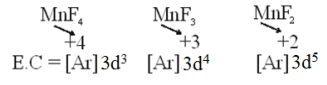
\(\left. E _{ Cr ^{+3}}^{0}\right|_{ Cr ^{+2}}=-0.41\,V\)\({\left[ Cr ^{+3}\right]=4 s ^{0} 3 d ^{3} }\)
\(\mu=\sqrt{ n ( n +2)}\,B.M\)
\(=\sqrt{15}\) B.M \(\sim 4\,B.M\)
-
- (A) \(4\)
- (B) \(3\)
- (C) \(2\)
- (D) \(5\)
Show answer and solution
Correct Answer: (D)
Hence \(MnF _{3} \Rightarrow\) strongest O.A\(\mu=\sqrt{4(4+2)}=\sqrt{24}=4.89=5\)
-
- (A) \(3\)
- (B) \(30\)
- (C) \(0.3\)
- (D) \(56\)
Show answer and solution
Correct Answer: (A)
Most basic oxide is \(V _{2} O _{3}\)\(V ^{+3} \rightarrow\left[A_{ r }\right] 3 d ^{2}\)
\(\mu=\sqrt{2(2+2)}=2.84\, BM\)
\(\approx 3\)
- 146. Which of the following \(3 d -m e t a l\) ion will give the lowest enthalpy of hydration \((\Delta_{ hyd } H )\) when dissolved in water? 2022 Medium
- (A) \(Cr ^{2+}\)
- (B) \(Mn ^{2+}\)
- (C) \(Fe ^{2+}\)
- (D) \(Co ^{2+}\)
Show answer and solution
Correct Answer: (B)
Enthalpy of hydration increases with increase in charge density. \(Mn ^{+2}\) has least charge density (as \(Mn\) has highest size among the given options) so it will have least enthalpy of hydration. -
- (A) \((A), (C)\) and \((D)\) only
- (B) \((A)\) and \((B)\) only
- (C) \((A)\) and \((C)\) only
- (D) \((A), (B)\) and \((C)\) only
Show answer and solution
Correct Answer: (D)
\((A)\) \(Cr =[ Ar ] 3 d ^{5} 4 s ^{1}\)\((B)\) \(m =-\ell\) to \(+\ell\)
\((C)\) According to Aufbau principle, orbitals are filled in order of their increasing energies.
\((D)\) Total nodes \(=n-1\)
-
- (A) \(Ce\) (Atomic Number \(58\))
- (B) \(Sm\) (Atomic Number \(62\))
- (C) \(Eu\) (Atomic Number \(63\))
- (D) \(Yb\) (Atomic Number \(70\))
Show answer and solution
Correct Answer: (C)
\(E _{ M ^{3+} / M ^{2+}}^{0} \Rightarrow Eu(-0.35) Yb(-1.05\)Hence, due to more reduction potential in \(Eu\) as compared to \(Yb\), it can concluded that \(Eu ^{2+}\) is more stable than \(Yb ^{2+}\).
- 149. Dichromate ion is treated with base, the oxidation number of \(Cr\) in the product formed is .... . 2021 Easy
- (A) \(3\)
- (B) \(4\)
- (C) \(5\)
- (D) \(6\)
Show answer and solution
Correct Answer: (D)
\(Cr _{2} O _{7}^{2-}+ OH ^{-} \longrightarrow CrO _{4}^{2-}\)Oxidation state of \(Cr\) in \(CrO _{4}^{2-}\) is \(+6\)
-
- (A) \(4\)
- (B) \(6\)
- (C) \(5\)
- (D) \(7\)
Show answer and solution
Correct Answer: (D)
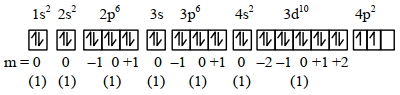
Completely filled orbital with \(\mathrm{m}_{\ell}=0\) are\(=1+1+1+1+1+1+1\)
\(=7\)
So Answer is \(7\)
No questions on this page match these filters.