


All D and f- block elements questions
Newest firstShowing 51–100 of 211 questions
-
- (A) 120
- (B) 140
- (C) 160
- (D) 180
Show answer and solution
Correct Answer: (C)
\(\mathrm{FeCr}_2 \mathrm{O}_4+\mathrm{Na}_2 \mathrm{CO}_3+\mathrm{O}_2 \rightarrow \mathrm{Na}_2 \mathrm{CrO}_4+\mathrm{Fe}_2 \mathrm{O}_3+\mathrm{CO}_2\)
Insoluble product will be \(\mathrm{Fe}_2 \mathrm{O}_3\)
molar mass \(=56 \times 2+16 \times 3\)
\(\begin{aligned}
& =112+48 \\
& =160
\end{aligned}\) -
- (A) \(8\)
- (B) \(9\)
- (C) \(6\)
- (D) \(10\)
Show answer and solution
Correct Answer: (C)
Out of \(\mathrm{Cr}, \mathrm{Co}, \mathrm{Fe}\) and \(\mathrm{Ni}\)
Chromium has lowest heat of atomisation.
\(\mathrm{Cr}=[\mathrm{Ar}] 3 \mathrm{~d}^5 4 \mathrm{~s}^1\)
\(\because\) Total six valence \(\mathrm{e}^{-}\)in \(\mathrm{Cr}\). -
- (A) 10
- (B) 15
- (C) 5
- (D) 20
Show answer and solution
Correct Answer: (C)
Strongest oxidising power among the option is \(\mathrm{Mn}_2 \mathrm{O}_3\) because of \(\mathrm{E}^{\circ}\) value
\(\begin{aligned}
& \mathrm{E}_{\mathrm{Mn}^{+3} / \mathrm{Mn}^{+2}}^{\circ}=+1.57 \mathrm{~V} \\
& \mathrm{Mn}^{+3} \rightarrow \mathrm{~d}^4 \text { configuration } \\
& \mu=\sqrt{24} \mathrm{BM} \\
& =4.89 \mathrm{BM} \\
& \Rightarrow 5
\end{aligned}\) -
- (A) \(0\)
- (B) 1
- (C) 2
- (D) 3
Show answer and solution
Correct Answer: (A)
\(\mathrm{K}_2\left[\mathrm{NiCl}_4\right] \Rightarrow \mathrm{sp}^3\), Paramagnetic
\(\left[\mathrm{Zn}\left(\mathrm{H}_2 \mathrm{O}\right)_6\right] \mathrm{Cl}_2 \Rightarrow \mathrm{sp}^3 \mathrm{~d}^2\), Diamagnetic
\(\mathrm{K}_3\left[\mathrm{Mn}(\mathrm{CN})_6\right] \Rightarrow \mathrm{d}^2 \mathrm{sp}^3\), Paramagnetic
\(\left[\mathrm{Cu}\left(\mathrm{PPh}_3\right)_3 \mathrm{I}\right] \Rightarrow \mathrm{sp}^3\), Diamagnetic
Hence the value of \(n\) is 2
Least value of enthalpy of atomisation among Ni ,
\(\mathrm{Zn}, \mathrm{Mn}\) and Cu is of Zn
\(\begin{aligned}
& \mathrm{Zn}^{+2}:-[\mathrm{Ar}] 3 \mathrm{~d}^{10} \\
& \mu=0
\end{aligned}\) -
- (A) \(\mathrm{Eu}^{2+}\)
- (B) \(\mathrm{Tb}^{4+}\)
- (C) \(\mathrm{Lu}^{3+}\)
- (D) \(\mathrm{Ce}^{3+}\)
Show answer and solution
Correct Answer: (B)
\(\mathrm{Tb}^{4+}\) is strongest oxidising agent as it will reduce to \(\mathrm{Tb}^{3+}\) (common O.S. of Ln) -
- (A) 5
- (B) 4
- (C) 2
- (D) 3
Show answer and solution
Correct Answer: (A)
\(\begin{aligned} & \mathrm{CrO}_3=\text { Acidic } \\ & \mathrm{Mn}_2 \mathrm{O}_7=\text { Acidic } \\ & \therefore \mathrm{x}=2\end{aligned}\)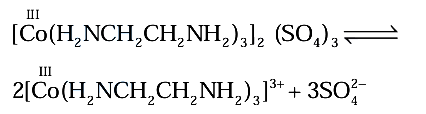
\(\begin{aligned} & \therefore \text { Primary valency }=3 \\ & \therefore \mathrm{x}+\mathrm{y}=5\end{aligned}\) -
- (A) Acidic
- (B) Neutral
- (C) Basic
- (D) Amphoteric
Show answer and solution
Correct Answer: (D)
Explanation:
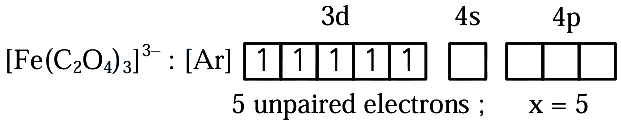
1. Identifying the Most Stable Complex: Among the given coordination complexes, \( \text{[Fe(C}_2\text{O}_4\text{)}_3\text{]}^{3-} \) is the most stable due to the chelation effect. The oxalate ion (\( \text{C}_2\text{O}_4^{2-} \)) is a bidentate ligand that binds to the central metal ion at two sites, forming three stable five-membered rings. Chelated complexes are significantly more stable than similar non-chelated complexes containing monodentate ligands.
2. Finding the Value of X: In the most stable complex \( \text{[Fe(C}_2\text{O}_4\text{)}_3\text{]}^{3-} \), the oxidation state of iron (\( \text{Fe} \)) is \( +3 \).
- Atomic number of \( \text{Fe} = 26 \)
- Ground state configuration of \( \text{Fe} = \text{[Ar] } 3d^6 4s^2 \)
- Configuration of \( \text{Fe}^{3+} = \text{[Ar] } 3d^5 4s^0 \)
Thus, the total number of electrons present in the \( d \)-orbitals of the central metal ion is \( X = 5 \).
3. Determining the Nature of the Oxide: Substituting \( X = 5 \) into the general oxide formula \( \text{V}_2\text{O}_X \) gives Vanadium Pentoxide (\( \text{V}_2\text{O}_5 \)). As the oxidation state of a transition metal increases, its oxides shift from basic to amphoteric/acidic characters. \( \text{V}_2\text{O}_5 \) is classically amphoteric because it reacts with both non-oxidizing acids and alkalis to form corresponding salts.
Hence, Option D is the correct choice. -
- (A) \(\mathrm{A}=\mathrm{Na}_2 \mathrm{CrO}_4, \mathrm{~B}=\mathrm{CrO}_5\)
- (B) \(\mathrm{A}=\mathrm{Na}_2 \mathrm{Cr}_2 \mathrm{O}_4, \mathrm{~B}=\mathrm{CrO}_4\)
- (C) \(\mathrm{A}=\mathrm{Na}_2 \mathrm{Cr}_2 \mathrm{O}_7, \mathrm{~B}=\mathrm{CrO}_3\)
- (D) \(\mathrm{A}=\mathrm{Na}_2 \mathrm{Cr}_2 \mathrm{O}_7,\mathrm{~B}=\mathrm{CrO}_5\)
Show answer and solution
Correct Answer: (A)
\(\mathrm{CrO}_2 \mathrm{Cl}_2+4 \mathrm{NaOH} \rightarrow \underset{\text { (A) }}{\mathrm{Na}_2 \mathrm{CrO}_4}+\underset{\text { (B) }}{2 \mathrm{NaCl}}+2 \mathrm{H}_2 \mathrm{O}\)\(\mathrm{Na}_2 \mathrm{CrO}_4+2 \mathrm{H}_2 \mathrm{O}_2+2 \mathrm{HCl} \rightarrow \underset{\begin{array}{l}\text { Missing from }\text { balanced eqaution }\end{array}}{2 \mathrm{NaCl}}+3 \mathrm{H}_2 \mathrm{O}\)
-
- (A) \(25\)
- (B) \(26\)
- (C) \(22\)
- (D) \(23\)
Show answer and solution
Correct Answer: (D)
\({ }_{22} \mathrm{Ti}^{+2} \Rightarrow[\mathrm{Ar}] 3 \mathrm{~d}^2\)\({ }_{23} \mathrm{~V}^{-2} \Rightarrow[\mathrm{Ar}] 3 \mathrm{~d}^3\)
\({ }_{25} \mathrm{Mn}^{+2} \Rightarrow[\mathrm{Ar}] 3 \mathrm{~d}^5\)
\({ }_{26} \mathrm{Fe}^{+2} \Rightarrow[\mathrm{Ar}] 3 \mathrm{~d}^0\)
-
- (A) \(1\)
- (B) \(2\)
- (C) \(3\)
- (D) \(0\)
Show answer and solution
Correct Answer: (D)
\(\mathrm{V}\) ' has highest enthalpy of atomisation ( \(515 \mathrm{~kJ} / \mathrm{mol}\) ) among first row transition elements.\(\mathrm{V}_2 \mathrm{O}_5\)
Here ' \(\mathrm{V}\) ' is in \(+5\) oxidation state
\(\mathrm{V}^{-5} \Rightarrow 1 \mathrm{~s}^2 2 \mathrm{~s}^2 2 \mathrm{p}^6 3 \mathrm{~s}^2 3 \mathrm{p}^6 \text { (no unpaired electrons) }\)
-
- (A) \(5\)
- (B) \(6\)
- (C) \(9\)
- (D) \(10\)
Show answer and solution
Correct Answer: (B)
Among given metals, \(\mathrm{Cr}\) has maximum \(\mathrm{IE}_2\)because Second electron is removed from stable
configuration \(3 \mathrm{~d}^5\)
\(\mathrm{Cr}^{+}:[\mathrm{Ar}] 3 \mathrm{~d}^5 4 \mathrm{~s}^0\)
\(\therefore\) No of unpaired \(\mathrm{e}^{-}\)in \(\mathrm{Cr}^{+}\)is \(5, \mathrm{n}=5\)
\(\text { So, Magnetic moment } =\sqrt{\mathrm{n}(\mathrm{n}+2)} \text { B.M }\)
\(=\sqrt{5(5+2)}=5.92 \mathrm{BM} \approx 6\)
-
- (A) \(\mathrm{Mn}_2 \mathrm{O}_7\) and \(\mathrm{MnO}_4^{-}\)
- (B) \(\mathrm{MnO}_4{ }^{2-}\) and \(\mathrm{MnO}_4^{-}\)
- (C) \(\mathrm{Mn}_2 \mathrm{O}_3\) and \(\mathrm{MnO}_4{ }^{2-}\)
- (D) \(\mathrm{MnO}_4{ }^{2-}\) and \(\mathrm{Mn}_2 \mathrm{O}_7\)
Show answer and solution
Correct Answer: (B)
Alkaline oxidative fusion of \(\mathrm{MnO}_2\) :\(2\mathrm{MnO}_2+4 \mathrm{OH}^{-}+\mathrm{O}_2 \rightarrow 2 \mathrm{MnO}_4^{2-}+2 \mathrm{H}_2 \mathrm{O}\)
Electrolytic oxidation of \(\mathrm{MnO}_4^{2-}\) in alkaline medium.
\(\mathrm{MnO}_4^{2-} \rightarrow \mathrm{MnO}_4^{-}+e^{-}\)
-
- (A) \(877\)
- (B) \(879\)
- (C) \(880\)
- (D) \(881\)
Show answer and solution
Correct Answer: (A)
CrO Basic oxide\(\mathrm{Cr}_2 \mathrm{O}_3\) Amphoteric oxide
In \(\mathrm{CrO}, \mathrm{Cr}\) exist as \(\mathrm{Cr}^{+2}\) and have \(\mu\) only \(=4.90\)
In \(\mathrm{Cr}_2 \mathrm{O}_3, \mathrm{Cr}\) exist as \(\mathrm{Cr}^{+3}\) and have \(\mu\) only \(=3.87\)
Sum of spin only magnetic moment
\(=4.90+3.87=8.77\)
\(\mu_{\text {only }}=877 \times 10^{-2}\)
Ans. \(877\)
-
- (A) \(1\)
- (B) \(0\)
- (C) \(5\)
- (D) \(8\)
Show answer and solution
Correct Answer: (B)
For \(3\)d transition series;Oxidising power : \(\mathrm{V}^{+5}<\mathrm{Cr}^{+6}<\mathrm{Mn}^{+7}\)
\(\mathrm{V}^{-5}:[\mathrm{Ar}] 4 \mathrm{~s}^0 3 \mathrm{~d}^0\)
Number of unpaired electron \(=0\)
\(u=0\)
-
- (A) \((C) < (E) < (B) < (A) < (D)\)
- (B) \((B) < (C) < (D) < (E) < (A)\)
- (C) \((A) < (D) < (C) < (B) < (E)\)
- (D) \(( A ) < (D) < (C) < (E) < (B)\)
Show answer and solution
Correct Answer: (D)
Unpaired electron\(\operatorname{Sc}[\mathrm{Ar}] 4 \mathrm{~s}^2 3 \mathrm{~d}^1 \ \ 1\)
\(\mathrm{Cr}[\mathrm{Ar}] 4 \mathrm{~s}^1 3 \mathrm{~d}^5 \ \ 6\)
\(\mathrm{~V}[\mathrm{Ar}] 4 \mathrm{~s}^2 3 \mathrm{~d}^3 \ \ 3\)
\(\mathrm{~T}[\mathrm{Ar}] 4 \mathrm{~s}^2 3 \mathrm{~d}^2 \ \ 2\)
\(\mathrm{Mn}[\mathrm{Ar}] 4 \mathrm{~s}^2 3 \mathrm{~d}^5 \ \ 5\)
- 66. Choose the correct option having all the elements with \(\mathrm{d}^{10}\) electronic configuration from the following: 2024 Hard
- (A) \({ }^{27} \mathrm{Co},{ }^{28} \mathrm{Ni},{ }^{26} \mathrm{Fe},{ }^{24} \mathrm{Cr}\)
- (B) \({ }^{29} \mathrm{Cu},{ }^{30} \mathrm{Zn},{ }^{48} \mathrm{Cd},{ }^{47} \mathrm{Ag}\)
- (C) \({ }^{46} \mathrm{Pd},{ }^{28} \mathrm{Ni},{ }^{26} \mathrm{Fe},{ }^{24} \mathrm{Cr}\)
- (D) \({ }^{28} \mathrm{Ni},{ }^{24} \mathrm{Cr},{ }^{26} \mathrm{Fe},{ }^{29} \mathrm{Cu}\)
Show answer and solution
Correct Answer: (B)
\( {[\mathrm{Cr}]=[\mathrm{Ar}] 4 \mathrm{~s}^1 3 \mathrm{~d}^5} \)\( {[\mathrm{Cd}]=[\mathrm{Kr}] 5 \mathrm{~s}^2 4 \mathrm{~d}^{10}} \)
\( {[\mathrm{Cu}]=[\mathrm{Ar}] 4 \mathrm{~s}^1 3 \mathrm{~d}^{10}} \)
\( {[\mathrm{Ag}]=[\mathrm{Kr}] 5 \mathrm{~s}^1 4 \mathrm{~d}^{10}} \)
\( {[\mathrm{Zn}]=[\mathrm{Ar}] 4 \mathrm{~s}^2 3 \mathrm{~d}^{10}}\)
-
- (A) \(A\), \(B\) and \(D\) only
- (B) \(A\) and \(C\) only
- (C) \(A\), \(B\) and \(C\) only
- (D) \(B\) and \(C\) only
Show answer and solution
Correct Answer: (B)
\((A)\) \(\mathrm{Mn}_2 \mathrm{O}_7\) is green oil at room temperature.\((B)\) \(\mathrm{V}_2 \mathrm{O}_4\) dissolve in acids to give \(\mathrm{VO}^{2+}\) salts.
\((C)\) \(\mathrm{CrO}\) is basic oxide
\((D)\) \(\mathrm{V}_2 \mathrm{O}_5\) is amphoteric it reacts with acid as well as base.
-
- (A) \(3\)
- (B) \(4\)
- (C) \(5\)
- (D) \(7\)
Show answer and solution
Correct Answer: (B)
\(\mathrm{MnO}_2+\mathrm{KOH}+\mathrm{O}_2 \rightarrow \mathrm{K}_2 \mathrm{MnO}_4+\mathrm{H}_2 \mathrm{O}\)\((A)\)
\({K}_2 \mathrm{MnO}_4 \xrightarrow{\text { Neutral/acidic solution }} \mathrm{KMnO}_4+\mathrm{MnO}_2\)
\(\mathrm{Mn}^{+4}:-[\mathrm{Ar}] 3 \mathrm{~d}^3\)
\(\mathrm{n}=3, \mu=\sqrt{3(3+2)}=3.87 \text { B.M. }\)
Nearest integer is (4)
-
- (A) \(\mathrm{Nd}^{3+}\) and \(\mathrm{Eu}^{3+}\)
- (B) \(\mathrm{La}^{3+}\) and \(\mathrm{Ce}^{4+}\)
- (C) \(\mathrm{Nd}^{3+}\) and \(\mathrm{Ce}^{4+}\)
- (D) \(\mathrm{Lu}^{3+}\) and \(\mathrm{Eu}^{3+}\)
Show answer and solution
Correct Answer: (B)
\(\mathrm{Ce}:[\mathrm{Xe}] 4 \mathrm{f}^1 5 \mathrm{~d}^1 6 \mathrm{~s}^2 ; \mathrm{Ce}^{4+}\) diamagnetic\(\mathrm{La}:[\mathrm{Xe}] 4 \mathrm{f}^0 5 \mathrm{~d}^1 6 \mathrm{~s}^2 ; \mathrm{La}^{3+}\) diamagnetic
-
- (A) Both \((A)\) and \((R)\) are true and \((R)\) is the correct explanation of \((A)\)
- (B) Both \((A)\) and \((R)\) are true but \((R)\) is not the correct explanation of \((A)\)
- (C) \((A)\) is false but \((R)\) is true
- (D) \((A)\) is true but \((R)\) is false
Show answer and solution
Correct Answer: (A)
\(\mathrm{Cr}^{2+}\) is reducing as it configuration changes from \(\mathrm{d}^4\) to \(\mathrm{d}^3\) due to formation of \(\mathrm{Cr}^{3+}\), which has half filled \(\mathrm{t}_{2 \mathrm{g}}\) level, on other hand, the change \(\mathrm{Mn}^{3+}\) to \(\mathrm{Mn}^{2+}\) result half filled \(d^3\) configuration which has extra stability. -
- (A) Both Statement \(I\) and Statement \(II\) is true
- (B) Both Statement \(I\) and Statement \(II\) is false
- (C) Statement \(I\) is true but Statement \(II\) is false
- (D) Statement \(I\) is false but Statement \(II\) is true
Show answer and solution
Correct Answer: (A)
\(\mathrm{MnO}_2+4 \mathrm{KOH}+\mathrm{O}_2 \xrightarrow{\text { fused }} 2 \mathrm{~K}_2 \mathrm{MnO}_4+2 \mathrm{H}_2 \mathrm{O}\)Dark green
Electrolytic oxidation in alkaline medium :
At anode :
\(\mathrm{MnO}_4^{2-} \rightarrow \mathrm{MnO}_4^{-}+\mathrm{e}^{-}\)
-
- (A) Statement \(I\) is false but Statement \(II\) is true
- (B) Both Statement \(I\) and Statement \(II\) are true
- (C) Statement \(I\) is true but Statement \(II\) is false
- (D) Both Statement \(I\) and Statement \(II\) are false
Show answer and solution
Correct Answer: (B)
Statement \((1)\) is true, \(\mathrm{Ce}^{+4}\) has noble gas electronic configuration.Statement \((2)\) is also true due to high reduction potential for \(\mathrm{Ce}^{4+} / \mathrm{Ce}^{3+}(+1.74 \mathrm{~V})\), and stability of \(\mathrm{Ce}^{3+}, \mathrm{Ce}^{4+}\) acts as strong oxidizing agent.
-
- (A) Both Statement \(I\) and Statement \(II\) are false
- (B) Statement \(I\) is false but Statement \(II\) is true
- (C) Both Statement \(I\) and Statement \(II\) are true
- (D) Statement \(I\) is true but Statement \(II\) is false
Show answer and solution
Correct Answer: (C)
On moving down the group in transition elements, stability of higher oxidation state increases, due to increase in effective nuclear charge.\( \Rightarrow \mathrm{E}_{\mathrm{Cu}^{+2} / \mathrm{Cu}}^{\circ}=0.34 \mathrm{~V} \)
\( \Rightarrow \mathrm{E}_{\mathrm{H}^{+} / \mathrm{H}_2}^{\circ}=0 \)
\( \mathrm{SRP}: \mathrm{Cu}^{2+}>\mathrm{H}^{+}\)
\(\mathrm{Cu}\) can't liberate hydrogen gas from weak acid.
-
- (A) \(B, C, D\) only
- (B) \(A, D, E\) only
- (C) \(A, B, C\) only
- (D) \(B, D, E\) only
Show answer and solution
Correct Answer: (D)
\(A\). \(\mathrm{CrO}_4{ }^{2-}\) is tetrahedral\(B\). \(2 \mathrm{Na}_2 \mathrm{CrO}_4+2 \mathrm{H}^{+} \rightarrow \mathrm{Na}_2 \mathrm{Cr}_2 \mathrm{O}_{/}+2 \mathrm{Na}^{+}+\mathrm{H}_2 \mathrm{O}\)
\(C\). As per \(NCERT\), green manganate is paramagnetic with \(1\) unpaired electron.
\(D\). Statement is correct.
\(E\). Statement is correct.
-
- (A) 2
- (B) 4
- (C) 6
- (D) 8
Show answer and solution
Correct Answer: (C)
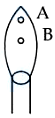
\(Fe ^{+3}\) will give green coloured bead when heated at point \(B\).
Number of unpaired \(e^{-}\)in \(Fe ^{+3}=5\)
\(\mu=5.92\)
Nearest integer = 6 -
- (A) \(\mathrm{IO}_4^{-}\)
- (B) \(\mathrm{IO}^{-}\)
- (C) \(\mathrm{I}_2\)
- (D) \(\mathrm{IO}_3^{-}\)
Show answer and solution
Correct Answer: (D)
\(2 \mathrm{MnO}_4^{-}+\mathrm{H}_2 \mathrm{O}+\mathrm{I}^{-} \xrightarrow{\text { allcaline medium }} 2 \mathrm{MnO}_2+2 \mathrm{OH}^{-}+\mathrm{IO}_3^{-}\) -
- (A) \(4\)
- (B) \(6\)
- (C) \(8\)
- (D) \(10\)
Show answer and solution
Correct Answer: (B)
\(\mathrm{K}_2 \mathrm{Cr}_2 \mathrm{O}_7(\mathrm{~s})+4 \mathrm{KCl}(\mathrm{s})+6 \mathrm{H}_2 \mathrm{SO}_4 \text { (conc.) }\)\(\rightarrow 2 \mathrm{CrO}_2 \mathrm{Cl}_2(\mathrm{~g})+6 \mathrm{KHSO}_4+3 \mathrm{H}_2 \mathrm{O}\)
This reaction is called chromyl chloride test. Here oxidation state of \(\mathrm{Cr}\) is +6 .
- 78. \(\mathrm{KMnO}_4\) decomposes on heating at \(513 \mathrm{~K}\) to form \(\mathrm{O}_2\) along with _______. 2024 Hard
- (A) \(\mathrm{MnO}_2 \& \mathrm{~K}_2 \mathrm{O}_2\)
- (B) \(\mathrm{K}_2 \mathrm{MnO}_4 \& \mathrm{Mn}\)
- (C) \(\mathrm{Mn} \& \mathrm{KO}_2\)
- (D) \(\mathrm{K}_2 \mathrm{MnO}_4 \& \mathrm{MnO}_2\)
Show answer and solution
Correct Answer: (D)
\(\mathrm{KMnO}_4 \xrightarrow{\Delta} \mathrm{K}_2 \mathrm{MnO}_4+\mathrm{MnO}_2+\mathrm{O}_2\) -
- (A) A-III, B-II, C-IV, D-I
- (B) A-III, B-IV, C-I, D-II
- (C) A-III, B-I, C-II, D-IV
- (D) A-III, B-I, C-IV, D-II
Show answer and solution
Correct Answer: (B)
(A-III, B-IV, C-I, D-II) -
- (A) \( (A)-I, (B)-II, (C)-III, (D)-IV\)
- (B) \( (A)-III, (B) - IV, (C) - I, (D)-II\)
- (C) \( (A)-IV, (B)-III, (C)-I, (D)-II\)
- (D) \((A)-II, (B)-I, (C)-IV, (D)-III\)
Show answer and solution
Correct Answer: (B)
\({24} \mathrm{Cr} \rightarrow[\mathrm{Ar}] 3 \mathrm{~d}^5 4 \mathrm{~s}^1 ; \mathrm{Cr}^{2+} \rightarrow[\mathrm{Ar}] 3 \mathrm{~d}^4\)\({25} \mathrm{Mn} \rightarrow\lfloor\mathrm{Ar}\rfloor 3 \mathrm{~d}^5 4 \mathrm{~s}^2 ; \mathrm{Mn}^{+} \rightarrow\lfloor\mathrm{Ar}\rfloor 3 \mathrm{~d}^5 4 \mathrm{~s}^1\)
\({28} \mathrm{Ni} \rightarrow[\mathrm{Ar}] 3 \mathrm{~d}^8 4 \mathrm{~s}^2 ; \mathrm{Ni}^{2+} \rightarrow[\mathrm{Ar}] 3 \mathrm{~d}^8\)
\({23} \mathrm{~V} \rightarrow[\mathrm{Ar}] 3 \mathrm{~d}^5 4 \mathrm{~s}^2 ; \mathrm{V}^{+} \rightarrow[\mathrm{Ar}] 3 \mathrm{~d}^3 4 \mathrm{~s}^1\)
-
- (A) \(\mathrm{CrO}_2 \mathrm{Cl}_2, \mathrm{Na}_2 \mathrm{CrO}_4\)
- (B) \(\mathrm{Na}_2 \mathrm{CrO}_4, \mathrm{CrO}_2 \mathrm{Cl}_2\)
- (C) \(\mathrm{CrO}_2 \mathrm{Cl}_2, \mathrm{KHSO}_4\)
- (D) \(\mathrm{CrO}_2 \mathrm{Cl}_2, \mathrm{Na}_2 \mathrm{Cr}_2 \mathrm{O}_7\)
Show answer and solution
Correct Answer: (A)
\( \mathrm{NaCl}+\text { conc. } \mathrm{H}_2 \mathrm{SO}_4+\mathrm{K}_2 \mathrm{Cr}_2 \mathrm{O}_7 \)
\( \rightarrow \mathrm{CrO}_2 \mathrm{Cl}_2 [(\text B)\text{ Reddish brown} ]+\mathrm{KHSO}_4+\mathrm{NaHSO}_4+\mathrm{H}_2 \mathrm{O}\)
\(\mathrm{CrO}_2 \mathrm{Cl}_2+\mathrm{NaOH} \rightarrow \mathrm{Na}_2 \mathrm{CrO}_4 [(\text C)\text{ Yellow colour}]+\mathrm{NaCl}+\mathrm{H}_2 \mathrm{O}\) -
- (A) \(1\)
- (B) \(2\)
- (C) \(5\)
- (D) \(8\)
Show answer and solution
Correct Answer: (B)
\(\mathrm{La}^{+3}-[\mathrm{Xe}] 4 \mathrm{f}^0\)\(\mathrm{Nd}^{+3}-[\mathrm{Xe}] 4 \mathrm{f}^3\)
\(\mathrm{Sm}^{+3}-[\mathrm{Xe}] 4 \mathrm{f}^5\)
\(\mathrm{Eu}^{+3}-[\mathrm{Xe}] 4 \mathrm{f}^6\)
\(\mathrm{Lu}^{+3}-[\mathrm{Xe}] 4 \mathrm{f}^{14}\)
\(\mathrm{La}^{+3}\) and \(\mathrm{Lu}^{+3}\) do not show any colour because no unpaired electron is present.
-
- (A) \(5\)
- (B) \(6\)
- (C) \(8\)
- (D) \(10\)
Show answer and solution
Correct Answer: (B)
Spin only magnetic moment of \(\mathrm{Mn}\) in \(\mathrm{KMnO}_4=0\) Spin only value of manganese product fromed during titration of \(\mathrm{KMnO}_4\) aganist oxalic acid in acidic medium is \(=6\)Ans. \(6\)
-
- (A) \([\mathrm{Xe}] 4 \mathrm{f}^4 6 \mathrm{~s}^2\)
- (B) \([\mathrm{Xe}] 5 \mathrm{f}^4 7 \mathrm{~s}^2\)
- (C) \([\mathrm{Xe}] 4 \mathrm{f}^6 6 \mathrm{~s}^2\)
- (D) \([\mathrm{Xe}] 4 \mathrm{f}^1 5 \mathrm{~d}^1 6 \mathrm{~s}^2\)
Show answer and solution
Correct Answer: (A)
Electronic configuration of \(\mathrm{Nd}(\mathrm{Z}=60)\) is; \([\mathrm{Xe}] 4 \mathrm{f}^4 6 \mathrm{~s}^2\) -
- (A) \(\mathrm{Cu}\) \((II)\) is less stable
- (B) Stability of \(\mathrm{Cu}\) \((I)\) and \(\mathrm{Cu}\) \((II)\) depends on nature of copper salts
- (C) \(\mathrm{Cu}\) \((II)\) is more stable
- (D) \(\mathrm{Cu}\) \((I)\) and \(\mathrm{Cu}\) \((II)\) are equally stable
Show answer and solution
Correct Answer: (C)
\(\mathrm{Cu}(\mathrm{II})\) is more stable than \(\mathrm{Cu}(\mathrm{I})\) because hydration energy of \(\mathrm{Cu}^{+2}\) ion compensate \(\mathrm{IE}_2\) of \(\mathrm{Cu}\). - 86. The electronic configuration of Einsteinium is _______. (Given atomic number of Einsteinium \(=99\) ) 2024 Medium
- (A) \([\mathrm{Rn}] 5 \mathrm{f}^{12} 6 \mathrm{~d}^0 7 \mathrm{~s}^2\)
- (B) \([\mathrm{Rn}] 5 \mathrm{f}^{11} 6 \mathrm{~d}^0 7 \mathrm{~s}^2\)
- (C) \([\mathrm{Rn}] 5 \mathrm{f}^{13} 6 \mathrm{~d}^0 7 \mathrm{~s}^2\)
- (D) \([\mathrm{Rn}] 5 \mathrm{f}^{10} 6 \mathrm{~d}^0 7 \mathrm{~s}^2\)
Show answer and solution
Correct Answer: (B)
Einsteinium (atomic No \(=99):[\mathrm{Rn}] 5 \mathrm{f}^{11} 6 \mathrm{~d}^0 7 \mathrm{~s}^2\) - 87. The element which shows only one oxidation state other than its elemental form is _______. 2024 Medium
- (A) Cobalt
- (B) Scandium
- (C) Titanium
- (D) Nickel
Show answer and solution
Correct Answer: (B)
Co, \(T i, N i\) can show \(+2,+3\) and +\(4\) oxidation state, But 'Sc' only shows +\(3\) stable oxidation state. -
- (A) \(5\)
- (B) \(6\)
- (C) \(8\)
- (D) \(10\)
Show answer and solution
Correct Answer: (B)
\(4 \mathrm{FeCr}_2 \mathrm{O}_4+8 \mathrm{Na}_2 \mathrm{CO}_3+7 \mathrm{O}_2 \rightarrow\)\(8 \mathrm{Na}_2 \mathrm{CrO}_4+2 \mathrm{Fe}_2 \mathrm{O}_3+8 \mathrm{CO}_2\)
\(\mathrm{~A} \quad \text { B }\)
Spin only magnetic moment
\(\text { For } \mathrm{Na}_2 \mathrm{CrO}_4 \mu_{\mathrm{B}}=0\)
\(\text { For } \mathrm{Fe}_2 \mathrm{O}_3 \mu_{\mathrm{B}}=5.9\)
\(\text { sum }=5.9\)
-
- (A) \(\mathrm{Fe}\)
- (B) \(\mathrm{Mn}\)
- (C) \(\mathrm{Ti}\)
- (D) \(\mathrm{Co}\)
Show answer and solution
Correct Answer: (B)
Mn shows highest oxidation state \(\left(\mathrm{Mn}^{+7}\right)\) in \(3 \mathrm{d}\) series metals. -
- (A) \(3\)
- (B) \(4\)
- (C) \(1\)
- (D) \(5\)
Show answer and solution
Correct Answer: (C)
\(\mathrm{Cm}\) is Actinide. -
- (A) 5
- (B) 10
- (C) 15
- (D) 20
Show answer and solution
Correct Answer: (A)
(A) \(SrSO _4\) - white
(B) \(Mg \left( NH _4\right) PO _4\) - white
(C) \(BaCrO _4\) - yellow
(D) \(Mn ( OH )_2\) - white
(E) \(PbSO _4\) - white
(F) \(PbCrO _4\) - yellow
(G) \(A g B r\)-pale yellow
(H) \(PbI _2\) - yellow
(I) \(CaC _2 O _4\) - white
(J) \(\left[ Fe ( OH )_2\left( CH _3 COO \right)\right]\) - Brown Red - 92. The orange colour of \(\mathrm{K}_2 \mathrm{Cr}_2 \mathrm{O}_7\) and purple colour of \(\mathrm{KMnO}_4\) is due to _______. 2024 Hard
- (A) Charge transfer transition in both.
- (B) \(d \rightarrow d\) transition in \(\mathrm{KMnO}_4\) and charge transfer transitions in \(\mathrm{K}_2 \mathrm{Cr}_2 \mathrm{O}_r\).
- (C) \(d \rightarrow d\) transition in \(\mathrm{K}_2 \mathrm{Cr}_2 \mathrm{O}_7\) and charge transfer transitions in \(\mathrm{KMnO}_4\).
- (D) \(\mathrm{d} \rightarrow \mathrm{d}\) transition in both.
Show answer and solution
Correct Answer: (A)
\(\mathrm{K}_2 \mathrm{Cr}_2 \mathrm{O}_7 \rightarrow \mathrm{Cr}^{+6} \rightarrow \text { No d - d transition }\)
\(\mathrm{KMnO}_4 \rightarrow \mathrm{Mn}^{7+} \rightarrow \text { No d - d transition }\) Charge transfer
-
- (A) \(0\)
- (B) \(5\)
- (C) \(8\)
- (D) \(9\)
Show answer and solution
Correct Answer: (A)
Metal having least metallic radii among \(\mathrm{Sc}, \mathrm{T} i, \mathrm{~V}\),\(\mathrm{Cr}, \mathrm{Mn} \& \mathrm{Zn}\) is \(\mathrm{Cr}\).
Spin only magnetic moment of \(\mathrm{CrO}_4{ }^{2-}\).
Here \(\mathrm{Cr}^{+0}\) is in \(\mathrm{d}^0\) configuration (diamagnetic).
-
- (A) \(5\)
- (B) \(8\)
- (C) \(10\)
- (D) \(15\)
Show answer and solution
Correct Answer: (A)
Strong oxidising agent \(=\mathrm{Co}^{+3}\)No. of unpaired \(\mathrm{e}^{-}\)in \(\mathrm{Co}^{+3}\left[3 \mathrm{~d}^6\right]=4\)
Hence \(\mu=\sqrt{n(n+2)}=\sqrt{24} B M\)
Nearest integer \(=5\)
- 95. The transition metal having highest \(3^{\text {rd }}\) ionisation enthalpy is _______. 2024 Hard
- (A) \(\mathrm{Cr}\)
- (B) \(\mathrm{Mn}\)
- (C) \(\mathrm{V}\)
- (D) \(\mathrm{Fe}\)
Show answer and solution
Correct Answer: (B)
\(3\)rd Ionisation energy : [\(NCERT\) Data]\(\mathrm{V}: 2833\ \mathrm{KJ} / \mathrm{mol}\)
\(\mathrm{Cr}: 2990\ \mathrm{KJ} / \mathrm{mol}\)
\(\mathrm{Mn}: 3260\ \mathrm{KJ} / \mathrm{mol}\)
\(\mathrm{Fe}: 2962\ \mathrm{KJ} / \mathrm{mol}\)
alternative
\(Mn\) : \(3 d^5 4 s^2\)
\(\mathrm{Fe}: 3 \mathrm{~d}^6 4 \mathrm{~s}^2\)
\(\mathrm{Cr}: 3 \mathrm{~d}^5 4 \mathrm{~s}^1\)
\(V: 3 d^3 4 s^2\)
So Mn has highest \(3rd\) IE among all the given elements due to \(d^5\) configuration.
-
- (A) \(\mathrm{Lu}^{3+}\)
- (B) \(\mathrm{Gd}^{3+}\)
- (C) \(\mathrm{Eu}^{2+}\)
- (D) \(\mathrm{Ce}^{4+}\)
Show answer and solution
Correct Answer: (C)
\(\begin{array}{ll}\mathrm{Eu}^{+2} & \mathrm{Eu}^{+3}+1 \mathrm{e}^{-} \\{[\mathrm{Xe}] 4 \mathrm{f}^7 6 \mathrm{~s}^0} \rightarrow & {[\mathrm{Xe}] 4 \mathrm{f}^6 6 \mathrm{~s}^0}\end{array}\) -
- (A) \(\mathrm{CuSO}_4 .5 \mathrm{H}_2 \mathrm{O}\)
- (B) \(\mathrm{K}_2 \mathrm{Cr}_2 \mathrm{O}_7\)
- (C) \(\mathrm{K}_2 \mathrm{CrO}_4\)
- (D) \(\mathrm{KMnO}_4\)
Show answer and solution
Correct Answer: (A)
\(\mathrm{CuSO}_4 \cdot 5 \mathrm{H}_2 \mathrm{O}\)\(\mathrm{Cu}^{2+}: 3 \mathrm{~d}^9 4 \mathrm{~s}^0\)
unpaired electron present so it show colour due to \(d-d\) transition.
- 98. Which of the following electronic configuration would be associated with the highest magnetic moment? 2024 Hard
- (A) \([\mathrm{Ar}] 3 \mathrm{~d}^7\)
- (B) \([\mathrm{Ar}] 3 \mathrm{~d}^8\)
- (C) \([\mathrm{Ar}] 3 \mathrm{~d}^3\)
- (D) \([\mathrm{Ar}] 3 \mathrm{~d}^6\)
Show answer and solution
Correct Answer: (D)
\(3\text{ d}^7\) \(3\text{ d}^8\) \(3\text{ d}^3\) \(3\text{ d}^6\) No. of. unpaired \(e^{-}\) \(3\) \(2\) \(3\) \(4\) Spin only Magnetic moment \(\sqrt{15}\text{ BM}\) \(\sqrt{8}\text{ BM}\) \(\sqrt{15}\text{ BM}\) \(\sqrt{24}\text{ BM}\) -
- (A) \(B\), \(D\) only
- (B) \(B\), \(C\) only
- (C) \(A\), \(D\) only
- (D) \(C\), \(D\) only
Show answer and solution
Correct Answer: (A)
\((A)\) \(\mathrm{Zn}, \mathrm{Cd}, \mathrm{Hg}\) exhibit lowest enthalpy of atomization in respective transition series.\((C)\) Compounds of \(\mathrm{Zn}, \mathrm{Cd}\) and \(\mathrm{Hg}\) are diamagnetic in nature.
-
- (A) Black
- (B) Red
- (C) Green
- (D) Blue
Show answer and solution
Correct Answer: (C)
\(Cr _2 O _7^{2-}+ SO _3^{2-} \stackrel{ H ^{+}}{\longrightarrow} \underset{\text { Green }}{ Cr ^{3+}}+ SO _4^{2-}\)
No questions on this page match these filters.