


All Co-ordination chemistry questions
Newest firstShowing 101–150 of 280 questions
-
- (A) \(\left[\mathrm{Ni}(\mathrm{CN})_4\right]^{2-}\)
- (B) \(\left[\mathrm{Ni}\left(\mathrm{NH}_3\right)_2 \mathrm{Cl}_2\right]\)
- (C) \(\left[\mathrm{Fe}\left(\mathrm{NH}_3\right)_4 \mathrm{Cl}_2\right]^{+}\)
- (D) \(\left[\mathrm{Co}\left(\mathrm{NH}_3\right)_4 \mathrm{Cl}_2\right]^{+}\)
Show answer and solution
Correct Answer: (A)
In Homoleptic complex all the ligand attached with the central atom should be the same. Hence \(\left[\mathrm{Ni}(\mathrm{CN})_4\right]^{2-}\) is a homoleptic complex. -
- (A) \(\left[\mathrm{Co}\left(\mathrm{H}_2 \mathrm{O}\right)_6\right]^{2+}\)
- (B) \(\left[\mathrm{Fe}\left(\mathrm{H}_2 \mathrm{O}\right)_6\right]^{2+}\)
- (C) \(\left[\mathrm{Mn}\left(\mathrm{H}_2 \mathrm{O}\right)_6\right]^{2+}\)
- (D) \(\left[\mathrm{Cr}\left(\mathrm{H}_2 \mathrm{O}\right)_6\right]^{2+}\)
Show answer and solution
Correct Answer: (A)
Least paramagnetic behaviour \(=\left[\mathrm{Co}\left(\mathrm{H}_2 \mathrm{O}\right)_6\right]^{2+}\)Number of unpaired \(\mathrm{e}^{-}\) \(\mu=\sqrt{n(n+2)}\) \(B.M.\) \(\left[\mathrm{Co}\left(\mathrm{H}_2 \mathrm{O}\right)_6\right]^{2+}\) \(3\) \(3.87\) \(\left[\mathrm{Fe}\left(\mathrm{H}_2 \mathrm{O}\right)_6\right]^{2+}\) \(4\) \(4.89\) \(\left[\mathrm{Mn}\left(\mathrm{H}_2 \mathrm{O}\right)_6\right]^{2+}\) \(5\) \(5.92\) \(\left[\mathrm{Cr}\left(\mathrm{H}_2 \mathrm{O}\right)_6\right]^{2+}\) \(4\) \(4.89\) - 103. Yellow compound of lead chromate gets dissolved on treatment with hot \(\mathrm{NaOH}\) solution. The product of lead formed is a : 2024 Hard
- (A) Tetraanionic complex with coordination number six
- (B) Neutral complex with coordination number four
- (C) Dianionic complex with coordination number six
- (D) Dianionic complex with coordination number four
Show answer and solution
Correct Answer: (D)
\(\mathrm{PbCrO}_4+\mathrm{NaOH}\) (hot excess) \(\rightarrow\left[\mathrm{Pb}(\mathrm{OH})_4\right]^{-2}+\) \(\mathrm{Na}_2 \mathrm{CrO}_4\)Dianionic complex with coordination number four
-
- (A) \(0.02,0.02\)
- (B) \(0.01,0.01\)
- (C) \(0.02,0.01\)
- (D) \(0.01,0.02\)
Show answer and solution
Correct Answer: (B)
\(\begin{array}{l}{\left[ Co \left( NH _3\right)_5 SO _4\right] Br + AgNO _3 \rightarrow AgBr \downarrow} \\ 0.01\, mol \qquad\quad \text { excess } \quad 0.01\,Mol \\ {\left[ Co \left( NH _3\right)_5 Br \right] SO _4+ BaCl _2 \rightarrow BaSO _4 \downarrow} \\ 0.01 mol \qquad\quad \text { excess } \quad 0.01\,Mol \\\end{array}\) - 105. An ammoniacal metal salt solution gives a brilliant red precipitate on addition of dimethylglyoxime. The metal ion is : 2023 Medium
- (A) \(Cu ^{2+}\)
- (B) \(Co ^{2+}\)
- (C) \(Fe ^{2+}\)
- (D) \(Ni ^{2+}\)
Show answer and solution
Correct Answer: (D)
\(Ni ^{+2}+2 DMG \stackrel{ NH _3( aq )}{\longrightarrow}\left[ Ni ( DMG )_2\right]\) -
- (A) cis \(-\left[ PtCl _2( en )_2\right]^{2+}\)
- (B) trans \(-\left[ PtCl _2( en )_2\right]^{2+}\)
- (C) cis \(-\left[ PtCl _2\left( NH _3\right)_2\right]\)
- (D) trans \(-\left[ Co \left( NH _3\right)_4 Cl _2\right]^{+}\)
Show answer and solution
Correct Answer: (A)
this is chiral complex form
- 107. For a metal ion, the calculated magnetic moment is \(4.90\,BM\). This metal ion has \(........\) number of unpaired electons. 2023 Medium
- (A) \(6\)
- (B) \(8\)
- (C) \(4\)
- (D) \(5\)
Show answer and solution
Correct Answer: (C)
\(\mu=\sqrt{n(n+2)}\,B M\)\(4.90=\sqrt{n(n+2)}\)
\(n=4\)
-
- (A) \(A\) is false but \(R\) is true.
- (B) \(A\) is true but \(R\) is false.
- (C) Both \(A\) and \(R\) are true and \(R\) is the correct explanation of \(A\).
- (D) Both \(A\) and \(R\) are true and R is NOT the correct explanation of \(A\).
Show answer and solution
Correct Answer: (A)
Since \(H _2 O\) is strong field ligand compared to chloride and \(Co ^{3+}\) ion is present.\(\therefore\) CFSE is higher for \(\left[ Co \left( NH _3\right)_5 H _2 O \right]^{+3}\), hence it will absorb at lower wavelength.
-
- (A) \(4\)
- (B) \(2\)
- (C) \(6\)
- (D) \(8\)
Show answer and solution
Correct Answer: (B)
\(\mu_{ s }=\sqrt{ n ( n +2)} BM \quad\) (n=no. of unpaired electrons)\(n\) \(V ^{3+}:[ Ar ] 3 d ^2 4 s ^0\) \(2\) \(Cr ^{3+}:[ Ar ] 3 d ^3 4 s ^0\) \(3\) \(Fe ^{2+}:[ Ar ] 3 d ^6 4 s ^0\) \(4\) \(Ni ^{3+}:[ Ar ] 3 d ^7 4 s ^0\) \(5\) \(Cr ^{3+}\) and \(Ni ^{3+}\) have same value of \(\mu_{ s }\)
-
- (A) \(A, B\) and \(C\)
- (B) \(A, B\) and \(D\)
- (C) \(A\) and \(D\)
- (D) \(B\) and \(C\)
Show answer and solution
Correct Answer: (B)
\(\left[ NiBr _2 Cl _2\right]^{2-} \rightarrow\) This complex species is tetrahedral as \(Br ^{\Theta}\) and \(Cl ^{\Theta}\) are weak field ligands. \(\left[ PtBr _2 Cl _2\right]^{2-} \rightarrow As\) Pt belongs to 5 d series. This complex species is square planar.Both the complex species are optically inactive. \(\left[ NiBr _2 Cl _2\right]^{2-}\), being tetrahedral does not show Geometrical Isomerism. \(\left[ PtBr _2 Cl _2\right]^{2-}\) shows two Geometrical Isomers.
\(\left[ PtBr _2 Cl _2\right]^{2-}\) shows two Geometrical Isomers.
-
- (A) \(481\)
- (B) \(482\)
- (C) \(480\)
- (D) \(483\)
Show answer and solution
Correct Answer: (C)
\(\left( Ti ^{+3}\left( H _2 O \right)_6\right)^{3+}\)\(Ti ^{+3}: 3 d ^1\)
\(C.F.S.E.\) \(=-0.4 \times \Delta_0\)
\(=-\frac{96 \times 10^3}{ N _0}\,J\)
\(\Delta_0=\frac{96 \times 10^3}{0.4 \times 6 \times 10^{23}}\)
\(\frac{ hc }{\lambda}=\frac{96 \times 10^3}{0.4 \times 6 \times 10^{23}}\)
\(\lambda=\frac{0.4 \times 6 \times 10^{23} \times 6.4 \times 10^{-34} \times 3 \times 10^8}{96 \times 10^3}\)
\(=0.48 \times 10^{-6}\,m\)
\(=480 \times 10^{-9}\,m\)
\(=480\,nm\)
- 112. In ammonium-phosphomolybdate, the oxidation state of Mo is \({ }^{+}\) \(..........\). 2023 Medium
- (A) \(8\)
- (B) \(4\)
- (C) \(10\)
- (D) \(6\)
Show answer and solution
Correct Answer: (D)
\(\left( NH _4\right)_3 PO _4 \cdot 12 MoO _3\)Let \(X =\) oxidation state of \(Mo\) in \(MoO _3\)
\(X +(-2) \times 3=0\)
\(X =+6\)
- 113. In potassium ferrocyanide, there are \(..........\) pairs of electrons in the \(t _{2 g }\) set of orbitals 2023 Medium
- (A) \(4\)
- (B) \(3\)
- (C) \(2\)
- (D) \(1\)
Show answer and solution
Correct Answer: (B)
\(K _4\left[ Fe ( CN )_6\right]\)\(Fe ^{+2}=[ Ar ] 3 d ^6\)
\(CN ^{-}= SFL\)
\(t _{2 g }\) contain \(6\) electron so it become \(3\) pairs:-

-
- (A) A - II, B - IV, C - I, D - III
- (B) A - IV, B-III, C - II, D - I
- (C) A - III, B - IV, C - I, D - II
- (D) A - II , B - I , C - IV , D - III
Show answer and solution
Correct Answer: (A)
For option \((A)\)\(Cr ^{+3}: 3 d ^3\)
\(CN ^{-} \rightarrow SFL\)
\(\Rightarrow \text { No. of unpaired electrons }=3\)
For option \((B)\)
\(Fe ^{+2}: 3 d ^6\)
\(H _2 O : WFL\)
No. of unpaired electrons \(=4\)
For option \((C)\)
\(Co ^{+3}: 3 d ^6\)
\(NH _3: SFL\)
No. of unpaired electrons \(=0\)
For option \((D)\)
\(Ni ^{-+2}: 3 d ^8\)
\(NH _3: SFL\)
No. of unpaired electrons \(=2\)
-
- (A) \(A-I, B-IV, C-II, D-III\)
- (B) \(A-II, B-III, C-I, D-IV\)
- (C) \(A-I, B-II, C-IV, D-III\)
- (D) \(A-III, B-IV, C-I, D-II\)
Show answer and solution
Correct Answer: (A)
CFSE \(=\left(-0.4 nt _{2 g }+0.6 n _{ eg }\right) \Delta_0\)\(nt _{2 g }=\) number of electrons in \(t _{2 g }\) orbital
\(n_{ eg }=\) number of electrons in eg orbital
-
- (A) \(A-II, B-IV, C-I, D-III\)
- (B) \(A-IV, B-I, C-II, D-III\)
- (C) \(A-IV, B-I, C-III, D-II\)
- (D) \(A-II, B-IV, C-III, D-I\)
Show answer and solution
Correct Answer: (B)
(A) \({\left[ Ti \left( H _2 O \right)_6\right]^{2+}}\)\(Ti ^{2+} \Rightarrow 3 d ^2 4 s ^0\)
\(t _{2 g } e ^{-}=2\)
\(e _{ g } e ^{-}=0\)
\(CFSE =[-0.4 \times 2+0.6 \times 0] \Delta_0\)
\(-0.8\,\Delta\)
(B) \({\left[ V \left( H _2 O \right)_6\right]^{2+}}\)
\(V ^{2+} \Rightarrow 3 d ^3 4 s ^0\)
\(t _{2 g } e ^{-}=3\)
\(e _{ g } e ^{-}=0\)
\(CFSE =[-0.4 \times 3+0.6 \times 0] \Delta_0\)
\(-1.2 \Delta_0\)
(C) \({\left[ Mn \left( H _2 O \right)_6\right]^{3+}}\)
\(Mn ^{3+} \Rightarrow 3 d ^4 4 s ^0\)
\(t _{2 g } e ^{-}=3\)
\(e _{ g } e ^{-}=1\)
\(CFSE =[-0.4 \times 3+0.6 \times 1] \Delta_0\)
\(=-0.6 \Delta_0\)
(D) \({\left[ Fe \left( H _2 O \right)_6\right]^{3+}}\)
\(Fe ^{3+} \Rightarrow 3 d ^5 4 s ^0\)
\(t _{2 g } e ^{-}=3 \quad e _{ g }=2\)
\(CFSE =[-0.4 \times 3+0.6 \times 2] \Delta_0\)
\(=0 \Delta_0\)
-
- (A) \(A - II, B - I, C - III, D - IV\)
- (B) \(A - I, B - II, C - III, D - IV\)
- (C) \(A - II, B - I, C - IV, D - III\)
- (D) \(A - I, B- II, C - IV, D - III\)
Show answer and solution
Correct Answer: (D)
For \(\left[ Fe \left( NH _3\right)_6\right]^{+2}, \Delta_0 < P\), hence the pairing of electrons does not occur in \(t_{2 g}\). Therefore complex is outer orbital and its hybridisation is \(sp ^3 d ^2\).List \(I\) (Complexes) List \(II\) (Hybridisation) \(A\) \(\left[ Ni ( CO )_4\right]\) \(I\) \(sp ^3\) \(B\) \(\left[ Cu \left( NH _3\right)_4\right]^{2+}\) \(II\) \(dsp^2\) \(C\) \(\left[ Fe \left( NH _3\right)_6\right]^{2+}\) \(III\) \(sp^3d^2\) \(D\) \(\left[ Fe \left( H _2 O \right)_6\right]^{2+}\) \(IV\) \(d^2sp^3\) -
- (A) \(A-IV, B-I, C-III, D-II\)
- (B) \(A-III, B-II, C-I, D-IV\)
- (C) \(A-III, B-I, C-II, D-IV\)
- (D) \(A- II, B-III, C-IV, D-I\)
Show answer and solution
Correct Answer: (B)
List \(I\) (Coordination entity) List \(II\) (Wavelength of light absorbed in \(nm\)) \(A\) \({\left[ CoCl \left( NH _3\right)_5\right]^{2+}}\) \(I\) \(535\) \(B\) \({\left[ Co \left( NH _3\right)_6\right]^{3+}}\) \(II\) \(475\) \(C\) \({\left[ Co ( CN )_6\right]^{3-}}\) \(III\) \(310\) \(D\) \({\left[ Cu \left( H _2 O \right)_4\right]^{2+}}\) \(IV\) \(600\) \(E =\frac{ hc }{\lambda} \Rightarrow E \propto \frac{1}{\lambda}\)
\(\Rightarrow \Delta( CFSE ) \propto \frac{1}{\lambda_{\text {absorb }}} \propto \text { strength of ligand. }\)
- 119. Number of ambidentate ligands in a representative metal complex \(\left[ M ( en )( SCN )_4\right]\) is \(\text { [en }=\text { ethylenediamine }]\) 2023 Medium
- (A) \(6\)
- (B) \(8\)
- (C) \(10\)
- (D) \(4\)
Show answer and solution
Correct Answer: (D)
\(\left[ M ( en )( SCN )_4\right]\)Ambidentate ligand means two ligand site,
so ambidentate ligand is \(SCN\).
- 120. Reaction of BeO with ammonia and hydrogen fluoride gives ' A ' which on thermal decomposition gives \(BeF _2\) and \(NH _4 F\). What is ' A '? 2023 Medium
- (A) H_3 NBeF_3
- (B) \left(NH_4\right)_2 BeF_4
- (C) \left(NH_4\right)\left(BeF_3\right)
- (D) \left(NH_4\right)_2\left(Be_2 F_6\right)
Show answer and solution
Correct Answer: (B)
\begin{array}{l} BeO+2 NH_3+4 HF \rightarrow\left(NH_4\right)_2 BeF_4+H_2 O \\ \left(NH_4\right)_2 BeF_4 \xrightarrow{\Delta} BeF_2+NH_4 F \end{array} - 121. The \(Cl - Co - Cl\) bond angle values in a fac\(\left[ Co \left( NH _3\right)_3 Cl _3\right]\) complex is/are: 2023 Medium
- (A) \(90^{\circ}\) and \(180^{\circ}\)
- (B) \(90^{\circ}\)
- (C) \(180^{\circ}\)
- (D) \(90^{\circ}\) and \(120^{\circ}\)
Show answer and solution
Correct Answer: (B)
The \(Cl - Co - Cl\) bond angle in above octahedral complex is \(90^{\circ}\)
-
- (A) \(\left[ Co \left( H _2 O \right)_6\right]^{3+}\)
- (B) \(\left[ Co \left( NH _3\right)_5 Cl \right]^{2+}\)
- (C) \(\left[ Co \left( NH _3\right)_5 NO _2\right]^{2+}\)
- (D) \(\left[ Co \left( NH _3\right)_5 Cl \right]^{+}\)
Show answer and solution
Correct Answer: (C)
\(\left(\left[ Co \left( NH _3\right)_5 NO _2\right]^{2+}\right.\)Two linkage isomers possible \(NO _2 \rightarrow\) Ambidentate ligand
-
- (A) \(Fe _4\left[ Fe ( CN )_6\right]_3\)
- (B) \(\left[ Fe _3( OH )_2( OAc )_6\right] Cl\)
- (C) \(K _3\left[ Co \left( NO _2\right)_6\right]\)
- (D) \(\left( NH _4\right)_3\left[\operatorname{As}\left( Mo _3 O _{10}\right)_4\right]\)
Show answer and solution
Correct Answer: (B)
\(Fe _4\left[ Fe ( CN )_6\right]_3\) Prussian Blue-water insoluble\(K _3\left[ Co \left( NO _2\right)_6\right]\) very poorly water soluble
\(\left( NH _4\right)_3\left[\right.\) As \(\left( MO _3 O _{10}\right)_4\) ] water insoluble ammonium arseno molybdate
\(\left[ Fe _3( OH )_2( OAc )_6\right] Cl\) is water soluble.
- 124. The complex with highest magnitude of crystal field splitting energy \(\left(\Delta_0\right)\) is 2023 Medium
- (A) \(\left[ Cr \left( OH _2\right)_6\right]^{3+}\)
- (B) \(\left[ Ti \left( OH _2\right)_6\right]^{3+}\)
- (C) \(\left[ Fe \left( OH _2\right)_6\right]^{3+}\)
- (D) \(\left[ Mn \left( OH _2\right)_6\right]^{3+}\)
Show answer and solution
Correct Answer: (A)
\(Ti ^{+3}=67\,pm\) radius\(Cr ^{3+}=62\,pm\) radius
\(Mn ^{+3}=65\, pm\) radius
\(Fe ^{+3}=65\, pm\) radius
So, \(Cr ^{3+}\) has highest tendency to attract ligand.
-
- (A) \(A < E < D < C < B\)
- (B) \(E < A < D < C < B\)
- (C) \(E < A < B < D < C\)
- (D) \(A < E < C < B < D\)
Show answer and solution
Correct Answer: (B)
\(A\). \(\left[ Fe ( CN )_6\right]^{3-} n =1\)\(B\). \(\left[ FeF _6\right]^{3-} n =5\)
\(C\). \(\left[ CoF _6\right]^{3-} n =4\)
\(D\). \(\left.[\text { Cr(oxalate })_3\right]^{3-} n =3\)
\(E\). \(\left[ Ni ( CO )_4\right] n =0\)
-
- (A) \(6\)
- (B) \(5\)
- (C) \(7\)
- (D) \(8\)
Show answer and solution
Correct Answer: (C)
\(Co ^{2+}: 3 d ^7 4 s ^0, Cl ^{-}: WFL\)Configuration \(e ^4 t _2^3: m =4\)
Number of unpaired electrons \(=3\)
So, answer \(=7\)

-
- (A) \(1\)
- (B) \(2\)
- (C) \(3\)
- (D) \(4\)
Show answer and solution
Correct Answer: (A)
\(Co ^{2+}: 3 d ^7\) configuration\(t _{2 g }^{221} e _{ g }^{11}\)
- 128. The hybridization and magnetic behaviour of cobalt ion in \(\left[ Co \left( NH _3\right)_6\right]^{3+}\) complex, respectively is 2023 Medium
- (A) \(sp ^3 d _3^2\) and diamagnetic
- (B) \(d ^2 sp _3^3\) and paramagnetic
- (C) \(d ^2 sp _3^3\) and diamagnetic
- (D) \(sp ^{3^1} d ^2\) and paramagnetic
Show answer and solution
Correct Answer: (C)
\(\left[ Co \left( NH _3\right)_6\right]^{+3}- d ^2 sp ^3\), diamagnetic -
- (A) \(6.92\,B.M.\) in both
- (B) \(4.89\,B.M.\) and \(6.92\,B.M.\)
- (C) \(3.87\,B.M.\) and \(1.732\,B.M.\)
- (D) \(5.92\,B.M.\) and \(1.732\,B.M\)
Show answer and solution
Correct Answer: (D)
\(\left[ Fe \left( H _2 O \right)_6\right]^{3+}\)\(\therefore \text { Unpaired } e ^{-}=5\)
\(\mu=\sqrt{ n ( n +2)}\)
\(=\sqrt{5(5+2)}\)
\(\mu=\sqrt{35}=5.92 \text { B.M. }\)
\({\left[ Fe ( CN )_6\right]^{-3}}\)
Pairing occur due to strong field ligand \(CN ^{-}\)
\(\therefore\) Unpaired \(e^-\) \(\Rightarrow 1\)
\(\mu=\sqrt{ n ( n +2)}\)
\(=\sqrt{1(1+2)}=\sqrt{3}=1.732 \text { B.M. }\)

-
- (A) \(A\) and \(C\) Only
- (B) \(A\) and \(E\) Only
- (C) \(D\) and \(E\) Only
- (D) \(A,C\) and \(E\) Only
Show answer and solution
Correct Answer: (A)
\(Mg\) is present in chlorophyll and in black and white photography the developed film is fixed by washing with hypo solution which dissolves the undecomposed \(AgBr\) to form a complex ion \(\left[ Ag \left( S _2 O _3\right)_2\right]^{3-}\) -
- (A) \(4\)
- (B) \(6\)
- (C) \(8\)
- (D) \(10\)
Show answer and solution
Correct Answer: (A)
\(\left[ Mn ( NCS )_6\right]^{x-}\)Number of unpaired electron \(=5\)
So, \(Mn\) must be in \(+2\) oxidation state \(\left( Mn ^{+2}\right)\)
\(\Rightarrow 2+(-6)=-x\)
\(\Rightarrow-4=-x\)
\(\Rightarrow x=4\)
-
- (A) \(\left[ NiCl _4\right]^{2-}\)
- (B) \(\left[ CoCl _6\right]^{3-}\)
- (C) \(\left[ CoF _6\right]^{3-}\)
- (D) \(\left[ Co \left( NH _3\right)_6\right]^{3+}\)
Show answer and solution
Correct Answer: (D)
(1) Paramagnetic, High Spin and Tetrahedral(2) Paramagnetic, High Spin and Octahedral
(3) Paramagnetic, High Spin and Octahedral
(4) Diamagnetic, Low Spin and Octahedral
\(\left[ Co \left( NH _3\right)_6\right]^{3+}, CN =6(\text { Octahedral })\)
\(NH _3= SFL\)
\(Co ^{+3}=[ Ar ] 3 d ^6\)
Diamagnetic and Low spin complex

- 133. The primary and secondary valencies of cobalt respectively in \(\left[ Co \left( NH _3\right)_5 Cl \right] Cl _2\) are : 2023 Medium
- (A) \(3\) and \(5\)
- (B) \(2\) and \(6\)
- (C) \(2\) and \(8\)
- (D) \(3\) and \(6\)
Show answer and solution
Correct Answer: (D)
\(\left[ Co \left( NH _3\right)_5 Cl \right] Cl _2\)Oxidation number of \(Co\) is \(+3\).
So primary valency is \(3\).
It is an octahedral complex so secondary valency \(6\) or Co-ordination number \(6\).
-
- (A) \(2\)
- (B) \(3\)
- (C) \(4\)
- (D) \(1\)
Show answer and solution
Correct Answer: (D)
Spin magnetic moment of \(\left[ Cr ( CN )_6\right]^{3-}\left( t _{2 g }^3 e _{ g }^0\right)\)\(\mu_1=\sqrt{3(3+2)}=\sqrt{15}\,BM\)
Spin magnetic moment of \(\left[ Cr \left( H _2 O \right)_6\right]^{3+}\left( t _{2 g }^3 e _{ g }^0\right)\)
\(\mu_2=\sqrt{3(3+2)}=\sqrt{15}\,BM\)
\(\frac{\mu_1}{\mu_2}=\frac{\sqrt{15}}{\sqrt{15}}=1\)
-
- (A) \(3\)
- (B) \(6\)
- (C) \(9\)
- (D) \(12\)
Show answer and solution
Correct Answer: (B)
\(\left(\left[ Mn \left( H _2 O \right)_6\right]^{2+}\right.\)\(Mn ^{2+}=3 d ^5\)
\(\mu=\sqrt{5(5+2)}=5.91\,BM\)
- 136. The total number of stereoisomers for the complex \(\left[ Cr ( ox )_2 ClBr ^{3-}\right.\) (where ox = oxalate) is: 2023 Hard
- (A) \(2\)
- (B) \(3\)
- (C) \(1\)
- (D) \(4\)
Show answer and solution
Correct Answer: (B)
\(\left[ Cr ( Ox )_2 ClBr ^{-3}\right.\)- No. of isomers -
- This structure has plane of symmetry, So no optical isomerism will be shown.
- This structure does not contain plane of symmetry, So two forms \(d\) as well as \(1\) will be shown.

-
- (A) \(B\) and \(D\) Only
- (B) \(C\) and \(D\) Only
- (C) \(A\) and \(B\) Only
- (D) \(A\) and \(C\) Only
Show answer and solution
Correct Answer: (A)
Cis - Platin is used in chemotherapy to inhibits the growth of tumors. ( \(\operatorname{cis}\left[ Pt \left( NH _3\right)_2 Cl _2\right]\) ) -
- (A) \(4.00\)
- (B) \(3.00\)
- (C) \(6.00\)
- (D) \(5.00\)
Show answer and solution
Correct Answer: (D)
\(\left[ Co \left( NH _3\right)_4 Cl _2\right] Cl \Rightarrow\) Gives \(1\) mole \(AgCl\)\(\left[ Ni \left( H _2 O \right)_6\right] Cl _2 \Rightarrow\) Gives \(2\) moles \(AgCl\)
\(\left[ Pt \left( NH _3\right)_2 Cl _2\right] \Rightarrow\) Gives No \(AgCl\)
\(\left[ Pd \left( NH _3\right)_4\right] Cl _2 \Rightarrow\) Gives \(2\) moles \(AgCl\)
Total number of moles of \(AgCl =5\) mole.
-
- (A) The order of spectrochemical series
- (B) Magnetic properties of transition metal complexes
- (C) Colour of metal complexes
- (D) Stability of metal complexes
Show answer and solution
Correct Answer: (D)
Crystal field theory introduce spectrochemical series based upon the experimental values of \(\Delta\) but can't explain it's order. While other three points are explained by \(CFT\). Specially when the \(CFSE\) increases thermodynamic stability of the complex increases. -
- (A) \(\left[ Co \left( NH _3\right)_3\left( NO _2\right)_3\right]\)
- (B) \(\left[ Co ( en )_3\right]\)
- (C) \(\left[ Co (\text { en })_2 Cl _2\right]\)
- (D) \(\left[ Pt \left( NH _3\right)_2 Cl _2\right]\)
Show answer and solution
Correct Answer: (A)
\(\left[ MA _3 B _3\right]\) type of compound exists as facial and meridonial isomer.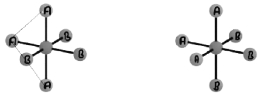
-
- (A) \(Na _3\left[ CoCl _6\right]\)
- (B) \(\left[ Ni \left( NH _3\right)_6\right] Cl _2\)
- (C) \(K _3\left[ Co ( CN )_6\right]\)
- (D) \(\left[ Co \left( H _2 O \right)_6\right] Cl _2\)
Show answer and solution
Correct Answer: (C)
\(Co ^{+3}= t _2 g ^6 eg ^0\)\(CN ^{-}\)-strong field ligand
All d-electrons should be paired \(\left(\mu_5=0\right)\)
Hence diamagnetic.
- 142. Which of the following complexes will exhibit maximum attraction to an applied magnetic field? 2023 Medium
- (A) \(\left[ Zn \left( H _2 O \right)_6\right]^{2+}\)
- (B) \(\left[ Co \left( H _2 O \right)_6\right]^{2+}\)
- (C) \(\left[ Co ( en )_3\right]^{3+}\)
- (D) \(\left[ Ni \left( H _2 O _6\right]^{2+}\right.\)
Show answer and solution
Correct Answer: (B)
Complex with maximum number of unpaired electron will exhibit maximum attraction to an applied magnetic field\({\left[ Zn \left( H _2 O \right)_6\right]^{2+} \rightarrow d ^{10} \text { system } \rightarrow t _{2 g }^6 eg ^4, 0 \text { unpaired } e ^{-}}\)
\({\left[ Co \left( H _2 O \right)_6\right]^{2+} \rightarrow d ^7 \text { system } \rightarrow t _{2 g }^5 eg ^2, 3 \text { unpaired } e ^{-}}\)
\({\left[ Co ( en )_3\right]^{3+} \rightarrow d ^6 \text { system } \rightarrow t _{2 g }^6 eg ^0, 0 \text { unpaired } e ^{-}}\)
\({\left[ Ni \left( H _2 O _6\right]^{2+} \rightarrow d ^8 \text { system } \rightarrow t _{2 g }^6 \text { eg }^2, 2 \text { unpaired } e ^{-}\right.}\)
-
- (A) \(CO < en < NH _3 < C _2 O _4^{2-} < S ^{2-}\)
- (B) \(S ^{2-} < C _2 O _4^{2-} < NH _3 < en < CO\)
- (C) \(NH _3 < en < CO < S ^{2-} < C _2 O _4^{2-}\)
- (D) \(S ^{2-} < NH _3 < en < CO < C _2 O _4^{2-}\)
Show answer and solution
Correct Answer: (B)
The increasing order of field strength of ligands (according to spectrochemical series)\(S ^{2-} < C _2 O _4^{2-} < NH _3 < en < CO\)
-
- (A) \(4\)
- (B) \(3\)
- (C) \(2\)
- (D) \(1\)
Show answer and solution
Correct Answer: (D)
\((a)\) \(CoCl _{3} \cdot 4 NH _{3}=\left[ Co \left( NH _{3}\right)_{4} Cl _{2}\right] Cl\)Can exhibit \(G.I.\)
\((b)\) \(CoCl _{3} \cdot 5 NH _{3}=\left[ Co \left( NH _{3}\right)_{5} Cl \right] Cl _{2}\)
Can't exhibit \(G.I.\)
\((c)\) \(CoCl _{3} \cdot 6 NH _{3}=\left[ Co \left( NH _{3}\right)_{6}\right] Cl _{3}\)
Can't exhibit \(G.I.\)
\((d)\) \(CoCl \left( NO _{3}\right)_{2} \cdot 5 NH _{3}=\left[ Co \left( NH _{3}\right)_{5} Cl \right]\left( NO _{3}\right)_{2}\)
OR
\(=\left[ Co \left( NH _{3}\right)_{5}\left( NO _{3}\right)\right] Cl \left( NO _{3}\right)\)
Both can't exhibit \(G.I.\)
-
- (A) \(5\)
- (B) \(0.2\)
- (C) \(2\)
- (D) \(20\)
Show answer and solution
Correct Answer: (C)
\(\left[ Fe \left( H _{2} O \right)_{3} Cl _{3}\right], \quad \underbrace{ K _{3}\left[ Fe ( CN )_{6}\right],\left[ Co \left( NH _{3}\right)_{6}\right] Cl _{3}}_{\text {inner orbital complexes }}\)\(K _{3}\left[ Fe ( CN )_{6}\right]\) has more value of \(\Delta_{0}\) than that of \(\left[ Co \left( NH _{3}\right)_{6}\right] Cl _{3} ;\) as \(\overline{ CN }\) is stronger ligand.
More \(\Delta_{0} \Rightarrow\) smaller value of absorbed \(\lambda\)
Spin only magnetic moment \((\mu)=\sqrt{3} \,BM\)
\(=1.732 \,BM\)
Rounding off \(\Rightarrow 2\)

-
- (A) \(A \,<\, B\, <\, D \,< \,C\)
- (B) \(B \,<\, D \,< \,C\, <\, A\)
- (C) \(A \,<\, C\, <\, D\, < \,B\)
- (D) \(B \,< \,D\, < \,A \,<\, C\)
Show answer and solution
Correct Answer: (B)
\((A)\) \(\left[ FeF _{6}\right]^{3-}\)\(Fe ^{+3} \rightarrow 3 d ^{5} 4 s ^{0}\)
\(n =5\)
\((B)\) \(\left[ Fe ( CN )_{6}\right]^{3-}\)
\(Fe ^{+3} \rightarrow 3 d ^{5} 4 s ^{0}\)
\(n =1\)
\((C)\) \(\left[ MnCl _{6}\right]^{3-}\)
\(Mn ^{+3} \rightarrow 3 d ^{4} 4 s ^{0}\)
\(n =4\)
\((D)\) \(\left[ Mn ( CN )_{6}\right]^{3-}\)
\(Mn ^{+3} \rightarrow 3 d ^{4} 4 s ^{0}\)
\(n =2\)
\(\mu \Rightarrow A > C > D > B\)

-
- (A) \(3\)
- (B) \(0\)
- (C) \(2\)
- (D) \(1\)
Show answer and solution
Correct Answer: (B)
\(\Delta_{0} \propto \frac{1}{\lambda}\)Here, \(CN\) being SFL will have maximum \(CFSE\) So, \(\left[ Co ( CN )_{6}\right]^{3-}\) will be \(d ^{2} sp ^{3}, \mu=0\)
-
- (A) \(5\)
- (B) \(4\)
- (C) \(3\)
- (D) \(2\)
Show answer and solution
Correct Answer: (D)
\(\left[ Fe ( CN )_{6}\right]^{3-}\)\(CN ^{-}\)is strong field ligand
\(Fe ^{+3}\; 3 d ^{5}\;(t_{2 g}^{5} e_{g}^{0})\)
\(\text { CFSE }=5\left(-0.4 \Delta_{0}\right)=-2.0 \Delta_{0}\)

-
- (A) \(1\)
- (B) \(3\)
- (C) \(2\)
- (D) \(7\)
Show answer and solution
Correct Answer: (C)
\(\left[ Fe ( CN )_{6}\right]^{4-} \quad\) Diamagnetic\(\left[ Fe ( CN )_{6}\right]^{3-} \quad\) Paramagnetic (\(1\) unpaired electron)
\(\left[ Ti ( CN )_{6}\right]^{3-} \quad\) Paramagnetic (\(1\) unpaired electron)
\(\left[ Ni ( CN )_{4}\right]^{2-} \quad\) Diamagnetic
\(\left[ Co ( CN )_{6}\right]^{3-} \quad\) Diamagnetic
-
- (A) \(189\)
- (B) \(95\)
- (C) \(5\)
- (D) \(50\)
Show answer and solution
Correct Answer: (C)
\(CoCl _{3} \cdot x\,NH _{3}+ AgNO _{3} \rightarrow AgCl \downarrow\) \(2\, mol\)\(\left[ Co \left( NH _{3}\right)_{5} Cl \right] Cl _{2}+ AgNO _{3} \rightarrow AgCl \downarrow\) \(2 \,mol\)
\(x=5\)
No questions on this page match these filters.