


All Co-ordination chemistry questions
Newest firstShowing 51–100 of 280 questions
- 51. The complex of \(\mathrm{Ni}^{2+}\) ion and dimethyl glyoxime contains ________ number of Hydrogen \((\mathrm{H})\) atoms. 2025 Easy
- (A) 10
- (B) 14
- (C) 18
- (D) 22
Show answer and solution
Correct Answer: (B)
\(\mathrm{Ni}^{2+}\) with(dmg) forms \(\left[\mathrm{Ni}(\mathrm{dmg})_2\right]^{2+}\) having 2 H -Bonds as shown:
The no. of H atoms \(=14\)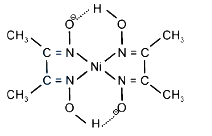
-
- (A) \({ }_{1 .}\left[\mathrm{Co}(\mathrm{en})_2 \mathrm{Cl}_2\right]^{+}\)
- (B) \(\left[\mathrm{Co}(\mathrm{en})_3\right]^{3+}\)
- (C) \(\left[\mathrm{Co}\left(\mathrm{NH}_3\right)_3 \mathrm{Cl}_3\right]\)
- (D) \(\left[\mathrm{Co}\left(\mathrm{NH}_3\right)_4 \mathrm{Cl}_2\right]^{+}\)
Show answer and solution
Correct Answer: (C)
\(\mathrm{Ma}_3 \mathrm{~b}_3\) type complexes show Facial - Meridional isomerism
(i) \(\left[\mathrm{Co}\left(\mathrm{NH}_3\right)_3 \mathrm{Cl}_3\right] \Rightarrow \mathrm{Ma}_3 \mathrm{~b}_3\)
(ii) \(\left[\mathrm{Co}\left(\mathrm{NH}_3\right)_4 \mathrm{Cl}_2\right]^{+} \Rightarrow \mathrm{Ma}_4 \mathrm{~b}_2\)
(iii) \(\left[\mathrm{Co}(\mathrm{en})_3\right]^{3+} \Rightarrow \mathrm{M}(\mathrm{AA})_3\)
(iv) \(\left[\mathrm{Co}(\mathrm{en})_2 \mathrm{Cl}_2\right]^{+} \Rightarrow \mathrm{M}(\mathrm{AA})_2 \mathrm{~b}_2\)
\(\mathrm{a}, \mathrm{b},=\mathrm{NH}_3, \mathrm{Cl}^{-}\)
\(\mathrm{AA}=\mathrm{en}\) - 53. The conditions and consequence that favours the \(t_{2 g}^3 e_g^1\) configuration in a metal complex are _______. 2025 Medium
- (A) weak field ligand, low spin complex
- (B) weak field ligand, high spin complex
- (C) strong field ligand, high spin complex
- (D) strong field ligand, low spin complex
Show answer and solution
Correct Answer: (B)
The conditions and consequence that favour \(t_{2 g}^3 e_g^1\) configuration in a metal complex are
(i) weak field ligand, and
(ii) high spin complex
For weak field ligands, splitting energy ( \(\Delta_0\) ) is lower than pairing energy \((P)\). As a result distribution of electrons for \(3 \mathrm{~d}^4\) will be \(t_{2 \mathrm{~g}}^3 \mathrm{e}_{\mathrm{g}}^1\). It results in high spin complex due to maximum number of unpaired electrons. -
- (A) \(\mathrm{IV} \lt \mathrm{III} \lt \mathrm{II} \lt \mathrm{I}\)
- (B) \(\mathrm{I} \lt \mathrm{II} \lt \mathrm{IV} \lt \) III
- (C) III \( \lt \) II \( \lt \) IV \( \lt \) I
- (D) II \( \lt \) III \( \lt \) I \( \lt \) IV
Show answer and solution
Correct Answer: (B)
Neglecting pairing energy
I. \([\mathrm{Mn}(\mathrm{CN}) \mathrm{B}]^{3-} \Rightarrow \mathrm{Mn}^{3+}, \mathrm{t}_2 \mathrm{~g}^4, \mathrm{CFSE}=-0.4 \times 4 \Delta \mathrm{o}\) \(=-1.6 \Delta\) 。
II. \([\mathrm{Co}(\mathrm{CN}) 8]^{4-} \Rightarrow \mathrm{Co}^{2+}, \mathrm{t}_2{ }^6 \mathrm{eg}^1, \mathrm{CFSE}=-0.4 \times 6+\) \(0.6 \times 1=-1.8 \Delta_{\circ}\)
III. \(\left[\mathrm{Fe}(\mathrm{CN})_8\right]^{4-} \Rightarrow \mathrm{Fe}^{2+}, \mathrm{t}_{2 g}{ }^6 \mathrm{e}^0, \mathrm{CFSE}=-0.4 \times 6=\) \(-2.4 \Delta_0\)
IV. \(\left[\mathrm{Fe}(\mathrm{CN})_8\right]^{3-} \Rightarrow \mathrm{Fe}^{3+}, \mathrm{t}_{2 g}{ }^5 \mathrm{e}^0, \mathrm{CFSE}=-0.4 \times 5=\) \(-2 \Delta_0\)
Order of stability III \(>\) IV \(>\) II \(>\) I -
- (A) D > A > B > C
- (B) C > B > D > A
- (C) D > C > B > A
- (D) C > B > A > D
Show answer and solution
Correct Answer: (A)
We know \(\mathrm{E}=\mathrm{h} v=\frac{\mathrm{hC}}{\lambda}\)
\(\mathrm{E} \propto \frac{1}{\lambda}\)
Here all Co in +3 oxidation state.
So, as the ligand field strength \(\uparrow, \operatorname{CFSE} \uparrow\)
Order of field strength of ligand :
\(\mathrm{CN} \gt \mathrm{NH}_3 \gt \mathrm{H}_2 \mathrm{O} \gt \mathrm{Cl}^{-}\)
CFSE order : \(\mathrm{C} \gt \mathrm{B} \gt \mathrm{A} \gt \mathrm{D}\)
Wavelength order: \(\mathrm{D} \gt \mathrm{A} \gt \mathrm{B} \gt \mathrm{C}\) - 56. The correct order of the following complexes in terms of their crystal field stabilization energies is _______. 2025 Hard
- (A) \(\left[\mathrm{Co}\left(\mathrm{NH}_3\right)_4\right]^{2+} \lt \left[\mathrm{Co}\left(\mathrm{NH}_3\right)_6\right]^{2+} \lt \left[\mathrm{Co}(\mathrm{en})_3\right]^{3+} \lt \left[\mathrm{Co}\left(\mathrm{NH}_3\right)_6\right]^{3+}\)
- (B) \(\left[\mathrm{Co}\left(\mathrm{NH}_3\right)_6\right]^{2+} \lt \left[\mathrm{Co}\left(\mathrm{NH}_3\right)_6\right]^{3+} \lt \left[\mathrm{Co}\left(\mathrm{NH}_3\right)_4\right]^{2+} \lt \left[\mathrm{Co}(\mathrm{en})_3\right]^{3+}\)
- (C) \(\left[\mathrm{Co}(\mathrm{en})_3\right]^{3+} \lt \left[\mathrm{Co}\left(\mathrm{NH}_3\right)_6\right]^{3+} \lt \left[\mathrm{Co}\left(\mathrm{NH}_3\right)_6\right]^{2+} \lt \left[\mathrm{Co}\left(\mathrm{NH}_3\right)_4\right]^{2+}\)
- (D) \(\left[\mathrm{Co}\left(\mathrm{NH}_3\right)_4\right]^{2+} \lt \left[\mathrm{Co}\left(\mathrm{NH}_3\right)_6\right]^{2+} \lt \left[\mathrm{Co}\left(\mathrm{NH}_3\right)_6\right]^{3+} \lt \left[\mathrm{Co}(\mathrm{en})_3\right]^{3+}\)
Show answer and solution
Correct Answer: (D)
Crystal field splitting energy \((\Delta) \propto\) charge or oxidation state of central metal atom.
Crystal field splitting energy \((\Delta) \propto\) Field strength of ligand (and chelation)
Crystal field stabilisation energy (CFSE) \(=\left[-0.4 \mathrm{t}_{\mathrm{g}_g}\right.\) +0.6 eg] \(\Delta_{\circ}\) (for octahedral)
For,
\(\begin{aligned} & {\left[\mathrm{Co}(\mathrm{en})_3\right]^{3+}: \mathrm{Co}^{3+}: \mathrm{t}_{2 \mathrm{~g}}^6 \mathrm{eg}^0 ; \mathrm{CFSE}=-2.4\left(\Delta_0\right)_1} \\ & {\left[\mathrm{Co}\left(\mathrm{NH}_3\right)_6\right]^{3+}: \mathrm{Co}^{3+}: \mathrm{t}_{2 \mathrm{~g}}^6 \mathrm{eg}^0 ; \mathrm{CFSE}=-2.4\left(\Delta_0\right)_2} \\ & {\left[\mathrm{Co}\left(\mathrm{NH}_3\right)_6\right]^{2+}: \mathrm{Co}^{2+}: \mathrm{t}_{2 g}^5 \mathrm{eg}^2 ; \mathrm{CFSE}=-0.8\left(\Delta_0\right)_3} \\ & {\left[\mathrm{Co}\left(\mathrm{NH}_3\right)_4\right]^{2+}: \mathrm{Co}^{2+}: \mathrm{e}^4 \mathrm{t}_2^3 ; \mathrm{CFSE}=-1.2 \Delta_{\mathrm{t}}} \\ & \left(\mathrm{as}:\left(\Delta_{\mathrm{t}}\right)=\frac{4}{9}\left(\Delta_0\right)_3\right) \\ & \because \Delta_{\mathrm{t}} < \left(\Delta_0\right)_3 < \left(\Delta_0\right)_2 < \left(\Delta_0\right)_1\end{aligned}\) - 57. The d- electronic configuration of an octahedral Co(II) complex having magnetic moment of 3.95 BM is _______. 2025 Medium
- (A) \(\mathrm{t}_{2 \mathrm{~g}}{ }^3 \mathrm{e}_{\mathrm{g}}{ }^0\)
- (B) \(\mathrm{t}_{2 \mathrm{~g}}{ }^6 \mathrm{e}_{\mathrm{g}}{ }^1\)
- (C) \(\mathrm{t}_{2 \mathrm{~g}}{ }^5 \mathrm{e}_{\mathrm{g}}{ }^2\)
- (D) \(\mathrm{e}^4 \mathrm{t}_2{ }^3\)
Show answer and solution
Correct Answer: (C)
\(\mathrm{Co}^{2+}\) complex having \(\mu=3.95 \mathrm{BM}\)
Hence number of unpaired electron \(=3\)
\(\mathrm{Co}^{2+} \Rightarrow 3 d^7=\mathrm{t}_{2 \mathrm{~g}}^5 \mathrm{e}_{\mathrm{g}}^2\) -
- (A) \(t_2^6 g_g^0\)
- (B) \(t_2^6 e_g^4\)
- (C) \(t_{2 g}^3 e_g^2\)
- (D) \(t_2^4 e_g^2\)
Show answer and solution
Correct Answer: (A)
In \(\left[\mathrm{Co}(\mathrm{en})_3\right]^{+3}\) S.F.L. is present and hence highest value of CFSE
In rest all complexes WFL is present hence CFSE will be low.
\(\left[\mathrm{Co}(\mathrm{en})_3\right]^{+3} \Rightarrow \mathrm{Co}^{+3}\) and en (SFL)
\(\mathrm{Co}^{+3} \Rightarrow[\mathrm{Ar}] 3 \mathrm{~d}^6\)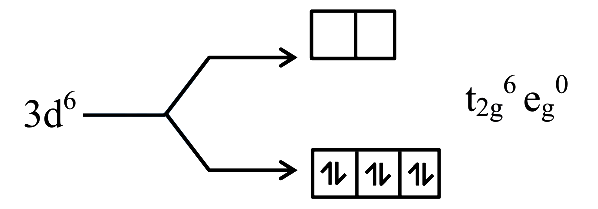
-
- (A) 2
- (B) 4
- (C) 6
- (D) 8
Show answer and solution
Correct Answer: (A)
\(\left[\mathrm{FeF}_6\right]^{3-} \quad\quad\) Paramagnetic \(\quad\quad \mathrm{sp}^3 \mathrm{~d}^2\)
\(\left[\mathrm{Fe}(\mathrm{CN})_6\right]^{3-} \quad\) Paramagnetic \(\quad\quad \mathrm{d}^2 \mathrm{sp}^3\)
\(\left[\mathrm{Mn}(\mathrm{CN})_6\right]^{3-} \quad\) Paramagnetic \(\quad\quad \mathrm{d}^2 \mathrm{sp}^3\)
\(\left[\mathrm{Co}\left(\mathrm{C}_2 \mathrm{O}_4\right)_3\right]^{3-} \quad\) Diamagnetic \(\quad\quad \mathrm{d}^2 \mathrm{sp}^3\)
\(\left[\mathrm{MnCl}_6\right]^{3-} \quad\) Paramagnetic \(\quad \mathrm{sp}^3 \mathrm{~d}^2\)
\(\left[\mathrm{CoF}_6\right]^{3-} \quad\) Paramagnetic \(\quad \mathrm{sp}^3 \mathrm{~d}^2\)
Only \(\quad\left[\mathrm{Fe}(\mathrm{CN})_6\right]^{3-}\) and \(\left[\mathrm{Mn}(\mathrm{CN})_6\right]^{3-}\) are paramagnetic and \(\mathrm{d}^2 \mathrm{sp}^3\) hybridisation of metal. -
- (A) \(5\)
- (B) \(6\)
- (C) \(4\)
- (D) \(3\)
Show answer and solution
Correct Answer: (D)
In \(\left[\mathrm{Co}\left(\mathrm{NH}_3\right]_6\right]^{3+}, \mathrm{Co}^{+3}:[\mathrm{Ar}] 3 \mathrm{~d}^6, \mathrm{NH}_3\) is S.F.L
Hybridisation state of \(\mathrm{Co}^{3+}\) is \(\mathrm{d}^2 \mathrm{sp}^3\)
In \(\mathrm{SF}_6\), Hybridisation state of sulphur is \(\mathrm{sp}^3 \mathrm{~d}^2\)
In \(\left[\mathrm{CrF}_6\right]^{3-}, \mathrm{Cr}^{+3}:[\mathrm{Ar}] 3 \mathrm{~d}^3\)
Hybridisation state of \(\mathrm{Cr}^{3+}\) is \(\mathrm{d}^2 \mathrm{sp}^3\)
\(\left[\mathrm{CoF}_6\right]^{3-}, \mathrm{Co}^{+3}:[\mathrm{Ar}] 3 \mathrm{~d}^6 \mathrm{~F}^{-}\)is W.F.L
Hybridisation state of \(\mathrm{Co}^{3+}\) is \(\mathrm{sp}^3 \mathrm{~d}^2\)
\(\left[\mathrm{Mn}(\mathrm{CN})_6\right]^{3-}, \mathrm{Mn}^{+3}:[\mathrm{Ar}] 3 \mathrm{~d}^4 \mathrm{CN}^{-}\)is S.F.L Hybridisation state of \(\mathrm{Mn}^{3+}\) is \(\mathrm{d}^2 \mathrm{sp}^3\)
\(\left[\mathrm{MnCl}_6\right]^{3-}, \mathrm{Mn}^{+3}:[\mathrm{Ar}] 3 \mathrm{~d}^4 \mathrm{Cl}^{-}\)is W.F.L
Hybridisation state of \(\mathrm{Cl}^{-}\)is \(\mathrm{sp}^3 \mathrm{~d}^2\)
Total number of \(\mathrm{sp}^3 \mathrm{~d}^2\) hybridized molecules is 3 - 61. The type of hybridization and the magnetic property of \(\left[\mathrm{MnCl}_6\right]^{3-}\) are _______. 2025 Medium
- (A) \(d^2 s p^3\), paramagnetic with four unpaired electrons
- (B) \(\mathrm{sp}^3 \mathrm{~d}^2\), paramagnetic with four unpaired electrons
- (C) \(\mathrm{d}^2 \mathrm{sp}^3\), paramagnetic with two unpaired electrons
- (D) \(\mathrm{sp}^3 \mathrm{~d}^2\), paramagnetic with two unpaired electrons
Show answer and solution
Correct Answer: (B)
\(\begin{aligned} & {\left[\mathrm{MnCl}_6\right]^{3-} \text { contains } \mathrm{Mn}^{+3}} \\ & \mathrm{Mn}^{+3}:-[\mathrm{Ar}] 3 \mathrm{~d}^4 \\ & \text { Ligand } \Rightarrow \mathrm{Cl}^{-}(\mathrm{WFL})\end{aligned}\)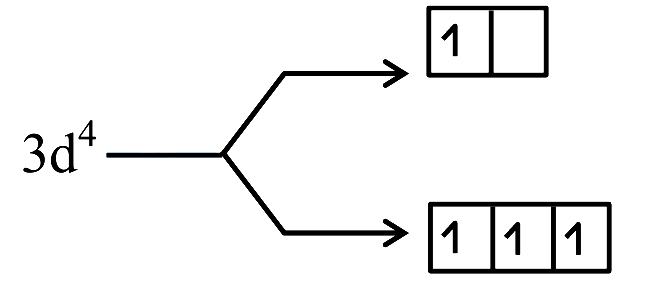
\(\text { Hybridisation }=\mathrm{sp}^3 \mathrm{~d}^2\)
4 unpaired electrons - 62. When Ethane-1,2-diamine is added progressively to an aqueous solution of Nickel (II) chloride, the sequence of colour change observed will be : 2025 Medium
- (A) Violet → Blue → Pale Blue → Green
- (B) Pale Blue → Blue → Green → Violet
- (C) Green → Pale Blue → Blue → Violet
- (D) Pale Blue → Blue → Violet → Green
Show answer and solution
Correct Answer: (C)
\(\left[ Ni \left( H _2 O \right)_6\right]_{( aq )}^{+2}+ en _{( aq )} \rightarrow\left[ Ni \left( H _2 O \right)_4( en )\right]_{( aq )}^{+2}+2 H _2 O\)
Green
\(\left[ Ni \left( H _2 O \right)_4( en )\right]_{( aq )}^{+2}+ en _{( aq )} \rightarrow\left[ Ni \left( H _2 O \right)_2( en )_2\right]_{( aq )}^{+2}+2 H _2 O\)
Pale Blue
\(\left[ Ni \left( H _2 O \right)_2( en )\right]_{( aq )}^{+2}+ en _{( aq )} \rightarrow\left[ Ni ( en )_3\right]_{( aq )}^{+2}+2 H _2 O\)
Blue / purple -
- (A) \(\left[\mathrm{Fe}(\mathrm{CN})_6\right]^4\)
- (B) \(\left[\mathrm{CO}\left(\mathrm{NH}_3\right)_6\right]^{3+}\)
- (C) \(\left[\mathrm{FeF}_6\right]^4\)
- (D) \(\left[\mathrm{Mn}(\mathrm{SCN})_6\right]^4\)
Show answer and solution
Correct Answer: (D)
(1) \(\left[\mathrm{Co}\left(\mathrm{NH}_3\right)_6\right]^{3+} \quad \mathrm{Co}^{3+} \Rightarrow 3 \mathrm{~d}^6 4 \mathrm{~s}^0\)
\(=[-0.4 \times 6+0.6 \times(0)] \Delta_0=-2.4 \Delta_0\)
(2)
\(\begin{aligned}
& {\left[\mathrm{Mn}(\mathrm{SCN})_6\right]^4} \\
& \mathrm{Mn}^{2+} \Rightarrow 3 \mathrm{~d}^5 4 \mathrm{~s}^0
\end{aligned}\)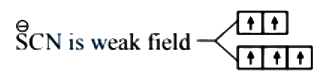
\(\begin{aligned}
& \mu=\sqrt{35} \text { B.M. }=5.96 \text { B.M. } \\
& \mathrm{CFSE}=(-0.4 \times 3+0.6 \times 2) \Delta_0
\end{aligned}\)
So \(\Delta_0=0\)
(3)
\(\begin{aligned}
& {\left[\mathrm{Fe}(\mathrm{CN})_6\right]^{-4} \quad \mathrm{Fe}^{2+} \Rightarrow 3 \mathrm{~d}^6 4 \mathrm{~s}^0}
\end{aligned}\)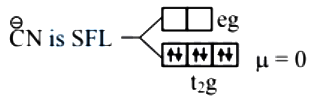
\(\mathrm{CFSE}=-2.4 \Delta_0\)
(4) \(\left[\mathrm{FeF}_6\right]^{4-}\)
\(\mathrm{Fe}^{2+} \Rightarrow 3 \mathrm{~d}^6 4 \mathrm{~s}^0\)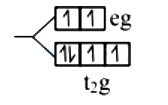
\(\begin{aligned}
& \mu=\sqrt{24} \text { B.M. }=4.89 \text { B.M. } \\
& \text { CFSE }=(-0.4 \times 4+0.6 \times 2) \Delta_0=-1.2 \Delta_0
\end{aligned}\) - 64. A reagent which gives brilliant red precipitate with Nickel ions in basic medium is _______. 2024 Medium
- (A) sodium nitroprusside
- (B) neutral \(FeCl _3\)
- (C) meta-dinitrobenzene
- (D) dimethyl glyoxime
Show answer and solution
Correct Answer: (D)
\(Ni ^{2+}+2 dmg ^{-} \rightarrow\left[ Ni ( dmg )_2\right]\)
Rosy red/Bright Red precipitate -
- (A) \(3\)
- (B) \(6\)
- (C) \(8\)
- (D) \(5\)
Show answer and solution
Correct Answer: (C)
\(\left.\left[\stackrel{+3}{\mathrm{Co}}\left(\mathrm{NH}_3\right)_5 \mathrm{Cl}\right] \mathrm{Cl}_2+\text { excess } \mathrm{AgNO}_3 \longrightarrow 2 \text { moles }\right)\)\(\mathrm{x}+0-1-2=0\)
\(\mathrm{x}=+3\)
\(\mathrm{n}=5\)
\(\therefore \mathrm{x}+\mathrm{n}=8\)
-
- (A) \((B), (C), (E)\) only
- (B) \((C), (D), (E)\) only
- (C) \((A), (B), (C)\) only
- (D) \((A), (D), (E)\) only
Show answer and solution
Correct Answer: (C)
\(image\) Based on Hall-Heroults process\(\left[\mathrm{Rh}\left(\mathrm{PPh}_3\right)_3 \mathrm{Cl}\right]\) Wilkinson's catalyst
\({Ag}_2 \mathrm{~S}+\mathrm{NaCN} \stackrel{\text { Air }}{\rightleftharpoons} \mathrm{Na}\left[\mathrm{Ag}(\mathrm{CN})_2\right]+\mathrm{Na}_2 \mathrm{~S}\)
\({Ca}^{++}\)ion forms more stable complex with \(EDTA\)

-
- (A) Spin free Complex, Spin paired Complex
- (B) Spin paired Complex, Spin free Complex
- (C) Outer orbital Complex, Inner orbital Complex
- (D) Inner orbital Complex, Spin paired Complex
Show answer and solution
Correct Answer: (B)
\({\left[\mathrm{Co}\left(\mathrm{NH}_3\right)_6\right]^{3+}}\)\(\mathrm{Co}^{3+}(\text { strong field ligand }) \Rightarrow 3 \mathrm{~d}^6\left(\mathrm{t}_{2 \mathrm{~g}}^6, \mathrm{e}_{\mathrm{g}}^0\right),\)
Hybridisation : \(d^2 \mathrm{sp}^3\)
Inner obital complex (spin paired complex) Pairing will take place.
\(\left[\mathrm{CoF}_6\right]^{3-}\)
\(\mathrm{Co}^{3+}\) (weak field ligand) \(\Rightarrow 3 \mathrm{~d}^6\left(\mathrm{t}_{2 \mathrm{~g}}^4, \mathrm{e}_{\mathrm{g}}^2\right)\)
Hybridisation : \(\mathrm{sp}^3 \mathrm{~d}^2\)
Outer orbital complex (spin free complex) no pairing will take place.
-
- (A) \(R < Q < P\)
- (B) \(R < P < Q\)
- (C) \(Q < R < P\)
- (D) \(Q < P < R\)
Show answer and solution
Correct Answer: (C)
\(\left[\mathrm{FeF}_6\right]^{3-}: \mathrm{Fe}^{+3}:[\mathrm{Ar}] 3 \mathrm{~d}^5\)
F : Weak field Ligand No. of unpaired electron'\(s=5\)
\( \mu=\sqrt{5(5+2)} \)
\( \mu=\sqrt{35} \mathrm{BM} \)
\( {\left[\mathrm{V}\left(\mathrm{H}_2 \mathrm{O}\right)_6\right]^{+2}: \mathrm{V}^{+2}: 3 \mathrm{~d}^3}\)
No. of unpaired electron's \(=3\)
\( \mu=\sqrt{3(3+2)} \)
\( \mu=\sqrt{15} \mathrm{BM} \)
\( {\left[\mathrm{Fe}\left(\mathrm{H}_2 \mathrm{O}\right)_6\right]^{+2}: \mathrm{Fe}^{+2}: 3 \mathrm{~d}^6}\)
\(\mathrm{H}_2 \mathrm{O}\) : Weak field Ligand
No. of unpaired electron's\(=4\)
\( \mu=\sqrt{4(4+2)} \)
\( \mu=\sqrt{24} \mathrm{BM}\)
-
- (A) \(C \) < \( D \) < \( A \) < \( B\)
- (B) \(D \) < \( A \) < \( C \) < \( B\)
- (C) \(A \) < \( C \) < \( B \) < \( D\)
- (D) \(B \) < \( C \) < \( A \) < \( D\)
Show answer and solution
Correct Answer: (B)
As ligand field increases, light of more energy is absorbedEnergy \(\propto\) wave number
\((\bar{v})\)
- 70. Consider the following reactions.
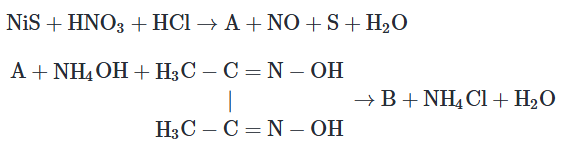
The number of protons that do not involve in hydrogen bonding in the product B is _______. 2024 Medium- (A) 12
- (B) 14
- (C) 16
- (D) 18
Show answer and solution
Correct Answer: (A)
\(3 NiS +2 HNO _3+6 HCl \rightarrow 3 NiCl _2+2 NO +3 S+4 H _2 O\)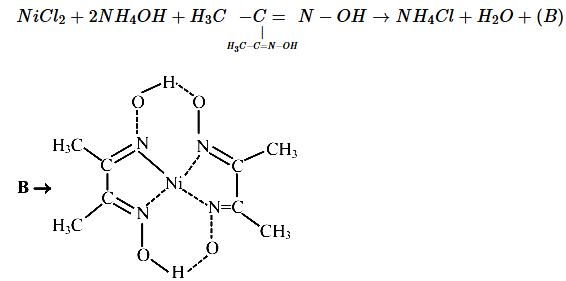
-
- (A) 0
- (B) 1
- (C) 2
- (D) 3
Show answer and solution
Correct Answer: (A)
If \(M ^{+2}= Co ^{+2}\)
then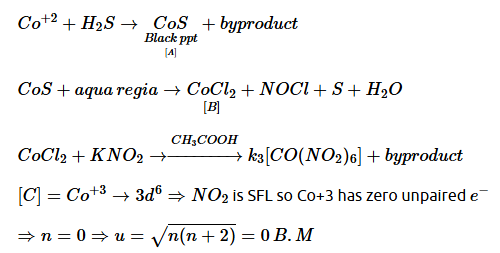
-
- (A) Both \((A)\) and \((R)\) are correct and \((R)\) is the correct explanation of \((A)\).
- (B) \((A)\) is correct but \((R)\) is not correct.
- (C) \((A)\) is not correct but \((R)\) is correct.
- (D) Both \((A)\) and \((R)\) are correct but \((R)\) is not the correct explanation of \((A)\).
Show answer and solution
Correct Answer: (C)
\(\left[\mathrm{Co}(\mathrm{en})_2 \mathrm{Cl}_2\right]^{+}\)has octahedral geometry with two geometrical isomers.
-
- (A) Both Statement \(I\) and Statement \(II\) are incorrect
- (B) Both Statement \(I\) and Statement \(II\) are correct
- (C) Statement \(I\) is incorrect but Statement \(II\) is correct
- (D) Statement \(I\) is correct but Statement \(II\) is incorrect
Show answer and solution
Correct Answer: (B)
\(\left[\mathrm{Ni}\left(\mathrm{H}_2 \mathrm{O}\right)_6\right]^{+2} \rightarrow\) Green colour solution due to d-d transition.\(\left[\mathrm{Ni}(\mathrm{CN})_4\right]^{-2} \rightarrow\) is diamagnetic and it is colourless.
-
- (A) Statement I is correct but Statement II is incorrect.
- (B) Statement I is incorrect but Statement II is correct.
- (C) Both Statement I and Statement II are correct.
- (D) Both Statement I and Statement II are incorrect.
Show answer and solution
Correct Answer: (A)
\(N\left( CH _3\right)_3\) and \(P \left( CH _3\right)_3\) both are Lewis base and acts as ligand, However, \(P\left( CH _3\right)_3\) has a \(\pi\)-acceptor character. - 75. Identify from the following species in which \(\mathrm{d}^2 \mathrm{sp}^3\) hybridization is shown by central atom: 2024 Hard
- (A) \(\left[\mathrm{Co}\left(\mathrm{NH}_3\right)_6\right]^{3+}\)
- (B) \(\mathrm{BrF}_5\)
- (C) \(\left[\mathrm{Pt}(\mathrm{Cl})_4\right]^{2-}\)
- (D) \(\mathrm{SF}_6\)
Show answer and solution
Correct Answer: (A)
\(\left[\mathrm{Co}\left(\mathrm{NH}_3\right)_6\right]^{+3}-d^2 \mathrm{sp}^3\) hybridization\(\mathrm{BrF}_5-\mathrm{sp}^3 \mathrm{~d}^2\) hybridization
\(\left[\mathrm{PtCl}_4\right]^{-2}-\mathrm{dsp}^2\) hybridization
\(\mathrm{SF}_6-\mathrm{sp}^3 \mathrm{~d}^2\) hybridization
-
- (A) Photography - \(\mathrm{AgBr}\)
- (B) Polythene preparation - \(\mathrm{TiCl}_4, \mathrm{Al}\left(\mathrm{CH}_3\right)_3\)
- (C) Haber process - Iron
- (D) Wacker process \(-\mathrm{Pt} \mathrm{Cl}_2\)
Show answer and solution
Correct Answer: (D)
The catalyst used in Wacker's process is \(\mathrm{PdCl}_2\) -
- (A) \(5\)
- (B) \(6\)
- (C) \(3\)
- (D) \(4\)
Show answer and solution
Correct Answer: (B)
Complex is\(\left[\mathrm{III}\left(\mathrm{NH}_3\right)_2(\mathrm{CN})_4\right]^{\Theta}\)\( x=2\)
\(y=4\)
\(\text { so } x+y=6\)
- 78. Match List \(I\) with List \(II\).Choose the correct answer from the options given below :
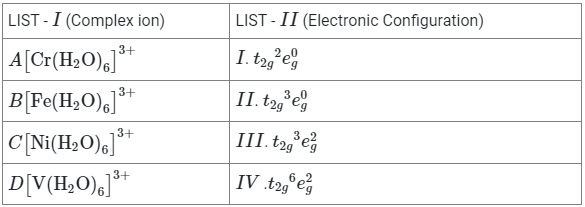 2024 Hard
- (A) \(A-III, B-II, C-IV, D-I\)
- (B) \(A-IV, B-I, C-II, D-III\)
- (C) \(A-IV, B-III, C-I, D-II\)
- (D) \(A-II, B-III, C-IV, D-I\)
Show answer and solution
Correct Answer: (D)
\({\left[\mathrm{Cr}\left(\mathrm{H}_2 \mathrm{O}\right)_6\right]^{3+} \text { Contains } \mathrm{Cr}^{3+}:[\mathrm{Ar}] 3 \mathrm{~d}^3: \mathrm{t}_{2 \mathrm{~g}}^3 \mathrm{e}_{\mathrm{g}}^{\mathrm{o}}}\)\({\left[\mathrm{Fe}\left(\mathrm{H}_2 \mathrm{O}\right)_6\right]^{3+} \text { Contains } \mathrm{Fe}^{3+}:[\mathrm{Ar}] 3 \mathrm{~d}^5: \mathrm{t}_{2 \mathrm{~g}}^3 \mathrm{e}_{\mathrm{g}}^2}\)
\({\left[\mathrm{Ni}\left(\mathrm{H}_2 \mathrm{O}\right)_6\right]^{2+} \text { Contains } \mathrm{Ni}^{2+}:[\mathrm{Ar}] 3 \mathrm{~d}^8: \mathrm{t}_{2 \mathrm{~g}}^6 \mathrm{e}_{\mathrm{g}}^2}\)
\({\left[\mathrm{~V}\left(\mathrm{H}_2 \mathrm{O}\right)_6\right]^{3+} \text { Contains } \mathrm{V}^{3+}:[\mathrm{Ar}] 3 \mathrm{~d}^2: \mathrm{t}_{2 \mathrm{~g}}^2 \mathrm{e}_{\mathrm{g}}^{\circ}}\)
-
- (A) \((A)-(I), (B)-(IV), (C)-(II), (D)-(III)\)
- (B) \((A)-(IV), (B)-(III), (C)-(I), (D)-(II)\)
- (C) \((A)-(II), (B)-(IV), (C)-(I), (D)-(III)\)
- (D) \((A)-(II), (B)-(III), (C)-(I), (D)-(IV)\)
Show answer and solution
Correct Answer: (C)
\((A)\)\({\left[\mathrm{Cr}\left(\mathrm{NH}_3\right)_6\right]^{3+}}\)
\(\mathrm{Cr}^{3+}: 3 \mathrm{~d}^3\)
\(\mathrm{n}=3 \text { (unpaired electrons) }\)
\(\mu \simeq 3.87 \text { B.M. (II) }\)
\((B)\)
\({\left[\mathrm{NiCl}_4\right]^{2-}}\)
\(\mathrm{Ni}^{2+}: 3 \mathrm{~d}^8\)
\(\mathrm{n}=2\)
\(\mu \simeq 2.83 \text { B.M. (IV) }\)
\((C)\)
\({\left[\mathrm{CoF}_6\right]^{3-}}\)
\(\mathrm{Co}^{3+}: 3 \mathrm{~d}^6\)
\(\mathrm{n}=4\)
\(\mu \simeq 4.90 \text { B.M. (I) }\)
\((D)\)
\({\left[\mathrm{Ni}(\mathrm{CN})_4\right]^{2-}}\)
\(\mathrm{Ni}^{2+}: 3 \mathrm{~d}^8\)
\(\mathrm{n}=0\)
\(\mu=0 \text { B.M. (III) }\)
-
- (A) \(A-III, B-I, C-II, D-IV\)
- (B) \(A-III, B-II, C-IV, D-I\)
- (C) \(A-I, B-III, C-II, D-IV\)
- (D) \(A-III, B-I, C-IV, D-II\)
Show answer and solution
Correct Answer: (D)
\(\begin{gathered}+2 \\ \text { (A) } \mathrm{K}_2\left[\mathrm{Ni}(\mathrm{CN})_4\right] \\ \mathrm{Ni}^{2+}:[\mathrm{Ar}] 3 \mathrm{~d}^8 4 \mathrm{~s}^{\circ},\left(\mathrm{CN}^{-} \text {is S.F.L) }\right. \\ \text { Pre hybridization state of } \mathrm{Ni}^{+2}\end{gathered}\)
(B) \(\left[\mathrm{Ni}(\mathrm{CO})_4\right]\)
\(\mathrm{Ni}:[\mathrm{Ar}] 3 \mathrm{~d}^8 4 \mathrm{~s}^2\)
\(CO\) is \(S.F.L,\) so pairing occur
Pre hybridization state of \(\mathrm{Ni}\)
\(\begin{aligned} & \text { (C) }\left[\mathrm{Co}\left(\mathrm{NH}_3\right)_6\right] \mathrm{Cl}_3 \\ & \mathrm{Co}^{+3}:[\mathrm{Ar}] 3 \mathrm{~d}^6 4 \mathrm{~s}^0 \\ & \text { With } \mathrm{Co}^{3+}, \mathrm{NH}_3 \text { act as S.F.L }\end{aligned}\)
\(\begin{aligned} & \text { (d) } \mathrm{Na}_3\left[\mathrm{CoF}_6\right] \\ & \mathrm{Co}^{3+}:[\mathrm{Ar}] 3 \mathrm{~d}^6\left(\mathrm{~F}^{\Theta}: \text { W.F.L }\right)\end{aligned}\)
-
- (A) (A)-(III), (B)-(IV), (C)-(II), (D)-(I)
- (B) (A)-(IV), (B)-(III), (C)-(I), (D)-(II)
- (C) (A)-(III), (B)-(I), (C)-(IV), (D)-(II)
- (D) (A)-(I), (B)-(III), (C)-(IV), (D)-(II)
Show answer and solution
Correct Answer: (C)
(A)-(III), (B)-(I), (C)-(IV), (D)-(II) -
- (A) \(A-II\), \(B-IV\), \(C-I\), \(D-III\)
- (B) \(A-II\), \(B-III\), \(C-IV\), \(D-I\)
- (C) \(A-III\), \(B-II\), \(C-IV\), \(D-I\)
- (D) \(A-IV\), \(B-III\), \(C-I\), \(D-II\)
Show answer and solution
Correct Answer: (D)
Ziegler catalyst \(\rightarrow\) TitaniumBlood pigment \(\rightarrow\) Iron
Wilkinson catalyst \(\rightarrow\) Rhodium
Vitamin \(\mathrm{B}_{12} \rightarrow\) Cobalt
- 83. Number of ambidentate ligands among the following is _______.
\(NO _2^{-}, SCN ^{-}, C _2 O _4^{2-}, NH _3, CN ^{-}, SO _4^{2-}, H _2 O\). 2024 Medium- (A) 1
- (B) 2
- (C) 3
- (D) 4
Show answer and solution
Correct Answer: (C)
Ligands which have two different donor sites but at a time connects with only one donor site to central metal are ambidentate ligands.
Ambidentate ligands are \(NO _2^{-} ; SCN ^{-} ; CN ^{-}\) -
- (A) \(2\)
- (B) \(4\)
- (C) \(5\)
- (D) \(1\)
Show answer and solution
Correct Answer: (A)
\({\left[\mathrm{V}\left(\mathrm{H}_2 \mathrm{O}\right)_6\right]^{3+} \rightarrow \mathrm{d}^2 \mathrm{sp}^3}\)\({ }_{23} \mathrm{~V}:-[\mathrm{Ar}] 3 \mathrm{~d}^3 4 \mathrm{~s}^2\)
\(\mathrm{~V}^{+j}:-[\mathrm{Ar}] 3 \mathrm{~d}^2, \mathrm{n}=2 \text { (even number of unpaired e) }\)
\({\left[\mathrm{Cr}\left(\mathrm{H}_2 \mathrm{O}\right)_6\right]^{2+} \rightarrow \mathrm{sp}^3 \mathrm{~d}^2}\)
\({ }_{24} \mathrm{Cr}:-[\mathrm{Ar}] 3 \mathrm{~d}^5 4 \mathrm{~s}^1\)
\(\left.\mathrm{Cr}^{+2}:-[\mathrm{Ar}] 3 \mathrm{~d}^4, \mathrm{n}=4 \text { (even number of unpaired } \mathrm{e}^{-}\right)\)
\({\left[\mathrm{Fe}\left(\mathrm{H}_2 \mathrm{O}\right)_6\right]^{3+} \rightarrow \mathrm{sp}^3 \mathrm{~d}^2}\)
\(\mathrm{Fe}^{3+}:-[\mathrm{Ar}] 3 \mathrm{~d}^5 4 \mathrm{~s}^0\)
\(\mathrm{n}=5 \text { (odd number of unpaired } \mathrm{e}^{-} \text {) }\)
\({\left[\mathrm{Ni}\left(\mathrm{H}_2 \mathrm{O}\right)_6\right]^{3+} \rightarrow \mathrm{sp}^3 \mathrm{~d}^2}\)
\(\mathrm{Ni}:-[\mathrm{Ar}] 3 \mathrm{~d}^8 4 \mathrm{~s}^2\)
\(\mathrm{Ni}^{+3}:-[\mathrm{Ar}] 3 \mathrm{~d}^7, \mathrm{n}=3 \text { (odd number of unpaired } \mathrm{e}^{-} \text {) }\)
\({\left[\mathrm{Cu}\left(\mathrm{H}_2 \mathrm{O}\right)_6\right]^{2+} \rightarrow \mathrm{sp}^3 \mathrm{~d}^2}\)
\(\mathrm{Cu}:-[\mathrm{Ar}] 3 \mathrm{~d}^9 4 \mathrm{~s}^0\)
\(\mathrm{n}=1 \text { (odd number of unpaired } \mathrm{e}^{-} \text {) }\)

-
- (A) \(4\)
- (B) \(5\)
- (C) \(6\)
- (D) \(7\)
Show answer and solution
Correct Answer: (A)
cis \(-\left[\mathrm{Cr}(\mathrm{ox})_2 \mathrm{Cl}_2\right]^{3-} \rightarrow\) can show optical isomerism (no \(POS\) & \(COS\))\(\left[\mathrm{Co}(\mathrm{en})_3\right]^{3+} \rightarrow\) can show (no \(POS\) & \(COS\))
cis \(-\left[\mathrm{Pt}(\mathrm{en})_2 \mathrm{Cl}_2\right]^{2+} \rightarrow\) can show (no \(POS\) & \(COSV\))
cis \(-\left[\mathrm{Co}(\mathrm{en})_2 \mathrm{Cl}_2\right]^{+} \rightarrow\) can show (no \(POS\) & \(COS\))
trans \(-\left[\mathrm{Pt}(\mathrm{en})_2 \mathrm{Cl}_2\right]^{2+} \rightarrow\) can't show (contains \(POS\) & \(COS\))
trans \(-\left[\mathrm{Cr}(\mathrm{ox})_2 \mathrm{Cl}_2\right]^{3-} \rightarrow\) can't show (contains \(POS\) & \(COS\))
-
- (A) 2
- (B) 4
- (C) 5
- (D) 1
Show answer and solution
Correct Answer: (D)
Complex formed during brown ring test is
\(\left[Fe\left(H_2 O\right)_5 NO\right] SO_4 .\)
NO is present as \(NO ^{+}\)here.
\(\begin{array}{l}x+5 \times 0+1=+2 \\x=+1\end{array}\)
Oxidation state of Fe is +1 -
- (A) \(\left[\mathrm{Ni}(\mathrm{CO})_4\right]\) and \(\left[\mathrm{NiCl}_4\right]^{2-}\) both diamagnetic
- (B) \(\left[\mathrm{Ni}(\mathrm{CO})_4\right]\) and \(\left[\mathrm{NiCl}_4\right]^{2-}\) both paramagnetic
- (C) \(\left[\mathrm{NiCl}_4\right]^{2-}\) diamagnetic, \(\left[\mathrm{Ni}(\mathrm{CO})_4\right]\) paramagnetic
- (D) \(\left[\mathrm{Ni}(\mathrm{CO})_4\right]\) diamagnetic, \(\left[\mathrm{NiCl}_4\right]^{2-}\) paramagnetic
Show answer and solution
Correct Answer: (D)
\(\left[\mathrm{Ni}(\mathrm{CO})_4\right] \rightarrow\) diamagnetic, \(\mathrm{sp}^3\) hybridisation, number of unpaired electrons \(=0\)\(\left[\mathrm{NiCl}_4\right]^{2-}, \rightarrow\) paramagnetic, \(\mathrm{sp}^3\) hybridisation, number of unpaired electrons \(=2\)
- 88. The coordination environment of \(\mathrm{Ca}^{2+}\) ion in its complex with \(EDTA\) \(^{4-}\) is _______. 2024 Medium
- (A) tetrahedral
- (B) octahedral
- (C) square planar
- (D) trigonal prismatic
Show answer and solution
Correct Answer: (B)
\(EDTA\) \(^{4-} \rightarrow\) Hexadentate ligand\([\mathrm{Ca}(\mathrm{EDTA})]^{2-}\)
So Coordination environment is octahedral
-
- (A) Octahedral
- (B) Trigonal bipyramidal
- (C) Square pyramidal
- (D) Square planar
Show answer and solution
Correct Answer: (A)
\(\mathrm{Mn}_2(\mathrm{CO})_{10}\)Octahedral around Mn
-
- (A) Potassium tetraoxopermanganate \((VI)\)
- (B) Potassium tetraoxidomanganate \((VI)\)
- (C) Dipotassium tetraoxidomanganate \((VII)\)
- (D) Potassium tetraoxidomanganese \((VI)\)
Show answer and solution
Correct Answer: (B)
\( \mathrm{K}_2 \mathrm{MnO}_4 \)\( 2+\mathrm{x}-8=0 \)
\( \Rightarrow \mathrm{x}=+6\)
O.S. of \(\mathrm{Mn}=+6\)
\(IUPAC\) Name \(=\)
Potassium tetraoxidomanganate\((VI)\)
- 91. The correct \(IUPAC\) name of \(\left[\mathrm{PtBr}_2\left(\mathrm{PMe}_3\right)_2\right]\) is _______. 2024 Medium
- (A) bis (trimethylphosphine) dibromoplatinum\((II)\)
- (B) bis [bromo(trimethylphosphine)] platinum\((II)\)
- (C) dibromobis (trimethylphosphine) platinum\((II)\)
- (D) dibromodi (trimethylphosphine) platinum\((II)\)
Show answer and solution
Correct Answer: (C)
Dibromo bis(trimethylphosphine) platinum \((II)\) -
- (A) \(\mathrm{Cl}^{-}<-\mathrm{OH}<\mathrm{Br}^{-}<\mathrm{CN}^{-}\)
- (B) \(\mathrm{F}^{-}<\mathrm{Br}^{-}<\mathrm{I}^{-}<\mathrm{NH}_3\)
- (C) \(\mathrm{Br}^{-}<\mathrm{F}^{-}<\mathrm{H}_2 \mathrm{O}<\mathrm{NH}_3\)
- (D) \(\mathrm{H}_2 \mathrm{O}<{ }^{-} \mathrm{OH}<\mathrm{CN}^{-}<\mathrm{NH}_3\)
Show answer and solution
Correct Answer: (C)
Experimental order \(\mathrm{Br}^{-}<\mathrm{F}^{-}<\mathrm{H}_2 \mathrm{O}<\mathrm{NH}_3\) - 93. The correct sequence of ligands in the order of decreasing field strength is _______. 2024 Medium
- (A) \(\mathrm{CO}>\mathrm{H}_2 \mathrm{O}>\mathrm{F}^{-}>\mathrm{S}^{2-}\)
- (B) \({ }^{-} \mathrm{OH}>\mathrm{F}^{-}>\mathrm{NH}_3>\mathrm{CN}^{-}\)
- (C) \(\mathrm{NCS}^{-}>\mathrm{EDTA}^{4-}>\mathrm{CN}^{-}>\mathrm{CO}\)
- (D) \(\mathrm{S}^{2-}>-\mathrm{OH}>\mathrm{EDTA}^{+}>\mathrm{CO}\)
Show answer and solution
Correct Answer: (A)
According to spectrochemical series ligand field strength is \(\mathrm{CO}>\mathrm{H}_2 \mathrm{O}>\mathrm{F}^{-}>\mathrm{S}^{2-}\) -
- (A) \(A\), \(D\) only
- (B) \(A\), \(C\) only
- (C) \(B\), \(D\) only
- (D) \(B\), \(C\) only
Show answer and solution
Correct Answer: (D)
\(B\). VBT does not explain stability of complex\(C\). Hybridisation of \(\left[\mathrm{Ni}(\mathrm{CN})_4\right]^{-2}\) is \(\mathrm{dsp}^2\).
-
- (A) 2
- (B) 0
- (C) 4
- (D) 3
Show answer and solution
Correct Answer: (B)
Tetrahedral complex does not show geometrical isomerism. -
- (A) \(3\)
- (B) \(1\)
- (C) \(4\)
- (D) \(2\)
Show answer and solution
Correct Answer: (A)
\(\mathrm{TiCl}_4 \Rightarrow \mathrm{Ti}^{+4} \mathrm{e}^0 \mathrm{t}_2^0\)\(\mathrm{MnO}_4^{-} \Rightarrow \mathrm{Mn}^{+7} \mathrm{e}^0 \mathrm{t}_2^0\)
\(\mathrm{FeO}_4^{2-} \Rightarrow \mathrm{Fe}^{+6} \mathrm{e}^2 \mathrm{t}_2^0\)
\(\mathrm{FeCl}_4^{2-} \Rightarrow \mathrm{Fe}^{+2} \mathrm{e}^3 \mathrm{t}_2^3\)
\(\mathrm{CoCl}_4^{2-} \Rightarrow \mathrm{Co}^{+2} \mathrm{e}^4 \mathrm{t}_2^3\)
- 97. The number of unpaired d-electrons in \(\left[\mathrm{Co}\left(\mathrm{H}_2 \mathrm{O}\right)_6\right]^{3+}\) is _______. 2024 Medium
- (A) \(4\)
- (B) \(2\)
- (C) \(0\)
- (D) \(1\)
Show answer and solution
Correct Answer: (C)
\(\Rightarrow\left[\mathrm{Co}\left(\mathrm{H}_2 \mathrm{O}\right)_6\right]^{+3}\)No unpaired electrons

-
- (A) \(20\)
- (B) \(28\)
- (C) \(30\)
- (D) \(35\)
Show answer and solution
Correct Answer: (B)
\(\mathrm{NH}_3\) act as WFL with \(\mathrm{Ni}^{2+}\) \(\mathrm{Ni}^{2+}=3 \mathrm{~d}^8\)\(Image\)
No. of unpaired electron \(=2\)
\(\mu=\sqrt{n(n+2)}=\sqrt{8}=2.82 \mathrm{BM}\)
\(=28.2 \times 10^{-1} \mathrm{BM}\)
\(\mathrm{x}=28\)

-
- (A) \(1\)
- (B) \(2\)
- (C) \(3\)
- (D) \(0\)
Show answer and solution
Correct Answer: (D)
\(\mathrm{Pt}^{2+}\left(\mathrm{d}^8\right)\)
\(\mathrm{Pt}^{2+} \rightarrow \mathrm{dsp}^2\) hybridization and have no unpaired e-s.
\(\therefore\) Magnetic moment \(\mathrm{o} 0\)
-
- (A) \(5\)
- (B) \(3\)
- (C) \(1\)
- (D) \(2\)
Show answer and solution
Correct Answer: (D)
\(\mathrm{Co}^{+3}: 3 d^6 \quad t_{2 g}^{2,2,2} e_g^{0,0}\)\(\text { Unpaired } e^{-}=0\)
\(\mathrm{Ni}^{+2}: 3 d^8 \quad e^{2,2} t_2^{2,1,1}\)
\(\text { Unpaired } e^{-}=2\)
No questions on this page match these filters.