


प्रश्न
4 प्रश्न4 में से 1–4 प्रश्न
-
- (A) \(1.68\)
- (B) \(1.83\)
- (C) \(0.59\)
- (D) \(1.20\)
उत्तर और हल देखें
सही उत्तर: (A)
The conductivity of semiconductor\( \sigma =\mathrm{e}\left(\mathrm{n}_{\mathrm{e}} \mu_{\mathrm{e}}+\mathrm{n}_{\mathrm{h}} \mu_{\mathrm{h}}\right)\)
\(=1.6 \times 10^{-19}\left(5 \times 10^{18} \times 2+5 \times 10^{19} \times 0.01\right) \)
\(=1.6 \times 1.05=1.68(\Omega-\mathrm{m})^{-1}\)
-
- (A) \(10\)
- (B) \(10^{-6}\)
- (C) \(10^6\)
- (D) \(100\)
उत्तर और हल देखें
सही उत्तर: (B)
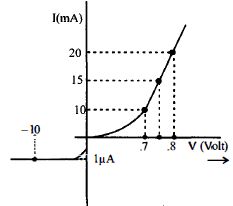
Forward bias resistance\(=\frac{\Delta V}{\Delta I}=\frac{0.1}{10 \times 10^{-3}}=10 \Omega\)
Reverse bias resistance \(=\frac{10}{10^{-6}}=10^{7} \Omega\)
Ratio of resistances
\(=\,\frac {Forward \,\,bias\,\, resistance }{Reverse\,\, bias \,\,resistance}\)
\(=10^{-6}\)
-
- (A) \(9.6\)
- (B) \(6.9\)
- (C) \(0.69\)
- (D) \(69\)
उत्तर और हल देखें
सही उत्तर: (B)
Given, current gain of \(CE\) amplifier \(\beta=69, \mathrm{I}_{\mathrm{E}}\) \(=7 \mathrm{mA}\)or \(\quad \frac{\mathrm{I}_{\mathrm{C}}}{\mathrm{I}_{\mathrm{B}}}=69\)
We know that, \(\alpha=\frac{\beta}{1+\beta}=\frac{69}{70} \cdot \frac{\mathrm{I_C}}{\mathrm{I}_{\mathrm{E}}}\)
\(\mathrm{I}_{\mathrm{C}}=\mathrm{I}_{\mathrm{E}} \times \frac{69}{70}=\frac{\mathrm{69}}{70} \times 7\)
Collector current, \(I_{C}=6.9\, \mathrm{mA}\)
-
- (A) \(45\)
- (B) \(90\)
- (C) \(135\)
- (D) \(180\)
उत्तर और हल देखें
सही उत्तर: (D)
Explanation: In CE amplifier cirucit the input and output voltage are out of phase. When the input voltage is increased then \(Rb\) is increased. Ic also increases so the voltage drop across Rc is increased. However increase in voltage across Rc is in opposite sense. So, phase angle between them is \(180^{\circ}\).
इस पेज पर इन फ़िल्टर से कोई प्रश्न नहीं मिला।