


प्रश्न
5 प्रश्न5 में से 1–5 प्रश्न
-
- (A) \(20\)
- (B) \(10\)
- (C) \(60\)
- (D) \(40\)
उत्तर और हल देखें
सही उत्तर: (C)
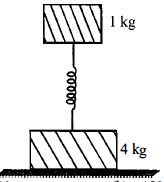
Mass of bigger body \(M=4 \mathrm{kg}\)Mass of smaller body \(\mathrm{m}=1 \mathrm{kg}\)
Smaller mass \((\mathrm{m}=1 \mathrm{kg})\) \(executes \,S.H.M \,of\)
angular frequency \(\omega=25\) rad \(/ \mathrm{s}\)
Amplitude \(x=1.6 \mathrm{cm}=1.6 \times 10^{-2}\)
As we know,
\(\mathrm{T}=2 \pi \sqrt{\frac{\mathrm{m}}{\mathrm{K}}}\)
\(\boldsymbol{\alpha}, \quad \frac{2 \pi}{\omega}=2 \pi \sqrt{\frac{\mathrm{m}}{\mathrm{K}}}\)
or, \(\quad \frac{1}{25}=\sqrt{\frac{1}{\mathrm{K}}}[\because \mathrm{m}=1 \mathrm{kg} ; \omega=25 \mathrm{rad} / \mathrm{s}]\)
or, \(\quad \mathrm{K}=625 \mathrm{Nm}^{-1}\)
The maximum force exerted by the system on the floor
\(=\mathrm{Mg}+\mathrm{Kx}+\mathrm{mg}\)
\(=4 \times 10+625 \times 1.6 \times 10^{-2}+1 \times 10\)
\(=40+10+10\)
\(=60 N\)
-
- (A) \(1 \%\) से वृद्धि होगी
- (B) \(8 \%\) से वृद्धि होगी
- (C) \(1 \%\) से घटेगा
- (D) \(8 \%\) से घटेगा
उत्तर और हल देखें
सही उत्तर: (A)
The change in time period compared to the undamped oscillator increases by \(1\%\) -
- (A) दोलनों का आवर्त काल \(8 \tau\) है।
- (B) दोलनों का आवर्त काल \(6 \tau\) है।
- (C) गति का आयाम \(4 a\) है।
- (D) गति का आयाम \(3 a\) है।
उत्तर और हल देखें
सही उत्तर: (B)
In simple harmonic motion, starting from rest,At \(t=0, x=A\)
\(x= Acos\omega t\) \(...(i)\)
\( When\,\,\, t=\tau, x=A-a\)
When \(t=2 \tau, x=A-3 a\)
From equation \(( i )\)
\(A-a=A \cos \omega \tau\) \(...(ii)\)
\(A-3 a=A \cos 2 \omega \tau\) \(...(iii)\)
As \(\cos 2 \omega \tau=2 \cos ^{2} \omega \tau-1 \ldots(\mathrm{iv})\)
From equation \((ii),\) \((iii)\) and \((iv)\)
\(\frac{A-3 a}{A}=2\left(\frac{A-a}{A}\right)^{2}-1\)
\(\Rightarrow \quad \frac{A-3 a}{A}=\frac{2 A^{2}+2 a^{2}-4 A a-A^{2}}{A^{2}}\)
\(\Rightarrow A^{2}-3 a A=A^{2}+2 a^{2}-4 A a\)
\(\Rightarrow \quad 2 a^{2}=a A \Rightarrow \quad A=2 a\)
\(\Rightarrow \quad \frac{a}{A}=\frac{1}{2}\)
Now, \(A-a=A \cos \omega \tau\)
\(\Rightarrow \quad \cos \omega \tau=\frac{A-a}{A} \Rightarrow \quad \cos \omega \tau=\frac{1}{2}\)
or, \(\quad \frac{2 \pi}{T} \tau=\frac{\pi}{3} \Rightarrow \quad \mathrm{T}=6 \tau\)
-
- (A) \(4\)
- (B) \(6\)
- (C) \(12\)
- (D) \(16\)
उत्तर और हल देखें
सही उत्तर: (C)
Given: Time period, \(T=0.5\) secAmplitude, \(\mathrm{A}=1 \mathrm{cm}\)
Average velocity in the interval in which body moves from equilibrium to half of its amplitude, \(\mathrm{v}=?\)
Time taken to a displacement \(A/2\) where \(A\) is the amplitude of oscillation from the
mean position \(^{\prime} \mathrm{O}^{\prime}\) is \(\frac{\mathrm{T}}{12}\)
Therefore, time, \(t=\frac{0.5}{12} \mathrm{sec}\)
Displacement, \(s=\frac{A}{2}=\frac{1}{2} c m\)
Average velocity, \(v=\frac{\frac{A}{2}}{t}=\frac{\frac{1}{2}}{\frac{0.5}{12}}=12 \mathrm{cm} / \mathrm{s}\)
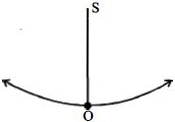
-
- (A) \(a + bx - cx^2\)
- (B) \(bx^2\)
- (C) \(a - bx + cx^2\)
- (D) \(-bx\)
उत्तर और हल देखें
सही उत्तर: (D)
In linear \(S.H.M\)., the restoring force acting on particle should always be proportional to the displacement of the particle and directed towards the equilibrium position.i.e., \(\mathrm{F} \propto x\)
or \(\mathrm{F}=-\mathrm{bx}\) where \(\mathrm{b}\) is a positive constant
इस पेज पर इन फ़िल्टर से कोई प्रश्न नहीं मिला।