


कार्बनिक रसायन प्रतिक्रिया तंत्र के सभी प्रश्न
नए पहले60 में से 51–60 प्रश्न
-
- (A) केवल \(( B )\) तथा \((C)\)
- (B) केवल \((A)\)
- (C) केवल \(( A )\) तथा \((C)\)
- (D) केवल \((B)\)
उत्तर और हल देखें
सही उत्तर: (C)
Ambident nucleophile\((A)\) \(KCN\) And \(AgCN\)
\((C)\) \(AgNO _{2}\) And \(KNO _{2}\)
-
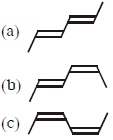
- (A) \((a) < (b) < (c)\)
- (B) \((b) < (c) < (a)\)
- (C) \((c) < (b) < (a)\)
- (D) \((a) < (c) < (b)\)
उत्तर और हल देखें
सही उत्तर: (A)
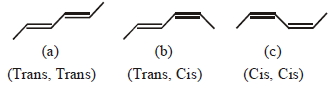
Generally trans is more stable then cis formHeat of combustion (HOC) \(\propto \frac{1}{\text { Stability }}\)
Stability : \(a>b>c\)
\(\mathrm{HOC}: \mathrm{c}>\mathrm{b}>\mathrm{a}\)
-
- (A) \((v) < (i) < (iv) < (ii) < (iii)\)
- (B) \((iii) < (i) < (ii) < (iv) < (v)\)
- (C) \((v) < (iii) < (ii) < (iv) < (i)\)
- (D) \((iii) < (iv) < (ii) < (i) < (v)\)
उत्तर और हल देखें
सही उत्तर: (C)
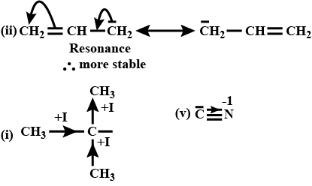
Basicity \(\propto \frac{1}{\text { Stability }}\)\((v)\) In figure \(5 , sp\) hybridised carbon is more electronegative. -ve charge on more electronegative atom makes it more stable. [ref. image]
Also, there is \(-I\) effect.
\(\therefore\) It is most stable.
\((iii)\) \(H - C \equiv \overline{ C }\)
sp hybridized carbon carry -ve charge.
\(\therefore\) Hence, it is also more stable
\((ii)\) In figure \(2\), resonance is taking place. [ref. image]
\(\therefore\) It is more stable.
\((iv)\) \(\overline{ C } H _3\)
-ve charge is carried by \(sp ^3\) hybridised carbon.
\(\therefore\) It is less stable.
\((i)\) In figure \(1\) , the central \(C\) is surrounded by \(CH _3\) and hence it shows \(+ I\) effect from \(3\) sides. [ref. image]
\(\therefore\) Hence, it is least stable.
\(\therefore \text { (v) }\,<\,\text { (iii) }\,<\,\text { (ii) }\,<\,\text { (iv) }\,<\,\text { (i) }\)
-
- (A) \(b\) तथा \(d\)
- (B) \(a, b\) तथा \(c\)
- (C) \(a\) तथा \(c\)
- (D) \(a\) तथा \(b\)
उत्तर और हल देखें
सही उत्तर: (B)
\(S _{ N }{ }^{1}\) favours\((a)\) The reaction is favoured by weak nucleophiles
\((b)\) \(R^ \oplus\) would be easily formed if the substituents are bulky
\((c)\) The reaction is accompained by recemization
- 55. \(CH = CH , CH _{3}- C = CH\) तथा \(CH _{2}= CH _{2}\) यौगिकों के अम्लीय सामर्थ्य का सही क्रम है : 2019 मध्यम
- (A) \(CH \equiv CH > C{H_2} = C{H_2} > C{H_3} - C \equiv CH\)
- (B) \(C{H_3} - C \equiv CH > CH \equiv CH > C{H_2} = C{H_2}\)
- (C) \(C{H_3} - C \equiv CH > C{H_2} = C{H_2} > CH \equiv CH\)
- (D) \(CH \equiv CH > \,C{H_3} - C \equiv CH > \,C{H_2} = C{H_2}\)
उत्तर और हल देखें
सही उत्तर: (D)
Acidic strength \( \propto \) Stability of conjugate base \(E.N. \to sp\, carbon > sp^2\, carbon > sp^3\, carbon\) -
- (A) \(CHBr_3\)
- (B) \(CHI_3\)
- (C) \(CH(CN)_3\)
- (D) \(CHCl_3\)
उत्तर और हल देखें
सही उत्तर: (C)
\(CH{\left( {CN} \right)_3} \rightleftharpoons \mathop C\limits^ - {\left( {CN} \right)_3} + {H^ + }\)Negative charge of the conjugate base \(\mathop C\limits^ - {\left( {CN} \right)_3}\) in extensively delocalized through the \(C \equiv N\) group.
-
- (A) \((b) < (c) < (a) < (d)\)
- (B) \((a) < (d) < (c) < (b)\)
- (C) \((d) < (a) < (c) < (b)\)
- (D) \((b) < (c) < (d) < (a)\)
उत्तर और हल देखें
सही उत्तर: (A)
\(\underset{Ch\arg ed\,ion}{\mathop{\underset{\_\_\_\_\_\_\_\_\_\_\_\_\_\_\_\_\_\_\_\_\_\_\_\_\_\_\_\_\_\_\_\_\_\_\_\_\_\_\_\_\_\_\_\_\_\_\_\_\_\_\_\_\_\_\_\_\_}{\mathop{O{{H}^{-}}>\begin{matrix}
C{{H}_{3}}-C-{{O}^{-}} \\
\,\,\,|| \\
\,\,\,O \\
\end{matrix}>\begin{matrix}
\,\,\,\,O \\
\,\,\,\,|| \\
C{{H}_{3}}-S-{{O}^{-}} \\
\,\,\,\,|| \\
\,\,\,\,O \\
\end{matrix}>}}\,}}\,\) \(\underset{\begin{smallmatrix}
neutral \\
system
\end{smallmatrix}}{\mathop{\underset{\_\_\_\_\_\_\_}{\mathop{{{H}_{2}}O}}\,}}\,\)ione pair donating tendency on oxygen is reduced, nucleophilicity reduced \(b < c < a < d\)
-
- (A) \((c) < (a) < (d) < (b)\)
- (B) \((b) < (d) < (a) < (c)\)
- (C) \((a) < (c) < (d) < (b)\)
- (D) \((b) < (d) < (c) < (a)\)
उत्तर और हल देखें
सही उत्तर: (C)
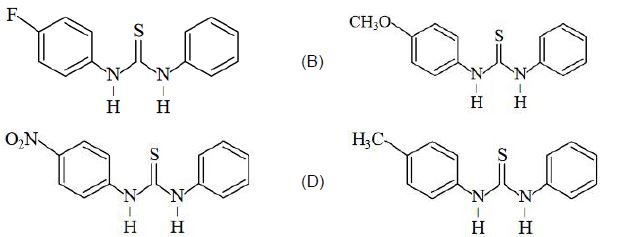
\(CH_3O-, CH_3-, H\) is electron donating, But \(-NO_2\) is electron withdrawing group. -
- (A) कार्बोॠणायन
- (B) कार्बिन
- (C) कार्बोधनायन
- (D) मुक्त मूलक
उत्तर और हल देखें
सही उत्तर: (C)
\(\begin{matrix}
Cl-CH-C{{H}_{3}} \\
|\,\,\,\,\,\,\,\,\, \\
\underset{(-)\,\,\,\,\,\,\,\,\,\,\,\,\,\,}{\mathop{Ph\,\,\,\,\,\,\,}}\, \\
\end{matrix}\xrightarrow[Toluene]{SbC{{l}_{5}}}\underset{\begin{smallmatrix}
(Carbocation) \\
(planar)
\end{smallmatrix}}{\mathop{Ph-\overset{\oplus }{\mathop{C}}\,H-C{{H}_{3}}}}\,+SbCl_{6}^{-}\) \(\to \underset{\begin{smallmatrix}
(d\,and\,l)\,mixture \\
+SbC{{l}_{5}}
\end{smallmatrix}}{\mathop{\begin{matrix}
Ph-CH-C{{H}_{3}} \\
\,|\,\,\,\,\,\,\,\,\, \\
Cl\,\,\,\,\,\,\,\,\, \\
\end{matrix}}}\,\) -
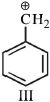
- (A) \(III > II > I\)
- (B) \(I > II > III\)
- (C) \(II > III > I\)
- (D) \(III > I > II\)
उत्तर और हल देखें
सही उत्तर: (D)
Stability due to resonance - More the no of resonating structure more is the stability.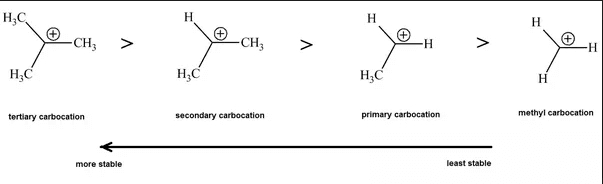
इस पेज पर इन फ़िल्टर से कोई प्रश्न नहीं मिला।