


All Organic chemistry reaction mechanism questions
Newest firstShowing 51–64 of 64 questions
-
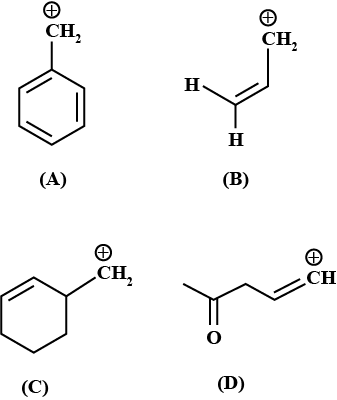
- (A) \((C)\) and \((D)\) only
- (B) \((A), (B)\) and \((C)\) only
- (C) \((A), (B)\) and \((D)\) only
- (D) \((A)\) and \((B)\) only
Show answer and solution
Correct Answer: (D)
\((A)\) and \((B)\) only in Resonance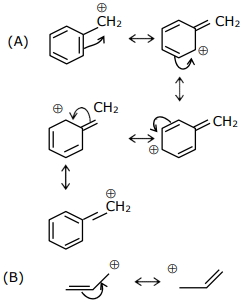
-
- (A) \((B)\) and \((C)\) only
- (B) \((A)\) only
- (C) \((A)\) and \((C)\) only
- (D) \((B)\) only
Show answer and solution
Correct Answer: (C)
Ambident nucleophile\((A)\) \(KCN\) And \(AgCN\)
\((C)\) \(AgNO _{2}\) And \(KNO _{2}\)
-
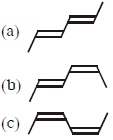
- (A) \((a) < (b) < (c)\)
- (B) \((b) < (c) < (a)\)
- (C) \((c) < (b) < (a)\)
- (D) \((a) < (c) < (b)\)
Show answer and solution
Correct Answer: (A)
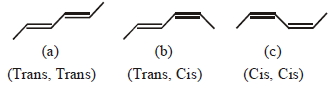
Generally trans is more stable then cis formHeat of combustion (HOC) \(\propto \frac{1}{\text { Stability }}\)
Stability : \(a>b>c\)
\(\mathrm{HOC}: \mathrm{c}>\mathrm{b}>\mathrm{a}\)
-
- (A) \((v) < (i) < (iv) < (ii) < (iii)\)
- (B) \((iii) < (i) < (ii) < (iv) < (v)\)
- (C) \((v) < (iii) < (ii) < (iv) < (i)\)
- (D) \((iii) < (iv) < (ii) < (i) < (v)\)
Show answer and solution
Correct Answer: (C)
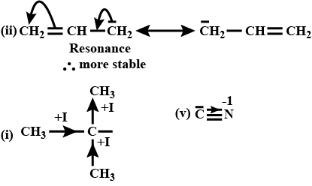
Basicity \(\propto \frac{1}{\text { Stability }}\)\((v)\) In figure \(5 , sp\) hybridised carbon is more electronegative. -ve charge on more electronegative atom makes it more stable. [ref. image]
Also, there is \(-I\) effect.
\(\therefore\) It is most stable.
\((iii)\) \(H - C \equiv \overline{ C }\)
sp hybridized carbon carry -ve charge.
\(\therefore\) Hence, it is also more stable
\((ii)\) In figure \(2\), resonance is taking place. [ref. image]
\(\therefore\) It is more stable.
\((iv)\) \(\overline{ C } H _3\)
-ve charge is carried by \(sp ^3\) hybridised carbon.
\(\therefore\) It is less stable.
\((i)\) In figure \(1\) , the central \(C\) is surrounded by \(CH _3\) and hence it shows \(+ I\) effect from \(3\) sides. [ref. image]
\(\therefore\) Hence, it is least stable.
\(\therefore \text { (v) }\,<\,\text { (iii) }\,<\,\text { (ii) }\,<\,\text { (iv) }\,<\,\text { (i) }\)
-
- (A) \(b\) and \(d\)
- (B) \(a, b\) and \(c\)
- (C) \(a\) and \(c\)
- (D) \(a\) and \(b\)
Show answer and solution
Correct Answer: (B)
\(S _{ N }{ }^{1}\) favours\((a)\) The reaction is favoured by weak nucleophiles
\((b)\) \(R^ \oplus\) would be easily formed if the substituents are bulky
\((c)\) The reaction is accompained by recemization
- 56. The correct order for acid strength of compounds \(CH \equiv CH,\,C{H_3} - C \equiv CH,\,C{H_2} = C{H_2}\) is as follows 2019 Medium
- (A) \(CH \equiv CH > C{H_2} = C{H_2} > C{H_3} - C \equiv CH\)
- (B) \(C{H_3} - C \equiv CH > CH \equiv CH > C{H_2} = C{H_2}\)
- (C) \(C{H_3} - C \equiv CH > C{H_2} = C{H_2} > CH \equiv CH\)
- (D) \(CH \equiv CH > \,C{H_3} - C \equiv CH > \,C{H_2} = C{H_2}\)
Show answer and solution
Correct Answer: (D)
Acidic strength \( \propto \) Stability of conjugate base \(E.N. \to sp\, carbon > sp^2\, carbon > sp^3\, carbon\) -
- (A) \((b) < (c) < (a) < (d)\)
- (B) \((a) < (d) < (c) < (b)\)
- (C) \((d) < (a) < (c) < (b)\)
- (D) \((b) < (c) < (d) < (a)\)
Show answer and solution
Correct Answer: (A)
\(\underset{Ch\arg ed\,ion}{\mathop{\underset{\_\_\_\_\_\_\_\_\_\_\_\_\_\_\_\_\_\_\_\_\_\_\_\_\_\_\_\_\_\_\_\_\_\_\_\_\_\_\_\_\_\_\_\_\_\_\_\_\_\_\_\_\_\_\_\_\_}{\mathop{O{{H}^{-}}>\begin{matrix}
C{{H}_{3}}-C-{{O}^{-}} \\
\,\,\,|| \\
\,\,\,O \\
\end{matrix}>\begin{matrix}
\,\,\,\,O \\
\,\,\,\,|| \\
C{{H}_{3}}-S-{{O}^{-}} \\
\,\,\,\,|| \\
\,\,\,\,O \\
\end{matrix}>}}\,}}\,\) \(\underset{\begin{smallmatrix}
neutral \\
system
\end{smallmatrix}}{\mathop{\underset{\_\_\_\_\_\_\_}{\mathop{{{H}_{2}}O}}\,}}\,\)ione pair donating tendency on oxygen is reduced, nucleophilicity reduced \(b < c < a < d\)
-
- (A) \((c) < (a) < (d) < (b)\)
- (B) \((b) < (d) < (a) < (c)\)
- (C) \((a) < (c) < (d) < (b)\)
- (D) \((b) < (d) < (c) < (a)\)
Show answer and solution
Correct Answer: (C)
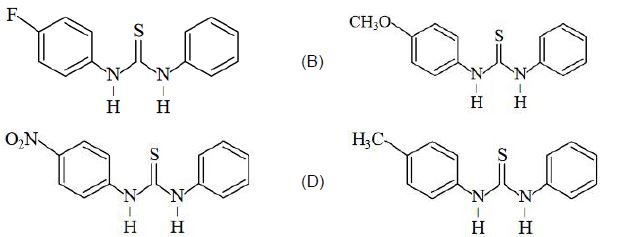
\(CH_3O-, CH_3-, H\) is electron donating, But \(-NO_2\) is electron withdrawing group. -
- (A) \(CHBr_3\)
- (B) \(CHI_3\)
- (C) \(CH(CN)_3\)
- (D) \(CHCl_3\)
Show answer and solution
Correct Answer: (C)
\(CH{\left( {CN} \right)_3} \rightleftharpoons \mathop C\limits^ - {\left( {CN} \right)_3} + {H^ + }\)Negative charge of the conjugate base \(\mathop C\limits^ - {\left( {CN} \right)_3}\) in extensively delocalized through the \(C \equiv N\) group.
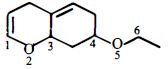
- 60. On the treatment of the following compound with a strong acid, the most susceptible site for bond cleavage is
 2018 Hard
- (A) \(O2- C3\)
- (B) \(O5 - C6\)
- (C) \(C4- O5\)
- (D) \(C1 - O2\)
Show answer and solution
Correct Answer: (B)
The lone pair of electrons on \(O2\) is involved in resonance with \(C= C\). Hence \(O2\) will not be protonated. The lone pair of electrons on \(O5\) is not involved in resonance with \(C\, = C\). Hence, \(O5\) will be protonated. Chloride ion will then attack least substituted \(C\) atom \((C6)\) -
- (A) carbanion
- (B) carbene
- (C) carbocation
- (D) free radical
Show answer and solution
Correct Answer: (C)
\(\begin{matrix}
Cl-CH-C{{H}_{3}} \\
|\,\,\,\,\,\,\,\,\, \\
\underset{(-)\,\,\,\,\,\,\,\,\,\,\,\,\,\,}{\mathop{Ph\,\,\,\,\,\,\,}}\, \\
\end{matrix}\xrightarrow[Toluene]{SbC{{l}_{5}}}\underset{\begin{smallmatrix}
(Carbocation) \\
(planar)
\end{smallmatrix}}{\mathop{Ph-\overset{\oplus }{\mathop{C}}\,H-C{{H}_{3}}}}\,+SbCl_{6}^{-}\) \(\to \underset{\begin{smallmatrix}
(d\,and\,l)\,mixture \\
+SbC{{l}_{5}}
\end{smallmatrix}}{\mathop{\begin{matrix}
Ph-CH-C{{H}_{3}} \\
\,|\,\,\,\,\,\,\,\,\, \\
Cl\,\,\,\,\,\,\,\,\, \\
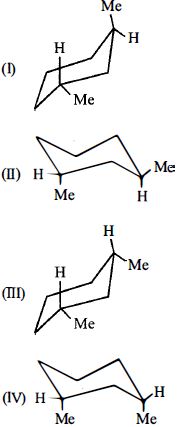
\end{matrix}}}\,\) - 62. Arrange in the correct order of stability (decreasing order) for the following molecules
 2013 Hard
- (A) \((I) > (II) > (III) >(IV)\)
- (B) \((IV) > (III) > (II) \approx (I)\)
- (C) \((I) > (II) \approx (III) > (IV)\)
- (D) \((III) > (I) \approx (II) > (IV)\)
Show answer and solution
Correct Answer: (C)
Disequatorial cis \(-1,\,3-\) Dimethylcyclohexane is more stable as both methyl groups are equatorial and are away from each other. (Refer to Image \(I\))It is followed by trans \(-1,\,3-\) Dimethylcyclohexane where one \(-C H_{3}\) group is equatorial and other is axial (Refer to Image \(II\))
Diaxial cis \(-1,\,3-\) Dimethylcyclohexane is less stable due to large amount of steric strain due to the interaction of axial - \(\mathrm{CH}_{3}\) groups. (Refer to Image \(III\) )
\((I) > (II) \approx (III) > (IV)\)
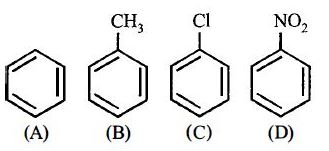
- 63. In the above compounds correct order of reactivity in electrophilic substitution reactions will be
 2013 Hard
- (A) \(B >A> C > D\)
- (B) \(D > C > B > A\)
- (C) \(A > B > C > D\)
- (D) \(B > C > A > D\)
Show answer and solution
Correct Answer: (A)
\(- Cl\) and \(-CH_3\) groups are \(o\) and \(p\) directing. They are electron releasing due to \(+ E\) and \(+ M\) effects. Further since such groups increase electron density in the nucleus, they facilitate further electrophilic substitution and hence known as activating group. The activating effect of these groups is in order of \(- CH_3 > -X\) but chlorine exceptionally deactive the ring due to strong \(- I\) effect. Hence, it is difticult to carry out substitution in chlorobenzene than in benzene . Further \(- NO_2\) is a deactivating group hence deactivates the benzene nucleus, i.e. hinder the further substitution. Thus nitrobenzene undergo electrophilic substitution with a great difficulty hence the correct order will be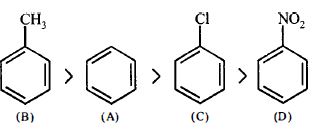
-
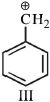
- (A) \(III > II > I\)
- (B) \(I > II > III\)
- (C) \(II > III > I\)
- (D) \(III > I > II\)
Show answer and solution
Correct Answer: (D)
Stability due to resonance - More the no of resonating structure more is the stability.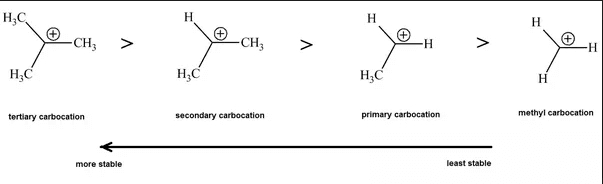
No questions on this page match these filters.