


कार्बनिक रसायन शुद्धि और लक्षण वर्णन के सभी प्रश्न
नए पहले133 में से 101–133 प्रश्न
-
- (A) \(2\)
- (B) \(7\)
- (C) \(1\)
- (D) \(15\)
उत्तर और हल देखें
सही उत्तर: (B)
\(\mathrm{C}_{2} \mathrm{H}_{7} \mathrm{~N}+\left(2 \mathrm{x}+\frac{\mathrm{y}}{2}\right) \mathrm{CuO} \rightarrow \mathrm{x} \mathrm{CO}_{2}+\frac{\mathrm{y}}{2} \mathrm{H}_{2} \mathrm{O}+\frac{\mathrm{z}}{2} \mathrm{~N}_{2}+\left(2 \mathrm{x}+\frac{\mathrm{y}}{2}\right) \mathrm{Cu}\)On balancing
\(\mathrm{C}_{2} \mathrm{H}_{7} \mathrm{~N}+\frac{15}{2} \mathrm{CuO} \rightarrow 2 \mathrm{CO}_{2}+\frac{7}{2} \mathrm{H}_{2} \mathrm{O}+\frac{1}{2} \mathrm{~N}_{2}+\frac{15}{2} \mathrm{Cu}\)
On comparing
\(\mathrm{y}=7\)
-
- (A) \(1\)
- (B) \(6\)
- (C) \(3\)
- (D) \(8\)
उत्तर और हल देखें
सही उत्तर: (C)
\(44 gm CO _{2}\), have \(12 gm\) carbonSo, \(420 gm CO _{2} \Rightarrow \frac{12}{44} \times 420\)
\(\Rightarrow \frac{1260}{11} gm\) carbon
\(\Rightarrow 114.545\) gram carbon
So, \(\%\) of carbon \(=\frac{114.545}{750} \times 100\)
\(=15.3 \%\)
\(18 gm H _{2} O \Rightarrow 2 gm H _{2}\)
\(210 gm \Rightarrow \frac{2}{18} \times 210\)
\(=23.33 gm H _{2}\)
\(So , \% H _{2} \Rightarrow \frac{23.33}{750} \times 100=3.11 \%\)
\(\approx 3 \%\)
-
- (A) \(4\)
- (B) \(400\)
- (C) \(40\)
- (D) \(0.40\)
उत्तर और हल देखें
सही उत्तर: (C)
\(\mathrm{n}_{\mathrm{AgBr}}=\frac{0.188 \mathrm{~g}}{188 \mathrm{~g} / \mathrm{mol}}=10^{-3}\, \mathrm{~mol}\)\(\Rightarrow \mathrm{n}_{\mathrm{Br}}=\mathrm{n}_{\lambda_{\mathrm{kBt}}}=0.001\, \mathrm{~mol}\)
\(\Rightarrow \text { mass }_{\mathrm{Bz}}=(0.001 \times 80) \,\mathrm{gm}=0.08 \,\mathrm{gm}\)
\(\Rightarrow \text { mass } \%=\frac{0.08 \times 100}{0.2}=40 \,\%\)
-
- (A) गतिशीलता अथवा विलायक तन्त्र का प्रवाह
- (B) यौगिक की विलेयता
- (C) कालम अथवा \(TLC\) प्लेट की लम्बाई
- (D) शुद्ध यौगिक की भौतिक अवस्था
उत्तर और हल देखें
सही उत्तर: (D)
In chromotography technique, the purification of a compound is independent of the physical -
- (A) \(8\)
- (B) \(9\)
- (C) \(41\)
- (D) \(12\)
उत्तर और हल देखें
सही उत्तर: (D)
Organic compound : \(0.8 \,\mathrm{gm}\)wt. of \(\mathrm{N}=\left(\frac{42}{100} \times 0.8\right)\, \mathrm{gm}\)
mole of \(N=\frac{42 \times 0.8}{100 \times 14}=\frac{2.4}{100}\, \mathrm{~mol}\)
moles of \(\mathrm{NH}_{3}=\frac{2.4}{100}\)
\(2 \mathrm{NH}_{3}+\mathrm{H}_{2} \mathrm{SO}_{4} \rightarrow\left(\mathrm{NH}_{4}\right)_{2} \mathrm{SO}_{4}\)
\(\quad\downarrow\quad\quad\quad\downarrow\)
\(\frac{2.4}{100}\) \(mole\) \(\quad\frac{1.2}{100}\) \(mole\)
For \(\mathrm{H}_{2} \mathrm{SO}_{4} \quad \frac{1.2}{100}=1 \times \mathrm{V}(\ell)\)
\(\Rightarrow \mathrm{V}_{\mathrm{H}_{2} \mathrm{SO}_{4}}=\frac{1.2}{100} \,\ell=12 \,\mathrm{~m} \ell\)
- 106. कैरिअस विधि में हैलोजनयुक्त कार्बनिक यौगिक को सधूम नाइट्रिक अम्ल के साथ जिसकी उपस्थिति में गर्म करते हैं, वह है 2021 कठिन
- (A) \(\mathrm{AgNO}_{3}\)
- (B) \(\mathrm{HNO}_{3}\)
- (C) \(\mathrm{BaSO}_{4}\)
- (D) \(\mathrm{CuSO}_{4}\)
उत्तर और हल देखें
सही उत्तर: (A)
Organic compound is heated with fuming nitric acid in the presence of silver nitrate in carius method.Lunar caustic \(\left(\mathrm{AgNO}_{3}\right)\) is used as reagent hare to distinguish \(\mathrm{Cl}^{-}, \mathrm{Br}\) and \(\mathrm{I}^{-}\)respectively as follows.
\(\mathrm{Cl}^{-}(\mathrm{aq}) \stackrel{\mathrm{AgNO}_{3}}{\longrightarrow} \mathrm{AgCl} \downarrow_{\mathrm{ppt}}\) white
\(\mathrm{Br}^{-}(\mathrm{aq})\stackrel{\mathrm{AgNO}_{3}}{\longrightarrow} \mathrm{AgBr} \downarrow_{\mathrm{ppt}} \mathrm{pale}\) yellow
\(\mathrm{I}^{-}(\mathrm{aq}) \stackrel{\mathrm{AgNO}_{3}}{\longrightarrow} \mathrm{AgNO}_{3} \mathrm{AgI} \downarrow_{\mathrm{ppt}}\) Dark yellow
-
- (A) \(96\)
- (B) \(12\)
- (C) \(85\)
- (D) \(68\)
उत्तर और हल देखें
सही उत्तर: (D)
Moles of \(\mathrm{Br}=\) Moles of \(\mathrm{AgBr}\) obtained\(\Rightarrow \quad\) Mass of \(\mathrm{Br}=\frac{0.2397}{188} \times 80\, \mathrm{~g}\)
therefore \(\%\) Br in the organic compound
\(=\frac{W_{\text {Br }}}{W_{T}} \times 100\)
\(=\frac{0.2397 \times 80}{188 \times 0.15} \times 100=0.85 \times 80\)
\(=68\)
\(\Rightarrow\) Nearest integer is \('68^{\prime}\)
-
- (A) \(1963\)
- (B) \(8510\)
- (C) \(1125\)
- (D) \(7412\)
उत्तर और हल देखें
सही उत्तर: (C)
Moles of \(\mathrm{N}\) in \(\mathrm{N}, \mathrm{N}\) - dimethylaminopentane\(=\left(\frac{57.5}{115}\right)=0.5\, \mathrm{~mol}\)
\(\Rightarrow \mathrm{C}_{7} \mathrm{H}_{17} \mathrm{~N}+\frac{45}{2} \mathrm{CuO} \rightarrow 7 \mathrm{CO}_{2}+\frac{17}{2} \mathrm{H}_{2} \mathrm{O}+\frac{1}{2} \mathrm{~N}_{2}+\frac{45}{2} \mathrm{Cu}\)
\(\frac{\mathrm{n}_{\mathrm{cuo}} \text { reacted }}{\left(\frac{45}{2}\right)}=\frac{\mathrm{n}_{\mathrm{C_7} \mathrm{H}_{17} \mathrm{N}} \text { reacted }}{1}\)
\(\Rightarrow \mathrm{n}_{\mathrm{C} \mathrm{u} O}\) reacted \(=\left(\frac{45}{2}\right) \times 0.5=11.25\)
-
- (A) कथन \(-I\) असत्य है परन्तु कथन \(II\) सत्य है दोनों
- (B) कथन \(-I\) तथा कथन \(II\) असत्य है
- (C) कथन \(-I\) सत्य है परन्तु कथन \(II\) असत्य है
- (D) दोनों कथन \(-I\) तथा कथन \(II\) सत्य है
उत्तर और हल देखें
सही उत्तर: (D)
Statement \(1: B.P.\) of chloroform \(=334 K\)\(B.P.\) of aniline \(=457 K\)
thus can be seprated of simple distillation.
Statement \(2 :\) Mixture of aniline and water seprated by simple distillation.
-
- (A) दोनों कथन \(I\) तथा कथन \(II\) असत्य है।
- (B) कथन \(I\) असत्य है परन्तु कथन \(I I\) सत्य है।
- (C) कथन \(I\) सत्य है परन्तु कथन \(II\) असत्य है।
- (D) दोनों कथन \(I\) तथा कथन \(II\) सत्य हैं।
उत्तर और हल देखें
सही उत्तर: (C)
Statement \(I:\) It is correct statementStatement \(II:\) \(\mathrm{CH}_{3}-\mathrm{C^+H}_{2}\) involve \(\mathrm{C}_{\mathrm{sp}^{3}}-\mathrm{H}_{1 \mathrm{~s}}\) bond with empty \(2 \mathrm{p}\) orbital hence given statement is false.
-
- (A) कथन \(-I\) सत्य है परन्तु कथन \(-II\) असत्य है।
- (B) दोनों कथन \(-I\) तथा कथन \(-II\) सत्य है।
- (C) दोनों कथन \(-I\) तथा कथन \(-II\) असत्य है।
- (D) कथन \(-I\) असत्य है परन्तु कथन \(-II\) सत्य है।
उत्तर और हल देखें
सही उत्तर: (C)
\(R _{ f }=\) retardation factorDistance travelled by the substance from
\(R _{ f }=\frac{\text { reference line }( c \cdot m )}{\text { Distan ce travelled by the solvent from }}\)
reference line \((c.m)\)
Note : \(R _{ f }\) value of different compounds are different.
-
- (A) \((A)\) सही नहीं है परन्तु \(( R )\) सही है।
- (B) दोनों \((A)\) तथा \((R)\) सही हैं और \(( R )\) सही व्याख्या नहीं है \((A)\) की।
- (C) \((A)\) सही है परन्तु \((R)\) सही नहीं है।
- (D) दोनों \((A)\) तथा \((R)\) सही हैं और \((R)\) सही व्याख्या है \((A)\) की।
उत्तर और हल देखें
सही उत्तर: (D)
Both assertion \(\&\) reason are correct \(\&\) \((\mathrm{R})\) is the correct explanation of \((A)\) -
- (A) \(2\)
- (B) \(1\)
- (C) \(4\)
- (D) \(3\)
उत्तर और हल देखें
सही उत्तर: (C)
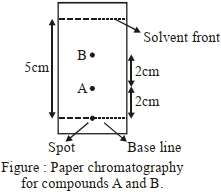
\(R _{ f }=\frac{\text { Distance travelled by compound }}{\text { Distance travelled by solvent }}\)on chromatogram distance travelled by cmopound is \(\rightarrow 2 \,cm\)
Distance travelled by solvent \(=5\, cm\)
So \(R _{ f }=\frac{2}{5}=4 \times 10^{-1}=0.4\)
-
- (A) एक कार्बनिक यौगिक में सल्फर का आकलन करने के लिए कैरिअस नली का उपयोग करते हैं।
- (B) नाइट्रोजन का कार्बनिक यौगिक में आकलन के लिए कैरिअस विधि का उपयोग करते हैं।
- (C) कार्बनिक यौगिक में उपस्थित फॉस्फोरस के ऑक्सीकरण से उत्पन्न फॉस्फोरिक अम्ल को मेग्नेसिया मिश्रण मिलाकर \(Mg _{2} P _{2} O _{7}\) के रूप में अवक्षेपित करते है।
- (D) जैल्डॉल विधि का उपयोग कार्बनिक यौगिकों में नाइट्रोजन आकलन के लिए करते हैं।
उत्तर और हल देखें
सही उत्तर: (B)
Carius method is used in the estimation of halogen in organic compounds. -
- (A) नाइट्रिक अम्ल
- (B) अमोनिया
- (C) हाइड्रोक्लोरिक अम्ल
- (D) सोडियम हाइड्रॉक्साइड
उत्तर और हल देखें
सही उत्तर: (A)
For testing of halogens, Nitric acid is added to the sodium extract because if \(CN ^{-}\) or \(S ^{2-}\) are present then they will be oxidised and removed before the test of halides. -
- (A) \(142\)
- (B) \(42\)
- (C) \(471\)
- (D) \(233\)
उत्तर और हल देखें
सही उत्तर: (B)
Molecular mass of \(\mathrm{BaSO}_{4}=233 \,\mathrm{~g}\)\(\because 233 \,g\,\mathrm{BaSO}_{4}\) contain \(\rightarrow 32\, \mathrm{~g}\) sulphur
\(\therefore 1.44\, \mathrm{~g} \,\mathrm{BaSO}_{4}\) contain \(\rightarrow \frac{32}{233} \times 1.44\, \mathrm{~g}\) sulphur
given : \(0.471\, \mathrm{~g}\) of organic compound
\(\%\) of \(\mathrm{S}=\frac{32 \times 1.44}{233 \times 0.471} \times 100=41.98 \,\% \approx 42\, \%\)
-
- (A) \((a)-(iii), (b)-(i), (c)-(ii), (d)-(iv)\)
- (B) \((a)-(i), (b)-(iv), (c)-(iii), (d)-(ii)\)
- (C) \((a)-(iii), (b)-(i), (c)-(iv),(d)-(ii)\)
- (D) \((a)-(i), (b)-(ii), (c)-(iv), (d)-(iii)\)
उत्तर और हल देखें
सही उत्तर: (C)
Match List :-\((a)\) Lassaigne's Test \((iii)\) \(N , S , P ,\) and halogen \((b)\) \(Cu ( II )\) oxide \((i)\) Carbon \((c)\) Silver nitrate \((iv)\) Halogen Specifically \((d)\) The sodium fusion extract gives black precipitate with acetic acid and lead acetate \((ii)\) Sulphur - 118. उच्च क्वथनांक के द्रव कार्बनिक यौगिक (क्वथनांक के समीप विघटित होता है) के शुद्धिकरण के लिए उपयोग की जाने वाली तकनीक कौन सी है \(?\) 2021 मध्यम
- (A) सामान्य आसवन
- (B) वाष्प आसवन
- (C) प्रभावी आसवन
- (D) दाब घटाकर आसवन
उत्तर और हल देखें
सही उत्तर: (D)
Reduced pressure distillation used for the purification of high boiling organic liquids which decomposes at or below their boiling point. -
- (A) \(19\)
- (B) \(21\)
- (C) \(25\)
- (D) \(80\)
उत्तर और हल देखें
सही उत्तर: (A)
\(\mathrm{n}_{\mathrm{cl}} \text { in compound }=\mathrm{n}_{\mathrm{AgCl}}=\frac{0.3849 \mathrm{~g}}{(107.87+35.5)}\, \mathrm{g} / \mathrm{mol}\)\(\Rightarrow \text { mass of chlorine }=\mathrm{n}_{\mathrm{Cl} } \times 35.5=0.0953\, \mathrm{gm}\)
\(\Rightarrow\, \% \text { wt of chlorine }=\frac{0.0953}{0.5} \times 100\)
\(\quad=19.06\, \%\)
-
- (A) साधारण आसवन, \(3\)-मेथिलपेंटेन
- (B) साधारण आसवन, आइसोहेक्सेन
- (C) प्रभाजी आसवन, आइसोहेक्सेन
- (D) प्रभाजी आसवन, \(3\)-मेथिलपेंटेन
उत्तर और हल देखें
सही उत्तर: (C)
Liquid which have less difference in boiling point can be isolated by fractional distillation and liquid with less boiling point will be isolated first. -
- (B) \(H _{3} C - CH _{2}- Br\)
- (D) \(H _{3} C - Br\)
उत्तर और हल देखें
सही उत्तर: (A)
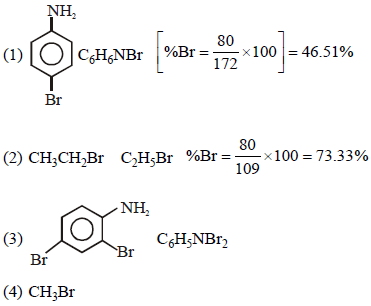
In Carius methodmass of organic compound \(=0.172 gm\) mass of Bromine \(=0.08 gm\)
Hence \(\%\) of Bromine \(=\frac{0.08}{0.172} \times 100\)
\(=46.51 \%\)
-
- (A) \(50\)
- (B) \(55\)
- (C) \(45\)
- (D) \(40\)
उत्तर और हल देखें
सही उत्तर: (A)
Carius method\(\%\) of \(Br =\frac{\text { wt of } AgBr }{\text { wt. of organic compound }} \times 100 \times \frac{\text { molar mass of Br }}{\text { AgBr }}\)
\(=\frac{1.88}{1.6} \times \frac{80}{188} \times 100=\frac{15040}{300.8}=50 \%\)
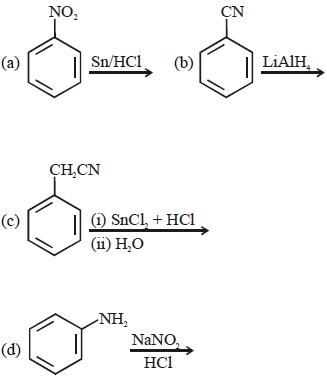
- 123. निम्नांकित किन अभिक्रिया उत्पादों के लिए नाइट्रोजन आकलन की जेल्डाल विधि असफल रहती है ?
 2020 मध्यम
- (A) \(a\) तथा \(d\)
- (B) \(c\) तथा \(d\)
- (C) \(a, c\) तथा \(d\)
- (D) \(b\) तथा \(c\)
उत्तर और हल देखें
सही उत्तर: (B)
Kjeldahl method is used for \(N\) estimation But not given by 'Diazo' compounds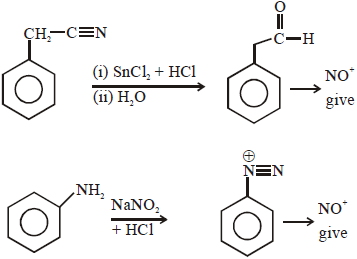
-
- (A) वाष्प आसवन
- (B) विभेदी निष्कर्षण
- (C) कम दाब पर आसवन
- (D) प्रभाजी आसवन
उत्तर और हल देखें
सही उत्तर: (C)
Glycerol is separated by reduced pressure distillation in soap industries. -
- (A) \((\mathrm{B}),(\mathrm{C})\) तथा \((\mathrm{A})\)
- (B) \((\mathrm{C}),(\mathrm{A})\) तथा \((\mathrm{B})\)
- (C) \((\mathrm{A}),(\mathrm{B})\) तथा \((\mathrm{C})\)
- (D) \((\mathrm{B}),(\mathrm{A})\) तथा \((\mathrm{C})\)
उत्तर और हल देखें
सही उत्तर: (B)
Benzanilide \(\rightarrow\) Ph-NH-CO-Ph \((\mu=2.71 \mathrm{D})\)Aniline \(\rightarrow \mathrm{Ph}-\mathrm{NH}_{2}\), \((\mu=1.59 \mathrm{D})\)
Acetophenone \(\rightarrow\) Ph-O-CH \(_{3}\) ( \(\mu=3.05 \mathrm{D}\) )
Dipole moment : \({C}>{A}>{B}\)
Hence the sequence of obtained compounds is \((\mathrm{C})\;,(\mathrm{A})\) and \((\mathrm{B})\)
-
- (A) \(C_{12}H_8N\)
- (B) \(C_{12}H_8N_2\)
- (C) \(C_6H_8N_2\)
- (D) \(C_6H_8N\)
उत्तर और हल देखें
सही उत्तर: (C)
\(CO_2 = 6\,mole,\,N_1 = 1\,mole\)\(C_{atom}= 6,\,N_{atom} = 2\)
Hence \(C_6H_8N_2\)
-
- (A) \(a - d, b -r, c -p\)
- (B) \(a -q, b -r, c -s\)
- (C) \(a -r, b -p, c -s\)
- (D) \(a -q, b -r, c -p\)
उत्तर और हल देखें
सही उत्तर: (B)
(mixture) \(\quad\quad\quad\quad\) (seperation method)\(H _2 O : \text { Sugar } \Rightarrow \text { Recrystallization }\)
\(H _2 O : \text { Aniline } \Rightarrow \text { Steam distillation }\)
\(H _2 O \text { : Toluene } \Rightarrow \text { Differential extraction }\)
-
- (A) गतिशील प्रावस्था एक गैस हो सकती है।
- (B) स्थिर प्रावस्था एक बहुत महीन पिसा हुआ ठोस अधिशोषक होता है।
- (C) प्रथक्करण एक गतिशील तथा स्थिर प्रावस्था के बीच विलेय के साम्यन पर निर्भर करता है।
- (D) कागज वर्णलेखन, वितरण वर्णलेखन का एक उदाहरण है।
उत्तर और हल देखें
सही उत्तर: (B)
Partition chromatography is the process of separation where by the component of the mixture get distributed into two phases that may be liquid-liquid, liquid gas but not to solid-gas. - 129. साबुन उद्योग में भूक्तशेष लाइ (स्पेन्ट लाई) से गिलसरॉल पृथक करने के लिए सबसे उपयुक्त आसवन विधि है: 2016 मध्यम
- (A) बाष्प आसवन
- (B) समानीत दाब पर आसवन
- (C) खामान्य आसवन
- (D) प्रभाजी आसवन
उत्तर और हल देखें
सही उत्तर: (B)
Spent-lye and glycerol are separated by distillation under reduced pressure.Under the reduced pressure the liquid boil at low temperature and the temperature of decomposition will not reach. e.g. glycerol boils at \(290^{\circ} \mathrm{C}\) with decomposition but at reduced pressure it boils at \(180^{\circ} \mathrm{C}\) without decomposition.
-
- (A) \(10\)
- (B) \(3\)
- (C) \(24\)
- (D) \(5\)
उत्तर और हल देखें
सही उत्तर: (A)
Mili equivalents of \(H_2SO_4\)\( = 60 \times \frac{{M \times 2}}{{10}} = 12\)
Mili equivalents of \(NaOH = 20 \times \frac{M}{{10}} = 2\)
Mili equivalents of \(N{H_3} = 12 - 2 = 10\)
\(\% \,\) of nitrogen \( = \frac{{1.4 \times (N \times V)N{H_3}}}{{(Wt.\,of\,organic\,compound)}}\)
\(\frac{{1.4 \times 10}}{{1.4}} = 10\)
-
- (A) \(48\)
- (B) \(60\)
- (C) \(24\)
- (D) \(36\)
उत्तर और हल देखें
सही उत्तर: (C)
Mass of substance \(=250 \mathrm{mg}=0.250 \mathrm{g}\)Mass of \(A g B r=141 \mathrm{mg}=0.141 \mathrm{g}\)
\(1\; mole\) of \(A g B r=1\; g\) atom of \(B r\)
\(188 g\) of \(A g B r=80 g\) of \(B r\)
\(188 g\) of \(A g B r\) contain bromine \(=80 g\)
\(0.141 g\) of \(A g B r\) contain bromine \(=\frac{80}{188} \times 0.141\)
This much amount of bromine present in \(0.250 \mathrm{g}\) of organic compound
\(\because \%\) of bromine \(=\frac{80}{188} \times \frac{0.414}{0.250} \times 100=24 \%\)
-
- (A) \(A - (ii); B - (iii) ; C - (i)\)
- (B) \(A - (iii); B - (i) ; C - (ii)\)
- (C) \(A - (iii); B - (ii) ; C - (i)\)
- (D) \(A - (ii); B - (i) ; C - (iii)\)
उत्तर और हल देखें
सही उत्तर: (C)
\((c)\) In Lassaigne's test, fusion with sodium take place and following species formed respectively.\((a)\) Aniline \(\to \) \(CN^-\)
\((b)\) Benzene sulfonic acid \(\to \) (figure)
\((c)\) Thiourea \(\to \) \(S^{2-}\)
Reaction of \(CN^-\) with hot and acidic solution of \(FeSO_4\) lead to formation of \(Fe_4[Fe(CN)_6]_3\) which is blue in colour. It contains iron in both \(II\) and \(III\) oxidation state.
Reaction of \(S^{2-}\) with sodium nitroprusside
\(N{a_2}S + N{a_2}[Fe{(CN)_5}NO] \to \mathop {N{a_4}[Fe{{(CN)}_5}NOS]}\limits_{(violet\,in\,colour)} \)
Phenoxide ion on reacting with \(FeCl_3\) give red colour with \(FeCl_3\).

-
- (A) \(6\)
- (B) \(10\)
- (C) \(3\)
- (D) \(5\)
उत्तर और हल देखें
सही उत्तर: (B)
\(\%\) of \(N=\frac{1.4 \times \text { meq.of acid }}{\text { mass of organic compound }}\)meq. of \(H_{2} S O_{4}=60 \times \frac{M}{10} \times 2=12\)
meq. of \(N a O H=20 \times \frac{M}{10}=2\)
meq. of acid consumed \(=12-2=10\)
\(\therefore \% \quad N=\frac{1.4 \times 10}{1.4}=10 \%\)
इस पेज पर इन फ़िल्टर से कोई प्रश्न नहीं मिला।