


All Organic chemistry purification and characterization questions
Newest firstShowing 101–139 of 139 questions
-
- (A) \(\mathrm{Fe}_{4}\left[\mathrm{Fe}(\mathrm{CN})_{6}\right]_{3}\)
- (B) \(\mathrm{K}_{5} \mathrm{Fe}\left[\mathrm{Fe}(\mathrm{CN})_{6}\right]_{2}\)
- (C) \(\mathrm{HFe}\left[\mathrm{Fe}(\mathrm{CN})_{6}\right]\)
- (D) \(\mathrm{KFe}\left[\mathrm{Fe}(\mathrm{CN})_{6}\right]\)
Show answer and solution
Correct Answer: (D)
\(\mathrm{FeCl}_{3}+\mathrm{K}_{4}\left[\mathrm{Fe}(\mathrm{CN})_{6}\right](\text { excess })\)\(\quad\quad\quad\downarrow\)
\(\mathrm{K} \mathrm{Fe}\left[\mathrm{Fe}(\mathrm{CN})_{6}\right]\)
Colloidal species
-
- (A) \(19\)
- (B) \(21\)
- (C) \(25\)
- (D) \(80\)
Show answer and solution
Correct Answer: (A)
\(\mathrm{n}_{\mathrm{cl}} \text { in compound }=\mathrm{n}_{\mathrm{AgCl}}=\frac{0.3849 \mathrm{~g}}{(107.87+35.5)}\, \mathrm{g} / \mathrm{mol}\)\(\Rightarrow \text { mass of chlorine }=\mathrm{n}_{\mathrm{Cl} } \times 35.5=0.0953\, \mathrm{gm}\)
\(\Rightarrow\, \% \text { wt of chlorine }=\frac{0.0953}{0.5} \times 100\)
\(\quad=19.06\, \%\)
-
- (A) \(1\)
- (B) \(6\)
- (C) \(3\)
- (D) \(8\)
Show answer and solution
Correct Answer: (C)
\(44 gm CO _{2}\), have \(12 gm\) carbonSo, \(420 gm CO _{2} \Rightarrow \frac{12}{44} \times 420\)
\(\Rightarrow \frac{1260}{11} gm\) carbon
\(\Rightarrow 114.545\) gram carbon
So, \(\%\) of carbon \(=\frac{114.545}{750} \times 100\)
\(=15.3 \%\)
\(18 gm H _{2} O \Rightarrow 2 gm H _{2}\)
\(210 gm \Rightarrow \frac{2}{18} \times 210\)
\(=23.33 gm H _{2}\)
\(So , \% H _{2} \Rightarrow \frac{23.33}{750} \times 100=3.11 \%\)
\(\approx 3 \%\)
-
- (A) \((A)\) is false but \((R)\) is true.
- (B) Both \((A)\) and \((R)\) are correct but \((R)\) is not the correct explanation of \((\mathrm{A})\)
- (C) \((A)\) is true but \((R)\) is false
- (D) Both \((A)\) and \((R)\) are correct and \((R)\) is the correct explanation of \((\mathrm{A})\)
Show answer and solution
Correct Answer: (D)
Both assertion \(\&\) reason are correct \(\&\) \((\mathrm{R})\) is the correct explanation of \((A)\) -
- (A) Statement\(-I\) is false but Statement \(II\) is true
- (B) Both Statement\(-I\) and Statement \(II\) are false
- (C) Statement\(-I\) is true but Statement \(II\) is false
- (D) Both Statement\(-I\) and Statement \(II\) are true
Show answer and solution
Correct Answer: (D)
Statement \(1: B.P.\) of chloroform \(=334 K\)\(B.P.\) of aniline \(=457 K\)
thus can be seprated of simple distillation.
Statement \(2 :\) Mixture of aniline and water seprated by simple distillation.
-
- (A) Both statement \(I\) and statement \(II\) are true
- (B) Statement \(\mathrm{I}\) is incorrect but statement \(II\) is true
- (C) Statement \(I\) is correct but statement \(II\) is false
- (D) Both Statement \(I\) and statement \(II\) are false.
Show answer and solution
Correct Answer: (C)
Statement \(I:\) It is correct statementStatement \(II:\) \(\mathrm{CH}_{3}-\mathrm{C^+H}_{2}\) involve \(\mathrm{C}_{\mathrm{sp}^{3}}-\mathrm{H}_{1 \mathrm{~s}}\) bond with empty \(2 \mathrm{p}\) orbital hence given statement is false.
-
- (A) Statement\(-I\) is true but statement\(-II\) is false
- (B) Both statement\(-I\) and statement\(-II\) are true
- (C) Both statement\(-I\) and statement\(-II\) are false
- (D) Statement\(-I\) is false but statement-II is true
Show answer and solution
Correct Answer: (C)
\(R _{ f }=\) retardation factorDistance travelled by the substance from
\(R _{ f }=\frac{\text { reference line }( c \cdot m )}{\text { Distan ce travelled by the solvent from }}\)
reference line \((c.m)\)
Note : \(R _{ f }\) value of different compounds are different.
-
- (A) \(4\)
- (B) \(400\)
- (C) \(40\)
- (D) \(0.40\)
Show answer and solution
Correct Answer: (C)
\(\mathrm{n}_{\mathrm{AgBr}}=\frac{0.188 \mathrm{~g}}{188 \mathrm{~g} / \mathrm{mol}}=10^{-3}\, \mathrm{~mol}\)\(\Rightarrow \mathrm{n}_{\mathrm{Br}}=\mathrm{n}_{\lambda_{\mathrm{kBt}}}=0.001\, \mathrm{~mol}\)
\(\Rightarrow \text { mass }_{\mathrm{Bz}}=(0.001 \times 80) \,\mathrm{gm}=0.08 \,\mathrm{gm}\)
\(\Rightarrow \text { mass } \%=\frac{0.08 \times 100}{0.2}=40 \,\%\)
- 109. In Carius method, halogen containing organic compound is heated with fuming nitric acid in the presence of : 2021 Hard
- (A) \(\mathrm{AgNO}_{3}\)
- (B) \(\mathrm{HNO}_{3}\)
- (C) \(\mathrm{BaSO}_{4}\)
- (D) \(\mathrm{CuSO}_{4}\)
Show answer and solution
Correct Answer: (A)
Organic compound is heated with fuming nitric acid in the presence of silver nitrate in carius method.Lunar caustic \(\left(\mathrm{AgNO}_{3}\right)\) is used as reagent hare to distinguish \(\mathrm{Cl}^{-}, \mathrm{Br}\) and \(\mathrm{I}^{-}\)respectively as follows.
\(\mathrm{Cl}^{-}(\mathrm{aq}) \stackrel{\mathrm{AgNO}_{3}}{\longrightarrow} \mathrm{AgCl} \downarrow_{\mathrm{ppt}}\) white
\(\mathrm{Br}^{-}(\mathrm{aq})\stackrel{\mathrm{AgNO}_{3}}{\longrightarrow} \mathrm{AgBr} \downarrow_{\mathrm{ppt}} \mathrm{pale}\) yellow
\(\mathrm{I}^{-}(\mathrm{aq}) \stackrel{\mathrm{AgNO}_{3}}{\longrightarrow} \mathrm{AgNO}_{3} \mathrm{AgI} \downarrow_{\mathrm{ppt}}\) Dark yellow
-
- (A) Mobility or flow of solvent system
- (B) Solubility of the compound
- (C) Length of the column or \(TLC\) Plate
- (D) Physical state of the pure compound
Show answer and solution
Correct Answer: (D)
In chromotography technique, the purification of a compound is independent of the physical -
- (A) \(25\)
- (B) \(19\)
- (C) \(32\)
- (D) \(16\)
Show answer and solution
Correct Answer: (B)
In Duma's method of estimation of Nitrogen.\(0.1840\, gm\) of organic compound gave \(30 \,mL\) of nitrogen which is collected at \(287\, K\) And \(758\,mm\) of \(Hg\).
Given ; Aqueous tension at \(287 \,K =14 \,mm\) of \(Hg\). Hence actual pressure \(=(758-14)\)
\(=744\, mm \text { of } Hg \text { . }\)
Volume of nitrogen at \(STP =\frac{273 \times 744 \times 30}{287 \times 760}\)
\(V =27.935 \,mL\)
\(\because 22400 mL\) of \(N _{2}\) at STP weighs \(=28\, gm .\)
\(\therefore 27.94 mL\) of \(N _{2}\) at STP weighs \(=\)
\(\left(\frac{28}{22400} \times 27.94\right)\, gm\)
\(=0.0349 \,gm\)
Hence \(=\left(\frac{0.0349}{0.1840} \times 100\right)\)
\(=18.97\, \%\)
Rond off. Answer \(=19 \,\%\)
-
- (A) \(142\)
- (B) \(42\)
- (C) \(471\)
- (D) \(233\)
Show answer and solution
Correct Answer: (B)
Molecular mass of \(\mathrm{BaSO}_{4}=233 \,\mathrm{~g}\)\(\because 233 \,g\,\mathrm{BaSO}_{4}\) contain \(\rightarrow 32\, \mathrm{~g}\) sulphur
\(\therefore 1.44\, \mathrm{~g} \,\mathrm{BaSO}_{4}\) contain \(\rightarrow \frac{32}{233} \times 1.44\, \mathrm{~g}\) sulphur
given : \(0.471\, \mathrm{~g}\) of organic compound
\(\%\) of \(\mathrm{S}=\frac{32 \times 1.44}{233 \times 0.471} \times 100=41.98 \,\% \approx 42\, \%\)
-
- (A) \((a)-(iii), (b)-(i), (c)-(ii), (d)-(iv)\)
- (B) \((a)-(i), (b)-(iv), (c)-(iii), (d)-(ii)\)
- (C) \((a)-(iii), (b)-(i), (c)-(iv),(d)-(ii)\)
- (D) \((a)-(i), (b)-(ii), (c)-(iv), (d)-(iii)\)
Show answer and solution
Correct Answer: (C)
Match List :-\((a)\) Lassaigne's Test \((iii)\) \(N , S , P ,\) and halogen \((b)\) \(Cu ( II )\) oxide \((i)\) Carbon \((c)\) Silver nitrate \((iv)\) Halogen Specifically \((d)\) The sodium fusion extract gives black precipitate with acetic acid and lead acetate \((ii)\) Sulphur -
- (A) \(1963\)
- (B) \(8510\)
- (C) \(1125\)
- (D) \(7412\)
Show answer and solution
Correct Answer: (C)
Moles of \(\mathrm{N}\) in \(\mathrm{N}, \mathrm{N}\) - dimethylaminopentane\(=\left(\frac{57.5}{115}\right)=0.5\, \mathrm{~mol}\)
\(\Rightarrow \mathrm{C}_{7} \mathrm{H}_{17} \mathrm{~N}+\frac{45}{2} \mathrm{CuO} \rightarrow 7 \mathrm{CO}_{2}+\frac{17}{2} \mathrm{H}_{2} \mathrm{O}+\frac{1}{2} \mathrm{~N}_{2}+\frac{45}{2} \mathrm{Cu}\)
\(\frac{\mathrm{n}_{\mathrm{cuo}} \text { reacted }}{\left(\frac{45}{2}\right)}=\frac{\mathrm{n}_{\mathrm{C_7} \mathrm{H}_{17} \mathrm{N}} \text { reacted }}{1}\)
\(\Rightarrow \mathrm{n}_{\mathrm{C} \mathrm{u} O}\) reacted \(=\left(\frac{45}{2}\right) \times 0.5=11.25\)
-
- (A) \(2\)
- (B) \(7\)
- (C) \(1\)
- (D) \(15\)
Show answer and solution
Correct Answer: (B)
\(\mathrm{C}_{2} \mathrm{H}_{7} \mathrm{~N}+\left(2 \mathrm{x}+\frac{\mathrm{y}}{2}\right) \mathrm{CuO} \rightarrow \mathrm{x} \mathrm{CO}_{2}+\frac{\mathrm{y}}{2} \mathrm{H}_{2} \mathrm{O}+\frac{\mathrm{z}}{2} \mathrm{~N}_{2}+\left(2 \mathrm{x}+\frac{\mathrm{y}}{2}\right) \mathrm{Cu}\)On balancing
\(\mathrm{C}_{2} \mathrm{H}_{7} \mathrm{~N}+\frac{15}{2} \mathrm{CuO} \rightarrow 2 \mathrm{CO}_{2}+\frac{7}{2} \mathrm{H}_{2} \mathrm{O}+\frac{1}{2} \mathrm{~N}_{2}+\frac{15}{2} \mathrm{Cu}\)
On comparing
\(\mathrm{y}=7\)
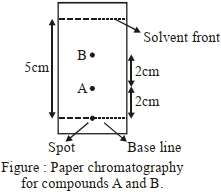
- 116. Using the provided information in the following paper chromatogram the calculate \(R _{ f }\) value of \(A\) .......... \(\times 10^{-1}\)
 2021 Medium
- (A) \(2\)
- (B) \(1\)
- (C) \(4\)
- (D) \(3\)
Show answer and solution
Correct Answer: (C)
\(R _{ f }=\frac{\text { Distance travelled by compound }}{\text { Distance travelled by solvent }}\)on chromatogram distance travelled by cmopound is \(\rightarrow 2 \,cm\)
Distance travelled by solvent \(=5\, cm\)
So \(R _{ f }=\frac{2}{5}=4 \times 10^{-1}=0.4\)
-
- (A) \(96\)
- (B) \(12\)
- (C) \(85\)
- (D) \(68\)
Show answer and solution
Correct Answer: (D)
Moles of \(\mathrm{Br}=\) Moles of \(\mathrm{AgBr}\) obtained\(\Rightarrow \quad\) Mass of \(\mathrm{Br}=\frac{0.2397}{188} \times 80\, \mathrm{~g}\)
therefore \(\%\) Br in the organic compound
\(=\frac{W_{\text {Br }}}{W_{T}} \times 100\)
\(=\frac{0.2397 \times 80}{188 \times 0.15} \times 100=0.85 \times 80\)
\(=68\)
\(\Rightarrow\) Nearest integer is \('68^{\prime}\)
- 118. Which of the following compound is added to the sodium extract before addition of silver nitrate for testing of halogens? 2021 Easy
- (A) Nitric acid
- (B) Ammonia
- (C) Hydrochloric acid
- (D) Sodium hydroxide
Show answer and solution
Correct Answer: (A)
For testing of halogens, Nitric acid is added to the sodium extract because if \(CN ^{-}\) or \(S ^{2-}\) are present then they will be oxidised and removed before the test of halides. -
- (A) Carius tube is used in the estimation of sulphur in an organic compound
- (B) Carius method is used for the estimation of nitrogen in an organic compound
- (C) Phosphoric acid produced on oxidation of phosphorus present in an organic compound is precipitated as \(Mg _{2} P _{2} O _{7}\) by adding magnesia mixture.
- (D) Kjeldahl's method is used for the estimation of nitrogen in an organic compound
Show answer and solution
Correct Answer: (B)
Carius method is used in the estimation of halogen in organic compounds. - 120. Which purification technique is used for high boiling organic liquid compound (decomposes near its boiling point)? 2021 Medium
- (A) Steam distillation
- (B) Simple distillation
- (C) Fractional distillation
- (D) Reduced pressure distillation
Show answer and solution
Correct Answer: (D)
Reduced pressure distillation used for the purification of high boiling organic liquids which decomposes at or below their boiling point. -
- (A) \((\mathrm{B}),(\mathrm{C})\) and \((\mathrm{A})\)
- (B) \((\mathrm{C}),(\mathrm{A})\) and \((\mathrm{B})\)
- (C) \((\mathrm{A}),(\mathrm{B})\) and \((\mathrm{C})\)
- (D) \((\mathrm{B}),(\mathrm{A})\) and \((\mathrm{C})\)
Show answer and solution
Correct Answer: (B)
Benzanilide \(\rightarrow\) Ph-NH-CO-Ph \((\mu=2.71 \mathrm{D})\)Aniline \(\rightarrow \mathrm{Ph}-\mathrm{NH}_{2}\), \((\mu=1.59 \mathrm{D})\)
Acetophenone \(\rightarrow\) Ph-O-CH \(_{3}\) ( \(\mu=3.05 \mathrm{D}\) )
Dipole moment : \({C}>{A}>{B}\)
Hence the sequence of obtained compounds is \((\mathrm{C})\;,(\mathrm{A})\) and \((\mathrm{B})\)
-
- (A) simple distillation, \(3-\)methylpentane
- (B) simple distillation, isohexane
- (C) fractional distillation, isohexane
- (D) fractional distillation, \(3-\)methylpentane
Show answer and solution
Correct Answer: (C)
Liquid which have less difference in boiling point can be isolated by fractional distillation and liquid with less boiling point will be isolated first. -
- (A) Steam distillation
- (B) Differential extraction
- (C) Distillation under reduced pressure
- (D) Fractional distillation
Show answer and solution
Correct Answer: (C)
Glycerol is separated by reduced pressure distillation in soap industries. -
- (A) \(50\)
- (B) \(55\)
- (C) \(45\)
- (D) \(40\)
Show answer and solution
Correct Answer: (A)
Carius method\(\%\) of \(Br =\frac{\text { wt of } AgBr }{\text { wt. of organic compound }} \times 100 \times \frac{\text { molar mass of Br }}{\text { AgBr }}\)
\(=\frac{1.88}{1.6} \times \frac{80}{188} \times 100=\frac{15040}{300.8}=50 \%\)
-
- (B) \(H _{3} C - CH _{2}- Br\)
- (D) \(H _{3} C - Br\)
Show answer and solution
Correct Answer: (A)
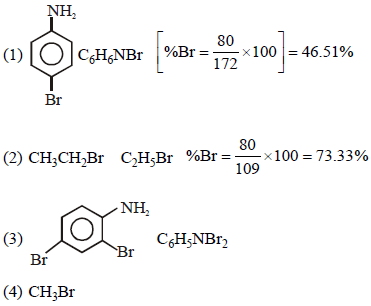
In Carius methodmass of organic compound \(=0.172 gm\) mass of Bromine \(=0.08 gm\)
Hence \(\%\) of Bromine \(=\frac{0.08}{0.172} \times 100\)
\(=46.51 \%\)
- 126. The Kjeldahl method of Nitrogen estimation fails for which of the following reaction products \(?\)
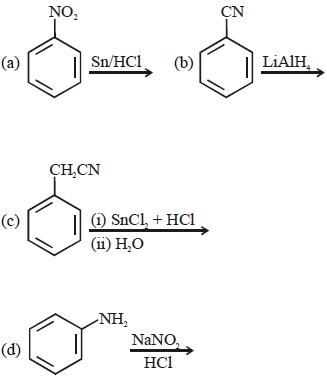 2020 Medium
- (A) \(a\) and \(d\)
- (B) \(c\) and \(d\)
- (C) \(a, c\) and \(d\)
- (D) \(b\) and \(c\)
Show answer and solution
Correct Answer: (B)
Kjeldahl method is used for \(N\) estimation But not given by 'Diazo' compounds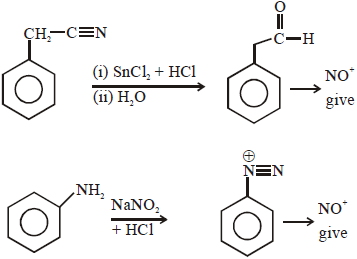
-
- (A) \(C_{12}H_8N\)
- (B) \(C_{12}H_8N_2\)
- (C) \(C_6H_8N_2\)
- (D) \(C_6H_8N\)
Show answer and solution
Correct Answer: (C)
\(CO_2 = 6\,mole,\,N_1 = 1\,mole\)\(C_{atom}= 6,\,N_{atom} = 2\)
Hence \(C_6H_8N_2\)
-
- (A) \(a\, \to \,q,\,\,b \to \,p,\,\,c \to r\)
- (B) \(a\, \to \,r,\,\,b \to \,q,\,\,c \to p\)
- (C) \(a\, \to \,q,\,\,b \to \,r,\,\,c \to p\)
- (D) \(a\, \to \,p,\,\,b \to \,r,\,\,c \to q\)
Show answer and solution
Correct Answer: (B)
Acetonitrile is used as mobile phase for most of the reverse chromatography. Benzaldehyde is adsorbed on alumina. -
- (A) \(a - d, b -r, c -p\)
- (B) \(a -q, b -r, c -s\)
- (C) \(a -r, b -p, c -s\)
- (D) \(a -q, b -r, c -p\)
Show answer and solution
Correct Answer: (B)
(mixture) \(\quad\quad\quad\quad\) (seperation method)\(H _2 O : \text { Sugar } \Rightarrow \text { Recrystallization }\)
\(H _2 O : \text { Aniline } \Rightarrow \text { Steam distillation }\)
\(H _2 O \text { : Toluene } \Rightarrow \text { Differential extraction }\)
-
- (A) \(II\) moves slower and has higher \(R_f\) value than \(I\)
- (B) \(II\) moves faster and has higher \(R_f\) value than \(I\)
- (C) \(I\) moves faster and has higher \(R_f\) value than \(II\)
- (D) \(I\) moves slower and has higher \(R_f\) value than \(I\)
Show answer and solution
Correct Answer: (B)
Since, adsorption of \(I > II\), \(I\) is firmly attached to column (stationary phase). Hence, it will move slowly and will move little distance. Also \(II\) is loosely attached to column (stationary phase). Hence, it will move faster and will move large distance -
- (A) Mobile phase can be a gas
- (B) Stationary phase is a finely divided solid adsorbent
- (C) Separation depends upon equilibration of solute between a mobile and a stationary phase
- (D) Paper chromatography is an example of partition chromatography
Show answer and solution
Correct Answer: (B)
Partition chromatography is the process of separation where by the component of the mixture get distributed into two phases that may be liquid-liquid, liquid gas but not to solid-gas. - 132. The distillation technique most suited for separating glycerol from spent-lye in the soap industry is: 2016 Medium
- (A) Steam distillation.
- (B) Distillation under reduced pressure.
- (C) Simple distillation
- (D) Fractional distillation
Show answer and solution
Correct Answer: (B)
Spent-lye and glycerol are separated by distillation under reduced pressure.Under the reduced pressure the liquid boil at low temperature and the temperature of decomposition will not reach. e.g. glycerol boils at \(290^{\circ} \mathrm{C}\) with decomposition but at reduced pressure it boils at \(180^{\circ} \mathrm{C}\) without decomposition.
-
- (A) \(10\)
- (B) \(3\)
- (C) \(24\)
- (D) \(5\)
Show answer and solution
Correct Answer: (A)
Mili equivalents of \(H_2SO_4\)\( = 60 \times \frac{{M \times 2}}{{10}} = 12\)
Mili equivalents of \(NaOH = 20 \times \frac{M}{{10}} = 2\)
Mili equivalents of \(N{H_3} = 12 - 2 = 10\)
\(\% \,\) of nitrogen \( = \frac{{1.4 \times (N \times V)N{H_3}}}{{(Wt.\,of\,organic\,compound)}}\)
\(\frac{{1.4 \times 10}}{{1.4}} = 10\)
-
- (A) \(48\)
- (B) \(60\)
- (C) \(24\)
- (D) \(36\)
Show answer and solution
Correct Answer: (C)
Mass of substance \(=250 \mathrm{mg}=0.250 \mathrm{g}\)Mass of \(A g B r=141 \mathrm{mg}=0.141 \mathrm{g}\)
\(1\; mole\) of \(A g B r=1\; g\) atom of \(B r\)
\(188 g\) of \(A g B r=80 g\) of \(B r\)
\(188 g\) of \(A g B r\) contain bromine \(=80 g\)
\(0.141 g\) of \(A g B r\) contain bromine \(=\frac{80}{188} \times 0.141\)
This much amount of bromine present in \(0.250 \mathrm{g}\) of organic compound
\(\because \%\) of bromine \(=\frac{80}{188} \times \frac{0.414}{0.250} \times 100=24 \%\)
-
- (A) \(A - (ii); B - (iii) ; C - (i)\)
- (B) \(A - (iii); B - (i) ; C - (ii)\)
- (C) \(A - (iii); B - (ii) ; C - (i)\)
- (D) \(A - (ii); B - (i) ; C - (iii)\)
Show answer and solution
Correct Answer: (C)
\((c)\) In Lassaigne's test, fusion with sodium take place and following species formed respectively.\((a)\) Aniline \(\to \) \(CN^-\)
\((b)\) Benzene sulfonic acid \(\to \) (figure)
\((c)\) Thiourea \(\to \) \(S^{2-}\)
Reaction of \(CN^-\) with hot and acidic solution of \(FeSO_4\) lead to formation of \(Fe_4[Fe(CN)_6]_3\) which is blue in colour. It contains iron in both \(II\) and \(III\) oxidation state.
Reaction of \(S^{2-}\) with sodium nitroprusside
\(N{a_2}S + N{a_2}[Fe{(CN)_5}NO] \to \mathop {N{a_4}[Fe{{(CN)}_5}NOS]}\limits_{(violet\,in\,colour)} \)
Phenoxide ion on reacting with \(FeCl_3\) give red colour with \(FeCl_3\).

-
- (A) \(6\)
- (B) \(10\)
- (C) \(3\)
- (D) \(5\)
Show answer and solution
Correct Answer: (B)
\(\%\) of \(N=\frac{1.4 \times \text { meq.of acid }}{\text { mass of organic compound }}\)meq. of \(H_{2} S O_{4}=60 \times \frac{M}{10} \times 2=12\)
meq. of \(N a O H=20 \times \frac{M}{10}=2\)
meq. of acid consumed \(=12-2=10\)
\(\therefore \% \quad N=\frac{1.4 \times 10}{1.4}=10 \%\)
- 137. For which of the following compounds Kjeldahl method can be used to determine the percentage of Nitrogen ? 2013 Medium
- (A) Nitrobenzene
- (B) Pyridine
- (C) Alanine
- (D) Diazomethane
Show answer and solution
Correct Answer: (C)
Kjeldahl's method is not applicable for cpmpounds containing nitrogen in nitro and azo groups and nitrogen present in the ring. Because nitrogen of these compounds does not change to ammonium sulphate under these conditions.Hence only Alanine can be used to determine percentage of nitrogen.
\(\underset{Alanine}{\mathop{\begin{matrix}
{{H}_{2}}N-CH-COOH \\
|\,\,\,\,\,\,\,\,\, \\
\,\,\,\,\,\,\,\,\,CH{{(C{{H}_{3}})}_{2}} \\
\end{matrix}}}\,\) - 138. Which of the following compounds is not expected to show Lassaignes' test for nitrogen ? 2013 Hard
- (A) Propanenitrile
- (B) Hydroxylamine hydrochloride
- (C) Nitromethane
- (D) Ethanamine
Show answer and solution
Correct Answer: (B)
Lassaigne's test is used for the detection of nitrogen and given by all nitrogenous compound except diazo \(\rlap{-} (\,\,N = N\rlap{-} )\) compounds.
This test is shown only by the compounds containing \(C\) and \(N\) both hence hydroxyl amine hydrochloride \((H_2NOH .HCl)\) will not perform this test -
- (A) \(Fe^{3+}\) ion also gives blood red colour with \(SCN^-\) ion.
- (B) \(Fe^{2+}\) ion also gives blood red colour with \(SCN^-\) ion.
- (C) On passing \(H_2S\) into \(Na_2ZnO_2\) solution a white ppt of \(ZnS\) is formed.
- (D) Cupric ion reacts with excess of ammonia solution to give deep blue colour of \([Cu(NH_3)_4]^{2+}\) ion
Show answer and solution
Correct Answer: (A)
Only \(Fe^{3+}\) ion gives blood red colouration with \(SCN^-\) ion.\(F{e^{3 + }} + SC{N^ - }\, \to \,\mathop {{{[Fe(SCN)]}^{2 + }}}\limits_{{\text{(dark red)}}} \)
No questions on this page match these filters.