


- JEE Mains 2014
- Hard
- MCQ
Three masses \(m,\,2\,m\) and \(3\,m\) are moving in \(x-y\) plane with speed \(3\,u,\,2\,u\,\) and \(u\) respectively as shown in figure. The three masses collide at the same point at \(P\) and stick together. The velocity of resulting mass will be
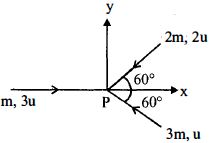
Answer & Solution
(D) \(\frac{u}{{12}}\left( {-\hat i\, - \,\sqrt 3 \hat j} \right)\)
Step-by-step Solution
Detailed explanation
\(\begin{array}{l}
{m_1}{u_1} + {m_2}{u_2} + ...... = {m_1}{v_1} + {m_2}{v_2} + ....\\
Given\,{m_1}\, = \,m,{m_2} = 2m\,and\,{m_3} = 3m\\
and\,{u_1} = 3u,\,{u_2} = 2u\,and\,{u_3} = u
\end{array}\)
Let the velocity when the stick \(= \overrightarrow v \)
Then, according to question,
\(\begin{array}{l}
m \times 3u\left( i \right) + 2m \times 2u\left( { - \hat i\cos {{60}^ \circ } - \hat j\sin {{60}^ \circ }} \right)\\
+ 3\,m \times u\left( { - \hat i\cos {{60}^ \circ } + \hat j\sin {{60}^ \circ }} \right)\\
= \left( {m + 2m + 3m} \right)\,\overrightarrow v \\
\Rightarrow \,3mu\hat i - 4mu\frac{{\hat i}}{2} - 4mu\left( {\frac{{\sqrt 3 }}{2}\hat j} \right) - 3mu\frac{{\hat i}}{2}\\
\,\,\,\,\,\,\,\,\,\,\,\,\,\,\,\,\,\,\,\,\,\,\,\,\,\,\,\,\,\,\,\,\,\,\,\,\,\, + 3mu\left( {\frac{{\sqrt 3 }}{2}\hat j} \right) = 6m\,\overrightarrow v \\
\Rightarrow \,mu\hat i\, - \frac{3}{2}mu\hat i - \frac{{\sqrt 3 }}{2}mu\hat j = 6m\,\overrightarrow v \\
\Rightarrow \frac{1}{2}mu\hat i - \frac{{\sqrt 3 }}{2}mu\hat j = 6m\,\overrightarrow v \\
\Rightarrow \,\overrightarrow v = \frac{u}{{12}}\,\left( { - \hat i - \sqrt 3 \hat j} \right)
\end{array}\)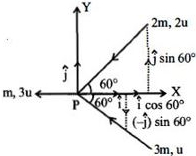
More questions from Physics
- Given below are two statements : Statements \(I\) : Astronomical unit \((Au)\). Parsec \((Pc)\) and Light year \((ly)\) are units for measuring astronomical distances. Statements \(II:\) \(Au < Parsec ( Pc ) < ly\) In the light of the above statements. choose the most appropriate answer from the options given below:JEE Mains 2023 Medium
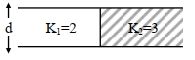
- A capacitor of \(10 \mu \mathrm{F}\) capacitance whose plates are separated by \(10 \mathrm{~mm}\) through air and each plate has area \(4 \mathrm{~cm}^2\) is now filled equally with two dielectric media of \(\mathrm{K}_1=2, \mathrm{~K}_2=3\) respectively as shown in figure. If new force between the plates is \(8 \mathrm{~N}\). The supply voltage is _______ \(\times 10^{-4}\)V.
 JEE Mains 2024 Hard
- Truth table for the given circuit will be
 JEE Mains 2018 Hard
- Orange light of wavelength \(6000 \times 10^{-10}\, m\) in illuminates a single slit of width \(0.6 \times 10^{-4}\, m\) The maximum possible number of diffraction minima produced on both sides of the central maximum is\(........\)JEE Mains 2020 Medium
- In a resonance tube experiment when the tube is filled with water up to height of \(17.0\, cm\) from bottom, it resonates with a given tuning fork. When the water level is raised the next resonance with the same tuning fork occurs at a height of \(24.5\, cm\). If the velocity of sound in air is \(330\, m / s ,\) the tuning fork frequency is\(......Hz\)JEE Mains 2020 Hard
- The ratio of intensities at two points \(P\) and \(Q\) on the screen in a Young's double slit experiment where phase difference between two wave of same amplitude are \(\pi / 3\) and \(\pi / 2\), respectively areJEE Mains 2023 Medium
More PYQs from JEE Mains
- The current \(I\) flowing through the given circuit will be \(.....A\).
 JEE Mains 2022 Medium
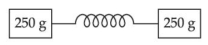
- As per the given figure, two blocks each of mass \(250\,g\) are connected to a spring of spring constant \(2\,Nm ^{-1}\). If both are given velocity \(V\) in opposite directions, then maximum elongation of the spring is:
 JEE Mains 2022 Hard
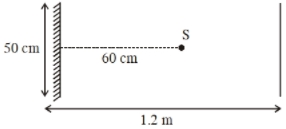
- A point source of light \(S\), placed at a distance \(60 \,cm\) infront of the centre of a plane mirror of width \(50 \,cm\), hangs vertically on a wall. A man walks infront of the mirror along a line parallel to the mirror at a distance \(1.2\, m\) from it (see in the \(figure\)). The distance between the extreme points where he can see the image of the light source in the mirror is \(\ldots \ldots \ldots\, cm.\)
 JEE Mains 2021 Hard
- A long cylindrical volume contains a uniformly distributed charge of density \(\rho\). The radius of cylindrical volume is \(R\). A charge particle \((q)\) revolves around the cylinder in a circular path. The kinetic of the particle isJEE Mains 2022 Hard