


JEE Mains · Physics · STD 11 - Gravitation
- JEE Mains 2014
- Hard
- MCQ
India's Mangalyan was sent to the Mars by launching it into a transfer orbit \(EOM\) around the sun . It leaves the earth at \(E\) and meets Mars at \(M\) . If the semi-major axis of Earth's orbit is \(a_e = 1.5 \times 10^{11}\, m\), that of Mars orbit \(a_m= 2.28 \times 10^{11}\, m\), taken Kepler's laws give the estimate of time for Mangalyan to reach Mars from Earth to be close to ........ \(days\).

Pick an option to check your answer.
Answer & Solution
Correct Answer
(C) \(260\)
Step-by-step Solution
Detailed explanation
semi major axis of mangalyan
\({a_{Mn}} = \frac{{{a_c} + {a_m}}}{2}\)
\( = 1.89 \times {10^{11}}m\)
From kepler's law
\({T^2} \propto {R^3}\)
\(\therefore \,{\left( {\frac{{{T_{mn}}}}{{Te}}} \right)^2} = {\left( {\frac{{{R_M}}}{{{\operatorname{R} _e}}}} \right)^3}\)
\(\therefore {T_{Mn}} = 518\,days\)
\(\therefore \operatorname{Re} duired\,time\, = \frac{{518}}{2} = 260\,days\)
More questions from Physics
- In an electromagnetic wave, at an instant and at a particular position, the electric field is along the negative \(z\)-axis and magnetic field is along the positive \(x\)-axis. Then the direction of propagation of electromagnetic wave isJEE Mains 2023 Easy
- Given below are two statements: one is labelled as Assertion \(A\) and the other is labelled as Reason \(R\). \(Assertion\) \(A\) : Number of photons increases with increase in frequency of light. \(Reason\) \(R\) : Maximum kinetic energy of emitted electrons increases with the frequency of incident radiation. In the light of the above statements, choose the most appropriate answer from the options given below :JEE Mains 2024 Hard
- One mole of an ideal diatomic gas expands from volume V to 2 V isothermally at a temperature \(27^{\circ} C\) and does W joule of work. If the gas undergoes same magnitude of expansion adiabatically from \(27^{\circ} C\) doing the same amount of work W , then its final temperature will be (close to) ___________ \({ }^{\circ} C\).JEE Mains 2026 Hard
- A point charge +q is placed at the origin. A second point charge +9 q is placed at \((\mathrm{d}, 0,0)\) in Cartesian coordinate system. The point in between them where the electric field vanishes is :JEE Mains 2025 Easy
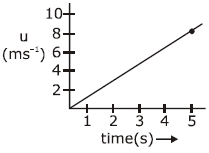
- The speed verses time graph for a particle is shown in the figure. The distance travelled (in \(m\) ) by the particle during the time interval \(t=0\) to \(t=5\, s\) will be
 JEE Mains 2020 Easy
- An effective power of a combination of \(5\) identical convex lenses which are kept in contact along the principal axis is \(25 \mathrm{D}\). Focal length of each of the convex lens is _______.JEE Mains 2024 Hard
More PYQs from JEE Mains
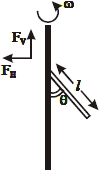
- A uniform rod of length \('l'\) is pivoted at one of its ends on a vertical shaft of negligible radius When the shaft rotates at angular speed \(\omega\) the rod makes an angle \(\theta\) with it (see figure). To find \(\theta\) equate the rate of change of angular momentum (direction going into the paper ) \(\frac{ m \ell^{2}}{12} \omega^{2} \sin \theta \cos \theta\) about the centre of mass \((CM)\) to the torque provided by the horizontal and vertical forces \(F_{H}\) and \(F_{V}\) about the CM. The value of \(\theta\) is then such that:
 JEE Mains 2020 Hard
- The decay of a proton to neutron is :JEE Mains 2021 Medium
- Water is flowing at a speed of \(1.5\, ms^{-1}\) through a horizontal tube of cross-sectional area \(10^{-2}\, m^2\) and you are trying to stop the flow by your palm. Assuming that the water stops immediately after hitting the palm. the minimum force that you must exert should be ......... \(N\) (density of water \(= 10^3\, kgm^{-3}\))JEE Mains 2014 Medium
- Choose the incorrect statement : \((a)\) The electric lines of force entering into a Gaussian surface provide negative flux. \((b)\) A charge ' \(q\) ' is placed at the centre of a cube. The flux through all the faces will be the same. \((c)\) In a uniform electric field net flux through a closed Gaussian surface containing no net charge, is zero. \((d)\) When electric field is parallel to a Gaussian surface, it provides a finite non-zero flux. Choose the most appropriate answer from the options given belowJEE Mains 2021 Medium