


- JEE Mains 2013
- Hard
- MCQ
The change in the value of acceleration of earth towards sun, when the moon comes from the position of solar eclipse to the position on the other side of earth in line with sun is: (mass of the moon \(= 7.36 \times 10^{22}\,kg,\) radius of the moon's orbit \(= 3 .8 \times 10^8\,m\) ).
Answer & Solution
(A) \(6.73\times 10^{-5}\,m/s^2\)
Step-by-step Solution
Detailed explanation
So the gravitational force acting on earth due to sun will add up with the gravitational force acting on earth due to moon during solar eclipse and the gravitational forces will subtract with each other during lunar eclipse.
Let \(F_S\) be the gravitational force between earth and sun and \(F_L\) be the gravitational force between earth and moon.
Also, the acceleration of earth during solar and lunar eclipse can be derived from Newton’s second law,
\(F=ma\)........(1)
During solar eclipse, eqn (1) will be
\(m.{a_s} = {F_s} + {F_L} \to \left( 2 \right)\)
During lunar ecllpse, eqn \((1)\) will be
\(m.{a_L} = {F_s} - {F_L} \to \left( 3 \right)\)
Here, \(a_s\) and \(a_L\) are the acceleration of earth towards sun during solar and lunar ecllpse respectlvely and \(m\) is the mass of earth.
So the change in acceleration of earth toward sun from solar to lunar ecllpse perlod, can be found, can be found by subtracting eqn \((2)\) from eqn \((3)\)
\(m\left( {{a_s} - {a_L}} \right) = {F_s} + {F_L} - {F_s} + {F_L}\)
\(\therefore m\left( {{a_s} - {a_L}} \right) = 2{F_L} \to \left( 4 \right)\)
Here,
\({F_L} = G\frac{{m.{M_L}}}{{{D^2}}}\)
Where \(G\) is the gravltational constant, \(m\) is the mass of earth, \(ML\) is the mass of moon, and \(D\) is the distance between moon and earth.
\(D\) is equal to the orbital radlus of moon.
So the eqn \((4)\) becomes,
\(\left( {{a_s} - {a_L}} \right) = 2G\frac{{{M_L}}}{{{D^2}}} \to \left( 5 \right)\)
Now, substitute the glven values in eqn \((5)\),
\({M_L} = 7.36 \times {10^{22}}\,kg\)
\(D = 3.8 \times {10^8}\,m\)
Gravltational constant value, \(G = 6.67 \times {10^{ - 11}}N.{m^2}.k{g^{ - 2}}\)
\(\left( {{a_s} - {a_L}} \right) = 2 \times 6.67 \times {10^{ - 11}} \times \frac{{7.36 \times {{10}^{22}}}}{{{{\left( {3.8 \times {{10}^8}} \right)}^2}}}\)
\(\left( {{a_s} - {a_L}} \right) = 6.799 \times {10^{ = 11 + 22 - 16}}\)
\(\left( {{a_s} - {a_L}} \right) = 6.799 \times {10^{ - 5}}m/{s^2}\)
More questions from Physics
- A girl standing on road holds her umbrella at \(45^{\circ}\) with the vertical to keep the rain away. If she starts running without umbrella with a speed of \(15 \sqrt{2} \; kmh ^{-1}\), the rain drops hit her head vertically. The speed of rain drops with respect to the moving girl is ........... \(kmh ^{-1}\)JEE Mains 2022 Medium
- The amplitude of magnetic field in an electromagnetic wave propagating along \(y\)-axis is \(6.0 \times 10^{-7}\,T\). The maximum value of electric field in the electromagnetic wave is:JEE Mains 2023 Easy
- A nucleus of masss \(M\) emits \(\gamma\)-ray photon of frequency \('v'.\) The loss of internal energy by the nucleus is:JEE Mains 2021 Hard
- The temperature of a gas having \(2.0 \times 10^{25}\) molecules per cubic meter at \(1.38 \mathrm{~atm}\) (Given, \(\mathrm{k}=\) \(\left.1.38 \times 10^{-23} \mathrm{JK}^{-1}\right)\) is _______.JEE Mains 2024 Hard
- An electron in the hydrogen atom initially in the fourth excited state makes a transition to \(\mathrm{n}^{\text {th }}\) energy state by emitting a photon of energy 2.86 eV. The integer value of \(n\) will be ____.JEE Mains 2025 Easy
- The period of oscillation of a simple pendulum is \(T =2 \pi \sqrt{\frac{ L }{ g }} .\) Measured value of \( L \) is \(1.0\, m\) from meter scale having a minimum division of \(1 \,mm\) and time of one complete oscillation is \(1.95\, s\) measured from stopwatch of \(0.01 \,s\) resolution. The percentage error in the determination of \(g\) will be ..... \(\%.\)JEE Mains 2021 Medium
More PYQs from JEE Mains
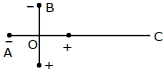
- Two ideal electric dipoles \(A\) and \(B\) having their dipole moment \(p_{1}\) and \(p_{2}\) respectively are placed on a plane with their centres at \(O\) as shown in the figure. At point \(C\) on the axis of dipole \(A\), the resultant electric field is making an angle of \(37^{\circ}\) with the axis. The ratio of the dipole moment of \(A\) and \(B, \frac{P_{1}}{P_{2}}\) is \(....\) (take \(\left.\sin 37^{\circ}=\frac{3}{5}\right)\)
 JEE Mains 2021 Hard
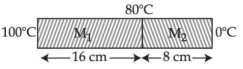
- Two metallic blocks \(M_{1}\) and \(M_{2}\) of same area of cross-section are connected to each other (as shown in figure). If the thermal conductivity of \(M _{2}\) is \(K\) then the thermal conductivity of \(M _{1}\) will be ]...............\(K\) [Assume steady state heat conduction]
 JEE Mains 2022 Medium
- A big drop is formed by coalescing \(1000\) small droplets of water. The ratio of surface energy of \(1000\) droplets to that of energy of big drop is \(\frac{10}{x}\). The value of \(x\) is _______.JEE Mains 2024 Hard