


JEE Mains · Chemistry · STD 11 - Organic chemistry isomerism
- JEE Mains 2024
- Medium
- Numerical
Total number of optically active compounds from the following is _______.
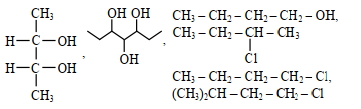
Pick an option to check your answer.
Answer & Solution
Correct Answer
(C) \(1\)
Step-by-step Solution
Detailed explanation
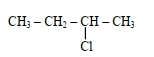
Explanation:
This question requires identifying the number of optically active compounds by analyzing their molecular structures for chiral centers and internal elements of symmetry:
1. Fischer Projection (Butane-2,3-diol):
This structure contains two chiral carbon centers. However, there is a clear horizontal plane of symmetry running through the middle of the molecule that divides it into two mirror-image halves. Due to this internal symmetry, the optical rotation of one half cancels out the other (internal compensation). Therefore, it is a meso compound and is optically inactive.
2. Skeletal Structure (Heptane-3,4,5-triol variant):
This molecule is constitutionally symmetrical from left to right. In the planar zigzag conformation shown, the middle carbon has its \( -\text{OH} \) group pointing downwards, while the two flanking chiral carbons have their \( -\text{OH} \) groups pointing upwards. A vertical plane of symmetry passes directly through the central carbon and its \( -\text{OH} \) group, mirroring the left half perfectly onto the right half. Because of this internal plane of symmetry, it is a meso form and is optically inactive.
3. Analyzing the Condensed Molecular Formulas:
- \( \text{CH}_3-\text{CH}_2-\text{CH}_2-\text{CH}_2-\text{OH} \) (Butan-1-ol): This molecule does not possess any chiral carbon atom (a carbon bonded to four different groups). Thus, it is optically inactive.
- \( \text{CH}_3-\text{CH}_2-\text{CH}(\text{Cl})-\text{CH}_3 \) (2-chlorobutane): The second carbon atom is asymmetric because it is bonded to four completely different groups: \( -\text{H} \), \( -\text{Cl} \), \( -\text{CH}_3 \), and an ethyl group (\( -\text{CH}_2\text{CH}_3 \)). Since it contains a chiral center and lacks any internal symmetry, it is optically active.
- \( \text{CH}_3-\text{CH}_2-\text{CH}_2-\text{CH}_2-\text{Cl} \) (1-chlorobutane): It contains no asymmetric carbon atom, making it optically inactive.
- \( (\text{CH}_3)_2\text{CH}-\text{CH}_2-\text{CH}_2-\text{Cl} \) (1-chloro-3-methylbutane): It contains no asymmetric carbon atom, making it optically inactive.
4. Conclusion:
Out of all the given configurations, only 2-chlorobutane is chiral and lacks internal symmetry elements. Therefore, the total count of optically active compounds is exactly 1.
Hence, Option C is the correct choice.
More questions from Chemistry
- Iodine reacts with concentrated \(HNO_3\) to yield along with other products. The oxidation state of iodine in \(Y\) isJEE Mains 2019 Hard
- Uracil is base present in \(RNA\) with the following structure. \(\%\) of \(N\) in uracil is \(............\).
Given :
Molar mass \(N =14\,g\,mol ^{-1} ; O =16\,g\,mol ^{-1} ; \)
\(C =12\,g\,mol ^{-1} ; H =1\,g\,mol ^{-1}\);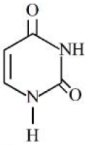 JEE Mains 2023 Medium
- Match List \(I\) with List \(II\).
Choose the correct answer from the options given below:LIST-\(I\) LIST-\(II\) \(A\). Glucose/NaHCO3/\(\Delta\) \(I\). Gluconic acid \(B\). Glucose/HNO3 \(II\). No reaction \(C\). Glucose/HI/\(\Delta\) \(III\). n-hexane \(D\). Glucose/Bromine water \(IV\). Saccharic acid JEE Mains 2024 Hard - Ferrous sulphate heptahydrate is used to fortify foods with iron. The amount (in \(grams\)) of the salt required to achieve \(10 \;ppm\) of iron in \(100 \;\mathrm{kg}\) of wheat is Atomic weight : \(Fe =55.85 ; \mathrm{S}=32.0\) \(\mathrm{O}=16.00\)JEE Mains 2020 Hard
- What is the correct order of the following elements with respect to their density ?JEE Mains 2021 Easy
- Identify the CORRECT set of details from the following:
A. \( [Co(NH_{3})_{6}]^{3+} \): Inner orbital complex; \( d^{2}sp^{3} \) hybridized
B. \( [MnCl_{6}]^{3-} \): Outer orbital complex; \( sp^{3}d^{2} \) hybridized
C. \( [CoF_{6}]^{3-} \): Outer orbital complex; \( d^{2}sp^{3} \) hybridized
D. \( [FeF_{6}]^{3-} \): Outer orbital complex; \( sp^{3}d^{2} \) hybridized
E. \( [Ni(CN)_{4}]^{2-} \): Inner orbital complex; \( sp^{3} \) hybridized
Choose the correct answer from the options given below:JEE Mains 2026 Medium
More PYQs from JEE Mains
- In sulphur estimation, \(2.0 \times 10^{-3}\) mol of an organic compound (X) (molar mass \(76\) g mol\(^{-1}\)) gave \(0.4813\) g of barium sulphate (molar mass \(233\) g mol\(^{-1}\)). The percentage of sulphur in the compound (X) is ______ \(\times 10^{-1}\) % (Nearest integer)JEE Mains 2026 Medium
- Mass per unit area of a circular disc of radius \(\mathrm{a}\) depends on the distance \(\mathrm{r}\) from its centre as \(\sigma(\mathrm{r})=\mathrm{A}+\mathrm{Br} .\) The moment of inertia of the disc about the the axis, perpendicular to the plane and passing through its centre isJEE Mains 2020 Hard
- An electromagnetic wave of frequency \(5\, GHz ,\) is travelling in a medium whose relative electric permittivity and relative magnetic permeability both are \(2 .\) Its velocity in this medium is \(\times 10^{7}\, m / s\)JEE Mains 2021 Hard
- A monochromatic light of wavelength \(6000\)A is incident on the single slit of width \(0.01 \mathrm{~mm}\). If the diffraction pattern is formed at the focus of the convex lens of focal length \(20 \mathrm{~cm}\), the linear width of the central maximum is _______.JEE Mains 2024 Hard
- A \(300\,mL\) bottle of soft drink has \(0.2\,M CO _2\) dissolved in it. Assuming \(CO _2\) behaves as an ideal gas, the volume of the dissolved \(CO _2\) at \(STP\) is \(......mL\). (Nearest integer) Given: At \(STP\), molar volume of an ideal gas is \(22.7\,L\,mol ^{-1}\)JEE Mains 2023 Hard
- Some distant star is to be observed by some telescope of diameter of objective lens \(a\), at an angular resolution of \(3.0\times 10^{-7}\) radian. If the wavelength of light from the star reaching the telescope is \(500\) nm, the minimum diameter of the objective lens of the telescope is ________ cm. (nearest integer)JEE Mains 2026 Medium