


Questions
Newest firstShowing 51–56 of 56 questions
-
- (A) \(107.2\)
- (B) \(53.6\)
- (C) \(26.8\)
- (D) \(214.4\)
Show answer and solution
Correct Answer: (A)
\(\ln \,\frac{{{K_2}}}{{{K_1}}}\, = \,\frac{{{E_a}}}{R}\,\left( {\frac{1}{{{T_1}}}\, - \,\frac{1}{{{T_2}}}} \right)\)\(\ln \,\,4\, = \,\frac{{{E_a}}}{{8.314}}\left( {\frac{{310 - 300}}{{310 \times 300}}} \right)\)
\(2\,\ln \,2\, = \,\frac{{{E_a}}}{{8.314}}\left( {\frac{{310 - 300}}{{310 \times 300}}} \right)\)
\({E_a} = \frac{{0.693\, \times 2\, \times \,8.314 \times 300 \times 310}}{{10}}\)
\( = 107.2\,\,kJ/mol\)
-
- (A) \(8\)
- (B) \(12\)
- (C) \(6\)
- (D) \(4\)
Show answer and solution
Correct Answer: (D)
According to Arrhenius equation\( k=A e^{-E_{2} / R T} \)
\( k_{1} =A e^{-E_{\mathrm{A} 1} / R T} \quad (1)\)
\(k_{2} =A e^{-E_{22} / R T} \quad (2)\)
Dividing Eq. \(( 2 )\) by Eq. \(( 1 )\), we get
\(\frac{k_{2}}{k_{1}}=e^{\left(\frac{E_{21}-E_{22}}{R T}\right)}\)
Taking natural logarithm of both sides, we get
\(\ln \left(\frac{k_{2}}{k_{1}}\right) =\frac{E_{\mathrm{al}}-E_{\mathrm{a} 2}}{R T} \)
\(=\frac{10,000}{8.314 \times 300}=4\)
-
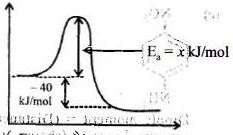
- (A) \(E_f\, = 80\, k\,J/mol ; E_b\, = 120\, k\,J/mol\)
- (B) \(E_f\, = 60\, k\,J/mol ; E_b\, = 100\, k\,J/mol\)
- (C) \(E_f\, = 30\, k\,J/mol ; E_b\, = 70\, k\,J/mol\)
- (D) \(E_f\, = 70\, k\,J/mol ; E_b\, = 30\, k\,J/mol\)
Show answer and solution
Correct Answer: (A)
\(\left( {\frac{{{E_{\mathop {forwad}\limits_{(A \to B)} }}}}{{{E_{\mathop {backward}\limits_{(B \to A)} }}}}} \right) = \frac{2}{3} = \frac{x}{{ - 40 + x}}\)\( \Rightarrow - 80 + 2x = 3x\)
\( \Rightarrow x = - 80\,kJ/mol\) for forward
For backward \( = - 40 + ( - 80 = - 120\,kJ/mol)\)
Because activation energy cannot be negative
so, for forwad reaction \(E_a=80\,kJ/mol\)
for forwad reaction \(E_a=120\,kJ/mol\)
-
- (A) shifting of equilibrium towards reactants due to elastic collisions
- (B) loss of active species on collision
- (C) low probability of simultaneous collision of all the reacting species
- (D) increase in entropy and activation energy as more molecules are involved
Show answer and solution
Correct Answer: (C)
Reactions of higher order \((>3 )\) are very rate due to very less chances of many molecules to undergo effective collisions. -
- (A) \(16\)
- (B) \(60\)
- (C) \(99\)
- (D) \(132\)
Show answer and solution
Correct Answer: (B)
According to arrhenius equation\(\log \,\frac{{{k_2}}}{{{k_1}}}\, = \,\frac{{{E_a}}}{{2.303\,\,R}}\,\left( {\frac{1}{{{T_1}}}\, - \,\frac{1}{{{T_2}}}} \right)\)
\(\log \,\frac{{1.3 \times {{10}^{ - 3}}}}{{1.3 \times {{10}^{ - 4}}}}\, = \,\frac{{{E_a}}}{{2.303 \times 8.314}}\,\left[ {\frac{1}{{373}} - \frac{1}{{423}}} \right]\)
\(1 = \frac{{{E_a}}}{{2.303 \times 8.314}}\,\left[ {\frac{1}{{373}} - \frac{1}{{423}}} \right]\)
\({E_a}\, = \,60\,\,kJ/mole\)
-
- (A) \(53.6\)
- (B) \(48.6\)
- (C) \(58.5\)
- (D) \(60.5\)
Show answer and solution
Correct Answer: (A)
Activation energy can be calculated from the equation \(\frac{\log \,k_{2}}{\log k_{1}}=\frac{E_{a}}{2.303 R}\left(\frac{1}{T_{1}}-\frac{1}{T_{2}}\right)\)given \(\frac{k_{2}}{k_{1}}=2 T_{2}=310\, K T_{1}=300 K\)
\(=\log \,2=\frac{-E_{a}}{2.303 \times 8.314}\left(\frac{1}{310}-\frac{1}{300}\right)\)
\(E_{a}=53598.6 \,J / \mathrm{mol}\)
\(=53.6\, \mathrm{kJ} / \mathrm{mol} .\)
No questions on this page match these filters.