


JEE Mains · Chemistry · STD 12 - Chemical kinetics
- JEE Mains 2021
- Medium
- Numerical
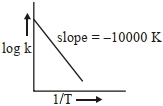
For the reaction, \(aA + bB \rightarrow cC + dD ,\) the plot of log \(k\) vs \(\frac{1}{ T }\) is given below The temperature at which the rate constant of the reaction is \(10^{-4} s ^{-1}\) is .............. \(K\). (Rounded-off to the nearest integer) [Given: The rate constant of the reaction is \(10^{-5} s ^{-1}\) at \(500 K\).]
Pick an option to check your answer.
Answer & Solution
Correct Answer
(B) \(526\)
Step-by-step Solution
Detailed explanation
\(\log K =\log A -\frac{ Ea }{2.303 RT }\)
\(\mid\)Slope\(\mid=\frac{E a}{2.303 R }=10,000\)
\(\log \left(\frac{ K _{2}}{ K _{1}}\right)=\frac{ Ea }{2.303 R }\left(\frac{1}{ T _{1}}-\frac{1}{ T _{2}}\right)\)
\(\log \left(\frac{10^{-4}}{10^{-5}}\right)=10,000\left[\frac{1}{500}-\frac{1}{ T _{2}}\right]\)
\(T _{2}=526.31 \simeq 526 K\)
Hence answer is \((526)\)
More questions from Chemistry
- Consider the cell \(Pt _{( s )}\left| H _2( g , 1\,atm )\right| H ^{+}( aq , 1 M )|| Fe ^{3+}( aq ), Fe ^{2+}( aq ) \mid Pt ( s )\) When the potential of the cell is \(0.712\,V\) at \(298\,K\), the ratio \(\left[ Fe ^{2+}\right] /\left[ Fe ^{3+}\right]\) is \(.......\)(Nearest integer) Given: \(Fe ^{3+}+ e ^{-}= Fe ^{2+}, E ^{\circ} Fe ^{3+}, Fe ^{2+} \mid Pt =0.771\) \(\frac{2.303 RT }{ F }=0.06\,V\)JEE Mains 2023 Hard
- Ceric ammonium nitrate and \(CHCl _{3} /\) alc. \(KOH\) are used for the identification of functional groups present in ...... and ........ respectively.JEE Mains 2021 Easy
- Consider the following electrochemical cell at standard condition.
\(\begin{aligned}
& \mathrm{Au}(\mathrm{s})\left|\mathrm{QH}_2, \mathrm{Q}\right| \mathrm{NH}_4 \mathrm{X}(0.01 \mathrm{M})| | \mathrm{Ag}^{+}(1 \mathrm{M}) \mid \mathrm{Ag}(\mathrm{s}) \\
& \mathrm{E}_{\text {cell }}=+0.4 \mathrm{~V}
\end{aligned}\)
The couple \(\mathrm{QH}_2 / \mathrm{Q}\) represents quinhydrone electrode, the half cell reaction is given below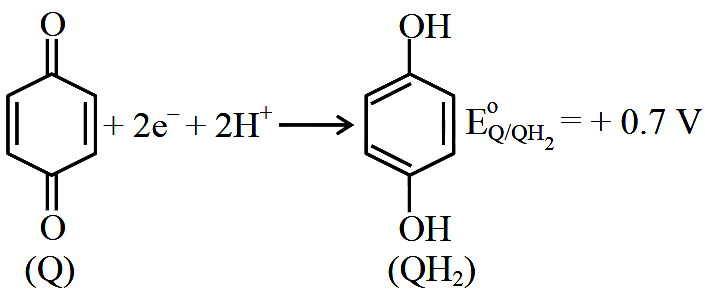
The \(\mathrm{pK}_{\mathrm{b}}\) value of the ammonium halide salt \(\left(\mathrm{NH}_4 \mathrm{X}\right)\) used here is _________. (nearest integer)JEE Mains 2025 Medium - \(\mathrm{A}(\mathrm{g}) \rightarrow \mathrm{B}(\mathrm{g})+\mathrm{C}(\mathrm{g})\) is a first order reaction.
\(\begin{array}{|l|l|l|}\hline \text{Time} & T & \infty \\\hline \mathbf{P}_{\text {system }} & \mathrm{P}_{\mathrm{t}} & \mathrm{P}_{\infty} \\\hline\end{array}\)
The reaction was started with reactant A only. Which of the following expression is correct for rate constant k ?JEE Mains 2025 Medium - Which of the following statements about \(Na_2O_2\) is not correctJEE Mains 2014 Medium
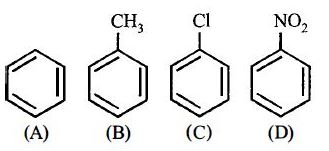
- In the above compounds correct order of reactivity in electrophilic substitution reactions will be
 JEE Mains 2013 Hard
More PYQs from JEE Mains
- The \(pH\) of ammonium phosphate solution, if \(pK _{ a }\) of phosphoric acid and \(pk _{ b }\) of ammonium hydroxide are \(5.23\) and \(4.75\) respectively, is ..... .JEE Mains 2021 Medium
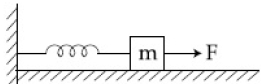
- A block of mass \(m\), lying on a smooth horizontal surface, is attached to a spring (of negligible mass) of spring constant \(k\). The other end of the spring is fixed, as shown in the figure. The block is initially at rest in a equilibrium position. If now the block is pulled with a constant force \(F\), the maximum speed of the block is
 JEE Mains 2019 Hard
- Which of the following is the wrong statement?JEE Mains 2013 Medium
- The de Broglie wavelength associated with an electron accelerated through a potential difference V is \(\lambda_e\) and the de Broglie wavelength associated with a proton accelerated through the same potential difference is \(\lambda_p\). If their corresponding masses are \(m_e\) and \(m_p\), respectively, then the ratio of their de Broglie wavelengths \(\left(\dfrac{\lambda_e}{\lambda_p}\right)\) is ______.JEE Mains 2026 Medium
- Which of the following amine (s) show (s) positive carbylamines test?
(A)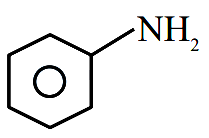
(B) \(\left(\mathrm{CH}_3\right)_2 \mathrm{NH}\)
(C) \(\mathrm{CH}_3 \mathrm{NH}_2\)
(D) \(\left(\mathrm{CH}_3\right)_3 \mathrm{~N}\)
(E)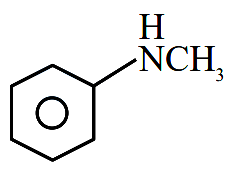 JEE Mains 2025 Medium
- In an octagon \(ABCDEFGH\) of equal side, what is the sum of \(\overrightarrow{ AB }+\overrightarrow{ AC }+\overrightarrow{ AD }+\overrightarrow{ AE }+\overrightarrow{ AF }+\overrightarrow{ AG }+\overrightarrow{ AH }\) if, \(\overrightarrow{ AO }=2 \hat{ i }+3 \hat{ j }-4 \hat{ k }\)
 JEE Mains 2021 Hard