


प्रश्न
3 प्रश्न3 में से 1–3 प्रश्न
-
- (A) \(1.6 \times 10^{-7} \) \(Ω m\)
- (B) \(1.6 \times 10^{-5} \) \(Ω m\)
- (C) \(1.6 \times 10^{-3} \) \(Ωm\)
- (D) \(1.6 \times 10^{-8} \) \(Ωm\)
उत्तर और हल देखें
सही उत्तर: (B)
\(V=I R=\left(n e A v_{d}\right) \rho \frac{\ell}{A}\)\(\therefore \quad \rho=\frac{\mathrm{V}}{\mathrm{V}_{\mathrm{d}} \mathrm{lne}}\)
Here \(\mathrm{V}=\) potential difference
\(\mathrm{I}=\) length of wire
\(\mathrm{n}=\mathrm{no} .\) of electrons per unit volume of conductor.
\(\mathrm{e}=\mathrm{no.}\) of electrons
Placing the value of above parameters we get resistivity
\(\rho=\frac{5}{8 \times 10^{28} \times 1.6 \times 10^{-19} \times 2.5 \times 10^{-4} \times 0.1}\)
\(=1.6 \times 10^{-5} \,\Omega m\)
-
- (A) \(6\)
- (B) \(3\)
- (C) \(5\)
- (D) \(4\)
उत्तर और हल देखें
सही उत्तर: (C)
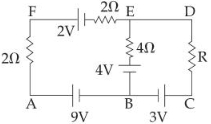
As no current flows through arm \(E B\) then\(\mathrm{V}_{\mathrm{D}}=0\, \mathrm{V}\)
\(\mathrm{V}_{\mathrm{E}}=0\, \mathrm{V}\)
\(\mathrm{v}_{\mathrm{B}}=-4 \,\mathrm{V}\)
\(\mathrm{V}_{\mathrm{A}}=5 \,\mathrm{V}\)
So, potential difference between the points
\(A\) and \(D\)
\(V_{A}-V_{D}=5\, \mathrm{V}\)
-
- (A) \(12.5\)
- (B) \(24.5\)
- (C) \(13.1\)
- (D) \(11.9\)
उत्तर और हल देखें
सही उत्तर: (C)
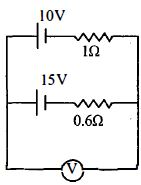
As the two cells oppose each other hence, the effective emf in closed circuit is \(15-10=5 \,\mathrm{V}\) and net resistance is \(1+\) \(0.6=1.6 \,\Omega\) (because in the closed circuit the internal resistance of two cells are in series.Current in the circuit,
\(I=\frac{\text { effective emf }}{\text { total resistance }}=\frac{5}{1.6} \,A\)
The potential difference across voltmeter will be same as the terminal voltage of either cell.
Since the current is drawn from the cell of \(15 \,\mathrm{V}\)
\(\therefore \quad V_{1}=E_{1}-I r_{1}\)
\(=15-\frac{5}{1.6} \times 0.6=13.1 \,\mathrm{V}\)
इस पेज पर इन फ़िल्टर से कोई प्रश्न नहीं मिला।