


P-ब्लॉक तत्त्व के सभी प्रश्न
नए पहले75 में से 51–75 प्रश्न
-
- (A) \([\mathrm{Xe}]{5} \mathrm{~d}^{10} 6 \mathrm{~s}^{2} 6 \mathrm{p}^{2}\)
- (B) \([\mathrm{Kr}] 4 \mathrm{~d}^{10} 5 \mathrm{~s}^{2} 5 \mathrm{p}^{2}\)
- (C) \([\mathrm{Kr}] 3 \mathrm{~d}^{10} 4 \mathrm{~s}^{2} 4 \mathrm{p}^{2}\)
- (D) \( [Ar]\) \(3 d^{10} 4 s^{2} 4 p^{2}\)
उत्तर और हल देखें
सही उत्तर: (B)
The element \(\mathrm{E}\) is \(\mathrm{Ga}\) and the diagonal element of \(5^{\mathrm{th}}\) period is \({ }_{50} \mathrm{Sn}\) having outer electronic configuration will be \([\mathrm{Kr}] \,5 \mathrm{~s}^{2} \,4 \mathrm{~d}^{10}\, 5 \mathrm{p}^{2}\). -
- (A) \(\left[\mathrm{GeCl}_{6}\right]^{2-}\)
- (B) \(\left[\mathrm{SiCl}_{6}\right]^{2-}\)
- (C) \(\left[\mathrm{Sn}(\mathrm{OH})_{6}\right]^{2-}\)
- (D) \(\left[\mathrm{SiF}_{6}\right]^{2-}\)
उत्तर और हल देखें
सही उत्तर: (B)
\(\left[\mathrm{SiCl}_{6}\right]^{2-}\) does not exist due to steric crowding of surrounding atoms. -
- (A) \((a)-(ii), (b)-(ii), (c)-(iii), (d)-(ii), (e)-(iii)\)
- (B) \((a)-(ii), (b)-(iii), (c)-(ii), (d)-(i), (e)-(iii)\)
- (C) \((a)-(ii), (b)-(ii), (c)-(iii), (d)-(i), (e)-(iii)\)
- (D) \((a)-(ii), (b)-(i), (c)-(ii), (d)-(iii), (e)-(iii)\)
उत्तर और हल देखें
सही उत्तर: (B)
\(\mathrm{NaOH} \longrightarrow\) Basic\(\mathrm{Be}(\mathrm{OH})_{2} \longrightarrow\) Amphoteric
\(\mathrm{Ca}(\mathrm{OH})_{2} \longrightarrow\) Basic
\(\mathrm{B}(\mathrm{OH})_{3} \longrightarrow\) Acidic
\(\mathrm{Al}(\mathrm{OH})_{3} \longrightarrow\) Amphoteric
- 54. ' \(X\) ' निम्न ताप पर पिघलता है तथा द्रव तथा ठोस दोनों अवस्थाओं में विद्युत का कुचालक है। \(X\) है 2020 मध्यम
- (A) कार्बन टेट्राक्लोराइड
- (B) मर्करी
- (C) सिलकान कार्बाइड
- (D) जिंक सल्फाइड
उत्तर और हल देखें
सही उत्तर: (A)
\(CCl_4\) is molecular solid so does not conduct electricity in liquid and solid state. -
- (A) बोरॉन नाइट्राइड तथा \(MeBr\)
- (B) बोरैजीन तथा \(MeMgBr\)
- (C) बोरेजीन तथा \(MeBr\)
- (D) डाइबोरेन तथा \(MeMgBr\)
उत्तर और हल देखें
सही उत्तर: (B)
\(\mathrm{H}_{3} \mathrm{N}_{3} \mathrm{B}_{3} \mathrm{Cl}_{3} (A)+3 \mathrm{LiBH}_{4} \xrightarrow [(T.H.F.)]{\text { In terahydrofurane }} \)\(\mathrm{H}_{3} \mathrm{N}_{3} \mathrm{B}_{3} \mathrm{H}_{3}(B)+3LiCl+3BH_3THF\)\(\mathrm{H}_{3} \mathrm{N}_{3} \mathrm{B}_{3} \mathrm{Cl}_{3}(A)+3 MeMgBr(C)\rightarrow\)\( \mathrm{H}_{3} \mathrm{N}_{3} \mathrm{B}_{3} \mathrm{(CH_3)}_{3}+3MgBrCl\)
-
- (A) \(H_3BO_3\) तथा \(B_2O_3\)
- (B) \(B_2O_3\) तथा \(H_3BO_3\)
- (C) \(HBO_2\) तथा \(H_3BO_3\)
- (D) \(B_2O_3\) तथा \([BH_4]^-\)
उत्तर और हल देखें
सही उत्तर: (B)
\(B_2H_6 + 3H_2O \longrightarrow 2H_3BO_3 + 3H_2\)\(B_2H_6 + 3O_2 \longrightarrow B_2O_3 + 3H_2O\)
-
- (A) \((i), (ii), (iii)\) तथा \((iv)\)
- (B) \((i), (ii)\) तथा \((iii)\)
- (C) केवल \((i)\) तथा \((ii)\)
- (D) \((i), (ii)\) तथा \((iv)\)
उत्तर और हल देखें
सही उत्तर: (D)
Silicones are polymers and hydrophobic due to presence of alkyl groups. They are used as greases as some of them are cyclic -
- (A) कार्बन
- (B) बोरान
- (C) बेरीलियम
- (D) लीथियम
उत्तर और हल देखें
सही उत्तर: (C)
Diagonal relationship -
- (A) \(I, II\) तथा \(III\)
- (B) \(II\) तथा \(III\) मात्र
- (C) \(I\) तथा \(III\) मात्र
- (D) \(I\) तथा \(II\) मात्र
उत्तर और हल देखें
सही उत्तर: (A)
\(B_2O_3\) is acidic in nature
\(Al_2O_3\) and \(Ga_2O_3\) are amphoteric
Oxides of \(In\) and \(Tl\) are basic in nature. Because the metallic character of the elements increases on moving down the group. -
- (A) \(PbCl_4\)
- (B) \(CCl_4\)
- (C) \(SnCl_4\)
- (D) \(SiCl_4\)
उत्तर और हल देखें
सही उत्तर: (B)
Central atom has no vacant orbital. -
- (A) \(20\) छ: सदस्य वलय, (hexagons)\(, 12\) पांच सदस्य वलय (Pentagons)
- (B) \(12\) छ: सदस्य वलय, (hexagons) \(,20\) पांच सदस्य वलय (Pentagons)
- (C) \(18\) छ: सदस्य वलय, (hexagons) \(,14\) पांच सदस्य वलय (Pentagons)
- (D) \(16\) छः: सदस्य वलय, (hexagons)\(, 16\) पांच सदस्य वलय (Pentagons)
उत्तर और हल देखें
सही उत्तर: (A)
In \(\;{C_{60 < {\rm{ }}Vsub{\rm{ }} > }}\) molecule there are \(20\) hexagons and \(12\) pentagons \(\therefore\) Ans.\((1)\) -
- (A) ग्रेफाइट
- (B) \(C_{70}\)
- (C) हीरा (डायमंड)
- (D) \(C_{60}\)
उत्तर और हल देखें
सही उत्तर: (C)
Since carbon in diamond is \(sp^3\) hybridized and its \(C -C\) bond order is \(1\). In graphite and fullerene there is both \(C -C\) and \(C = C\) in conjugation, hence there is partial double bond character between carbon atoms -
- (A) \(\begin{array}{*{20}{c}}
{R\,\,\,\,\,\,\,\,\,\,} \\
{|\,\,\,\,\,\,\,\,\,\,} \\
{{{[ - Si - O - ]}_n}} \\
{|\,\,\,\,\,\,\,\,\,\,} \\
{R\,\,\,\,\,\,\,\,\,\,}
\end{array}\) \((R = Me)\) - (B) \({\left( {Si{O_3}} \right)^{2 - }}\)
- (C) \({Si{O_2}}\)
- (D) \({\left( {Si{O_4}} \right)^{4 - }}\)
उत्तर और हल देखें
सही उत्तर: (D)
Basic unit is silicat \({\left( {Si{O_4}} \right)^{4 - }}\) - (A) \(\begin{array}{*{20}{c}}
-
- (A) \(C > Sn > Si \approx Ge\)
- (B) \(Ge > Sn > Si > C\)
- (C) \(Si > Sn > C > Ge\)
- (D) \(C > Si > Ge \approx Sn\)
उत्तर और हल देखें
सही उत्तर: (D)
In this order of catenation is asked. Catenation is a self-linking property here and for group \(14\) : Self-linking is through covalent bonding \(C > Si > Ge \approx Sn\) In \(C\) there is \(2p -2p\) overlapping further \(3p -3p, 4p-4p\) and so on and the extent of overlapping is more in \(2p-2p > 3p-3p > 4p-4p \approx 5p-5p\) -
- (A) \(Ge\)
- (B) \(Si\)
- (C) \(Sn\)
- (D) \(Pb\)
उत्तर और हल देखें
सही उत्तर: (D)
Due to the lowest bond energy of \(Pb -Pb\) bond. -
- (A) क्वार्ट्स
- (B) किजेलगूर
- (C) क्रिस्टोबेलाइट
- (D) ट्राइडाइमाइट
उत्तर और हल देखें
सही उत्तर: (B)
Kieselguhr is amorphous form of silica - 67. ग्रेफाइट तथा डायमंड के संकरण में, संकर कक्षकों के \(p-\) गुणों की प्रतिशतता क्रमशः होगी : 2018 कठिन
- (A) \(33\) तथा \(25\)
- (B) \(67\) तथा \(75\)
- (C) \(50\) तथा \(75\)
- (D) \(33\) तथा \(75\)
उत्तर और हल देखें
सही उत्तर: (B)
\(\%\) of \(p-\) in graphite \({(sp)^2} = \frac{2}{3} \times 100 = 67\% \)\(\%\) of \(p-\) in diamond \({(sp)^3} = \frac{3}{4} \times 100 = 75\% \)
-
- (A) \(B\)
- (B) \(Al\)
- (C) \(In\)
- (D) \(Ga\)
उत्तर और हल देखें
सही उत्तर: (A)
\(BCl_3\)\(B+C{{l}_{2}}\to \underset{\begin{smallmatrix}
[does\,not\,dimerise\,due\,to\, \\
(p\pi -p\pi )back\,bonding]
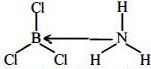
\end{smallmatrix}}{\mathop{BC{{l}_{3}}}}\,\xrightarrow{N{{H}_{3}}}\)\(BCl_3\) is electron deficient but it does not form dimer like \(Al,Ga\) or \(In\) because its electron deficiency is complemented by the formation of co-ordinate bond between lone pair of electron of chlorine and empty unhybridized \(p-\) orbital of boron forming \(p\pi -p\pi\) bonding.
-
- (A) \(KO_2\)
- (B) \(BaO_2\)
- (C) \(SiO_2\)
- (D) \(CsO_2\)
उत्तर और हल देखें
सही उत्तर: (C)
Compound nature\(KO_2\) Superoxide
\(BaO_2\) Peroxide
\(SiO_2\) Oxide
\(CsO_2\) Superoxide
-
- (A) \(PH_3\)
- (B) \(CH_4\)
- (C) \(NH_3\)
- (D) \(H_2O\)
उत्तर और हल देखें
सही उत्तर: (B)
More the number of lone pairs on central atom, the greater is the contraction caused in the angle between bond pairs. In \(PH_3\) the bond pairs of electrons are so much farther away from the central atom due to larger size. Thus the lone pair cause greater distortion in \(PH_3\) . Hence the bond angle decreases to \(98^o\) . -
- (A) \((A) - (iii), (B) - (i), (C) - (iv), (D) - (ii)\)
- (B) \((A) - (iv), (B) - (i), (C) - (ii), (D) - (iii)\)
- (C) \((A) - (ii), (B) - (i), (C) - (iv), (D) - (iii)\)
- (D) \((A) - (ii), (B) - (iv), (C) - (i), (D) - (iii)\)
उत्तर और हल देखें
सही उत्तर: (A)
\(A - \) Silica gel packets are used to absorb moisture and keep things dry \(i.e.\) as drying agent.
\(B -\) Silicon is a semiconductor and is used in transistors.
\(C -\) Silicone is used as sealant.
\(D -\) Silicates are widely used in ion-exchange beds in domestic and commercial water purification, softening, and other applications -
- (A) \(B _{2} H _{6}\) के साथ लीथियम हाइड्राइड की अभिक्रिया
- (B) प्लेटिनम इलेक्ट्रोडों का प्रयोग करके अम्लीकृत जल का विधुत अपघटन
- (C) जलीय क्षार के साथ जिंक की अभिक्रिया
- (D) द्रव अमोनिया में सोडियम के विलयन को स्थिर होने के लिए छोड़ देना
उत्तर और हल देखें
सही उत्तर: (A)
Lithium hydride react with diborane to produce lithiumborohydride\(2LiH + B_2H_6 \longrightarrow 2Li[BH_4]\)
-
- (A) हाइड्रोफ्लोसिलिसिक ऐसिड
- (B) सिलिका जैल
- (C) सिलिसिक ऐसिड
- (D) कैल्शियमफ्लोरोसिलिकेट
उत्तर और हल देखें
सही उत्तर: (D)
\(2CaF_2 + SiO_2 + H_2SO_4\, \longrightarrow\)\(Si{F_4} + {H_2}O + CaS{O_4}\xrightarrow{{hydrolysis}}CaSi{F_6}\)
-
- (A) \(1\) और \(2\)
- (B) \(1\) और \(3\)
- (C) \(2\) और \(4\)
- (D) \(3\) और \(4\)
उत्तर और हल देखें
सही उत्तर: (B)
Aluminium oxide is amphoteric oxide because it shows the properties of the both acidic and basic oxides . It reacts with both acids and bases to form salt and water.\(Al_2O_3 . xH_2O + 2NaOH \longrightarrow NaAlO_2 +H_2O\)
\(Al_2O_3 . xH_2O+HCl \longrightarrow AlCl_3 + H_2O\)
-
- (A) ज़ियोलाइटें
- (B) अल्ट्रामैरीनें
- (C) फेल्डस्पारें
- (D) बेरिलें
उत्तर और हल देखें
सही उत्तर: (C)
The feldspars are most abundant aluminosilicate minerals in the Earth surface. The silicon atoms and aluminium atoms occupy the centres of interlinked tetrahedra of \(SiO_4^{-4}\) and \(AlO_4^{-5}\) . These tetrahedra connect at each corner to other tetrahedra forming an intricate, three dimesional, negatively charged framework. The sodium cations sit within the voids in this structure
इस पेज पर इन फ़िल्टर से कोई प्रश्न नहीं मिला।