


All P-Block elements - I questions
Newest firstShowing 51–77 of 77 questions
-
- (A) \((a)-(ii), (b)-(ii), (c)-(iii), (d)-(ii), (e)-(iii)\)
- (B) \((a)-(ii), (b)-(iii), (c)-(ii), (d)-(i), (e)-(iii)\)
- (C) \((a)-(ii), (b)-(ii), (c)-(iii), (d)-(i), (e)-(iii)\)
- (D) \((a)-(ii), (b)-(i), (c)-(ii), (d)-(iii), (e)-(iii)\)
Show answer and solution
Correct Answer: (B)
\(\mathrm{NaOH} \longrightarrow\) Basic\(\mathrm{Be}(\mathrm{OH})_{2} \longrightarrow\) Amphoteric
\(\mathrm{Ca}(\mathrm{OH})_{2} \longrightarrow\) Basic
\(\mathrm{B}(\mathrm{OH})_{3} \longrightarrow\) Acidic
\(\mathrm{Al}(\mathrm{OH})_{3} \longrightarrow\) Amphoteric
-
- (A) \([\mathrm{Xe}]{5} \mathrm{~d}^{10} 6 \mathrm{~s}^{2} 6 \mathrm{p}^{2}\)
- (B) \([\mathrm{Kr}] 4 \mathrm{~d}^{10} 5 \mathrm{~s}^{2} 5 \mathrm{p}^{2}\)
- (C) \([\mathrm{Kr}] 3 \mathrm{~d}^{10} 4 \mathrm{~s}^{2} 4 \mathrm{p}^{2}\)
- (D) \( [Ar]\) \(3 d^{10} 4 s^{2} 4 p^{2}\)
Show answer and solution
Correct Answer: (B)
The element \(\mathrm{E}\) is \(\mathrm{Ga}\) and the diagonal element of \(5^{\mathrm{th}}\) period is \({ }_{50} \mathrm{Sn}\) having outer electronic configuration will be \([\mathrm{Kr}] \,5 \mathrm{~s}^{2} \,4 \mathrm{~d}^{10}\, 5 \mathrm{p}^{2}\). -
- (A) \(\left[\mathrm{GeCl}_{6}\right]^{2-}\)
- (B) \(\left[\mathrm{SiCl}_{6}\right]^{2-}\)
- (C) \(\left[\mathrm{Sn}(\mathrm{OH})_{6}\right]^{2-}\)
- (D) \(\left[\mathrm{SiF}_{6}\right]^{2-}\)
Show answer and solution
Correct Answer: (B)
\(\left[\mathrm{SiCl}_{6}\right]^{2-}\) does not exist due to steric crowding of surrounding atoms. - 54. \('X'\) melts at low temperature and is a bad conductor of electricity in both liquid and solid state. \(X\) is 2020 Medium
- (A) Carbon tetrachloride
- (B) Mercury
- (C) Silicon carbide
- (D) Zinc sulphide
Show answer and solution
Correct Answer: (A)
\(CCl_4\) is molecular solid so does not conduct electricity in liquid and solid state. -
- (A) Boron nitride and \(MeBr\)
- (B) Borazine and \(MeMgBr\)
- (C) Borazine and \(MeBr\)
- (D) Diborane and \(MeMgBr\)
Show answer and solution
Correct Answer: (B)
\(\mathrm{H}_{3} \mathrm{N}_{3} \mathrm{B}_{3} \mathrm{Cl}_{3} (A)+3 \mathrm{LiBH}_{4} \xrightarrow [(T.H.F.)]{\text { In terahydrofurane }} \)\(\mathrm{H}_{3} \mathrm{N}_{3} \mathrm{B}_{3} \mathrm{H}_{3}(B)+3LiCl+3BH_3THF\)\(\mathrm{H}_{3} \mathrm{N}_{3} \mathrm{B}_{3} \mathrm{Cl}_{3}(A)+3 MeMgBr(C)\rightarrow\)\( \mathrm{H}_{3} \mathrm{N}_{3} \mathrm{B}_{3} \mathrm{(CH_3)}_{3}+3MgBrCl\)
-
- (A) \(20\) hexagons and \(12\) pentagons.
- (B) \(12\) hexagons and \(20\) pentagons
- (C) \(18\) hexagons and \(14\) pentagons
- (D) \(16\) hexagons and \(16\) pentagons
Show answer and solution
Correct Answer: (A)
In \(\;{C_{60 < {\rm{ }}Vsub{\rm{ }} > }}\) molecule there are \(20\) hexagons and \(12\) pentagons \(\therefore\) Ans.\((1)\) -
- (A) \((i), (ii), (iii)\) and \((iv)\)
- (B) \((i), (ii)\) and \((iii)\)
- (C) \((i)\) and \((ii)\) only
- (D) \((i), (ii)\) and \((iv)\)
Show answer and solution
Correct Answer: (D)
Silicones are polymers and hydrophobic due to presence of alkyl groups. They are used as greases as some of them are cyclic - 58. Diborane \((B_2H_6)\) reacts independently with \(O_2\) and \(H_2O\) to produce, respectively 2019 Hard
- (A) \(H_3BO_3\) and \(B_2O_3\)
- (B) \(B_2O_3\) and \(H_3BO_3\)
- (C) \(HBO_2\) and \(H_3BO_3\)
- (D) \(B_2O_3\) and \([BH_4]^-\)
Show answer and solution
Correct Answer: (B)
\(B_2H_6 + 3H_2O \longrightarrow 2H_3BO_3 + 3H_2\)\(B_2H_6 + 3O_2 \longrightarrow B_2O_3 + 3H_2O\)
-
- (A) quartz
- (B) kieselguhr
- (C) cristobalite
- (D) tridymite
Show answer and solution
Correct Answer: (B)
Kieselguhr is amorphous form of silica -
- (A) \(\begin{array}{*{20}{c}}
{R\,\,\,\,\,\,\,\,\,\,} \\
{|\,\,\,\,\,\,\,\,\,\,} \\
{{{[ - Si - O - ]}_n}} \\
{|\,\,\,\,\,\,\,\,\,\,} \\
{R\,\,\,\,\,\,\,\,\,\,}
\end{array}\) \((R = Me)\) - (B) \({\left( {Si{O_3}} \right)^{2 - }}\)
- (C) \({Si{O_2}}\)
- (D) \({\left( {Si{O_4}} \right)^{4 - }}\)
Show answer and solution
Correct Answer: (D)
Basic unit is silicat \({\left( {Si{O_4}} \right)^{4 - }}\) - (A) \(\begin{array}{*{20}{c}}
-
- (A) graphite
- (B) \(C_{70}\)
- (C) diamond
- (D) \(C_{60}\)
Show answer and solution
Correct Answer: (C)
Since carbon in diamond is \(sp^3\) hybridized and its \(C -C\) bond order is \(1\). In graphite and fullerene there is both \(C -C\) and \(C = C\) in conjugation, hence there is partial double bond character between carbon atoms -
- (A) \(PbCl_4\)
- (B) \(CCl_4\)
- (C) \(SnCl_4\)
- (D) \(SiCl_4\)
Show answer and solution
Correct Answer: (B)
Central atom has no vacant orbital. -
- (A) \(C > Sn > Si \approx Ge\)
- (B) \(Ge > Sn > Si > C\)
- (C) \(Si > Sn > C > Ge\)
- (D) \(C > Si > Ge \approx Sn\)
Show answer and solution
Correct Answer: (D)
In this order of catenation is asked. Catenation is a self-linking property here and for group \(14\) : Self-linking is through covalent bonding \(C > Si > Ge \approx Sn\) In \(C\) there is \(2p -2p\) overlapping further \(3p -3p, 4p-4p\) and so on and the extent of overlapping is more in \(2p-2p > 3p-3p > 4p-4p \approx 5p-5p\) -
- (A) \(I, II\) and \(III\)
- (B) \(II\) and \(III\) only
- (C) \(I\) and \(III\) only
- (D) \(I\) and \(II\) only
Show answer and solution
Correct Answer: (A)
\(B_2O_3\) is acidic in nature
\(Al_2O_3\) and \(Ga_2O_3\) are amphoteric
Oxides of \(In\) and \(Tl\) are basic in nature. Because the metallic character of the elements increases on moving down the group. -
- (A) carbon
- (B) boron
- (C) beryllium
- (D) lithium
Show answer and solution
Correct Answer: (C)
E. N. of \(Al =(1.5) \approx \operatorname{Be}(1.5)\)Both Al and Be has diagonal relation to each other.
-
- (A) \(Ge\)
- (B) \(Si\)
- (C) \(Sn\)
- (D) \(Pb\)
Show answer and solution
Correct Answer: (D)
Due to the lowest bond energy of \(Pb -Pb\) bond. -
- (A) \(B\)
- (B) \(Al\)
- (C) \(In\)
- (D) \(Ga\)
Show answer and solution
Correct Answer: (A)
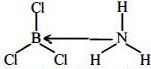
\(BCl_3\)\(B+C{{l}_{2}}\to \underset{\begin{smallmatrix}
[does\,not\,dimerise\,due\,to\, \\
(p\pi -p\pi )back\,bonding]
\end{smallmatrix}}{\mathop{BC{{l}_{3}}}}\,\xrightarrow{N{{H}_{3}}}\)\(BCl_3\) is electron deficient but it does not form dimer like \(Al,Ga\) or \(In\) because its electron deficiency is complemented by the formation of co-ordinate bond between lone pair of electron of chlorine and empty unhybridized \(p-\) orbital of boron forming \(p\pi -p\pi\) bonding.
- 68. In graphite and diamond, the percentage of \(p-\) characters of the hybrid orbitals in hybridisation are respectively 2018 Hard
- (A) \(33\) and \(25\)
- (B) \(67\) and \(75\)
- (C) \(50\) and \(75\)
- (D) \(33\) and \(75\)
Show answer and solution
Correct Answer: (B)
\(\%\) of \(p-\) in graphite \({(sp)^2} = \frac{2}{3} \times 100 = 67\% \)\(\%\) of \(p-\) in diamond \({(sp)^3} = \frac{3}{4} \times 100 = 75\% \)
-
- (A) \(LiCl,AlH_3\) and \(SiH_4\)
- (B) \(LiCl, AlCl_3\) and \(SiH_4\)
- (C) \(LiH,AlCl_3\) and \(SiCl_2\)
- (D) \(LiH, AlH_3\) and \(SiH_4\)
Show answer and solution
Correct Answer: (B)
\(SiCl_4 + LiAlH_4\to LiCl + AlCl_3 + SiH_4\) -
- (A) \(KO_2\)
- (B) \(BaO_2\)
- (C) \(SiO_2\)
- (D) \(CsO_2\)
Show answer and solution
Correct Answer: (C)
Compound nature\(KO_2\) Superoxide
\(BaO_2\) Peroxide
\(SiO_2\) Oxide
\(CsO_2\) Superoxide
-
- (A) Reaction of lithium hydride with \(B_2H_6\)
- (B) Electrolysis of acidified water using \(Pt\) electrodes
- (C) Reaction of zinc with aqueous alkali
- (D) Allowing a solution of sodium in liquid ammonia to stand
Show answer and solution
Correct Answer: (A)
Lithium hydride react with diborane to produce lithiumborohydride\(2LiH + B_2H_6 \longrightarrow 2Li[BH_4]\)
-
- (A) \((A) - (iii), (B) - (i), (C) - (iv), (D) - (ii)\)
- (B) \((A) - (iv), (B) - (i), (C) - (ii), (D) - (iii)\)
- (C) \((A) - (ii), (B) - (i), (C) - (iv), (D) - (iii)\)
- (D) \((A) - (ii), (B) - (iv), (C) - (i), (D) - (iii)\)
Show answer and solution
Correct Answer: (A)
\(A - \) Silica gel packets are used to absorb moisture and keep things dry \(i.e.\) as drying agent.
\(B -\) Silicon is a semiconductor and is used in transistors.
\(C -\) Silicone is used as sealant.
\(D -\) Silicates are widely used in ion-exchange beds in domestic and commercial water purification, softening, and other applications -
- (A) \(PH_3\)
- (B) \(CH_4\)
- (C) \(NH_3\)
- (D) \(H_2O\)
Show answer and solution
Correct Answer: (B)
More the number of lone pairs on central atom, the greater is the contraction caused in the angle between bond pairs. In \(PH_3\) the bond pairs of electrons are so much farther away from the central atom due to larger size. Thus the lone pair cause greater distortion in \(PH_3\) . Hence the bond angle decreases to \(98^o\) . -
- (A) Zeolites
- (B) Ultramarines
- (C) Feldspars
- (D) Beryls
Show answer and solution
Correct Answer: (C)
The feldspars are most abundant aluminosilicate minerals in the Earth surface. The silicon atoms and aluminium atoms occupy the centres of interlinked tetrahedra of \(SiO_4^{-4}\) and \(AlO_4^{-5}\) . These tetrahedra connect at each corner to other tetrahedra forming an intricate, three dimesional, negatively charged framework. The sodium cations sit within the voids in this structure -
- (A) \(1\) and \(2\)
- (B) \(1\) and \(3\)
- (C) \(2\) and \(4\)
- (D) \(3\) and \(4\)
Show answer and solution
Correct Answer: (B)
Aluminium oxide is amphoteric oxide because it shows the properties of the both acidic and basic oxides . It reacts with both acids and bases to form salt and water.\(Al_2O_3 . xH_2O + 2NaOH \longrightarrow NaAlO_2 +H_2O\)
\(Al_2O_3 . xH_2O+HCl \longrightarrow AlCl_3 + H_2O\)
-
- (A) hydrofluosilicic acid
- (B) silica gel
- (C) silicic acid
- (D) calciumfluorosilicate
Show answer and solution
Correct Answer: (D)
\(2CaF_2 + SiO_2 + H_2SO_4\, \longrightarrow\)\(Si{F_4} + {H_2}O + CaS{O_4}\xrightarrow{{hydrolysis}}CaSi{F_6}\)
-
- (A) In \((Si_3O_9)^{6-}\), tetrahedral \(SiO_4\) units share two oxygen atoms
- (B) Trialkylchlorosilane on hydrolysis gives \(R_3SiOH\).
- (C) \(SiCl_4\) undergoes hydrolysis to give \(H_4SiO_4\)
- (D) \((Si_3O_9)^{6-}\) has cyclic structure.
Show answer and solution
Correct Answer: (B)
The hydrolysis of Trialkylchlorosilane \(R_3SiCl\) yields dimer :\(\begin{matrix}
\,\,\,R\,\,\,\,\,\,\,\,\,\,\,\,\,\,\,\,\,R\, \\
\,|\,\,\,\,\,\,\,\,\,\,\,\,\,\,\,\,\,\,\,\,|\, \\
R-Si-O-Si-R \\
|\,\,\,\,\,\,\,\,\,\,\,\,\,\,\,\,\,\,\,\,\,| \\
R\,\,\,\,\,\,\,\,\,\,\,\,\,\,\,\,\,R \\
\end{matrix}\)
No questions on this page match these filters.