


प्रश्न
3 प्रश्न3 में से 1–3 प्रश्न
-
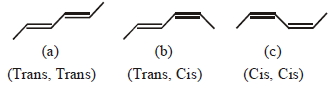
- (A) \((a) < (b) < (c)\)
- (B) \((b) < (c) < (a)\)
- (C) \((c) < (b) < (a)\)
- (D) \((a) < (c) < (b)\)
उत्तर और हल देखें
सही उत्तर: (A)
Generally trans is more stable then cis formHeat of combustion (HOC) \(\propto \frac{1}{\text { Stability }}\)
Stability : \(a>b>c\)
\(\mathrm{HOC}: \mathrm{c}>\mathrm{b}>\mathrm{a}\)
-
- (A) \((v) < (i) < (iv) < (ii) < (iii)\)
- (B) \((iii) < (i) < (ii) < (iv) < (v)\)
- (C) \((v) < (iii) < (ii) < (iv) < (i)\)
- (D) \((iii) < (iv) < (ii) < (i) < (v)\)
उत्तर और हल देखें
सही उत्तर: (C)
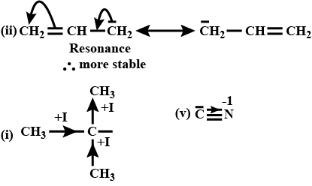
Basicity \(\propto \frac{1}{\text { Stability }}\)\((v)\) In figure \(5 , sp\) hybridised carbon is more electronegative. -ve charge on more electronegative atom makes it more stable. [ref. image]
Also, there is \(-I\) effect.
\(\therefore\) It is most stable.
\((iii)\) \(H - C \equiv \overline{ C }\)
sp hybridized carbon carry -ve charge.
\(\therefore\) Hence, it is also more stable
\((ii)\) In figure \(2\), resonance is taking place. [ref. image]
\(\therefore\) It is more stable.
\((iv)\) \(\overline{ C } H _3\)
-ve charge is carried by \(sp ^3\) hybridised carbon.
\(\therefore\) It is less stable.
\((i)\) In figure \(1\) , the central \(C\) is surrounded by \(CH _3\) and hence it shows \(+ I\) effect from \(3\) sides. [ref. image]
\(\therefore\) Hence, it is least stable.
\(\therefore \text { (v) }\,<\,\text { (iii) }\,<\,\text { (ii) }\,<\,\text { (iv) }\,<\,\text { (i) }\)
-
- (A) \(b\) तथा \(d\)
- (B) \(a, b\) तथा \(c\)
- (C) \(a\) तथा \(c\)
- (D) \(a\) तथा \(b\)
उत्तर और हल देखें
सही उत्तर: (B)
\(S _{ N }{ }^{1}\) favours\((a)\) The reaction is favoured by weak nucleophiles
\((b)\) \(R^ \oplus\) would be easily formed if the substituents are bulky
\((c)\) The reaction is accompained by recemization
इस पेज पर इन फ़िल्टर से कोई प्रश्न नहीं मिला।