


प्रश्न
12 प्रश्न12 में से 1–12 प्रश्न
-
- (A) \(41\)
- (B) \(42\)
- (C) \(40\)
- (D) \(38\)
उत्तर और हल देखें
सही उत्तर: (B)
\(\%\) sulphur \(=\frac{32}{233} \times \frac{\text { weight of } BaSO _4 \text { formed }}{\text { weight of organic compound }} \times 100\)\(=\frac{32}{233} \times \frac{1.4439}{0.471} \times 100\)
\(=42.10\)
Nearest integer \(42\)
-
- (A) \(42\)
- (B) \(43\)
- (C) \(48\)
- (D) \(44\)
उत्तर और हल देखें
सही उत्तर: (D)
weight of \(C\) in \(0.792\,gm CO _2\)\(=\frac{12}{44} \times 0.792=0.216\)
\(\% \text { of } C \text { in compound }=\frac{0.216}{0.492} \times 100\)
\(=43.90 \%\)
Ans:\(44\)
-
- (A) \(A,C,B\)
- (B) \(B,C,A\)
- (C) \(C,A,B\)
- (D) \(B,A,C\)
उत्तर और हल देखें
सही उत्तर: (A)
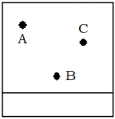
According to the observation,\(A\) is more mobile and interacts with the mobile phase more than \(C\), and \(C\) is more drawn to the mobile phase than \(B\).Hence, the correct order of elution in the silico gel column chromatography is \(- B < C < A\)

-
- (A) \(20\)
- (B) \(30\)
- (C) \(50\)
- (D) \(40\)
उत्तर और हल देखें
सही उत्तर: (D)
mole of \(AgBr =\frac{0.376}{188}\)mole of \(Br ^{-}=\)mole of \(AgBr =\frac{0.376}{188}\)
mass of \(Br ^{-}=\frac{0.376}{188} \times 80\)
\(\%\) of \(Br ^{-}=\frac{0.376 \times 80}{188 \times 0.4} \times 100=40 \%\)
-
- (A) \(10\)
- (B) \(11\)
- (C) \(12\)
- (D) \(13\)
उत्तर और हल देखें
सही उत्तर: (B)
Percentage of Carbon\(=\frac{12}{44} \times \frac{\text { mass of } CO _2 \text { formed }}{\text { mass of compound taken }} \times 100\)
\(60=\frac{12}{44} \times \frac{\text { mass of } CO _2 \text { formed }}{0.5} \times 100\)
Mass of \(CO _2\) formed \(=\frac{60 \times 44 \times 0.5}{12 \times 100}\,g\)
\(=1.1 \text { gram }\)
\(=11 \times 10^{-1} \text { gram }\)
-
- (A) \(A-(iii), B-(iv), C-(ii), D-(i)\)
- (B) \(A-(i), B-(iii), C-(ii), D-(iv)\)
- (C) \(A-(ii), B-(iii), C-(iv), D-(i)\)
- (D) \(A-(ii), B-(iv), C-(i), D-(iii)\)
उत्तर और हल देखें
सही उत्तर: (C)
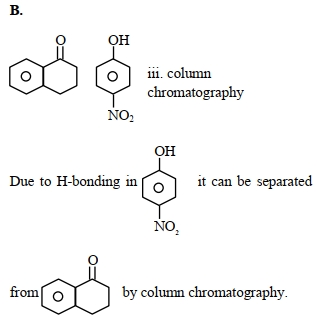
\(A\). \(H _2 O / CH _2 Cl _2 \rightarrow\) \(ii\), \(CH _2 Cl _2> H _2 O\) (density) so they can be separated by differential solvent extraction.\(B\).\(C.\) Kerosene / Naphthalene \(\rightarrow\) iv. Fractional distillation.
Due to different B.P. of kerosene and Naphthalene it can be separated by fractional distillation.
\(D.\) \(C _6 H _{12} O _6 / NaCl \rightarrow\) i. Crystallization.
\(NaCl\) (ionic compound) can be crystallized.
-
- (A) निम्न \(\mathrm{R}_{\mathrm{f}}\), दुर्बल अधिशोषण
- (B) उच्च \(R _{ f }\), stronger adsorption
- (C) उच्च \(R_f\), दुर्बल अधिशोषण
- (D) निम्न \(\mathrm{R}_{\mathrm{f}}\), प्रबल अधिशोषण
उत्तर और हल देखें
सही उत्तर: (D)
If any component eluted second then it means that its \(R_f\) value is low and its adsorption is stronger\(R _{ f }=\frac{\text { distance covered by substance from base line }}{\text { total distance covered by solvent from base line }}\)
-
- (A) गतिशील प्रावस्था में उपस्थित जल को पेपर द्वारा अवशोषित किया जाता है, जो अब स्थिर प्रावस्था का कार्य करता है।
- (B) पेपर के छिद्रों में उपस्थित जल स्थिर प्रावस्था का कार्य करता है।
- (C) पेपर शीट स्थिर प्रावस्था का कार्य करता है।
- (D) पेपर एवं उसके छिद्रों में उपस्थित जल स्थिर प्रावस्था का कार्य करता है।
उत्तर और हल देखें
सही उत्तर: (B)
In paper chromatography, a special quality paper known as chromatography paper is used. Paper contains water trapped in it, which acts as the stationary phase. -
- (A) ऑक्सीकरण से बचा जा सके
- (B) अपचयन से बचा जा सके
- (C) जल अपघटन से बचा जा सके
- (D) टूटने से बचा जा सके
उत्तर और हल देखें
सही उत्तर: (A)
Prolonged heating will cause oxidation of \(Fe ^{+2}\) to \(Fe ^{+3}\). -
- (A) \(A-IV, B-I, C-III, D-II\)
- (B) \(A-III, B-IV, C-I, D-II\)
- (C) \(A-II, B-I, C-III, D-IV\)
- (D) \(A-III, B-I, C-IV, D-II\)
उत्तर और हल देखें
सही उत्तर: (B)
List \(I\) (Mixture) List \(II\) (Separation Technique) \(A\) \(CHCl _3+ C _6 H _5 NH _2\) \(I\) Distillation \(B\) \(C _6 H _{14}+ C _5 H _{12}\) \(II\) Fractional distillation \(C\) \(C _6 H _5 NH _2+ H _2 O\) \(III\) Steam distillation \(D\) Organic compound in \(H _2 O\) \(IV\) Differential extraction NCERT \((XI)\) Vol. \(2\) Page No. \(359, 360. \)
-
- (A) \(A-II, B-IV, C-I, D-III\)
- (B) \(A-IV, B-II, C-I, D-III\)
- (C) \(A-II, B-I, C-IV, D-III\)
- (D) \(A-III, B-I, C-IV, D-II\)
उत्तर और हल देखें
सही उत्तर: (D)
Nitrogen detection by lassaigne's method\(Na + C + N \rightarrow NaCN\)
\(6 NaCN + FeSO _4 \rightarrow Na _4\left[ Fe ( CN )_6\right]+ Na _2 SO _4\)
\(Na _4\left[ Fe ( CN )_6\right]+ Fe ^{3+} \rightarrow Fe _4\left[ Fe ( CN )_6\right]_3\)
(Prussian blue)
Sulphur detection by Sodium nitroprusside
\(Na _2\left[ Fe ( CN )_5 NO \right]+ Na _2 S \rightarrow Na 4\left[ Fe ( CN )_5 NOS \right]\)
\(\text { [Purple }]\)
Phosphorus detection by ammonium molybdate
\(Na _3 PO _4+3 HNO _3 \rightarrow H _3 PO _4+3 NaNO _3\)
\(H _3 PO _4+12\left( NH _4\right)_2 MoO _4+21 HNO _3 \rightarrow\)
\(\left( NH _4\right)_3 PO _4 .12 MoO _3+21 NH _4 NO _3+12 H _2 O\)
\(\text { (canary yellow) }\)
\(\text { Halogen give specific coloured ppt with }\)
\(AgNO _3( aq )\)
\(NaCl + AgNO _3( aq ) \rightarrow AgCl + NaNO _3\)
\(\text { (White) }\)
\(NaBr + AgNO _3( aq ) \rightarrow AgBr + NaNO _3\)
\(\text { (Pale yellow) }\)
\(NaI + AgNO _3( aq ) \rightarrow AgI + NaNO _3\)
\(\text { (Yellow) }\)
-
- (A) \(24\)
- (B) \(25\)
- (C) \(23\)
- (D) \(22\)
उत्तर और हल देखें
सही उत्तर: (B)
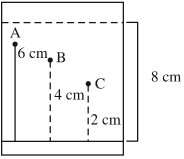
More \(R _{ f }\), less its polarity\(R _{ f }=\frac{\text { Distance travelled by compound ' } X \text { ' }}{\text { Distance travelled by solvent ' } Y '}\)
\(=\frac{2}{8}=0.25=25 \times 10^{-2}\)
इस पेज पर इन फ़िल्टर से कोई प्रश्न नहीं मिला।