


प्रश्न
20 प्रश्न20 में से 1–20 प्रश्न
-
- (A) \(\mathrm{Fe}_{4}\left[\mathrm{Fe}(\mathrm{CN})_{6}\right]_{3}\)
- (B) \(\mathrm{K}_{5} \mathrm{Fe}\left[\mathrm{Fe}(\mathrm{CN})_{6}\right]_{2}\)
- (C) \(\mathrm{HFe}\left[\mathrm{Fe}(\mathrm{CN})_{6}\right]\)
- (D) \(\mathrm{KFe}\left[\mathrm{Fe}(\mathrm{CN})_{6}\right]\)
उत्तर और हल देखें
सही उत्तर: (D)
\(\mathrm{FeCl}_{3}+\mathrm{K}_{4}\left[\mathrm{Fe}(\mathrm{CN})_{6}\right](\text { excess })\)\(\quad\quad\quad\downarrow\)
\(\mathrm{K} \mathrm{Fe}\left[\mathrm{Fe}(\mathrm{CN})_{6}\right]\)
Colloidal species
-
- (A) \(2\)
- (B) \(7\)
- (C) \(1\)
- (D) \(15\)
उत्तर और हल देखें
सही उत्तर: (B)
\(\mathrm{C}_{2} \mathrm{H}_{7} \mathrm{~N}+\left(2 \mathrm{x}+\frac{\mathrm{y}}{2}\right) \mathrm{CuO} \rightarrow \mathrm{x} \mathrm{CO}_{2}+\frac{\mathrm{y}}{2} \mathrm{H}_{2} \mathrm{O}+\frac{\mathrm{z}}{2} \mathrm{~N}_{2}+\left(2 \mathrm{x}+\frac{\mathrm{y}}{2}\right) \mathrm{Cu}\)On balancing
\(\mathrm{C}_{2} \mathrm{H}_{7} \mathrm{~N}+\frac{15}{2} \mathrm{CuO} \rightarrow 2 \mathrm{CO}_{2}+\frac{7}{2} \mathrm{H}_{2} \mathrm{O}+\frac{1}{2} \mathrm{~N}_{2}+\frac{15}{2} \mathrm{Cu}\)
On comparing
\(\mathrm{y}=7\)
-
- (A) \(1\)
- (B) \(6\)
- (C) \(3\)
- (D) \(8\)
उत्तर और हल देखें
सही उत्तर: (C)
\(44 gm CO _{2}\), have \(12 gm\) carbonSo, \(420 gm CO _{2} \Rightarrow \frac{12}{44} \times 420\)
\(\Rightarrow \frac{1260}{11} gm\) carbon
\(\Rightarrow 114.545\) gram carbon
So, \(\%\) of carbon \(=\frac{114.545}{750} \times 100\)
\(=15.3 \%\)
\(18 gm H _{2} O \Rightarrow 2 gm H _{2}\)
\(210 gm \Rightarrow \frac{2}{18} \times 210\)
\(=23.33 gm H _{2}\)
\(So , \% H _{2} \Rightarrow \frac{23.33}{750} \times 100=3.11 \%\)
\(\approx 3 \%\)
-
- (A) \(4\)
- (B) \(400\)
- (C) \(40\)
- (D) \(0.40\)
उत्तर और हल देखें
सही उत्तर: (C)
\(\mathrm{n}_{\mathrm{AgBr}}=\frac{0.188 \mathrm{~g}}{188 \mathrm{~g} / \mathrm{mol}}=10^{-3}\, \mathrm{~mol}\)\(\Rightarrow \mathrm{n}_{\mathrm{Br}}=\mathrm{n}_{\lambda_{\mathrm{kBt}}}=0.001\, \mathrm{~mol}\)
\(\Rightarrow \text { mass }_{\mathrm{Bz}}=(0.001 \times 80) \,\mathrm{gm}=0.08 \,\mathrm{gm}\)
\(\Rightarrow \text { mass } \%=\frac{0.08 \times 100}{0.2}=40 \,\%\)
-
- (A) गतिशीलता अथवा विलायक तन्त्र का प्रवाह
- (B) यौगिक की विलेयता
- (C) कालम अथवा \(TLC\) प्लेट की लम्बाई
- (D) शुद्ध यौगिक की भौतिक अवस्था
उत्तर और हल देखें
सही उत्तर: (D)
In chromotography technique, the purification of a compound is independent of the physical -
- (A) \(8\)
- (B) \(9\)
- (C) \(41\)
- (D) \(12\)
उत्तर और हल देखें
सही उत्तर: (D)
Organic compound : \(0.8 \,\mathrm{gm}\)wt. of \(\mathrm{N}=\left(\frac{42}{100} \times 0.8\right)\, \mathrm{gm}\)
mole of \(N=\frac{42 \times 0.8}{100 \times 14}=\frac{2.4}{100}\, \mathrm{~mol}\)
moles of \(\mathrm{NH}_{3}=\frac{2.4}{100}\)
\(2 \mathrm{NH}_{3}+\mathrm{H}_{2} \mathrm{SO}_{4} \rightarrow\left(\mathrm{NH}_{4}\right)_{2} \mathrm{SO}_{4}\)
\(\quad\downarrow\quad\quad\quad\downarrow\)
\(\frac{2.4}{100}\) \(mole\) \(\quad\frac{1.2}{100}\) \(mole\)
For \(\mathrm{H}_{2} \mathrm{SO}_{4} \quad \frac{1.2}{100}=1 \times \mathrm{V}(\ell)\)
\(\Rightarrow \mathrm{V}_{\mathrm{H}_{2} \mathrm{SO}_{4}}=\frac{1.2}{100} \,\ell=12 \,\mathrm{~m} \ell\)
- 7. कैरिअस विधि में हैलोजनयुक्त कार्बनिक यौगिक को सधूम नाइट्रिक अम्ल के साथ जिसकी उपस्थिति में गर्म करते हैं, वह है 2021 कठिन
- (A) \(\mathrm{AgNO}_{3}\)
- (B) \(\mathrm{HNO}_{3}\)
- (C) \(\mathrm{BaSO}_{4}\)
- (D) \(\mathrm{CuSO}_{4}\)
उत्तर और हल देखें
सही उत्तर: (A)
Organic compound is heated with fuming nitric acid in the presence of silver nitrate in carius method.Lunar caustic \(\left(\mathrm{AgNO}_{3}\right)\) is used as reagent hare to distinguish \(\mathrm{Cl}^{-}, \mathrm{Br}\) and \(\mathrm{I}^{-}\)respectively as follows.
\(\mathrm{Cl}^{-}(\mathrm{aq}) \stackrel{\mathrm{AgNO}_{3}}{\longrightarrow} \mathrm{AgCl} \downarrow_{\mathrm{ppt}}\) white
\(\mathrm{Br}^{-}(\mathrm{aq})\stackrel{\mathrm{AgNO}_{3}}{\longrightarrow} \mathrm{AgBr} \downarrow_{\mathrm{ppt}} \mathrm{pale}\) yellow
\(\mathrm{I}^{-}(\mathrm{aq}) \stackrel{\mathrm{AgNO}_{3}}{\longrightarrow} \mathrm{AgNO}_{3} \mathrm{AgI} \downarrow_{\mathrm{ppt}}\) Dark yellow
-
- (A) \(96\)
- (B) \(12\)
- (C) \(85\)
- (D) \(68\)
उत्तर और हल देखें
सही उत्तर: (D)
Moles of \(\mathrm{Br}=\) Moles of \(\mathrm{AgBr}\) obtained\(\Rightarrow \quad\) Mass of \(\mathrm{Br}=\frac{0.2397}{188} \times 80\, \mathrm{~g}\)
therefore \(\%\) Br in the organic compound
\(=\frac{W_{\text {Br }}}{W_{T}} \times 100\)
\(=\frac{0.2397 \times 80}{188 \times 0.15} \times 100=0.85 \times 80\)
\(=68\)
\(\Rightarrow\) Nearest integer is \('68^{\prime}\)
-
- (A) \(1963\)
- (B) \(8510\)
- (C) \(1125\)
- (D) \(7412\)
उत्तर और हल देखें
सही उत्तर: (C)
Moles of \(\mathrm{N}\) in \(\mathrm{N}, \mathrm{N}\) - dimethylaminopentane\(=\left(\frac{57.5}{115}\right)=0.5\, \mathrm{~mol}\)
\(\Rightarrow \mathrm{C}_{7} \mathrm{H}_{17} \mathrm{~N}+\frac{45}{2} \mathrm{CuO} \rightarrow 7 \mathrm{CO}_{2}+\frac{17}{2} \mathrm{H}_{2} \mathrm{O}+\frac{1}{2} \mathrm{~N}_{2}+\frac{45}{2} \mathrm{Cu}\)
\(\frac{\mathrm{n}_{\mathrm{cuo}} \text { reacted }}{\left(\frac{45}{2}\right)}=\frac{\mathrm{n}_{\mathrm{C_7} \mathrm{H}_{17} \mathrm{N}} \text { reacted }}{1}\)
\(\Rightarrow \mathrm{n}_{\mathrm{C} \mathrm{u} O}\) reacted \(=\left(\frac{45}{2}\right) \times 0.5=11.25\)
-
- (A) कथन \(-I\) असत्य है परन्तु कथन \(II\) सत्य है दोनों
- (B) कथन \(-I\) तथा कथन \(II\) असत्य है
- (C) कथन \(-I\) सत्य है परन्तु कथन \(II\) असत्य है
- (D) दोनों कथन \(-I\) तथा कथन \(II\) सत्य है
उत्तर और हल देखें
सही उत्तर: (D)
Statement \(1: B.P.\) of chloroform \(=334 K\)\(B.P.\) of aniline \(=457 K\)
thus can be seprated of simple distillation.
Statement \(2 :\) Mixture of aniline and water seprated by simple distillation.
-
- (A) दोनों कथन \(I\) तथा कथन \(II\) असत्य है।
- (B) कथन \(I\) असत्य है परन्तु कथन \(I I\) सत्य है।
- (C) कथन \(I\) सत्य है परन्तु कथन \(II\) असत्य है।
- (D) दोनों कथन \(I\) तथा कथन \(II\) सत्य हैं।
उत्तर और हल देखें
सही उत्तर: (C)
Statement \(I:\) It is correct statementStatement \(II:\) \(\mathrm{CH}_{3}-\mathrm{C^+H}_{2}\) involve \(\mathrm{C}_{\mathrm{sp}^{3}}-\mathrm{H}_{1 \mathrm{~s}}\) bond with empty \(2 \mathrm{p}\) orbital hence given statement is false.
-
- (A) कथन \(-I\) सत्य है परन्तु कथन \(-II\) असत्य है।
- (B) दोनों कथन \(-I\) तथा कथन \(-II\) सत्य है।
- (C) दोनों कथन \(-I\) तथा कथन \(-II\) असत्य है।
- (D) कथन \(-I\) असत्य है परन्तु कथन \(-II\) सत्य है।
उत्तर और हल देखें
सही उत्तर: (C)
\(R _{ f }=\) retardation factorDistance travelled by the substance from
\(R _{ f }=\frac{\text { reference line }( c \cdot m )}{\text { Distan ce travelled by the solvent from }}\)
reference line \((c.m)\)
Note : \(R _{ f }\) value of different compounds are different.
-
- (A) \((A)\) सही नहीं है परन्तु \(( R )\) सही है।
- (B) दोनों \((A)\) तथा \((R)\) सही हैं और \(( R )\) सही व्याख्या नहीं है \((A)\) की।
- (C) \((A)\) सही है परन्तु \((R)\) सही नहीं है।
- (D) दोनों \((A)\) तथा \((R)\) सही हैं और \((R)\) सही व्याख्या है \((A)\) की।
उत्तर और हल देखें
सही उत्तर: (D)
Both assertion \(\&\) reason are correct \(\&\) \((\mathrm{R})\) is the correct explanation of \((A)\) -
- (A) \(2\)
- (B) \(1\)
- (C) \(4\)
- (D) \(3\)
उत्तर और हल देखें
सही उत्तर: (C)
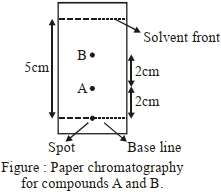
\(R _{ f }=\frac{\text { Distance travelled by compound }}{\text { Distance travelled by solvent }}\)on chromatogram distance travelled by cmopound is \(\rightarrow 2 \,cm\)
Distance travelled by solvent \(=5\, cm\)
So \(R _{ f }=\frac{2}{5}=4 \times 10^{-1}=0.4\)
-
- (A) एक कार्बनिक यौगिक में सल्फर का आकलन करने के लिए कैरिअस नली का उपयोग करते हैं।
- (B) नाइट्रोजन का कार्बनिक यौगिक में आकलन के लिए कैरिअस विधि का उपयोग करते हैं।
- (C) कार्बनिक यौगिक में उपस्थित फॉस्फोरस के ऑक्सीकरण से उत्पन्न फॉस्फोरिक अम्ल को मेग्नेसिया मिश्रण मिलाकर \(Mg _{2} P _{2} O _{7}\) के रूप में अवक्षेपित करते है।
- (D) जैल्डॉल विधि का उपयोग कार्बनिक यौगिकों में नाइट्रोजन आकलन के लिए करते हैं।
उत्तर और हल देखें
सही उत्तर: (B)
Carius method is used in the estimation of halogen in organic compounds. -
- (A) नाइट्रिक अम्ल
- (B) अमोनिया
- (C) हाइड्रोक्लोरिक अम्ल
- (D) सोडियम हाइड्रॉक्साइड
उत्तर और हल देखें
सही उत्तर: (A)
For testing of halogens, Nitric acid is added to the sodium extract because if \(CN ^{-}\) or \(S ^{2-}\) are present then they will be oxidised and removed before the test of halides. -
- (A) \(142\)
- (B) \(42\)
- (C) \(471\)
- (D) \(233\)
उत्तर और हल देखें
सही उत्तर: (B)
Molecular mass of \(\mathrm{BaSO}_{4}=233 \,\mathrm{~g}\)\(\because 233 \,g\,\mathrm{BaSO}_{4}\) contain \(\rightarrow 32\, \mathrm{~g}\) sulphur
\(\therefore 1.44\, \mathrm{~g} \,\mathrm{BaSO}_{4}\) contain \(\rightarrow \frac{32}{233} \times 1.44\, \mathrm{~g}\) sulphur
given : \(0.471\, \mathrm{~g}\) of organic compound
\(\%\) of \(\mathrm{S}=\frac{32 \times 1.44}{233 \times 0.471} \times 100=41.98 \,\% \approx 42\, \%\)
-
- (A) \((a)-(iii), (b)-(i), (c)-(ii), (d)-(iv)\)
- (B) \((a)-(i), (b)-(iv), (c)-(iii), (d)-(ii)\)
- (C) \((a)-(iii), (b)-(i), (c)-(iv),(d)-(ii)\)
- (D) \((a)-(i), (b)-(ii), (c)-(iv), (d)-(iii)\)
उत्तर और हल देखें
सही उत्तर: (C)
Match List :-\((a)\) Lassaigne's Test \((iii)\) \(N , S , P ,\) and halogen \((b)\) \(Cu ( II )\) oxide \((i)\) Carbon \((c)\) Silver nitrate \((iv)\) Halogen Specifically \((d)\) The sodium fusion extract gives black precipitate with acetic acid and lead acetate \((ii)\) Sulphur - 19. उच्च क्वथनांक के द्रव कार्बनिक यौगिक (क्वथनांक के समीप विघटित होता है) के शुद्धिकरण के लिए उपयोग की जाने वाली तकनीक कौन सी है \(?\) 2021 मध्यम
- (A) सामान्य आसवन
- (B) वाष्प आसवन
- (C) प्रभावी आसवन
- (D) दाब घटाकर आसवन
उत्तर और हल देखें
सही उत्तर: (D)
Reduced pressure distillation used for the purification of high boiling organic liquids which decomposes at or below their boiling point. -
- (A) \(19\)
- (B) \(21\)
- (C) \(25\)
- (D) \(80\)
उत्तर और हल देखें
सही उत्तर: (A)
\(\mathrm{n}_{\mathrm{cl}} \text { in compound }=\mathrm{n}_{\mathrm{AgCl}}=\frac{0.3849 \mathrm{~g}}{(107.87+35.5)}\, \mathrm{g} / \mathrm{mol}\)\(\Rightarrow \text { mass of chlorine }=\mathrm{n}_{\mathrm{Cl} } \times 35.5=0.0953\, \mathrm{gm}\)
\(\Rightarrow\, \% \text { wt of chlorine }=\frac{0.0953}{0.5} \times 100\)
\(\quad=19.06\, \%\)
इस पेज पर इन फ़िल्टर से कोई प्रश्न नहीं मिला।