


JEE Mains · Physics · STD 12 - Electric charges and fields
- JEE Mains 2026
- Easy
- Numerical
A point charge \(q = 1\ \mu\text{C}\) is located at a distance \(2\text{ cm}\) from one end of a thin insulating wire of length \(10\text{ cm}\) having a charge \(Q = 24\ \mu\text{C}\), distributed uniformly along its length, as shown in figure. Force between \(q\) and wire is _______ N.
(Use \(\frac{1}{4\pi\varepsilon_0} = 9 \times 10^9\text{ N}\cdot\text{m}^2/\text{C}^2\))

Pick an option to check your answer.
Answer & Solution
Correct Answer
(B) 90
Step-by-step Solution
Detailed explanation
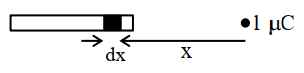
Explanation:
Let us calculate the electrostatic force between the point charge and the uniformly charged wire step-by-step using calculus:
1. Convert Given Values to SI Units:
- Point charge, \(q = 1\ \mu\text{C} = 10^{-6}\text{ C}\)
- Total charge on wire, \(Q = 24\ \mu\text{C} = 24 \times 10^{-6}\text{ C}\)
- Length of the wire, \(L = 10\text{ cm} = 10 \times 10^{-2}\text{ m} = 10^{-1}\text{ m}\)
- Distance of point charge from nearest end = \(2\text{ cm} = 2 \times 10^{-2}\text{ m}\)
- Distance from furthest end = \(2\text{ cm} + 10\text{ cm} = 12\text{ cm} = 12 \times 10^{-2}\text{ m}\)
2. Define Linear Charge Density (\(\lambda\)):
The charge per unit length of the wire is:
\(\lambda = \frac{Q}{L} = \frac{24 \times 10^{-6}}{10^{-1}}\text{ C/m}\)
3. Set Up the Integration:
Consider a small element of length \(dx\) on the wire at a distance \(x\) from the point charge \(q\). The small charge on this element is \(dq = \lambda dx\).
The small electrostatic force \(dF\) between \(q\) and \(dq\) is given by Coulomb's Law:
\(dF = \frac{k \cdot q \cdot dq}{x^2} = \frac{k \cdot q \cdot \lambda \cdot dx}{x^2}\)
Integrating this expression from the nearest end (\(x = 2\text{ cm}\)) to the farthest end (\(x = 12\text{ cm}\)):
\(F = \int_{2 \times 10^{-2}}^{12 \times 10^{-2}} \frac{k \cdot q \cdot \lambda}{x^2} dx\)
\(F = k \cdot q \cdot \lambda \left[ -\frac{1}{x} \right]_{2 \times 10^{-2}}^{12 \times 10^{-2}}\)
\(F = k \cdot q \cdot \lambda \left( \frac{1}{2 \times 10^{-2}} - \frac{1}{12 \times 10^{-2}} \right)\)
\(F = k \cdot q \cdot \lambda \cdot \left( \frac{5}{12 \times 10^{-2}} \right)\)
4. Substitute the Values:
\(F = (9 \times 10^9) \times (10^{-6}) \times \left( \frac{24 \times 10^{-6}}{10^{-1}} \right) \times \left( \frac{5}{12} \right) \times 10^2\)
\(F = 9 \times 24 \times \frac{5}{12} = 9 \times 2 \times 5 = 90\text{ N}\)
Hence, Option B is the correct choice.
More questions from Physics
- A air bubble of radius \(1\,cm\) in water has an upward acceleration \(9.8\, cm\, s ^{-2}\). The density of water is \(1\, gm\, cm ^{-3}\) and water offers negligible drag force on the bubble. The mass of the bubble is\(.......gm\) \(\left( g =980 \,cm / s ^{2}\right)\)JEE Mains 2020 Hard
- A mass of \(10 \,kg\) is suspended vertically by a rope of length \(5 \,m\) from the roof. A force of \(30 \,N\) is applied at the middle point of rope in horizontal direction. The angle made by upper half of the rope with vertical is \(\theta=\tan ^{-1}\left(x \times 10^{-1}\right)\). The value of \(x\) is ................ \(\text { (Given } g =10 \,m / s ^{2} \text { ) }\)JEE Mains 2022 Medium
- This question has statement \(1\) and statement \(2\) . Of the four choices given after the statements, choose the one that best describes the two statements.
Statement \(- 1\): A point particle of mass m moving with speed \(u\) collides with stationary point particle of mass \(M\). If the maximum energy loss possible is given as \(f\) \(\left( {\frac{1}{2}m{v^2}} \right)\) then \( f = \left( {\frac{m}{{M + m}}} \right)\) Statement \(-2\): Maximum energy loss occurs when the particles get stuck together as a result of the collision.JEE Mains 2013 Medium - A battery with EMF E and internal resistance r is connected across a resistance R. The power consumption in R will be maximum when :JEE Mains 2026 Easy
- A thin circular disc of mass \(M\) and radius \(R\) is rotating in a horizontal plane about an axis passing through its centre and perpendicular to its plane with angular velocity \(\omega\). If another disc of same dimensions but of mass \(\mathrm{M} / 2\) is placed gently on the first disc co-axially, then the new angular velocity of the system is _______.JEE Mains 2024 Hard
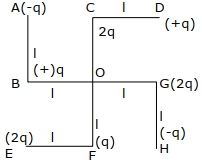
- What will be the magnitude of electric field at point \(O\) as shown in figure ? Each side of the figure is \(I\) and perpendicular to each other.
 JEE Mains 2021 Hard
More PYQs from JEE Mains
- Imagine that a reactor converts all given mass into energy and that it operates at a power level of \(10^9\, watt\). The mass of the fuel consumed per hour in the reactor will be : (velocity of light, \(c\) is \(3\times10^8\, m/s\))JEE Mains 2017 Medium
- A man (mass \(= 50\, kg\)) and his son (mass \(= 20\, kg\)) are standing on a frictionless surface facing each other. The man pushes his son so that he starts moving at a speed of \(0.70\, ms^{-1}\) with respect to the man. The speed of the man with respect to the surface is ........ \(ms^{-1}\)JEE Mains 2019 Medium
- A container contains a liquid with refractive index of 1.2 up to a height of 60 cm and another liquid having refractive index 1.6 is added to height H above first liquid. If viewed from above, the apparent shift in the position of bottom of container is 40 cm. The value of H is ______ cm.
(Consider liquids are immisible)JEE Mains 2025 Medium - A wire of length \(314\,cm\) carrying current of \(14\,A\) is bent to form a circle. The magnetic moment of the coil is \(........A- m ^{2}\). [Given \(\left.\pi=3.14\right]\)
 JEE Mains 2022 Medium
- In the given figure switches \(S_{1}\) and \(S_{2}\) are in open condition. The resistance across \(a b\) when the switches \(S_{1}\) and \(S_{2}\) are closed is \(...\,\Omega\)
 JEE Mains 2021 Hard