


All Organic chemistry purification and characterization questions
Newest firstShowing 51–100 of 139 questions
-
- (A) \(Na _3 PO _4 \cdot 12 MoO _3\)
- (B) \(\left( NH _4\right)_3 PO _4 \cdot 12 MoO _3\)
- (C) \(MoPO _4 \cdot 21 NH _4 NO _3\)
- (D) \(\left( NH _4\right)_3 PO _4 \cdot 12\left( NH _4\right)_2 MoO _4\)
Show answer and solution
Correct Answer: (B)
\(2 P +3 Na _2 O _2+\underset{\text { air }}{ O _2} \xrightarrow{\text { fusion }} 2 Na _3 PO _4\)
\(Na _3 PO _4+12\left( NH _4\right)_3 MoO _4+21 HNO _3 \rightarrow\) \(\left( NH _4\right)_3 PO _4 \cdot \underset{\text { yellow }}{12 MoO _3}+21 NH _4 NO _3+12 H _2 O\) -
- (A) 15
- (B) 20
- (C) 25
- (D) 30
Show answer and solution
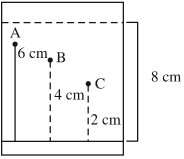
Correct Answer: (A)
\(\begin{array}{l}R_{f_A}=\frac{\text { distance traveled by substance from base line }}{\text { distance traveled by Solvent from base line }} \\ R_{f_A}=\frac{4}{8} R_{f_B}=\frac{6}{8} \\ \frac{R_{f_B}}{R_{f_A}}=\frac{6}{8} \times \frac{8}{4} \\ R_{f_B}=1.5 \times R_{f_A} \\ x =15\end{array}\) -
- (A) Nitrogen and Sulphur only
- (B) Nitrogen, Sulphur and Phosphorous Only
- (C) Phosphorous and halogens only
- (D) Nitrogen, Sulphur, phosphorous and halogens
Show answer and solution
Correct Answer: (D)
Lassaigne's test is used for detection of all element \(\mathrm{N}, \mathrm{S}, \mathrm{P}, \mathrm{X}\). -
- (A) \(A-III, B-I, C-II, D-IV\)
- (B) \(A-IV, B-I, C-II, D-III\)
- (C) \(A-II, B-III, C-IV, D-I\)
- (D) \(A-I, B-II, C-III, D-IV\)
Show answer and solution
Correct Answer: (A)
\(\mathrm{Fe}_4\left[\mathrm{Fe}(\mathrm{CN})_6\right]_3 \cdot \mathrm{xH}_2 \mathrm{O} \rightarrow \text { Prussian Blue }\)\({\left[\mathrm{Fe}(\mathrm{CN})_5 \mathrm{NOS}\right]^{4-} \rightarrow \text { Violet }}\)
\({[\mathrm{Fe}(\mathrm{SCN})]^{2+} \rightarrow \text { Blood Red }}\)
\(\left(\mathrm{NH}_4\right)_3 \mathrm{PO}_4 \cdot 12 \mathrm{MoO}_3 \rightarrow \text { Yellow }\)
-
- (A) \(A-IV, B-I, C-II, D-III\)
- (B) \(A-IV, B-III, C-II. D-I\)
- (C) \(A-I. B-II, C-IV, D-III\)
- (D) \(A-II, B-III. C-I, D-IV\)
Show answer and solution
Correct Answer: (B)
Fact \((NCERT)\) -
- (A) (A)-(IV), (B)-(III), (C)-(I), (D)-(II)
- (B) (A)-(II), (B)-(III), (C)-(IV), (D)-(I)
- (C) (A)-(IV), (B)-(I), (C)-(II), (D)-(III)
- (D) (A)-(III), (B)-(I), (C)-(IV), (D)-(II)
Show answer and solution
Correct Answer: (A)
(A)-(IV), (B)-(III), (C)-(I), (D)-(II) -
- (A) A-III, B-IV, C-I, D-II
- (B) A-I, B-II, C-III, D-IV
- (C) A-IV, B-I, C-II, D-III
- (D) A-II, B-III, C-IV, D-I
Show answer and solution
Correct Answer: (D)
A-II, B-III, C-IV, D-I -
- (A) neither on nature of compound nor on the impurity present.
- (B) nature of compound only.
- (C) nature of compound and presence of impurity.
- (D) presence of impurity only.
Show answer and solution
Correct Answer: (C)
Organic compounds are purified based on their nature and impruity present in it. -
- (A) \(06\)
- (B) \(07\)
- (C) \(8\)
- (D) \(5\)
Show answer and solution
Correct Answer: (B)
Retardation factor \(=\frac{\text { Distance travelled by sample/organic compound }}{\text { Distance travelled by solvent }}\) \(=\frac{3.5}{5}=7 \times 10^{-1}\) -
- (A) \(B\) only
- (B) \(C\) and \(D\) only
- (C) \(A\) and \(B\) only
- (D) \(A\) only
Show answer and solution
Correct Answer: (C)
The most common polar and acidic support used is adsorption chromatography is silica. The surface silanol groups on their supported to adsorb polar compound and work particularly well for basic substances. Alumina is the example of polar and basic adsorbent that is used in adsorption chromatography. -
- (A) ammonium sulphide
- (B) lead sulphate
- (C) lead iodide
- (D) ammonium arsinomolybdate
Show answer and solution
Correct Answer: (B)
Lead sulphate - white
Ammonium sulphide -soluble
Lead iodide - Bright yellow
Ammonium arsinomolybdate - yellow - 62. The correct statements among the following for a ' chromatography ' purification method is _______. 2024 Medium
- (A) Organic compounds run faster than solvent in the thin layer chromatographic plate.
- (B) Non-polar compounds are retained at top and polar compounds come down in column chromatography.
- (C) \(R_f\) of a polar compound is smaller than that of a non-polar compound.
- (D) \(R_f\) is an integral value.
Show answer and solution
Correct Answer: (C)
Non polar compounds are having higher value of \(R_f\) than polar compound. -
- (A) crystallisation
- (B) distillation under reduced pressure
- (C) distillation
- (D) steam distillation
Show answer and solution
Correct Answer: (D)
Steam distillation technique is applied to separate substances which are steam volatile and are immiscible with water. - 64. The Lassiagne's extract is boiled with dil \(\mathrm{HNO}_3\) before testing for halogens because, 2024 Hard
- (A) \(\mathrm{AgCN}\) is soluble in \(\mathrm{HNO}_3\)
- (B) Silver halides are soluble in \(\mathrm{HNO}_3\)
- (C) \(\mathrm{Ag}_2 \mathrm{~S}\) is soluble in \(\mathrm{HNO}_3\)
- (D) \(\mathrm{Na}_2 \mathrm{~S}\) and \(\mathrm{NaCN}\) are decomposed by \(\mathrm{HNO}_3\)
Show answer and solution
Correct Answer: (D)
If nitrogen or sulphur is also present in the compound, the sodium fusion extract is first boiled with concentrated nitric acid to decompose cyanide or sulphide of sodium during Lassaigne's test. -
- (A) Fractional distillation
- (B) Fractional distillation under reduced pressure
- (C) Distillation
- (D) Steam distillation
Show answer and solution
Correct Answer: (D)
Steam distillation is used for those liquids which are insoluble in water, containing non-volatile impurities and are steam volatile. -
- (A) \(50\)
- (B) \(40\)
- (C) \(30\)
- (D) \(20\)
Show answer and solution
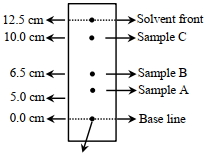
Correct Answer: (A)
\(R_r \text { of } A=\frac{5}{12.5} \quad R_r \text { of } C=\frac{10}{12.5}\)\(\text { Ratio }=\frac{R_{f(A)}}{R_{f(C)}}=\frac{1}{2}=0.5 \text { or } 50 \times 10^{-2}\)
- 67. Which among the following purification methods is based on the principle of "Solubility" in two different solvents? 2024 Hard
- (A) Column Chromatography
- (B) Sublimation
- (C) Distillation
- (D) Differential Extraction
Show answer and solution
Correct Answer: (D)
Different ExtractionDifferent layers are formed which can be separated in funnel. (Theory based).
- 68. Which of the following nitrogen containing compound does not give Lassaigne's test ? 2024 Medium
- (A) Phenyl hydrazine
- (B) Glycene
- (C) Urea
- (D) Hydrazine
Show answer and solution
Correct Answer: (D)
Hydrazine \(\left(\mathrm{NH}_2-\mathrm{NH}_2\right)\) have no carbon so does not show Lassaigne's test. -
- (A) \(A, B, C\) only
- (B) \(A, C, D\) only
- (C) \(B, C, D\) only
- (D) \(A, B, D\) only
Show answer and solution
Correct Answer: (B)
Option \((B)\) is incorrect because aniline is immisible in water. -
- (A) \(20\)
- (B) \(30\)
- (C) \(50\)
- (D) \(40\)
Show answer and solution
Correct Answer: (D)
mole of \(AgBr =\frac{0.376}{188}\)mole of \(Br ^{-}=\)mole of \(AgBr =\frac{0.376}{188}\)
mass of \(Br ^{-}=\frac{0.376}{188} \times 80\)
\(\%\) of \(Br ^{-}=\frac{0.376 \times 80}{188 \times 0.4} \times 100=40 \%\)
- 71. \(0.5\,g\) of an organic compound \((X)\) with \(60 \%\) carbon will produce \(........\times 10^{-1}\, g\) of \(CO _2\) on complete combustion. 2023 Medium
- (A) \(10\)
- (B) \(11\)
- (C) \(12\)
- (D) \(13\)
Show answer and solution
Correct Answer: (B)
Percentage of Carbon\(=\frac{12}{44} \times \frac{\text { mass of } CO _2 \text { formed }}{\text { mass of compound taken }} \times 100\)
\(60=\frac{12}{44} \times \frac{\text { mass of } CO _2 \text { formed }}{0.5} \times 100\)
Mass of \(CO _2\) formed \(=\frac{60 \times 44 \times 0.5}{12 \times 100}\,g\)
\(=1.1 \text { gram }\)
\(=11 \times 10^{-1} \text { gram }\)
-
- (A) \(41\)
- (B) \(42\)
- (C) \(40\)
- (D) \(38\)
Show answer and solution
Correct Answer: (B)
\(\%\) sulphur \(=\frac{32}{233} \times \frac{\text { weight of } BaSO _4 \text { formed }}{\text { weight of organic compound }} \times 100\)\(=\frac{32}{233} \times \frac{1.4439}{0.471} \times 100\)
\(=42.10\)
Nearest integer \(42\)
-
- (A) \(A-(iii), B-(iv), C-(ii), D-(i)\)
- (B) \(A-(i), B-(iii), C-(ii), D-(iv)\)
- (C) \(A-(ii), B-(iii), C-(iv), D-(i)\)
- (D) \(A-(ii), B-(iv), C-(i), D-(iii)\)
Show answer and solution
Correct Answer: (C)
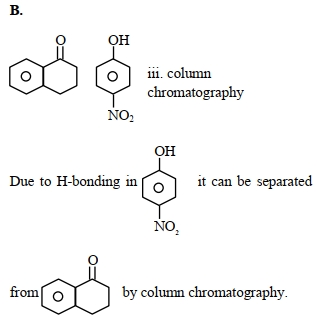
\(A\). \(H _2 O / CH _2 Cl _2 \rightarrow\) \(ii\), \(CH _2 Cl _2> H _2 O\) (density) so they can be separated by differential solvent extraction.\(B\).\(C.\) Kerosene / Naphthalene \(\rightarrow\) iv. Fractional distillation.
Due to different B.P. of kerosene and Naphthalene it can be separated by fractional distillation.
\(D.\) \(C _6 H _{12} O _6 / NaCl \rightarrow\) i. Crystallization.
\(NaCl\) (ionic compound) can be crystallized.
-
- (A) \(A-II, B-IV, C-I, D-III\)
- (B) \(A-IV, B-II, C-I, D-III\)
- (C) \(A-II, B-I, C-IV, D-III\)
- (D) \(A-III, B-I, C-IV, D-II\)
Show answer and solution
Correct Answer: (D)
Nitrogen detection by lassaigne's method\(Na + C + N \rightarrow NaCN\)
\(6 NaCN + FeSO _4 \rightarrow Na _4\left[ Fe ( CN )_6\right]+ Na _2 SO _4\)
\(Na _4\left[ Fe ( CN )_6\right]+ Fe ^{3+} \rightarrow Fe _4\left[ Fe ( CN )_6\right]_3\)
(Prussian blue)
Sulphur detection by Sodium nitroprusside
\(Na _2\left[ Fe ( CN )_5 NO \right]+ Na _2 S \rightarrow Na 4\left[ Fe ( CN )_5 NOS \right]\)
\(\text { [Purple }]\)
Phosphorus detection by ammonium molybdate
\(Na _3 PO _4+3 HNO _3 \rightarrow H _3 PO _4+3 NaNO _3\)
\(H _3 PO _4+12\left( NH _4\right)_2 MoO _4+21 HNO _3 \rightarrow\)
\(\left( NH _4\right)_3 PO _4 .12 MoO _3+21 NH _4 NO _3+12 H _2 O\)
\(\text { (canary yellow) }\)
\(\text { Halogen give specific coloured ppt with }\)
\(AgNO _3( aq )\)
\(NaCl + AgNO _3( aq ) \rightarrow AgCl + NaNO _3\)
\(\text { (White) }\)
\(NaBr + AgNO _3( aq ) \rightarrow AgBr + NaNO _3\)
\(\text { (Pale yellow) }\)
\(NaI + AgNO _3( aq ) \rightarrow AgI + NaNO _3\)
\(\text { (Yellow) }\)
-
- (A) \(A-IV, B-I, C-III, D-II\)
- (B) \(A-III, B-IV, C-I, D-II\)
- (C) \(A-II, B-I, C-III, D-IV\)
- (D) \(A-III, B-I, C-IV, D-II\)
Show answer and solution
Correct Answer: (B)
List \(I\) (Mixture) List \(II\) (Separation Technique) \(A\) \(CHCl _3+ C _6 H _5 NH _2\) \(I\) Distillation \(B\) \(C _6 H _{14}+ C _5 H _{12}\) \(II\) Fractional distillation \(C\) \(C _6 H _5 NH _2+ H _2 O\) \(III\) Steam distillation \(D\) Organic compound in \(H _2 O\) \(IV\) Differential extraction NCERT \((XI)\) Vol. \(2\) Page No. \(359, 360. \)
-
- (A) \(42\)
- (B) \(43\)
- (C) \(48\)
- (D) \(44\)
Show answer and solution
Correct Answer: (D)
weight of \(C\) in \(0.792\,gm CO _2\)\(=\frac{12}{44} \times 0.792=0.216\)
\(\% \text { of } C \text { in compound }=\frac{0.216}{0.492} \times 100\)
\(=43.90 \%\)
Ans:\(44\)
-
- (A) prevent oxidation
- (B) prevent reduction
- (C) prevent hydrolysis
- (D) prevent breaking
Show answer and solution
Correct Answer: (A)
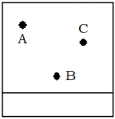
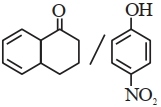
Prolonged heating will cause oxidation of \(Fe ^{+2}\) to \(Fe ^{+3}\). - 78. Thin layer chromatography of a mixture shows the following observation: The correct order of elution in the silica gel column chromatography is
 2023 Medium
- (A) \(A,C,B\)
- (B) \(B,C,A\)
- (C) \(C,A,B\)
- (D) \(B,A,C\)
Show answer and solution
Correct Answer: (A)
According to the observation,\(A\) is more mobile and interacts with the mobile phase more than \(C\), and \(C\) is more drawn to the mobile phase than \(B\).Hence, the correct order of elution in the silico gel column chromatography is \(- B < C < A\)

-
- (A) \(24\)
- (B) \(25\)
- (C) \(23\)
- (D) \(22\)
Show answer and solution
Correct Answer: (B)
More \(R _{ f }\), less its polarity\(R _{ f }=\frac{\text { Distance travelled by compound ' } X \text { ' }}{\text { Distance travelled by solvent ' } Y '}\)
\(=\frac{2}{8}=0.25=25 \times 10^{-2}\)
- 80. Using column chromatography, mixture of two compounds ' \(A\) ' and ' \(B\) ' was separated. '\(A\)' eluted first, this indicates ' \(B\) ' has 2023 Medium
- (A) low \(R_f\), weaker adsorption
- (B) high \(R _{ f }\), stronger adsorption
- (C) high \(R_f\), weaker adsorption
- (D) low \(R _{ f }\), stronger adsorption
Show answer and solution
Correct Answer: (D)
If any component eluted second then it means that its \(R_f\) value is low and its adsorption is stronger\(R _{ f }=\frac{\text { distance covered by substance from base line }}{\text { total distance covered by solvent from base line }}\)
-
- (A) Water present in the mobile phase gets absorbed by the paper which then forms the stationary phase.
- (B) Water present in the pores of the paper forms the stationary phase.
- (C) Paper sheet forms the stationary phase.
- (D) Paper and water present in its pores together form the stationary phase.
Show answer and solution
Correct Answer: (B)
In paper chromatography, a special quality paper known as chromatography paper is used. Paper contains water trapped in it, which acts as the stationary phase. -
- (A) \(14\)
- (B) \(21\)
- (C) \(18\)
- (D) \(56\)
Show answer and solution
Correct Answer: (A)
weight of organic compound \(=0.2\, g\)\(\text { mass of } N _{2}( g ) \text { evolved }=\frac{22.4 \times 10^{-3}}{22.4} \times 28\)
\(=28 \times 10^{-3} \,g\)
\(\% \text { of } N =\frac{28 \times 10^{-3}}{0.2} \times 100=14\)
-
- (A) \(40\)
- (B) \(140\)
- (C) \(80\)
- (D) \(143\)
Show answer and solution
Correct Answer: (A)
wt. of organic compound \(=0.25 \,g\)mass of \(Cl =\frac{35.5}{143.5} \times 0.4\, g\)
mass \(\%\) of \(Cl\) in the organic compound
\(=\frac{35.5 \times 0.4}{143.5 \times 0.25} \times 100\)
\(=39.58 \,\%\)
-
- (A) \(22\)
- (B) \(23\)
- (C) \(21\)
- (D) \(20\)
Show answer and solution
Correct Answer: (A)
\(V =22.78\,ml , T =280\,K\)\(P _{\text {total }}=759\,mmHg\)
\(P _{ N _{2}}=759-14.2=744.8\,mmHg\)
\(n _{ N _{2}}=\frac{744.8 \times 22.78}{760 \times 1000 \times 0.082 \times 280}=0.00097\)
\(W _{\text {Nitrogen }}=0.02716\)
\(\% N =\frac{0.02716}{0.125} \times 1000=21.728\)
-
- (A) Dimethylglyoxime and \(Ni ^{2+}\)
- (B) Dimethylglyoxime and \(Co ^{2+}\)
- (C) Nessler's reagent and \(Hg ^{2+}\)
- (D) Nessler's reagent and \(Ni ^{2+}\)
Show answer and solution
Correct Answer: (A)
\(Ni ^{2+}+ DMG ^{-} \rightarrow\left[ Ni ( DMG )_{2}\right] \downarrow\)(Bright red precipitate)
- 86. \(Fe ^{3+}\) cation gives a prussian blue precipitate on addition of potassium ferrocyanide solution due to the formation of. 2022 Easy
- (A) \(\left[ Fe \left( H _{2} O \right)_{6}\right]_{2}\left[ Fe ( CN )_{6}\right]\)
- (B) \(Fe _{2}\left[ Fe ( CN )_{6}\right]_{2}\)
- (C) \(Fe _{3}\left[ Fe ( OH )_{2}( CN )_{4}\right]_{2}\)
- (D) \(Fe _{4}\left[ Fe ( CN )_{6}\right]_{3}\)
Show answer and solution
Correct Answer: (D)
\(4 Fe ^{3+}+3\left[ Fe ( CN )_{6}\right]^{-4} \underset{\text { Prussian Blue }}{\longrightarrow} Fe _{4}\left[ Fe ( CN )_{6}\right]_{3}\) -
- (A) Both \(A\) and \(R\) are true and \(R\) is the correct explanation of \(A.\)
- (B) Both \(A\) and \(R\) are true but \(R\) is \(NOT\) the correct explanation of \(A\)
- (C) \(A\) is true but \(R\) is false
- (D) \(A\) is false but \(R\) is true
Show answer and solution
Correct Answer: (A)
Theory basedThin layer chromoatography \((TLC)\) is another type of adsorption chromatography, which involve sepration of substance of a mixture ovel a thin layer of an adsorbent coated on glass plate. A thin layer (about \(0.2\,mm\) thick) of an adsorbent (silica gel) or (Alumina) in spread overa glass plate of suitable size. Hence Assertion \((A)\) is correct and Reason \((R)\) is correct explanation of \((A)\)
-
- (A) Both Statement \(I\) and Statement \(II\) are correct.
- (B) Both Statement \(I\) and Statement \(II\) are incorrect.
- (C) Statement \(I\) is correct but Statement \(II\) is incorrect.
- (D) Statement \(I\) is incorrect but Statement \(II\) is correct.
Show answer and solution
Correct Answer: (A)
Both statement \(I\) and statement \(II\) are correct. -
- (A) \(34.04 \%\)
- (B) \(40.04 \%\)
- (C) \(36.03 \%\)
- (D) \(38.04 \%\)
Show answer and solution
Correct Answer: (A)
Mass of organic compound \(=0.45\,gm\)Mass of \(AgBr\) obtained \(=0.36\,gm\)
\(\therefore\) Moles of \(AgBr =\frac{0.36}{188}\)
\(\therefore\) Mass of Bromine \(=\frac{0.36}{188} \times 80=0.1532\,gm\)
\(\therefore \% Br\) in compound \(=\frac{0.1532}{0.45} \times 100=34.04 \%\)
-
- (A) \(340\)
- (B) \(90\)
- (C) \(188\)
- (D) \(34\)
Show answer and solution
Correct Answer: (D)
\(O . C \longrightarrow AgBr\)\(0.5\, g \quad 0.4\, g\)
\(mol\) of \(Br = mol\) of \(AgBr =\frac{0.4}{188}\)
\(\%\, Br =\%\, Br =\frac{\frac{0.4}{188} \times 80}{0.5} \times 100\)
\(=34.04\, \%\)
-
- (A) \(1\)
- (B) \(84\)
- (C) \(32\)
- (D) \(64\)
Show answer and solution
Correct Answer: (D)
Meq of \(H _{2} SO _{4}\) used by \(NH _{3}=12.5 \times 1 \times 2=25\)\(\%\) of \(N\) in the compound \(=\frac{25 \times 10^{-3} \times 14 \times 100}{0.55}=63.6\)
-
- (A) \((A)-(IV), (B)-(III), (C)-(I), (D)-(II)\)
- (B) \((A)-(III), (B)-(I), (C)-(IV), (D)-(II)\)
- (C) \((A)-(III), (B)-(IV), (C)-(II), (D)-(I)\)
- (D) \((A)-(III), (B)-(IV), (C)-(I), (D)-(II)\)
Show answer and solution
Correct Answer: (D)
\((A)\) Chloroform + Aniline \(\rightarrow\) \((III)\) Distillation\((B)\) Benzoic acid + Napthalene \(\rightarrow\) \((IV)\) Crystallisation
\((C)\) Water + Aniline \(\rightarrow\) \((I)\) Steam distillation
\((D)\) Napthalene + Sodium chloride \(\rightarrow\) \((II)\) Sublimation
-
- (A) \(18\)
- (B) \(180\)
- (C) \(65\)
- (D) \(74\)
Show answer and solution
Correct Answer: (A)
\(C _{ x } HyOz +\left( x +\frac{ y }{4}-\frac{ z }{2}\right) O _{2} \rightarrow xCO _{2}+\frac{ y }{2} H _{2} O\)\(0.3g\quad\quad\quad\quad\quad\quad\quad\quad0.2g\quad\quad\quad0.1g\)
\(\frac{ n _{ CO _{2}}}{ n _{ H _{2} O }}=\frac{ x }{ y / 2}=\frac{0.2 / 44}{.1 / 18}\)
\(\frac{2 x }{ y }=\frac{36}{44}=\frac{9}{11}\)
\(x =\frac{9 y }{22}\)
\(\frac{ n _{ C _{ x } H _{ y } O_{ z } }}{ nCO _{ 2 } }=\frac{1}{ x }\)
\(\frac{0.3 }{12 x + y +16 z } \times \frac{44}{0.2}=\frac{1}{ x }\)
\(66 x =12 x + y +16 z\)
\(54 x = y +16 z\)
\(\frac{54 \times 9 y }{22}- y =16 z\)
\(\frac{464 y }{22}=16 z\)
\(z =\frac{29 y }{22}\)
\(C _{ x } H _{ y } O _{z}= C _{ x } H _{ y } O _{z}\)
\(C _{\frac{9 y}{22}} H _{ y } O _{\frac{29 y}{22}}^{22}\)
\(C _{9} H _{22} O _{29}\)
\(\,\%\) of \(C =\frac{12 \times 9}{(12 \times 9+22+29 \times 16)} \times 100=\frac{108}{594} \times 100\)
\(18.18 \,\%\)
-
- (A) \(46\)
- (B) \(44\)
- (C) \(43\)
- (D) \(42\)
Show answer and solution
Correct Answer: (A)
\(0.492\,g\) of \(C _{ x } H _{ y } O _{z}\)Gives \(0.7938\,g\,CO _{2}=0.018\) moles
\(0.4428\,g\,H _{2} O =0.0246\) moles
So moles of \(C =0.018 \Rightarrow 0.216\,g\)
Moles of \(H =0.049 \Rightarrow 0.049\,g\)
\(\therefore\) wt. of Oxygen \(=0.492-0.216-0.049\)
\(\%\) of Oxygen \(=\frac{0.227}{0.492} \times 10046\) (approx.)
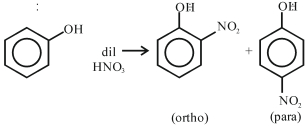
- 95. Phenol on reaction with dilute nitric acid, gives two products. Which method will be most effective for large scale separation ? 2022 Medium
- (A) Chromatographic separation
- (B) Fractional Crystallisation
- (C) Steam distillation
- (D) Sublimation
Show answer and solution
Correct Answer: (C)
Para product has higher boiling point than ortho as intermolecular \(H\)-bond is possible in former, where as intramolecular \(H\)-bond is possible in ortho product.Steam distillation can separate them as ortho product is steam volatile.
-
- (A) \(64\)
- (B) \(92\)
- (C) \(50\)
- (D) \(46\)
Show answer and solution
Correct Answer: (D)
Mole of \(CO _{2}=\) Moles of \(C =\frac{0.793}{44}\)Weight of ' \(C\) ' \(=\frac{0.793}{44} \times 12=0.216 \,gm\)
Moles of ' \(H ^{\prime}=\frac{0.442}{18} \times 2\)
Weight of ' \(H ^{\prime}=\frac{0.442}{18} \times 2 \times 1=0.049 \,gm\)
\(\therefore\) Weight of ' \(O\) ' \(=0.492-0.216-0.049=0.227\, gm\) \(\,\%\) of ' \({ }^{\prime}{ }^{\prime}=\frac{0.227}{0.492} \times 100=46.13\, \%\)
- 97. The formula of the purple colour formed in Laissaigne's test for sulphur using sodium nitroprusside is ...... 2022 Medium
- (A) \(NaFe \left[ Fe ( CN )_{6}\right]\)
- (B) \(Na \left[ Cr \left( NH _{3}\right)_{2}\left( NCS _{4}\right]\right.\)
- (C) \(Na _{2}\left[ Fe ( CN )_{5}( NO )\right]\)
- (D) \(Na _{4}\left[ Fe ( CN )_{5}( NOS )\right]\)
Show answer and solution
Correct Answer: (D)
\(Na _{2} S + Na _{2}\left[ Fe ( CN )_{5} NO \right] \rightarrow Na _{4}\left[ Fe ( CN )_{5} NO _{5}\right]\) -
- (A) \(5\)
- (B) \(3\)
- (C) \(8\)
- (D) \(2\)
Show answer and solution
Correct Answer: (D)
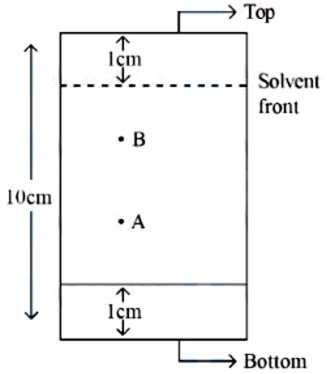
\(\frac{ R _{ F _{ A }}}{ R _{ F _{ B }}}=\frac{\frac{2.08}{3.25}}{\frac{1.05}{3.25}}=\frac{2.08}{1.05} \simeq 2\) -
- (A) \(55\)
- (B) \(56\)
- (C) \(54\)
- (D) \(53\)
Show answer and solution
Correct Answer: (B)
\(\% N =\frac{1.4\left( N _{1} V _{1}\right)}{\text { mass of organic compound }}\)\(\% N =\frac{1.4(2.5 \times 2 \times 2)}{0.25}=56\)
-
- (A) \(8\)
- (B) \(9\)
- (C) \(41\)
- (D) \(12\)
Show answer and solution
Correct Answer: (D)
Organic compound : \(0.8 \,\mathrm{gm}\)wt. of \(\mathrm{N}=\left(\frac{42}{100} \times 0.8\right)\, \mathrm{gm}\)
mole of \(N=\frac{42 \times 0.8}{100 \times 14}=\frac{2.4}{100}\, \mathrm{~mol}\)
moles of \(\mathrm{NH}_{3}=\frac{2.4}{100}\)
\(2 \mathrm{NH}_{3}+\mathrm{H}_{2} \mathrm{SO}_{4} \rightarrow\left(\mathrm{NH}_{4}\right)_{2} \mathrm{SO}_{4}\)
\(\quad\downarrow\quad\quad\quad\downarrow\)
\(\frac{2.4}{100}\) \(mole\) \(\quad\frac{1.2}{100}\) \(mole\)
For \(\mathrm{H}_{2} \mathrm{SO}_{4} \quad \frac{1.2}{100}=1 \times \mathrm{V}(\ell)\)
\(\Rightarrow \mathrm{V}_{\mathrm{H}_{2} \mathrm{SO}_{4}}=\frac{1.2}{100} \,\ell=12 \,\mathrm{~m} \ell\)
No questions on this page match these filters.