


Questions
20 questionsShowing 1–20 of 20 questions
-
- (A) \(0\)
- (B) \({hv}\left[1+\frac{{hv}}{2 {Mc}^{2}}\right]\)
- (C) \(hv\)
- (D) \({hv}\left[1-\frac{{hv}}{2 {Mc}^{2}}\right]\)
Show answer and solution
Correct Answer: (B)
Energy of \(\gamma\, \operatorname{ray}\left[E_{\gamma}\right]=h v\)Momentum of \(\gamma\) ray \(\left[P_{\gamma}\right]=\frac{h}{\gamma}=\frac{h v}{C}\)
Total momentum is conserved
\(\vec{P}_{\gamma}+\vec{P}_{N u}=0\)
Where \(\vec{P}_{N u}=\) Momentum of decayed nuclei
\(\Rightarrow P_{\gamma}=P_{N u} \Rightarrow \frac{h v}{C}=P_{N u}\)
\(\Rightarrow \text { K.E of nuclei }\)
\(=\frac{1}{2} M v^{2}=\frac{\left(P_{N u}\right)^{2}}{2 M}=\frac{1}{2 M}\left[\frac{h v}{C}\right]^{22}\)
Loss in internal energy \(=E_{\gamma}+K \cdot E_{N u}\)
\(=h v+\frac{1}{2 M}\left[\frac{h v}{C}\right]^{2}=h v\left[1+\frac{h v}{2 M C^{2}}\right]\)
-
- (A) \(5.0\)
- (B) \(5.5\)
- (C) \(0.12\)
- (D) \(5.38\)
Show answer and solution
Correct Answer: (D)
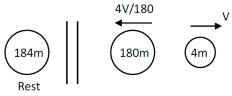
\(\frac{1}{2}(4\, m) v^{2}+\frac{1}{2}(180\, m)\left(\frac{4\, v}{180}\right)^{2}=5.5\, {MeV}\)\(\Rightarrow \frac{1}{2} 4 m v^{2}\left[1+45\left(\frac{4}{180}\right)^{2}\right]=5.5\, {MeV}\)
\({K} . E._{a}=\frac{5.5}{1+45 \cdot\left(\frac{4}{180}\right)^{2}}\, {MeV}\)
\({K} \cdot {E} \cdot_{A}=5.38\, {MeV}\)
-
- (A) \(1110\)
- (B) \(340\)
- (C) \(740\)
- (D) \(700\)
Show answer and solution
Correct Answer: (C)
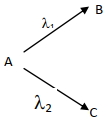
\(\text { Given } \lambda_{1}=\frac{\ell {n} 2}{700} / \text { year }, \lambda_{2}=\frac{\ell {n} 2}{1400} / \text { year }\)\(\therefore \lambda_{\text {net }}=\lambda_{1}+\lambda_{2}=\ell n 2\left[\frac{1}{700}+\frac{1}{1400}\right]=\frac{3 \ell {n} 2}{1400} / \text { year }\)
Now, Let initial no. of radioactive nuclei be No
\(\therefore \frac{{N}_{0}}{3}={N}_{0} {e}^{-\lambda_{{mt}} {t}}\)
\(\Rightarrow \ell {n} \frac{1}{3}=-\lambda_{\text {net }} {t}\)
\(\Rightarrow 1.1 \frac{3 \times 0.693}{1400} {t} \Rightarrow {t} \approx 740 \text { year }\)
-
- (A) None of the above
- (B) \(T _{1 / 2}= T _{1 / 2}^{(1)}+ T _{1 / 2}^{(2)}\)
- (C) \(T _{1 / 2}=\frac{ T _{1 / 2}^{(1)} T _{1 / 2}^{(2)}}{ T _{1 / 2}^{(1)}+ T _{1 / 2}^{(2)}}\)
- (D) \(T _{1 / 2}=\frac{ T _{1 / 2}^{(1)}+ T _{1 / 2}^{(2)}}{ T _{1 / 2}^{(1)}- T _{1 / 2}^{(2)}}\)
Show answer and solution
Correct Answer: (C)
\(\lambda_{ eq }=\lambda_{1}+\lambda_{2}\)\(\frac{1}{ T _{1 / 2}}=\frac{1}{ T _{1 / 2}^{(1)}}+\frac{1}{ T _{1 / 2}^{(2)}}\)
\(T _{1 / 2}=\frac{ T _{1 / 2}^{(1)} T _{1 / 2}^{(2)}}{ T _{1 / 2}^{(1)}+ T _{1 / 2}^{(2)}}\)
-
- (A) \(100\)
- (B) \(200\)
- (C) \(150\)
- (D) \(250\)
Show answer and solution
Correct Answer: (C)
\(q=q_{0} e^{-\frac{t}{R C}}\)where, \(R C\) is the time constant of \(R C\) - circuit.
At time \(t\), activity \(A\) is given by
\(A=A_{0} e ^{-\lambda t} \) where, \(A_{0}=\) initial activity and \(\quad \lambda=\) decay constant. On dividing Eqs. (i) and (ii), we get
\(\frac{q}{A} =\frac{q_{0} e^{-\frac{t}{R C}}}{A_{0} e^{-\lambda t}}\)
\(1=\frac{e^{-\frac{t}{R C}}}{e^{-\lambda t}}\)
\(e^{-\lambda t} =e^{-\frac{t}{R C}}\)
\(\Rightarrow\) Taking log on both sides of above equation, we get
\(\ln \left(e^{-\lambda t}\right) =\ln \left(e^{-\frac{t}{R C}}\right)\)
\(-\lambda t =-\frac{t}{R C}\)
\(\lambda =\frac{1}{R C}\)
\(R =\frac{1}{\lambda C}\)
\(R =\frac{30 \times 10^{-3}}{200 \times 10^{-6}}\)
\(R =150 \Omega\)
\(\Rightarrow \lambda=\frac{1}{R C}\)
\(\Rightarrow R=\frac{1}{\lambda C}\)
\(\Rightarrow R=\frac{30 \times 10^{-3}}{200 \times 10^{-6}}\)
\(\Rightarrow R=150 \Omega\)
-
- (A) \(\frac{\ell n 5}{ t _{2}- t _{1}}\)
- (B) \(\frac{ t _{1}- t _{2}}{\ell n 5}\)
- (C) \(\frac{ t _{2}- t _{1}}{\ell n 5}\)
- (D) \(\frac{\ell n \left( t _{2}+ t _{1}\right)}{2}\)
Show answer and solution
Correct Answer: (C)
Let initial activity be \(A _{0}\)\(A = A _{0} e ^{-\lambda t_{2}}....(i)\)
\(\frac{ A }{5}= A _{0} e ^{-\lambda t_{2}}....(ii)\)
\(( i ) \div ( ii )\)
\(5= e ^{\lambda\left(t_{2}-t_{1}\right)}\)
\(\lambda=\frac{\ell n 5}{t_{2}-t_{1}}=\frac{1}{\tau}\)
\(\tau=\frac{t_{2}-t_{1}}{\ell n \cdot 5}\)
-
- (A) \(20\)
- (B) \(200\)
- (C) \(2\)
- (D) \(4\)
Show answer and solution
Correct Answer: (A)
\(N_{o} \stackrel{t_{\frac{1}{2}}}{\longrightarrow} \frac{N_{o}}{2} \stackrel{t_{\frac{1}{2}}}{\longrightarrow} \frac{N_{o}}{4} \stackrel{t_{\frac{1}{2}}}{\longrightarrow} \frac{N_{o}}{8} \stackrel{t_{\frac{1}{2}}}{\longrightarrow} \frac{N_{o}}{16}\)\(4 \times t_{1 / 2}=80\)
\(t_{1 / 2}=20 \text { days }\)
-
- (A) \(60\)
- (B) \(20\)
- (C) \(40\)
- (D) \(13\)
Show answer and solution
Correct Answer: (B)
\(N _{1}= N _{0} e ^{-\lambda t_{1}}\)\(\frac{ N _{1}}{ N _{0}}= e ^{-\lambda t _{1}}\)
\(0.67= e ^{-\lambda t _{1}}\)
\(\ln (0.67)=-\lambda t _{1}\)
\(N _{2}= N _{0} e ^{-\lambda t _{2}}\)
\(\frac{ N _{2}}{ N _{0}}= e ^{-\lambda t _{2}}\)
\(0.33= e ^{-\lambda t _{2}}\)
\(\ln (0.33)=-\lambda t _{2}\)
\(\ln (0.67)-\ln (0.33)=\lambda t _{1}-\lambda t _{2}\)
\(\lambda\left( t _{1}- t _{2}\right)=\ln \left(\frac{0.67}{0.33}\right)\)
\(\lambda\left( t _{1}- t _{2}\right) \cong \ln 2\)
\(t _{1}- t _{2} \simeq \frac{\ln 2}{\lambda}= t _{1 / 2}\)
Half life \(= t _{1 / 2}=20\,minutes.\)
-
- (A) \(A,B\) and \(E\) only
- (B) \(B\) and \(D\) only
- (C) \(A, C\) and \(E\) only
- (D) \(A,B, C,D\) and \(E\)
Show answer and solution
Correct Answer: (A)
\((A)\) True, atom of each element emits characteristic spectrum.\((B)\) True, according to Bohr's postulates \(m v r=\frac{n h}{2 \pi}\) and hence electron resides into orbits of specific radius called stationary orbits.
\((C)\) False, Density of nucleus is constant
\((D)\) False, \(A\) free neutron is unstable decays into proton and electron and antineutrino.
\((E)\) True unstable uncleus show radioactivity.
-
- (A) \(6.93\)
- (B) \(4.62\)
- (C) \(2.62\)
- (D) \(9.15\)
Show answer and solution
Correct Answer: (B)
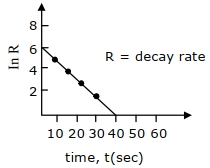
\({R}=R_{o} e^{-\lambda t}\)\(\ell n R=\ell n R_{o}-\lambda t\)
\(-\lambda\) is slope of straight line
\(\lambda=\frac{3}{20}\)
\(t_{1 / 2}=\frac{\ell n 2}{\lambda}=4.62\)
-
- (A) \(25\)
- (B) \(26\)
- (C) \(27\)
- (D) \(31\)
Show answer and solution
Correct Answer: (C)
\(\Delta m =\left( Zm m _{ P }+( A - Z ) m _{ n }\right)- M _{ Al}\)\(=(13 \times 1.00726+14 \times 1.00866)-27.18846\)
\(=27.21562-27.18846\)
\(=0.02716 u\)
\(E =27.16 \times 10^{-3} J\)
-
- (A) \(\lambda\left(1-{e}^{-\lambda t}\right)\)
- (B) \(-\lambda e^{-\lambda t}\)
- (C) \(\lambda e^{-\lambda t}\)
- (D) \(-\lambda\left(1-{e}^{-\lambda . t}\right)\)
Show answer and solution
Correct Answer: (C)
\(N = N _{0} e ^{-\lambda t}\)\(N _{ d }= N _{0}- N\)
\(N _{ d }= N _{0}\left(1- e ^{-\lambda t }\right)\)
\(\frac{ N _{ d }}{ N _{0}}= f =1- e ^{-\lambda t }\)
\(\frac{ df }{ dt }=\lambda e ^{-\lambda t }\)
-
- (A) \(\frac{2 \ln 2}{\lambda}\)
- (B) \(\frac{1}{2} \frac{\ln 2}{\lambda}\)
- (C) \(\frac{\ln \frac{3}{2}}{\lambda}\)
- (D) \(\frac{\ln 2}{\lambda}\)
Show answer and solution
Correct Answer: (C)
\(\frac{3 N _{0}}{4}= N _{0} e ^{-\lambda t _{1}}\)\(\frac{ N _{0}}{2}= N _{0} e ^{-\lambda t _{2}}\)
\(\ln (\frac 34)=-\lambda t _{1}\)
\(\ln (\frac 12)=-\lambda t _{2}\)
\(\ln (\frac 34)-\ln (\frac 12)=\lambda\left( t _{2}- t _{1}\right)\)
\(\Delta t =\frac{\ln (\frac 32)}{\lambda}\)
-
- (A) not possible as proton mass is less than the neutron mass
- (B) possible only inside the nucleus
- (C) not possible but neutron to proton conversion is possible
- (D) always possible as it is associated only with \(\beta^{+}\) decay
Show answer and solution
Correct Answer: (B)
It is possible only inside the nucleus and not otherwise. -
- (A) \(2.67\)
- (B) \(16.18\)
- (C) \(6.06\)
- (D) \(32.36\)
Show answer and solution
Correct Answer: (B)
\(A =\lambda N\)\(\lambda=\frac{\ln 2}{ t _{1 / 2}}=\frac{\ln 2}{3 \times 24 \times 60 \times 60} sec ^{-1}=2.67 \times 10^{-6} sec ^{-1}\)
\(N =\) Number of atoms in \(2 \;mg \;Au\)
\(=\frac{2 \times 10^{-3}}{198} \times 6 \times 10^{23}=6.06 \times 10^{15}\)
\(A=\lambda N =1.618 \times 10^{13}=16.18 \times 10^{12} dps\)
-
- (A) \(240\)
- (B) \(357\)
- (C) \(535\)
- (D) \(252\)
Show answer and solution
Correct Answer: (B)
\(A =\lambda N\)\(N = nN _{ A }\)\(\quad\left( t _{1 / 2}=\frac{\ln 2}{\lambda}\right)\)
\(N =\left(\frac{1.5 \times 10^{-3}}{198}\right) N _{ A }\)
\(A=\left(\frac{\ln 2}{t_{1 / 2}}\right) N\)
\(1\) Curie \(=3.7 \times 10^{10}\, Bq\)
\(A =365\, Bq\)
-
- (A) \({x}\)-will decay faster than \({y}\).
- (B) \({y}\) - will decay faster than \({x}\).
- (C) \({x}\) and \({y}\) have same decay rate initially and later on different decay rate.
- (D) \({x}\) and \({y}\) decay at the same rate always.
Show answer and solution
Correct Answer: (B)
\(\left(t_{1 / 2}\right)_{x}=(\tau)_{y}\)\(\Rightarrow \frac{\ell n 2}{\lambda_{x}}=\frac{1}{\lambda_{y}} \Rightarrow \lambda_{x}=0.693 \lambda_{y}\)
Also initially \({N}_{{x}}={N}_{{y}}={N}_{0}\)
Activity \({A}=\lambda {N}\)
As \(\lambda_{{x}}<\lambda_{{y}} \Rightarrow {A}_{{x}}<{A}_{{y}}\)
\(\Rightarrow {y}\) will decay faster than \({x}\)
-
- (A) \(15\)
- (B) \(10\)
- (C) \(20\)
- (D) \(25\)
Show answer and solution
Correct Answer: (B)
\(A = A _{0} e ^{-\lambda t }\)\(\frac{ A _{0}}{8}= A _{0} e ^{-\lambda t } \Rightarrow \lambda t =\ln 8\)
\(\lambda t =3 \ln 2\)
\(\frac{\ln 2}{\lambda}=\frac{ t }{3}=\frac{30}{3}\)
\(10\;years\)
-
- (A) \(2 \times 10^{10}\)
- (B) \(7 \times 10^{9}\)
- (C) \(10^{5}\)
- (D) \(4 \times 10^{10}\)
Show answer and solution
Correct Answer: (B)
\(\frac{{N}}{{N}_{0}}=\left(\frac{1}{2}\right)^{\frac{{t}}{t_{\frac{1}{2}}}}\)\(\frac{{N}}{10^{10}}=\left(\frac{1}{2}\right)^{\frac{30}{60}}\)
\({N}=10^{10} \times\left(\frac{1}{2}\right)^{\frac{1}{2}}=\frac{10^{10}}{\sqrt{2}} \approx 7 \times 10^{9}\)
-
- (A) \(\frac{1}{8}\)
- (B) \(\frac{3}{1}\)
- (C) \(\frac{8}{1}\)
- (D) \(\frac{1}{3}\)
Show answer and solution
Correct Answer: (C)
\(T _{ x }= t ; T _{ y }=2 t\)\(3 T _{ y }=6 t\)
\(N _{1}^{\prime}= N _{2}^{\prime}\)
\(N _{1} e ^{-\lambda_{1} 6 t }= N _{2} e ^{-\lambda_{2} 6 t }\)
\(\frac{ N _{1}}{ N _{2}}= e ^{\left(\lambda_{1}-\lambda_{2}\right) 6 t }= e ^{\ln 2\left(\frac{1}{t}-\frac{1}{2 t }\right) \times 6 t }= e ^{(1 n 2) \times 3}= e ^{ ln 8}=8\)
\(\frac{ N _{1}}{ N _{2}}=\frac{8}{1}\)
No questions on this page match these filters.