


JEE Mains · Physics · STD 12 - 4. Moving charges and magnetism
Two long straight wires \(P\) and \(Q\) carrying equal current \(10\,A\) each were kept parallel to each other at \(5\,cm\) distance. Magnitude of magnetic force experienced by \(10\,cm\) length of wire \(P\) is \(F_1\). If distance between wires is halved and currents on them are doubled, force \(F_2\) on \(10\,cm\) length of wire \(P\) will be :
- A \(8 F_1\)
- B \(10 F_1\)
- C \(F_1 / 8\)
- D \(F_1 / 10\)
Answer & Solution
Correct Answer
(A) \(8 F_1\)
Step-by-step Solution
Detailed explanation
Force per unit length between two parallel straight \(\text { wires }=\frac{\mu_0 i_1 i_2}{2 \pi d }\) \(\frac{ F _1}{ F _2}=\frac{\frac{\mu_0(10)^2}{2 \pi(5\,cm )}}{\frac{\mu_0(20)^2}{2 \pi\left(\frac{5 cm }{2}\right)}}=\frac{1}{8}\) \(\Rightarrow F_2=8 F_1\)
See the Complete Solution
Get step-by-step explanations for this and 2.5 Lakh+ more JEE, NEET & CET questions.
- Unlock all solutions
- Practice the full chapter
- Track accuracy across PYQs
4.8 rated on Google Play · 14,000+ reviews
More questions from Physics
- A mass \(m\) attached to free end of a spring executes SHM with a period of \(1\; s\). If the mass is increased by \(3\; kg\) the period of oscillation increases by one second, the value of mass \(m\) is \(..............kg\).JEE Mains 2023 Medium
- If the time period \(t\) of the oscillation of a drop of liquid of density \(d\), radius \(r\), vibrating under surface tension \(s\) is given by the formula \(t = \sqrt {{r^{2b}}\,{s^c}\,{d^{a/2}}} \) . It is observed that the time period is directly proportional to \(\sqrt {\frac{d}{s}} \) . The value of \(b\) should therefore beJEE Mains 2013 Hard
- Six point charges are kept \( 60^{\circ} \) apart from each other on the circumference of a circle of radius R as shown in figure. The net electric field at the centre of the circle is __________ .
(\( \epsilon \) is permittivity of free space)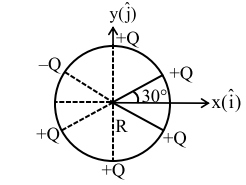 JEE Mains 2026 Hard
 - Given are statements for certain thermodynamic variables,
(A) Internal energy, volume (V) and mass (M) are extensive variables.
(B) Pressure (P), temperature (T) and density ( \(\rho\) ) are intensive variables.
(C) Volume (V), temperature (T) and density ( \(\rho\) ) are intensive variables.
(D) Mass (M), temperature (T) and internal energy are extensive variables.
Choose the correct answer from the options given below :JEE Mains 2025 Easy - Given below are two statements: Statement \(I\) : Electromagnetic waves are not deflected by electric and magnetic field. Statement \(II\) : The amplitude of electric field and the magnetic field in electromagnetic waves are related to each other as \(E _0=\sqrt{\frac{\mu_0}{\varepsilon_0}} B_0\) In the light of the above statements, choose the correct answer from the options given below:JEE Mains 2023 Medium
- The number of electrons flowing per second in the filament of a \(110 \mathrm{~W}\) bulb operating at \(220 \mathrm{~V}\) is _______. (Given \(\mathrm{e}=1.6 \times 10^{-19} \mathrm{C}\) )JEE Mains 2024 Hard
More PYQs from JEE Mains
- If \(\sin(\tan^{-1}(x\sqrt{2})) = \cot(\sin^{-1}\sqrt{1-x^2})\), \(x \in (0,1)\), then the value of \(x\) is :JEE Mains 2026 Medium
- Keeping the significant figures in view, the sum of the physical quantities \(52.01 m, 153.2 m\) and 0.123 m is :JEE Mains 2026 Medium
- \(\mathop {\lim }\limits_{x \to 0} \frac{{{{\left( {1 - \cos \,2x} \right)}^2}}}{{2x\,\tan \,x - x\,\tan \,2x}}\) isJEE Mains 2016 Hard
- A moving coil of galvanometer when shunted with \(2\,\Omega\) resistance gives a full scale deflection for a current of \(500\) mA. When a resistance of \(470\,\Omega\) is connected in series it gives a full scale deflection for \(10\) V potential applied on it. The value of resistance of galvanometer coil is __________ \(\Omega\).JEE Mains 2026 Hard
- A person has three different bags and four different books. The number of ways, in which he can put these books in the bags so that no bag is empty, is:JEE Mains 2026 Medium
- A particle of mass \(M\) is moving in a circle of fixed radius \(R\) in such a way that its centripetal acceleration at time \(t\) is given by \(n^2Rt^2\) where \(n\) is a constant. The Power delivered to the particle by the force acting on it, isJEE Mains 2016 Medium