


JEE Mains · Physics · STD 11 - 4.1 newtons laws of motion
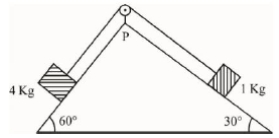
As per given figure, a weightless pulley \(P\) is attached on a double inclined frictionless surface. The tension in the string (massless) will be (if \(g=\) \(10\,m / s ^2\) )
- A \((-4 \sqrt{3}+1) N\)
- B \(4(\sqrt{3}+1) N\)
- C \(-4(\sqrt{3}-1) N\)
- D \((4 \sqrt{3}-1) N\)
Answer & Solution
Correct Answer
(B) \(4(\sqrt{3}+1) N\)
Step-by-step Solution
Detailed explanation
\(4 g \sin 60^{\circ}-T=4 a.....(1)\) \(T - g \sin 30^{\circ}= a.......(2)\) Solving \((1)\) and \((2)\) we get. \(20 \sqrt{3}-T=4 T-20\) \(T=4(\sqrt{3}+1)\,N\)
See the Complete Solution
Get step-by-step explanations for this and 2.5 Lakh+ more JEE, NEET & CET questions.
- Unlock all solutions
- Practice the full chapter
- Track accuracy across PYQs
4.8 rated on Google Play · 14,000+ reviews
More questions from Physics
- A mirror is used to produce an image with magnification of \(\frac{1}{4}\). If the distance between object and its image is 40 cm , then the focal length of the mirror is ________JEE Mains 2025 Hard
- A circuit to verify \(Ohm's\) law uses ammeter and voltmeter in series or parallel connected correctly to the resistor. In the circuitJEE Mains 2020 Medium
- A water spray gun is attached to a hose of cross sectional area \(30\) cm\(^2\). The gun comprises of \(10\) perforations each of cross sectional area \(15\) mm\(^2\). If the water flows in the hose with the speed of \(50\) cm/s, calculate the speed at which the water flows out from each perforation. (Neglect any edge effects)JEE Mains 2026 Medium
- A hydrogen atom changes its state from \(n=3\) to \(\mathrm{n}=2\). Due to recoil, the percentage change in the wave length of emitted light is approximately \(1 \times 10^{-\mathrm{n}}\). The value of \(\mathrm{n}\) is _______. [Given \(\mathrm{Rhc}=13.6 \mathrm{eV}, \mathrm{hc}=1242 \mathrm{eV} \mathrm{nm}\), \(\mathrm{h}=6.6 \times 10^{-34} \mathrm{~J} \mathrm{~s}\), mass of the hydrogen atom \(\left.=1.6 \times 10^{-27} \mathrm{~kg}\right]\)JEE Mains 2024 Hard
- The area of cross-section of a railway track is \(0.01\, {m}^{2}\). The temperature variation is \(10^{\circ} {C}\). Coefficient of linear expansion of material of track is \(10^{-5} /{ }^{\circ} {C}\). The energy stored per meter in the track is ...... \({J} / {m} .\) (Young's modulus of material of track is \(10^{11} \,{Nm}^{-2}\) ))JEE Mains 2021 Hard
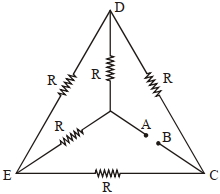
- Five equal resistances are connected in a network as shown in figure. The net resistance between the points \(A\) and \(B\) is
 JEE Mains 2021 Medium
More PYQs from JEE Mains
- Moment of inertia of a body about a given axis is \(1.5\, kg\, m^2\) Initially the body is at rest. In order to produce a rotational kinetic energy of \(1200\, J\), the angular acceleration of \(20\, rad/s^2\) must be applied about the axis of rotation for a duration of ......... \(\sec\).JEE Mains 2019 Medium
- The function \(f(x)=\left|x^{2}-2 x-3\right| \cdot e^{\left|9 x^{2}-12 x+4\right|}\) is not differentiable at exactly :JEE Mains 2021 Hard
- The electric field between the two parallel plates of a capacitor of \(1.5 \mu \mathrm{F}\) capacitance drops to one third of its initial value in \(6.6 \mu \mathrm{s}\) when the plates are connected by a thin wire. The resistance of this wire is _______ \(\Omega\). (Given, \(\log 3=1.1)\)JEE Mains 2024 Hard
- Two identical particles each of mass \(m\) go round a circle of radius \(a\) under the action of their mutual gravitational attraction. The angular speed of each particle will beJEE Mains 2023 Medium
- Two particles are performing simple harmonic motion in a straight line about the same equilibrium point. The amplitude and time period for both particles are same and equal to \(A\) and \(T,\) respectively. At time \(t=0\) one particle has displacement \(A\) while the other one has displacement \(\frac {-A}{2}\) and they are moving towards each other. If they cross each other at time \(t,\) then \(t\) isJEE Mains 2016 Hard
- Let \(\vec{a} = \sqrt{7}\hat{i} + \hat{j} - \hat{k}\) and \(\vec{b} = \hat{j} + 2\hat{k}\). If \(\vec{r}\) is a vector such that \(\vec{r} \times \vec{a} + \vec{a} \times \vec{b} = \vec{0}\) and \(\vec{r} \cdot \vec{a} = 0\), then \(|3\vec{r}|^2\) is equal to:JEE Mains 2026 Medium